Should Babette’s creator have been expected to ask for permission to be a writer?

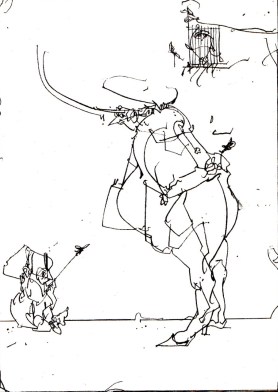
Drawing by Sascha Juritz

Drawing by Sascha Juritz

Dear Reader, our wish for a Happy New Year comes in the spirit of the lovebird mentioned here, in this set of advance instructions:

When a baby budgerigar died in a cage adjacent to the lovebird’s the latter grieved horribly for three days. She sat on her perch with her eyes squeezed tightly shut and ignored all attempts to communicate with her. She ate meagrely — but after three days, she put the matter firmly behind her and would entertain no reminders. She had returned to her usual vivacious self. So there you are, the animals are ahead of us. Humans are always uncertain about the policy in any situation, but animals …possess an answer to all problems.

The witty, magisterial line of Sascha Juritz, about whom we posted earlier this year, accompanies those thoughts of ACB’s, an ardent admirer of feathered creatures, whose flashing communication about an iris we recently recorded in this spot.

What came to mind when we revisited Sascha’s sketch yesterday was the title of a short story, ‘The Old Chevalier,’ from the Seven Gothic Tales of Isak Dinesen, to whose incomparable oeuvre post-Gutenberg was introduced by that same ACB — one of the two most significant forces in our existence — to whom we had no choice but to say a final good-bye last week.

Reflecting on her life, we find ourselves thinking often about Dinesen’s ideas about redemption through literature and art for all those who feel more thwarted than not; who can justify seeing themselves as victims of implacable, virtually lifelong, opposition to their hopes, dreams and plans.

Our woolgathering inevitably led us to Google, where we found, first, an appreciation by Susan Hardy Aiken of the most famous Dinesen story, ‘Babette’s Feast,’ whose theme the critic considers a reprise of another tale by the same genius, ‘The Supper at Elsinore’ — ‘a story of failed flight, of “all the betrayed and broken hearts of the world, all the sufferings of weak and dumb creatures, all injustice and despair on earth” …’ …

Of the later story, Aiken tells us:

… [T]he haunting presence … is … a revolutionary woman. At once ‘beggar’ and ‘conqueror’, benignly maternal and bewitchingly seductive, a festive, unclessifiable figure who makes ‘righteousness and bliss kiss one another’, Babette is also … a ‘great artist’ with ‘the gift of tongues’ whose concoctions can transcend and transform the confinements of culture and the misdirections of history. … Writing ‘Babette’s Feast’ in her old age, at a time when her own body was consumed by incurable illness, Dinesen would enact her artistic transcendence of that carnal confinement, offering her readers a ‘celestial’ feast of words, a ‘blissful’ feminine Eucharist able to redeem those who are failed or thwarted …

Then we found, in Susan Brantly’s book about Dinesen, a reminder of the reason why this author was first published outside her Danish homeland:

Dinesen’s reception in the United States was enthusiastic beyond all expectation [ … but her… ] misgivings about how the Danish audience would receive her book proved to be well founded … [Her] imaginative tales set in the previous century were quite different from what most Danes were reading. Svend Borberg described Dinesen as a flamingo-red orchid in a cabbage patch … The most notorious of the Danish reviews accused Dinesen of ‘snobbism, the fantastic, and perversity.’ The negative Danish reviews upset Dinesen. Svend Borberg, with a good dose of irony, suggested one reason for Dinesen’s being subjected to such a beating by the Danish critics: ‘It was naturally very cheeky, not to say brash, of Isak Dinesen — alias Baroness Karen Blixen — to conquer the world first with her book Seven Gothic Tales and then come to Denmark with it. As a Danish author she should have felt obligated to ask here at home first if she was worth anything.’

Ah, gatekeepers … We have posted about these beings before, when we considered Samuel Beckett’s opinions of them in a post here last winter. No doubt we will revisit the subject in 2013, if we can keep this blog going.


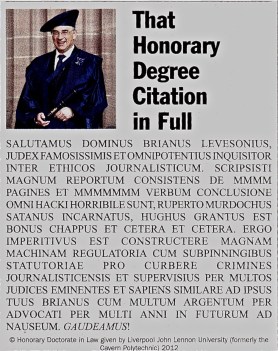
How high ambition hobbled Lord Justice Leveson’s chance to be a shining model for guiding media evolution and put new muscles on democracy

MIL22 + p-G leggitrice

Comrades across time: a scholarly girl of the 19th c. and a debater-netizen at a university today. (See our last two posts)
Sculpture by Pietro Magni, 1861, Villa Reale, Milano
Photomontage: MIL22 and post-Gutenberg

In social situations I try and leave telling people I am a lawyer to the end. I would much rather they see me first as an innovator, explorer, change agent, problem solver or entrepreneur.

— excerpt from article by Geoff Wild in the Law Gazette, selected for Private Eye‘s ‘Pseuds Corner,’ 14 December 2012

Why has Lord Justice Leveson turned against free speech on the net, after wisely refraining from doing any such thing during his hearings on press ethics and practices? His report and the aftermath of its publication, subjects of our last two entries in this blog, confirmed our grimmest expectations. The header of a post in May actually read:

Will Leveson end blessing press partisanship and slamming the brakes on the rise of new media and the 5th Estate?

Though honest, incisive journalists and editors of the highest rank justified — at the Leveson hearings — the public’s perception of the dangers of a fact-bending partisan press, the Leveson report said:

We want the news in the press to be true and accurate; we do not want to be misled or lied to. But we want, or are content for, it to be presented in a partisan way. We want a measure of balance and context, but we also want a perspective. We want the truth, but we understand that there are many versions of the truth, and incompleteness in all versions. […] [‘F]act’ and ‘comment’ […]  are by no means distinct and watertight categories. The very act of describing a fact is to comment on it. All forms of recording are selective.

As we interpret that, hair standing on end, the judge now fully supports newspapers and proprietors of the likes of Rupert Murdoch in their wish to protect their power base  — no matter what damage partisanship does to the presentation of the truth. In our May post in this spot, quoting the Leveson testimony of Alastair Campbell, the famously Machiavellian political adviser to Tony Blair who deeply regrets his own manipulations, we explained:

Why is the press so desperate to convince us that media partisanship is a good thing? Because, if the public approves of the press siding with particular political leaders and parties — instead of preferring press impartiality,  as it actually does, at present – the 4th Estate can continue to assume king-making powers.

Politicians will continue to put themselves at the beck and call of newspaper proprietors and editors in the hope of winning their nominations in elections. As Campbell pointed out yesterday, Murdoch’s is not the only press fiefdom involved in […] ‘a co-dependent relationship between politicians and the media’.

And then, just as we feared in early summer, in remarks made earlier this month, the judge has disappointed everyone who understands the internet as our best hope of accelerating and refining democracy — the steady trend across centuries, in the world’s free societies, towards making one human being more fully the equal of another in, above all, the right to unfettered expression.

Where did he go wrong?

It is clear that this happened at the very beginning.

The judge’s big mistake was in announcing at the start of his excavation into press misbehaviour that he did not want his recommendations for improvement to gather ‘dust on an academic’s shelf’ — along with the reports of several failed 20th-century attempts at tackling the job he was handed by David Cameron in 2011.

If Lord Justice Leveson only knew that he stood no chance of being a force for the good if he showed how much he cared about putting his ideas into practice.

This is because turning his conclusions into policy is the work of politicians. A politician sees getting re-elected as his or her most important duty. Politicians still believe that the support of the famous names in the newspaper business is crucial to winning elections — in spite of the internet’s destruction of the financial viability of these mouthpieces and readers’ growing reliance on other, net-based sources of information.

If only #Leveson LJ — who so impressed many of us watching the hearings with his intellectual rigour, meticulousness, and scrupulous disinterestedness — could have realised that in revealing that his supreme aim was to make his mark on history, he had fallen into the role of the hapless innocent in fairy tales who blindly promises the evil wizard his first-born child tomorrow, in exchange for magic that lets him slay dragons today.

During Tony Blair’s testimony at the hearings in late May, the judge implored the ex-prime minister to help him make his dream come true. What this lofty witness said proved that politicians fear falling out with powerful old print media to an unimaginable degree — as France 24 reported:

‘With any of these big media groups, you fall out with them and you watch out, because it is literally relentless and unremitting once that happens,’ Blair, looking tanned and smart in a navy suit and white shirt, told the Leveson inquiry.

‘My view is that that is what creates this situation in which these media people get a power in the system that is unhealthy and which I felt, throughout my time, uncomfortable with. I took the strategic decision to manage this and not confront it but the power of it is indisputable.’

What should the judge have concluded, from that remarkable, quaking confession of intimidation? That committing himself to being steered by politicians would mean losing his ability to offer wise, objective counsel about rules for fair combat in the evolutionary struggle between fading old media and their digital successors.

Which is how the Leveson Inquiry shows every sign of sinking ever-deeper into the muck of political bargaining and infighting in which politicians — now the main actors — will use every delaying tactic they can think of to ensure that the Inquiry’s clear demonstration of what needs to be repaired, discarded and replaced in British media comes to naught.

But then, isn’t the point of the Law to ensure that the behaviour of people and institutions conforms to rules and standards wrought from yesterday’s ideas? In that sense, lawyers and judges are innately, unavoidably, conservative — preoccupied with conserving the values of the past until forced to do otherwise.

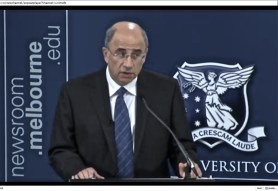
So of course Lord Justice Leveson’s speeches in Australia earlier this month amounted to threatening the internet, or mass communication’s future, to please his new friends — the fogeys of the old print press.

Forget the debates now droning on about choices for self-regulation by the press, with or without statutory support. The judge has become the chief protector and champion of that same institution he seemed bent on purging, sanitising, and returning to the marvellous ideal of an incorruptible and deeply moral 4th Estate, mere months ago.

Will sic transit gloria do, for a Christmas message?

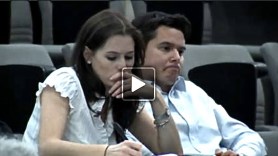
Quick screen grabs: the internet generation reacts to #Leveson LJ lecturing about laws on the way for online life

SUPER sceptical blonde student Screen Shot 2012-12-12 at 00.06.54

Watching Lord Justice Leveson speak to a predominantly middle-aged audience at the University of Melbourne’s Centre for Advanced Journalism four hours ago, post-Gutenbergers were struck by the extraordinary scepticism and disengagement on the few young and youthful faces among his listeners. The yawning gap in perspective is unsurprising. How could someone who has never blogged, tweeted, or commented on articles online understand the power and glory of communicating on the web? How could he be expected to do more than issue grim warnings about freedom’s end?

We rushed to take some fast-and-dirty screen shots.

In a future post — before the new year, time thieves permitting — this blog should have rather more to say about the judge’s speech.

tweet tries boring int into submission Screen Shot 2012-12-12 at 00.59.18

sceptics, 2, young, small scr Screen Shot 2012-12-11 at 23.58.52

lev S sceptical pink Screen Shot 2012-12-11 at 23

sceptical or sleeping aud members Screen Shot 2012-12-12 at 00.11.29
sceptical yng mn wmn Screen Shot 2012-12-11 at 23.40.14
sceptical blonde girl (b) Screen Shot 2012-12-12 at 00.06.51
LJL warning Screen Shot 2012-12-11 at 23.42.19

tweet lev pedestrian + BLOGGERS NOT NECESS A DANGER Screen Shot 2012-12-12 at 01.02.11