Posts by Cheryll Barron

Neuroscience says that the power of faces is unique and crucial: should Facebook be allowed to effectively own it, with or without regulation?

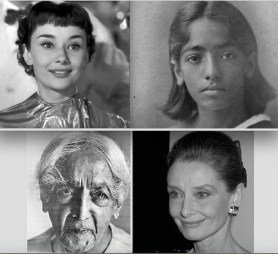
Audrey Hepburn, Jiddu Krishnamurti, younger and older postgutenberg@gmail.com.jpg

Two striking 20th-century faces: Audrey Hepburn at 24, top L, and at 60, bottom R; Jiddu Krishnamurti at 15, top R, and at 86, bottom L

Law-making ¯politicians in Facebook’s home country are wrangling with Silicon Valley over whether regulations from Washington slated for drafting this year, putting Big Tech under some degree of pan-U.S. leash control — for the first time ever — should exert a tighter or looser grip on these companies.

That is beside the point. Especially in the case of Facebook, it is impossible that regulation could — remotely — address the actual need, which is to curtail severely the shaping by mere business executives of the relationship between people and the computer technology with which human lives are ever more subtly enmeshed.

What needs protection from the naked, exclusive pursuit of profit is the co-evolutionary future of men and machines. That this has so far been left to commerce defies belief.

Facebook began as an American college student’s invention of a new form of amusement — organising on a digital platform a sort of beauty or sex-appeal contest, not as a staged event but a long-playing rating game. Through Mark Zuckerberg’s entrepreneurial shrewdness — and a lot of lucky stumbling-upon — a businessman created a corporation made unprecedentedly powerful by exploiting an absolutely basic biological element in human attachment to other human beings. 

This, according to science, is the power of faces.

‘We have modules for learning to interpret facial expressions — parts of our brain learn that and nothing else.’ So we were told in 1993 in The Red Queen: Sex and the Evolution of Human Nature, a book in which the science writer Matt Ridley theorised about the links between our reproductive instincts and the evolution of our species. ‘It is possible that facial features are a clue to genetic or nurtured quality, or to character and personality,’ he wrote. One of the scientists he quoted described the face as ‘the most information-dense part of the body,’ — and through research in the intervening quarter-century, the evidence justifying that remark has only multiplied.

Should any traditional capitalist enterprise own that power? Even one whose ethics could be above reproach — unlike Facebook’s? From the perspective of our species, it is elemental power equivalent to effective ownership of the dominion of air, or water, fire or earth.

Surely this — above all else — is what needs to be impressed on legislators and policy advisers in every government weighing Big Tech’s role in society? Not as just an elegant philosophical perspective, but at the crux of the matter? 

The Age of Insight (2012), by the Austrian-American neuroscientist and Nobelist Eric Kandel, should be required reading for everyone involved in deciding what do about Facebook’s annexation of face-power. Extracts:

The brain mechanisms underlying face recognition emerge early in infancy. From birth onward, infants are much more likely to look at faces than at other objects. In addition, infants have a predilection for imitating facial expressions, a finding that is consistent with the central role that face perception plays in social interaction.

[…]

Instead of trying to process a face from a pattern of lines, as it does other visual images, the brain uses a template matching approach. It reconstructs the face from a more abstract, higher-order figural primitive: an oval containing two dots (for eyes, a vertical line between those dots (for the nose), and a horizontal line below them (for the mouth). Thus, perception of a face requires less deconstruction and reconstruction of an image than perception of other objects does.

[…]

Moreover, the brain is specialized to deal with faces. Unlike other complex forms, faces are easily recognizable only when they are right side up.

[…]

Faces are by far the most important category of object recognition … We approach people as friends or avoid them as foes by recognizing them, and we infer their emotional state from their facial expression.

The real question that legislators have to tackle has been raised repeatedly on this site: isn’t it time for Facebook to be owned by its users? (See: ‘The media establishment has begun to see sense in a user-owned Facebook …‘.)

The alternative of public control by turning technology giants into public utilities would be an invitation to governments to replace unregulated Big Tech in the Big Brother role into which Silicon Valley has been growing — alarming many of us, rightly, if the quality and sources of answers to the search engine query, ‘Is Big Tech Big Brother?’ are any guide.

for 1. 1. 2019

red truck, high room postgutenberg@gmail.com

The Room above the Square

The light in the window seemed perpetual
When you stayed in the high room for me;
It glowed above the trees through leaves
Like my certainty.

The light is fallen and you are hidden
In sunbright peninsulas of the sword:
Torn like leaves through Europe is the peace
That through us flowed.

Now I climb up alone to the high room
Above the darkened square
Where among stones and roots, the other
Peaceful lovers are.

Stephen Spender (1909-1995), New Collected Poems

(2) red truck, high room postgutenberg@gmail.com

How is such a mystery to be explained. None of the details fit your circumstances, nor does the story to which they belong, yet the poem could not be better suited to your state.

There are bonuses. It softens the world’s unyielding — adamantine — edges, and reminds you of its magnificence. Rare as this is for blank verse, it plays in your inner ear as a melody.

H  A  P  P  Y    N  E  W    Y  E  A  R

new year's day cactus 2019 postgutenberg@gmail.com

for 25. 12. 2018


>>> Fawn, summer 2018 - postgutenberg@gmail.com

H A P P Y   C H R I S T M A S

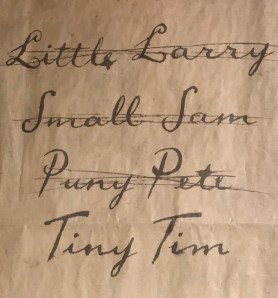
00Manuscript page, A Christmas Carol - Charles Dickens - posgutenberg@gmail.com

This page from the manuscript of A Christmas Carol shows how important it was for Charles Dickens to find precisely the right name for his story’s second most important but best-loved (except by the Scrooges among us) character

0 Christmas cactus flower 2018 postgutenberg@gmail.com

O happy day! The ‘free’ surveillance/advertising-centred/data-cow business model has been superseded by the pay-to-be-spied-on contract for e-commerce

+++ dog + blonde postgutenberg@gmail.com

A watchful pair: he was too intent on his task to move a single canine muscle **

The tale of Big Brother at A Certain Newspaper (ACN.com), the last entry on this site,  omitted a crucial fact because it deserves its own post.

It is this: access to the visitor-sleuthing, visitor-interrogating ACN site is not free, but requires a subscription. Reader, if you haven’t noticed, this should tell you that things have gone from bad to dire — well beyond the normalisation of the surveillance business model’s (SBM) unwritten contract, in which the actual cost of ‘free’ admission and use of a site’s services is the loss of our privacy.

Bowing to the SBM meant accepting that when we pay no cash to use  Facebook — and innumerable other web services, including search engines — these companies can make records of our every click and cursor twitch. In many cases they do worse, following us wherever we go on the net, even after we have signed out of their domains. We have effectively told them, do come in and help yourselves to anything you’d like to know about us — or, as post-Gutenberg has observed before: by all means, please milk us like dumb data cows.

In the SBM’s successor, the pay-to-be-spied-on model for e-commerce that we are now bowing to in an almost imperceptible transition, we are giving them money to exploit us. In our delight with the discount on sub-zero winter boots and free shipping that the online retailer offers us, we do not object to being hooked up to the automated data-milking machines that our cash helps to finance ***.

The media version of this shift entails a striking switch in the terms of trade that our ACN.com encounter dramatised. In the old days of print, a newspaper handed over pages filled with news and analysis in exchange for our coins — and those paper pages had countless secondary uses. The exchange between buyer and seller ended, there. Today, a newspaper can believe that the sum billed to a credit card entitles it to monitor and record exactly how the owner of that plastic rectangle reads its online pages — to facilitate ‘personalising content and ads,’ as the ACN.com site informs visitors, ‘and to analyse how our sites are being used’ — today, tomorrow, … whenever.

What we call data-milking is blandly referred to by digital commerce specialists as ‘data-gathering.’ One such expert, Josh Bernoffwrites about ‘the data equation’ — implying that there is a fair and just equivalence in Facebook users paying with undefined ‘data and attention’ to upload what they want to communicate or ‘share’ on the social media platform. But saying ‘equation’ is applying a misleading euphemism to what the average Facebook user grasps, since that user does not understand the SBM, or know that it is also the advertising business model. Users do not understand how they enrich social media giants by letting them hawk facts about their behaviour and demographic and psychological profiles to other companies that use the information to maximise their advertisements’ ability to seduce them into buying their products.

In a perceptive post on Medium.com, Bernoff suddenly swerves sharply from tip-toeing around the sensitivities of e-commerce giants to making the critical point that users ‘are happy to give up an infinite amount of data’ to social media platforms and predicts — sadly, without exaggeration — that most of them will not stop doing this until ‘Facebook starts taking naked pictures of everyone in the shower and posting them without permission.’

That was a point made in his ruminations in early October about whether the software that Tim Berners-Lee (TBL) has been developing to return control of their data to internet users will be usable and used by enough people to reverse the soaring trend of exploitation, manipulation and restriction. Bernoff concludes that this will not happen unless a rich, dominant company can adopt and deploy it to support TBL’s project.

He nominates Apple for the task.

We cannot imagine a better use for Apple’s cash mountains than destroying the surveillance business model. But surely putting Apple in charge of creating ‘new devices, new experiences, new apps, and new ways to entertain yourself and experience life without requiring you to give up all your data’ would be a move in the wrong direction — further centralising power, when TBL is trying to take the web back to the freeing open space it was originally?

Today’s Tim Cook-led Apple appears to have high ethical standards, but what guarantee is there that this company’s tremendous potential for doing good would not be misused if he were replaced by — say, someone like Mark Zuckerberg, whose actions seldom match the high humanitarian ideals he claims to believe in, and who chronically breaks promises about protecting and respecting the privacy of Facebook users?

What might be more compatible with TBL’s aims? Putting Apple’s cash and managerial resources behind social media platforms that their users jointly own. Apple could assist with and finance their design and launch. 

See: ‘The media establishment has begun to see sense in a user-owned Facebook …’ An extract:

[L]ast Wednesday, the New York Times presented, as if this were a brand new idea, the otherwise commendable suggestion by three scholars — Jeremy Heimans, Henry Timms and separately, Nathan Schneider in 2016: ‘[W]hat if a social network was truly run by its users?’ In a newly published book they have written together, Heimans and Timms note the unfairness of what we — like many others — have been pointing out for years: the injustice of ‘the creative output of billions of people’ being turned ‘into a giant, centralized enterprise, with most users sharing none of the economic value they create and getting no say in the platform’s governance.’

[ continues here … ]      

** like any other well-trained ceramic dog

*** Why are we permitting this? See John Logan’s reference, in his comment on the last post-Gutenberg post, to soma — the drug crucial to subjugating the masses in Aldous Huxley’s Brave New World (1932), which creates ‘a quite impenetrable wall between the actual universe and their minds’. Imagining themselves as ‘celebrities’ on their Facebook pages, and riding waves of happiness from online shopping discounts that let them buy-buy-buy probably works a similar dark magic on real, live, people in our time.