Posts by Cheryll Barron

Summer turns binary

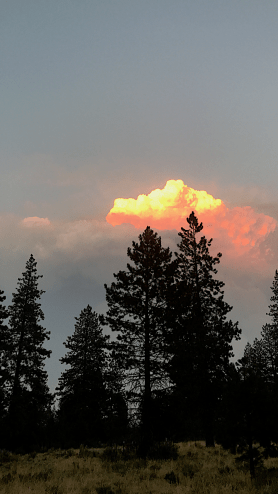
fire cloud vertical postgutenberg@gmail.com


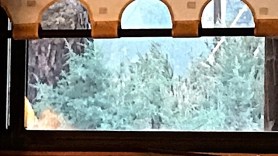
smoky window under blind, postgutenberg@gmail.com

Summers have turned binary in parts of the world living through the Time of the Wildfires — as if nature were playing a deadly metaphorical game inspired by transformations elsewhere (we are straining not to say digital revolution). The transition between phases is abrupt and disorienting.

Above: the apocalyptic part 2

Summer-to-autumn. At the top, an image from last summer — looking out of a kitchen window — that could easily be part of this one. Beneath it, the view outside in early August of this year.

Dread; destruction; unending vigilance; a mind swimming in images of ashen skies choked with deadly particulates — not always a safe distance away.

Below: the hopeful part 1

Spring-to-summer, pictures taken this year.

Growth; blooming under blue skies and grey; cool and fragrant delight; a sense of endless possibilities for harmony and good.

In a very different context from his poem ( ‘Easter, 1916’ ), these lines of W. B. Yeats come floating in:

… changed, changed utterly:
A terrible beauty is born.

spring-summer panel.jpg postgutenberg@gmail.com.jpg

In the puzzling rise of retro nationalism in an age of digital linking, a well-argued warning by Spain’s most famous philosopher is being ignored — again


ortega y gasset

The Revolt of the Masses (1929) — a warning about nationalism published between the  world wars to international acclaim — is being dusted off and read, but not widely enough

The anger of people who blame their country’s social problems on letting in too many outsiders — Brexiters and their nationalist counterparts worldwide — is not hard to understand. They have been led to think as they do by the facts available to them — a minute fraction of the internet’s bounty, despite its magical capacity for instantaneous dissemination.

Some far from obvious information that they might want to look at — if only to refine their arguments and positions — is in Jared Diamond’s panoptic Guns, Germs and Steel (1997). In that prizewinning book’s interdisciplinary explorations, drawing on the whole of human history, Diamond floats his hypothesis that the most successful civilisations evolved where geography allowed for the freest movement of people, ideas, agricultural innovations and technologies, and let rival cultures compete in material prosperity.

In an interview posted on the leading American (NIH) medical research website, he described his theory’s genesis:

 … [Y]ou asked about “Eureka” moments. There were actually two. The first occurred in 1990 when an archaeologist at the University of North Carolina was discussing with me why Europeans conquered Native Americans, and we started talking about agriculture. “Yes, there’s corn and maize and tomatoes and wheat and so on,” he said, “but an important consideration is that Europe has an east–west axis whereas the Americas run north–south, and that made it difficult for crops, as well as technology, to spread in the Americas.” A year or two later, when I was at the University of Utah preparing to give several Tanner lectures and had 2 or 3 days to kill, I thought to myself, “I need another lecture topic. Why not see if I could have some original insights into African history?” So I looked at a map of Africa, and it was, “My God, look at that map. Here is another continent with a north–south axis.”

In fact, slow north–south spreads are an issue not only in the New World, with Andean potatoes and llamas never reaching Mexico and Mexican turkeys never reaching Peru, but also in Africa, where the spread of cattle and sheep and goats from the Fertile Crescent was very slow, and where wheat and Mediterranean crops from the north never reached the south at all.

Not much of a leap from that train of thought is the insistence nearly a hundred years ago of Spain’s most famous philosopher, José Ortega y Gasset (1883-1955), that successful nations are built not from nationalism and shutting out other people and cultures but by opening mental doors and windows to their influence.

In The Revolt of the Masses ( La rebelión de las masas ) — a protest against narrow, parochial thinking that has been finding new audiences lately, not least because so much of its criticism applies to the nationalist prejudices reshaping contemporary politics all over Europe and in the U.S. — Ortega spelt out risks of aggressive tribalism that are not obvious. He distinguished between nation-building (good) and isolationist, defensive nationalism (bad) in making an original, passionate case for a European federation, advancing a refreshing argument from first principles. That was decades before the European Union was born, only after his and other wise warnings were ignored and nationalism killed an estimated 60 million in a second world war started less than a decade after the first.

Hispanist contributors to the Wikipedia have corrected a crucial misconception in the entry about his Revolt — pointing out that the ‘masses’ to which Ortega was referring are not the poorer, uneducated citizens that critics of ‘populism’ have in mind today:

He does not … refer to specific social classes, as has been so commonly misunderstood in the English-speaking world. Ortega states that the mass-man could be from any social background, but his specific target is the bourgeois educated man, the señorito satisfecho (satisfied young man or Mr. Satisfied), the specialist who believes he has it all and extends the command he has of his subject to others, contemptuous of his ignorance in all of them.

If only the following short extracts from TROTM could be debated on mainstream television …

Blood, language, and common past are static principles … If the nation consisted in these and nothing more, [ the idea of nations ] would be something lying behind us, something with which we should have no concern. … England, France, Spain, Germany would never have been born… [ but ] … Whether we like it or not, human life is a constant preoccupation with the future … bringing something future into effect.

… The groups which … have been known as nations arrived about a century ago at their highest point of expansion. … They are now mere past accumulating all around Europe, weighing it down, imprisoning it.… What was before a nation open to all the winds of heaven, has turned into something provincial, an enclosed space.

Everyone sees the need for a new principle of life. But as always happens in similar crises — some people attempt to save the situation by an artificial intensification of the very principle which led to decay. This is the meaning of the ‘nationalist’ outburst of recent years. … On the very eve of their disappearance there is an intensification of frontiers — military and economic.

But all these nationalisms are so many blind alleys. Try to project one into the future and see what happens. There is no outlet that way. Nationalism is always an effort in a direction opposite to the one that creates nations. The former is exclusive in tendency, the latter inclusive. In periods of consolidation, nationalism has a positive value, and it is a lofty standard. But in Europe everything is more than consolidated [ in individual nations ] and nationalism is nothing more than a mania, a pretext to escape from the necessity of inventing something new, some great enterprise.

… Only the determination to construct a great nation from the group of peoples of the Continent would give new life to the pulses of Europe.


A dunce cap for T. S. Eliot, who could not tell a lilac from a lollipop — and an explainer in images

lilac buds 4 april 2018 postgutenberg@gmail.com SC

Lilacs, 1: Budding: 4 April 2018 (Does that ground look not just cold and post-wintry but ‘dead’? Scroll down for the next acts in the drama.)

In the internet tradition of putting out bird seed for each other — information for nameless, faceless strangers — this entry is mostly for those visitors revealed by our site traffic analysis to be doing their English Literature homework.

We would march in the streets to protect poetic licence, but a poet who cannot get his elementary facts about nature right cannot be trusted as a wielder of metaphors or teller of even strictly psychological truths. He is liable to be written off as a pretentious twit for ending a poem with, for instance, …

… London Bridge is falling down falling down falling down

Poi s’ascose nel foco che gli affina

Quando fiam uti chelidon—O swallow swallow

Le Prince d’Aquitaine à la tour abolie

These fragments I have shored against my ruins

Why then Ile fit you. Hieronymo’s mad againe.

Datta. Dayadhvam. Damyata.

Shantih shantih shantih

… as T.S. Eliot did The Waste Land (1922), if he had started it with these offences against accurate observation and common-sense botany:

April is the cruellest month, breeding

Lilacs out of the dead land, mixing

Memory and desire, stirring

Dull roots with spring rain.

Winter kept us warm, covering

Earth in forgetful snow, feeding

A little life with dried tubers.

What dead land would that be? Year after year, we watch as lilac bushes close by bud, sprout, come into leaf, then give us a live demonstration of why ‘You’re blooming!’ can be a true and sumptuous compliment paid to a young girl in love. Year after year, we imagine students in places where no lilacs grow frowning over the complexities of Eliot’s best-known poem — with no idea that he had everything back-to-front in its opening.

Internet searching suggests that those of us acutely irritated by this are (or were once) amateur or expert gardeners. Hardly anyone else has remarked — like the Oxford historian and gardening connoisseur Robin Lane Fox, in a marvellous essay about gardens in literature — that

No gardener … would agree that April is “the cruellest month” and in no gardens or landscapes known to me does April breed “lilacs out of the dead land,” least of all on the American East Coast within range of the young T. S. Eliot.

Even non-gardeners in the northern hemisphere know that the cruellest month is August. The hot weather is at its most evil, then, in warmer parts of the globe. In cooler maritime spots with changeable weather, it is when the last hope of any summer at all can be cruelly denied.

There is nothing dead about the ground when lilacs begin to push tiny brown buds from brown canes — as in the first of this sequence of pictures (above and below). It is wriggly with riotous new life. And no, Mr Eliot, you cannot believably proceed from a warm winter — or even one keeping only you warm — that fed ‘a little life with dried tubers’, to earth that somehow had all life mysteriously drained from it as the days lengthened and the temperature rose, more or less steadily.

Yes, we know about metaphors, you Eliot-defenders out there. We ourselves have been known to excoriate the obdurately literal-minded for refusing to dance with a poet’s imagination. We know from experience what T.S.E. was trying to say about how painful spring breaking out all over can be for someone depressed, after the protective cocooning of the dark, burrowing months. But if he had to reverse the truth of lilacs coming into their season, why didn’t he say he was writing science-fiction poetry?

We are in deepest sympathy with Vladimir Nabokov, when he asked a college student sent to him for tips on a career in writing if he knew the name of a tree outside a nearby window. When the acolyte confessed that he did not, Nabokov said simply, ‘Then you’ll never be a writer.’ **

** ‘Remembering Nabokov’ by Alfred Appel Jnr., in Vladimir Nabokov: A Tribute, edited by Peter Quenell, 1979.

lilacs sprouted 28 april 2018 SC postgutenberg@gmail.com

Lilacs, 2: Sprouting, 28 April 2018

lilacs green gold 6 may 2018 SC postgutenberg@gmail.com

Lilacs, 3: Cluster-setting, 6 May 2018

lilacs blooming 10 may 2018 SC postgutenberg@gmail.com

Lilacs, 4: Blooming: 10 May 2018

lilacs in bloom in thunderstorm 15 may 2018 SC postgutnberg@gmail.com

Lilacs, 5: In full flower, in spring rain: 15 May 2018

Wanted: a 21st-century version of the cowboy code for Silicon Valley and a cautionary popup for Facebook screens


cowboy -- from myth to reality -- SC -- postgutenberg@gmail.com.jpg
Above: Tribute in a California hardware store to real cowboys (not the techie kind), who do not refer to people who trust them with private information as ‘dumb *ucks’; below: Facebook’s true terms of service, by way of Private Eye: Issue No. 1467, 6-19 April 2018

Private Eye Issue No.1467 6-19 April 2018

[ Note to readers on mobile devices on 30 April: the site should be working normally again, thanks to kind ‘happiness engineers’ at WordPress. ]

It was once unremarkable to hear the entrepreneurs of Silicon Valley called cowboys — as praise, not condemnation, at least as late as the 1980s. They were innovators, independent-minded risk-lovers who made the suits in big corporations look like cowardly dullards. They were the forerunners of the super-millionaires, then billionaires, that the internet spawned.

Real cowboys — the inspiration for the glamorous mythological kind that enchanted audiences around the world in Hollywood westerns — were typically poor hired hands looking after cattle in round-the-clock workdays, often in conditions no workers’ union would tolerate. They found their moral compass in an unwritten Code of the West. This has been summarised in different ways, some a little dated for the few remaining cattle-herders in America, who must travel not just on horseback but on wheels subject to rules of the road — ‘Always drink your whisky with your gun hand,’ for instance, which must follow ‘Always fill your whisky glass to the brim.’

In the less rambunctious version of the essence of the Code by a poet and scholar, E. Martin Pederson, this is the list of ideals which, he says, was intended to draw a firm line of distinction between cowboys and ‘the easy success of the thief or gambler’:

hospitality and assistance to others, faithfulness to the paternalistic employer (with some exceptions), care and affection for horses, a dislike for bragging or complaining, praise for bravery, and pride in skill with horse, rope and gun.

What could the de facto equivalent be for 21st-century technology cowboys?

After last week’s public interrogation in Washington of Mark Zuckerberg, the most famous entrepreneur in contemporary Silicon Valley, Julia Carrie Wong — an old Harvard classmate of his — said that his performance at that hearing showed how little he has changed from his 19 year-old self. She republished the record he unknowingly created for posterity of his own personal code as a student — in a private text exchange with a friend that was later leaked to Silicon Valley Insider. In this extract from it, he tells his friend about his new-found powers, thanks to the website he had launched a few weeks earlier — the project that would become Facebook:

ZUCK: yea so if you ever need info about anyone at harvard
ZUCK: just ask
ZUCK: i have over 4000 emails, pictures, addresses, sns
FRIEND: what!? how’d you manage that one?
ZUCK: people just submitted it
ZUCK: i don’t know why
ZUCK: they “trust me”
ZUCK: dumb fucks

Wong also reminded us that in 2004, the Facebook leader told the Harvard Crimson that his fledgling social network had ‘pretty intensive privacy options … People have very good control over who can see their information.’ His testimony in Washington did not supply any reason to believe the seemingly ashamed and repentant adult Zuckerberg, answering questions from senators, more than the teenage Zuckerberg, in identical false assurances.

Barely a day had passed after that drama than Facebook broke its promise to regulators in Europe not to use its facial recognition technology over there. This is software that lets the company identify you in photographs, alone or with other people, that you never placed on its platform or gave anyone permission to upload there, and proceed to using data capturing details of your appearance to track your movements across the internet. Your consent to its doing all this is taken for granted unless you sign up for a Facebook account — if you don’t already have one — and follow the steps in its opt-out procedure.

What difference could a code of ethics make to technology companies behaving so rottenly? In a paper written for economists**, Stuart Gilman, an international authority on rooting out corruption in public service has explained how the codification of model conduct can improve the government of countries. He notes:

Ethics codes are as old as antiquity. […] They often capture a vision of excellence, of what individuals and societies should be striving for and what they can achieve. […] Effective codes operate at two levels: Institutional and symbolic. Within institutions codes articulate boundaries of behavior as well as expectations for behavior. That is they provide clear markers as to what behavior is prohibited (bribery) and what behavior is expected (showing impartiality to all citizens). They are also highly symbolic. Subscribing to institutional codes is the way we define a model professional not only as we see ourselves but as we want to be seen by others.

He quotes the practical justification of Adam Smith — a founding father of economics (1723-90) — for setting high ethical standards:

To be amiable and to be meritorious; that is, to deserve love and to deserve reward, are the great characters of virtue; and to be odious and punishable, of vice. But all these characters have an immediate reference to the sentiments of others. Virtue is not said to be amiable, or to be meritorious, because it is the object of its own love, or of its own gratitude; but because it excites those sentiments in other men.

In the neverending Facebook scandals, a truly disruptive technology company would impress us — YEEHA! — by making a radical commitment to behaving well and altruistically without any pressure from governments. It would take too long for legislators and the law to catch up with what these companies are doing and the extent of their incursions into the intimate realms of our lives.

The politicians who did not understand the business model or technologies behind the social media heavyweight were widely mocked for not knowing how to grill Zuckerberg  in his appearance before Congress. Facebook reforming itself would have the fastest transformative effect and would change Silicon Valley’s culture for good. How likely is that, on the evidence so far? Fat chance.

It is time to sing this site’s refrain — that Facebook should rightly be owned by its users, to whose data this company has been helping itself liberally for dubious purposes, without the fully-informed permission of those users.

In the meanwhile, we do not expect the US or EU to be capable of much more than slapping a warning on users’ Facebook screens — a popup in the same spirit as the health cautions on bottles of alcohol and cigarette packets. Sadly, government notices are never witty, or we would propose simply borrowing the warning about Facebook’s true terms of service thoughtfully composed by editors in the London offices of Private Eye (above). It should be blown up into a poster plastered everywhere on public transport and, in the company’s home territory in California, where buses and trains are scarce, on extra-large billboards on freeways and interstate highways.

** ‘Ethics Codes And Codes Of Conduct As Tools For Promoting An Ethical And Professional Public Service: Comparative Successes and Lessons’, Stuart C. Gilman, OECD, 2005 https://www.oecd.org/mena/governance/35521418.pdf