Posts by Cheryll Barron

Milan says a tender goodbye to Umberto Eco in high style: let’s hope that someone put his confession about The Da Vinci Code into a eulogy

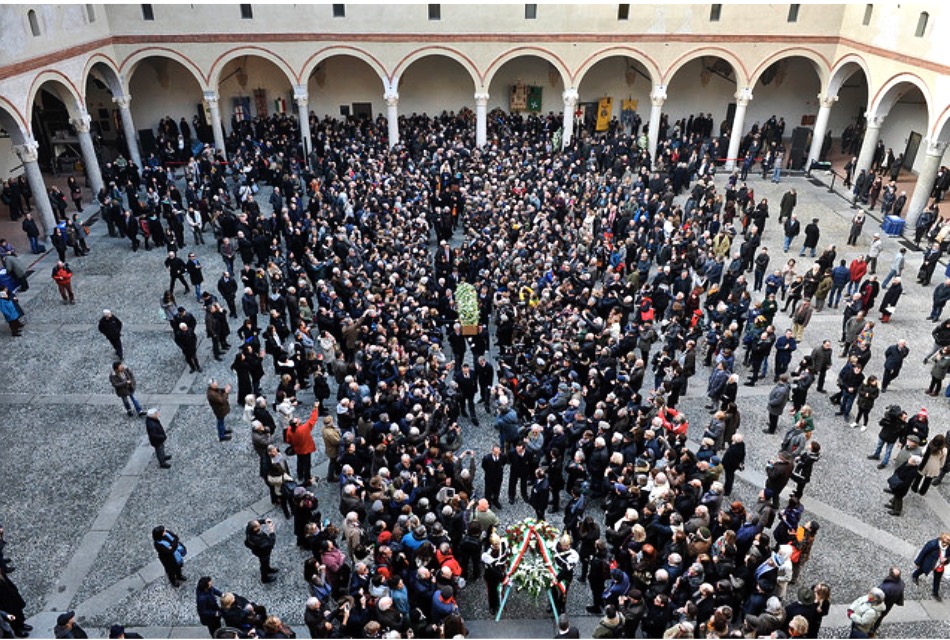
Umberto Eco funeral, Sforza Castle inner courtyard

Photographs of mourners at Castello Sforzesco (Sforza Castle): Comune di Milano, with thanks to our peerless detective MIL22

Photographs of mourners at Castello Sforzesco (Sforza Castle): our thanks to Comune di Milano and our peerless detective MIL22

[ an earlier post on the same subject: here ]

Have we ever seen a novelist or scholar given anything resembling a state funeral before? Probably not, and if Umberto Eco was a typical humbug-hating scribbler — as we suspect, not just from his work but the many descriptions of his large form shuffling along the corridors of his house in ancient slippers and baggy, comfortable clothes — we would expect him to have been vastly amused as well as touched by the sendoff he was given in Italy’s capital of book publishing. He would probably also agree with Flannery O’Connor’s belief that …

[The writer’s] concern with poverty is with a poverty fundamental to man. I believe that the basic experience of everyone is the experience of human limitation….[I]n the sight of the novelist we are all poor, and the actual poor only symbolize for him the state of all men.

Even though Dottore Eco died immensely rich, and even if he took a certain pride in that, no remorseless realist like him would disagree with O’Connor’s take on the philosophical core of all good writers — which rings deeply true.

On a lighter note, … we went looking for fresh experiences of what he offered us — which was a long-running ‘feast of intelligence and intellectual sparkle,’ far more so than technically perfect novels. And never mind if the quotation is a clip from the Libération review on the back cover of The Name of the Rose.

How did Eco explain the sales of Foucault’s Pendulum? Our last post admired Alexander Stille’s review of it in Harper’s, which contains this revelation:

One Italian magazine reported that only 20 percent of the people who bought the book have bothered to read it. Finding even that figure suspiciously high, the magazine quizzed people who claimed to have read the book and found that most could not recall key incidents in the novel.

Now, here are two delectable excerpts from a Paris Review interview with the author. The first seems a flawless encapsulation of the reasons why he was so successful. As for the second, what would-be reader of Foucault and the American blockbuster Eco was asked about — that we must admit we have not read but only listened to, in helpless convulsions, on a long car journey — could possibly disagree with him?

INTERVIEWER

In Foucault’s Pendulum you write, “The more elusive and ambiguous a symbol is, the more it gains significance and power.”

ECO

A secret is powerful when it is empty. People often mention the “Masonic secret.” What on earth is the Masonic secret? No one can tell. As long as it remains empty it can be filled up with every possible notion, and it has power.

INTERVIEWER

Have you read The Da Vinci Code?

ECO

Yes, I am guilty of that too.

INTERVIEWER

That novel seems like a bizarre little offshoot of Foucault’s Pendulum.

ECO

The author, Dan Brown, is a character from Foucault’s Pendulum! I invented him. He shares my characters’ fascinations—the world conspiracy of Rosicrucians, Masons, and Jesuits. The role of the Knights Templar. The hermetic secret. The principle that everything is connected. I suspect Dan Brown might not even exist.

Farewell, phenomenal Umberto Eco

Umberto Eco top of NYT home page (1)

[ late addition below ]

A yellowing copy of ‘The Novel as Status Symbol,’ a 1989 book review by Alexander Stille not available on the net, happened to be lying on this desk when the divine imp Umberto Eco died on Friday. For several weeks, we had smiled every time we came across it, hunting for other pieces of paper. It made finding him honoured with an obituary portrait at the top of the home page of The New York Times a sad pleasure: he deserved no less.

What Stille recounted of the great semiotician-novelist’s fiction writing philosophy was quite wicked enough a quarter-century ago, when marketing chieftains in publishing companies were well on their way to wresting supreme veto power from editor-tsars. In our new age of scribes, book-promoters and whole literary communities bowing low to likey/no-likey social media, it is not impossible to envisage someone like Eco being burned at the stake for heresy, some day.

Some extracts from the most enthralling sketch we have ever read of the author of The Name of the Rose and Foucault’s Pendulum:

Last June, Eco — a medieval scholar and a professor of semiotics at Italy’s University of Bologna — stood on the dais of the cavernous ballroom in the Washington Hilton before a crowd of more than a thousand American booksellers.

In open defiance of the usual laws of marketing, Eco told the booksellers, he had written his first novel for about a thousand readers and decided to write the second for five hundred. ‘With my first book I was criticized for putting in too many quotations in Latin, so I started my new book with a long quotation in Hebrew. That’s my challenge.’ But Eco is not a naïve professor who was catapulted to stardom by an unlikely turn of fate. As a professor of semiotics (the theory of signs), a former publishing executive, a journalist, and the author of some twenty books, Eco is an expert on mass media and the machinery of popular fiction. ‘The world of media is full of free gifts, wash-and-wear philosophy, and instant ecstasy,’ he explained to the booksellers. ‘Readers want a little more; they want to be discouraged in order to be respected.’

… Since its publication in Italy last fall Foucault’s Pendulum has provided several new twists to what has come to be known as the Eco phenomenon. The novel has sold more quickly than any book in Italian publishing history, while becoming the center of a fierce national controversy.

Rumors than Eco was working on the book were eagerly picked up by the Italian press as early as two years before the book appeared … Anticipation built up to such an extent that when the book finally appeared, 500,000 copies were sold before the first buyers had a chance to grapple with it and tell their friends what they thought.

But within several weeks the Eco phenomenon boomeranged. Readers who had bought the book for faddish reasons gave up when confronted with the labyrinthine complexities of a novel that explores the mysteries of the Jewish cabala, hermetic philosophy, and a thousand years of esoteric thought. Eco was accused of having shrewdly manipulated the press in a plot to push sales. ‘Eco is a genius of our culture,’ one critic wrote, ‘a genius of self-promotion.’ To his dismay, Eco has become a kind of literary Midas: everything he does makes news and sells copies. Even his decision not to appear on television was perceived as another clever maneuver to attract attention. But the attacks, predictably, only had the effect of selling more copies …

Harper’s, November 1989

But, as we discovered not long after we posted those Stille quotations, Eco hardly spared the editor-tsars. We had long wondered how any editor, no matter how skilled and revered, could have had any idea of how to edit his novels — known whether to add or substract as much as a comma — which could define idiosyncratic. What did Eco think of their role? On the site of The New York Review of Books, there was his concise answer to that question, in 1994: ‘Case for Textual Harrassment’. Skim-read it at your peril: after we stopped to re-read it with closer attention, we were shaking so excessively that we had to lie down for a minute-and-a-half. Unless you know Philip Larkin’s and T.S. Eliot’s most famous poems, you will not understand. (The ‘rites of vegetation,’ William Weaver’s translation of whatever Eco wrote in the Italian original, is a master-stroke. Oh, you poor lilacs …)

The miniature essay begins:

These days, especially in the United States, implacable copy editors demand of authors not only stylistic revisions but even changes in plot, new endings, whatever commercial necessity dictates. But … can we honestly say that they ordered things so differently in the past?

Take the usually overlooked fact that the first version of a well-known poem by Philip Larkin originally went: “They do you harm, your father and mother.” It was only the insistence of Larkin’s editor that inspired the now famous variant. And the first draft of Eliot’s Waste Land opened: “April is the cruelest month. And March isn’t all that great, either.” Weakened in its impact by this peevish insistence on climactic details, the earlier text denied April any implied link with the rites of vegetation. As everyone knows, Ariosto at first submitted to his publisher a very brief poem that went: “Of women and knights, arms, loves, courtly rituals, and bold ventures I have nothing to say.” And that was that. “How about developing it a bit?” the editor suggested. And Master Ludovico, who was having enough trouble as civil governor of a remote Tuscan province, said, “What’s the use? There are dozens of epics of chivalry already. Leave it. I want to urge poets to try new genres.” And the editor replied, “Yes, of course, I understand, and, personally, I agree with you. But why not try approaching the form from another angle? With irony, for instance. Anyway, we can’t sell a onepage book, particularly one with only two verses on the page. It looks like imitation Mallarmé. It would have to be a limited, numbered edition. So unless we can get Philip Morris to sponsor it, we’re screwed.” …


Surely they aren’t trying to reinvent the mandala? A pictorial entertainment on computerised visions by cosmologists of gravitational waves

Mandala of Vajrabhairava (detail), 1600-1800, Tibet, Asian Art Museum, San Francisco

Mandala of Vajrabhairava (detail), 1600-1800, Tibet, Asian Art Museum, San Francisco

Computer simulation by NASA of gravity waves emanating from two orbiting black holes, slightly modified by postgutenberg@gmail.com. Compare with the original image: here

Computer simulation by NASA of gravity waves emanating from two orbiting black holes, slightly modified by postgutenberg@gmail.com. Compare with the original image: http://www.nasa.gov/centers/goddard/images/content/146977main_gwave_lg4.jpg

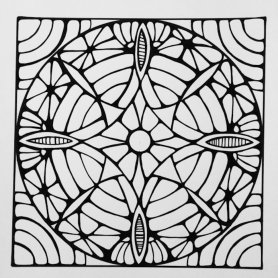
mandala_17 soutien67.free.fr

mandala in square img1.etsystatic.com il_570xN.701326921_2yu0

Mandala patterns floating about on the net

mandala google dictionary

Didn’t nearly everyone notice the close resemblance to mandalas of some images cosmologists published last week to tell us what confirming Einstein’s theory of gravitational waves meant to them? Strangely, we have found scant evidence of that on Google.

In very old Buddhist and Hindu metaphysics a mandala represents the cosmos.

But, as most scientists abhor religion — or say that they do — wouldn’t they consider any such connection a besmirching?

Not necessarily. Not all of them.

We found a mention of mandalas on a German site, Einstein Online — belonging to the Max Planck Institute for Gravitational Physics — on a page with a charming animation of a ‘simple gravitational wave traversing [a] mandala’. Fitted to the circle in this visualisation is a tribute to Leonardo da Vinci’s Vitruvian Man, a diagram as mystical as it was an accurate geometric anatomisation of the human body. The Encyclopedia Britannica:

Leonardo envisaged the great picture chart of the human body he had produced through his anatomical drawings and Vitruvian Man as a cosmografia del minor mondo (“cosmography of the microcosm”). He believed the workings of the human body to be an analogy, in microcosm, for the workings of the universe.

Leonardo's Vitruvian Man in a mandala -- Max Planck Institute for Gravitational Physics

Leonardo’s Vitruvian Man in a mandala
Max Planck Institute for Gravitational Physics

… That Einstein Online link was nearly all that showed up in searches using the string ‘mandala gravitational waves’ — except for a Google Books offering in which someone called Choudhur Satyanarayana Moorthy has reinterpreted parts of Hindu scripture to make long-ago sages — rishis — experts on the cutting edge of quantum mechanics. He even has a Rishi Kutsah Angirasah describing gravitational force deified as ‘Rudra’:

With his firm limbs … he is forceful. He is ruddy brown, but has taken the bright golden form. He is the supreme ruler of the vast universe.

Ahem!

Lawyers leading the way in the litigation revolution in Britain

Shireen Irani, founder of iProbono and Simon Harper of Lawyers on Demand

Shireen Irani, founder of iProbono, and Simon Harper of Lawyers on Demand

On the Financial Times site — behind a paywall — we found this welcome surprise in a video clip of the paper’s celebration last October of the tenth anniversary of its Innovative Lawyers report.

The joint winners of the FT Innovative Lawyers Award were Shireen Irani, founder of iProbono, ‘a platform that allows lawyers and law students to give their skills to community organizations,’ and Simon Harper of Lawyers on Demand.

Gatekeepers, at the centre of many a conversation about post-Gutenberg publishing, are viewed differently in this revolution. The iProbono leader says:

The idea is that as lawyers we are gatekeepers to justice and should be using our skills as much as possible to change things in society — like Nelson Mandela and Mahatma Gandhi.

Lowering the barrier to legal representation in Britain has won room in minds at the top comparable to the attention being paid to affordable medicine in the U.S.. David Cameron announced in November that iProbono was the latest winner of the Big Society Award.

The other FT prizewinner, Simon Harper, described his organisation as

… a platform that allows lawyers to choose how they want to work.

The Lawyers on Demand web site explains:

Originally launched in 2007, LOD is the original alternative legal service, born out of changes in the way people worked. Under huge cost pressures, users of legal services were keen to find a way to make their budgets stretch further, without sacrificing the quality of the expertise that they had access to. Simultaneously, many lawyers were looking for greater flexibility and autonomy without compromising quality of work or career satisfaction. At the same time, technology was making it easier to connect without always physically being in the same place.

From this, LOD emerged. The idea was to pair talented, freelance lawyers with clients looking for an alternative resource and for LOD to provide the technology, support and know-how needed to make the service work. It began as a pilot in 2007 with eight great lawyers working with in-house clients on a secondment style basis.