Mass surveillance: can our secret services spy transparently, and not too much or too little?

Oddly familiar in 2013 … But Kim did not suspect that Mahbub Ali, known as one of the best horse-dealers in the Punjab, … was registered in one of the locked books of the Indian Survey Department as C25 IB. … [R]ecently, five confederated Kings, who had no business to confederate, had been informed by a kindly Northern Power that there was a leakage of news from their territories into British India. So those Kings' Prime Ministers were seriously annoyed and took steps … They suspected, among many others, the bullying, red-bearded horsedealer whose caravans ploughed through their fastnesses belly-deep in snow. Kim, Rudyard Kipling, 1901

Oddly familiar in 2013 …
‘But Kim did not suspect that Mahbub Ali, known as one of the best horse-dealers in the Punjab, … was registered in one of the locked books of the Indian Survey Department as C25 IB. … [R]ecently, five confederated Kings, who had no business to confederate, had been informed by a kindly Northern Power that there was a leakage of news from their territories into British India. So those Kings’ Prime Ministers were seriously annoyed and took steps … They suspected, among many others, the bullying, red-bearded horsedealer whose caravans ploughed through their fastnesses belly-deep in snow.’
Kim, Rudyard Kipling, 1901


Can a newspaper editor in societies in which military service largely belongs to the past grasp the importance of protecting military secrets? We mean, understand this viscerally – at gut-level – like any child who ever had to ask, ‘But what if Daddy doesn’t come home?’. We mean, return from a war; any child ever comforted by assurances that ‘Our spies are better than their spies,’ – the mysterious and murky specialists in warning about the likely direction from which gunfire and bombs could come; the places where land mines might be buried and assassins or submarines lurk.

The question marks have only been multiplying as we have wondered why the media-stoked outrage over the thumping-great scale of government surveillance is not matched by shock and anger about vast apparatuses of commercial surveillance. Life without Google would be as frightful a prospect for post-Gutenberg as for anyone else. Still, we ask with furrowed brow, why are people incandescent with rage about spooks, but paying no attention to — for instance — the news on the Extreme Tech site last month that Microsoft and Google are working on ‘super cookies [that] will track you wherever you go, and whatever you do, whether it’s on your smartphone, PC, game console, or even TV.’ Or, this quotation of an expert in The Wall Street Journal in September:

“It’s a persistent identifier, a super cookie,” says Jeff Chester, head of the Center for Digital Democracy. “Google will gain more information about users wherever they are, across platforms and with one number. This will be the new way they identify you 24/7.”

Why are only some of us apparently willing to give the motives of those entrusted exclusively with our protection the benefit of the doubt, the way everyone else does commercial surveillance that is done exclusively for profit?

John le Carré, one of our heroes, told his North London neighbour Philippe Sands that ‘all of us have an aunt in the secret service.’ Of course he was being witty. But some of us in this conversation who grew up as disgusted by the cover-ups in the Vietnam War as our contemporaries, everywhere, are also members of a minority caught up in childhood in small, regional wars, or who had parents who served in peacekeeping forces in war zones. That makes for a different sort of anti-authoritarian perspective. Press contributions to and coverage of the surveillance debate strike us as surreal.

Because information is the common stock-in-trade for spies and journalists,  The Guardian and its partners in publishing the massive, continuing Snowden leaks of military secrets have been engaged in an extraordinary flexing of power. We have been transfixed by the sight of them not merely criticising but punishing their governments in kind for the comprehensive surveillance of civilians that they deem entirely wrong – without judge, jury, or any public consultation about this conclusion. Those rotten spooks  overstepped the limits of decency in stealing our private information, did they? Fine, let’s rip the covers off their private information and broadcast it to the world!

Punishment to fit alleged or actual government misdeeds is not typically an option for newspapers. For a parallel, consider that in 2009, when The Daily Telegraph followed up on a freelance journalist’s discoveries about British members of parliament writing off the costs of second homes and cleaning castle moats as ‘expenses’ passed on to taxpayers, that newspaper could hardly chastise parliamentary paymasters and expenses-checkers by flinging millions of pound notes into the Thames, or publicising passwords to bank accounts for the public purse. A San Francisco paper lambasting California’s state government for inhumane overcrowding in prisons cannot lock the governor and his aides into scorching and stinking penitentiary cells for a week to make its point.

The scale of the leaks is staggering. ‘In early 2013,’ the Wikipedia records, ‘Edward Snowden handed over 15,000 – 20,000 top secret documents to various media outlets.’ We have yet to see as much as a hint in The Guardian — the  standard-bearer for the fight against government spying on citizens – that the whistle-blower might have been a touch excessive, or, as Charles Dickens put it in a different context, shown a lack of ‘that faculty of extracting the essence from a heap of statements which is among the most striking and necessary of the advocate’s accomplishments.’

Snowden’s objective seems clearly to have been not merely to reveal but wound – and The Guardian and its co-publishers apparently went along with that, as it largely did with Julian Assange’s Wikileaks, because of a cultural shift analysed in the one deeply informative and scrupulously balanced evaluation of the mass surveillance crisis we have read so far. Writing in the journal National Affairs, Gabriel Schoenfeld suggests:

The new willingness, even eagerness, of journalists to publish such sensitive information stems first and foremost from two cultural developments … The first is the increasing prevalence of the libertarian notion — with adherents on both the left and right, and in both journalism and the federal bureaucracy — that “information should be free.” This ideology leaves room for almost no rationale for secrecy in government and is deeply skeptical of and angered by post-9/11 government surveillance practices.

The second development is the changing nature of the news business, with its fierce competition and intense pressure to be first to break a story. In deciding whether to publish leaked secrets in the face of government warnings to desist, news organizations seem to operate according to a logic reminiscent of Cold War nuclear strategy: If we don’t strike, one of our competitors will …

The Guardian, widely known to be fighting for its economic survival, has been frantic to triumph in this evolution of competition. Make no mistake, post-Gutenberg is as disturbed as anyone else by the implications of governments tracking everything we do, say and even think. But both The Guardian’s framing of the problem — through its barrage of reports about and opinion pieces on it – and its chief conclusion about it have serious flaws:

 The newspaper’s coverage is unbalanced in the extreme degree – and proudly. Its editor, Alan Rusbridger proclaims his preference for partisan journalism in the latest issue of The New York Review of Books

The Guardian itself inhabits an editorial space that is quite distinct from most American newspapers. British papers have grown up with less reverence for the notions of objectivity and detachment that can, rightly or wrongly, preoccupy some of our American colleagues.

How can anyone trust the information in a newspaper draping itself in a banner like that?

• Proud partisanship explains why Guardian readers have not – as far as we know – been given  much, if anything, in the way of objective context and historical background for government spying. Without that, how can the paper claim to be fostering the intelligent public debate about mass surveillance supposedly its chief motive for the Snowden leaks?

Espionage policy-makers and administrators have been permitted only a series of robotic and too-predictable sound bytes to explain their reasoning and actions in the technically dazzling transmedia production on this theme offered on the Guardian website. In The Black Swan (2007), a clever polemic widely read among the intelligentsia, Nassim Taleb mentions his surprise at meeting US top brass, ‘military people’ who ‘thought, behaved and acted like philosophers,’ only more so and far more imaginatively than professional philosophers, and ‘without fear of introspection’. Why are people of this calibre not invited to defend government surveillance in Guardian reportage or op-ed contributions?

• Like virtually every other print media publication, The Guardian is hardly realistic in proposing that the solution to excessive surveillance is greater transparency in the running of intelligence-gathering, and stringent oversight. There must be something wrong with us at post-Gutenberg, because we see see-through spying and spy-runners as a prospect as likely as scholarly, library-haunting footballers.

How strange that closer oversight has also been recommended for the media in the wake of the phone hacking scandals and the Leveson Inquiry into press practices and ethics. Better supervision for both spies and journalists would mean, as a first step, requiring them to be guided less by judgment and instinct, as they often are at present, than by a set of precisely defined rules.

Would it be any easier to agree on such rules for spies than for journalists? In his testimony at the Leveson hearings, The Guardian’s freelance contributor Nick Davies – the star reporter who exposed tabloid phone hacking and was also a driving force behind the publication of the Julian Assange leaks – described the difficulty of deciding precisely what reporting is and isn’t in the public interest:

We had a huge problem with the Wikileaks stuff. […] I went off and persuaded Julian Assange to give all this material to The Guardian and The New York Times and Der Spiegel, and it rapidly became apparent that that material contained information which could get people on the ground in Afghanistan seriously hurt. They were implicit[ly] identified as sources of information for the coalition forces.

I raised this with Julian very early on and he said, “If an Afghan civilian gives information to Coalition forces, they deserve to die. They are informers. They are collaborators.” And there were huge tussles between the journalists and him — actually, maybe this isn’t a terrible good example because I would say emphatically it’s absolutely clear that we couldn’t publish that information and didn’t, but he did.

Any government trying to direct newspapers in such decisions – or demand that they debate their ins and outs ‘transparently,’ in public — would be accused of interfering with the traditional freedom of the press, if not behaving like a police state. In the continuing battle in Britain over press regulation, as Chris Huhne noted in The Guardian, this week, …

According to the newspapers, self-regulation failed in securities trading, banking, construction and many other fields. But it works brilliantly in just one area: newspapers. This inconsistency is ludicrously implausible.

In the US, Joshua Foust recently recorded on his blog the appearance of new journalistic techniques in reporting national-security stories. The evidence for this is limited because, as one Washington Post reporter recently explained, there is “a widespread practice in the media industry of declining comment on reportorial methods.”

Yet the media are howling that spies should be required to reveal their methods and tricks. … Should The Guardian and other media campaigners calling for tight constraints on and supervision of government spying on the populace make a less ambitious demand — to perhaps simply hold the spooks to account more rigorously for their mistakes and infractions?

It will be a happy day when some widely-read British or American newspaper stops merely shouting about the horrors of mass surveillance by the government – as opposed to Google and Microsoft – for extended, intelligent explorations of the  ‘other side’ of the argument.

Should The Guardian be taking its own advice to a beloved London restaurant — to turn itself into a cooperative to keep from going under?

- photograph by MIL22

– photograph by MIL22

Funny to catch The Guardian dishing out, to an old Hungarian restaurant, the same advice that post-Gutenberg has been offering the newspaper for at least two years. Astonishing that The Gay Hussar is the spot just off Soho Square where we, in our dewy twenties – when it still had  genuine ‘socialist’ prices we could afford – ate many of our most cheering lunches in the upstairs room run by Albert, always at the table next to the flower box packed with saucy red geraniums.

But what advice could that possibly be? And why should an institution with the power and heft of this London newspaper pay any attention to an obscure little blog like ours? … Even closer to impossible than improbable, we agree. But scroll down anyway:

Extract from editorial in The Guardian, 25 October 2013: ‘The Gay Hussar in Soho could become a socialist model for today’s politicians’:

The Gay Hussar is … one of the most celebrated venues in the history of the post-war left. On these red plush banquettes, immortalised by the great cartoonists of the past 60 years, Bevanite heroes – Aneurin Bevan himself, Michael Foot, Barbara Castle – would scheme and plot, usually unsuccessfully. But they are long dead now, and the place needs a new owner. To the dismay of the loyal staff, it’s to be auctioned at Christie’s sometime in early December. Time surely to reclaim history and bring its traditional values into a modernised setting.

[…]

The real change would come from a new model of ownership, the previously untried diners’ co-operative … somewhere between the John Lewis model of profit-sharing for the staff and the Co-op model of dividends for regular customers. A socialist model for today’s politicians.

Extract from post-Gutenberg entry, 5 September 2011 — ‘Wanted: a brave newspaper, for an experiment in which readers become stakeholders’ — quoting a commenter reacting to a statistic in an opinion piece:

How would you redesign the ownership of newspapers? How about starting here:

Last month, for example, 51 million individual users clicked into the Guardian site — a number that should please online advertisers.

Great! So what if the Guardian were to let us readers/commenters buy shares in the comments sections of its site?

– Reader commenting on,‘At their best, newspapers became beautiful objects, I shall miss them’

Ian Jack, The Guardian, 24 September 2011

 Extract from post-Gutenberg entry, 6 December 2011: Co-owning media is on the horizon …’:

A stranger, someone astute and entrepreneurial, [said] about a comment posted in a discussion about the future of journalism on the site of Harvard’s Nieman Lab. ‘I think you’re on the right track …’. … He was referring to an outline of a means for old media organisations to move into post-print publishing … The essence of the idea was that every reader’s subscription would also be a share or financial stake in prospective profits. It would be an inducement for each reader or viewer to help bring many more visitors to a site. It would both help the site owner to attract more advertising and – implicitly – reduce dependence on advertising, if the concept of subscription-stakes caught on and went viral.

‘I tried an experiment along [those lines.]  ‘It was a tremendous success … as far as it went.’

[…]

‘Ownership can be transferred at any time. The trick is to have something worth transferring first. … There could be NGO funding possibilities from which a larger community trust with cooperative member ownership could emerge…’.

And that, strangely enough, is very close to the proposal for a ‘keiretsu-cooperative’.  A publishing enterprise with a thriving community of reader-commenters could easily progress to sharing ownership of the commenting sites where readers already supply most of what there is to read or watch.

Come on, Guardian, surely it’s time to take the plunge?

Net democracy: the great science magazines value readers’ comments, but a pop-sci counterpart shuts down discussions and criticism

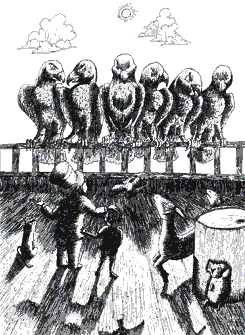
Reader-commenters are vacuous birds of prey for some members of the media's old guard - drawing by Hugh Lofting 1886-1947

Reader-commenters: vacuous birds of prey, to media’s old guard
– drawing by Hugh Lofting (1886-1947)

‘My user names and passwords … ’ the wrinkly figure in the drawing wheezes at the heirs leaning over his bedside, in a recent addition to Private Eye’s ‘Modern Last Words’ series. ‘I want you to continue my work as the most hated troll on the internet.’

Trolls. Harpies. Brainless vultures. Vacuous attack dogs. Surprisingly often, it is not just the media’s old guard but political liberals in occupations unrelated to publishing – status-obsessed and change-resistant types – who froth at any mention of commenters on media web sites. As this blog began with a proposal for newspapers to evolve into sites partially owned by reader-commenters, we at post-Gutenberg have been flabbergasted by reflexive references to public debate in these spots as unintelligent – usually, from people who have never devoted enough time or effort to ‘below the line’ conversations to discover how often these are more informative than the articles or posts that initiate them.

Imagine how amused we were to learn from a New York Times report last week about the reactions from illustrious upmarket competitors of Popular Science to the news that this magazine was shutting down commenting on its web site altogether. This is hardly a move you would expect from a publication whose headlines appear to be written by a teenager desperate to win a popularity contest: ‘Giant Carnivorous Plant Found In Silicon Valley,’ for instance, or ‘Eating Yogurt Does Weird Things To Your Brain’.

Grave as a sermonising clergywoman, Suzanne LaBarre, the magazine’s ‘online content director’ justified the decision to return to print media’s traditional one-way dialogue:

Comments can be bad for science. That’s why, here at PopularScience.com, we’re shutting them off.

It wasn’t a decision we made lightly. As the news arm of a 141-year-old science and technology magazine, we are as committed to fostering lively, intellectual debate as we are to spreading the word of science far and wide. The problem is when trolls and spambots overwhelm the former, diminishing our ability to do the latter.

That is not to suggest that we are the only website in the world that attracts vexing commenters. Far from it. Nor is it to suggest that all, or even close to all, of our commenters are shrill, boorish specimens of the lower internet phyla. We have many delightful, thought-provoking commenters.

But even a fractious minority wields enough power to skew a reader’s perception of a story, recent research suggests …

Really. In a justification that  revealed the power of intelligent and articulate readers as her real fear – an argument that would delight dictatorships all over the world, she added:

[C]ommenters shape public opinion; public opinion shapes public policy; public policy shapes how and whether and what research gets funded–you start to see why we feel compelled to hit the “off” switch. 

Her reasoning did not impress science magazines with a serious interest in science. Snippets from the NY Times story – for which that newspaper must be congratulated:

Fred Guterl, the executive editor of Scientific American: ‘I have to say I don’t think comments are bad for science. To a point I think it’s good when people talk about things and try their ideas out. Social media can go off the rails but I don’t think comments are worse than Twitter.’

Noah Gray, senior editor at Nature:

“There’s no doubt that uncivil discourse is bad for science,” Dr. Gray said by e-mail.

But, he said, comments can be very valuable, sometimes pointing out errors or alternative interpretations of the facts and theories presented in the article.

“The comments section can often express the openness of scientific debate,” Dr. Gray said, adding, “Removing this channel for feedback rather than exploring an alternative means to improve it simply ignores the problem.”

A reaction from a NY Times reader-commenter seemed especially apt:

Laird Wilcox, Kansas

I suspect that an individual’s capacity for objectivity depends upon their ability to entertain conflicting values, opinions and beliefs without feeling threatened by them. When you find someone who “can’t stand” another’s “ignorance” you may be dealing with an insecure bigort[sic] who fears contradiction or is woefully unsure of themselves.

But some egotistical old media professionals apparently cannot stand readers discussing their work as incisively as in this delicious exchange between Popular Science commenters – about a 2009 piece titled, ‘Could There Be A Planet Hidden On The Opposite Side Of Our Sun?: We ask a scientist who has peered around it.’

bdhoro87

04/20/2009 at 11:01 am

Behind the sun? This article is tempting me to use a lot of profanity. We travel to the other side of the sun and back every year, what does behind the sun mean? Behind the sun with respect to earth? So like where the Earth would be half a year from now? Or on a different axis or what? All logic tells me is the sun doesn’t have a front and behind… its pretty spherical and it rotates. Was this a search for a planet that maintains the exact orbit of earth but 180 degrees out of phase? Can someone please clarify how the sun could have “sides” and where “the other side of the sun” is?

Loschen

04/20/2009 at 12:07 pm

I’m guessing that what they mean is it revolves at the same speed as the earth but stays on the exact opposite side of the sun. Therefore, it is perpetually out of normal sight for earth. But, that’s just how I read and understood it. you’re right they didn’t do a very good job of clarifying…

qlmmb2086

04/20/2009 at 2:33 pm

One thing people need to realize about PopSci is that these are not scientific articles. It’s similar to, say, a CNN reporter writing an article on a scientific discovery; these are written by journalists, not scientists.

That having been said, this article does seem kind of pointless… Why bother debunking a theory about a hidden planet synchronized with earth’s orbit, when nobody thinks that anyhow? You may as well write an article to show that the earth isn’t flat.

… We can hardly type for laughing …

The Guardian’s ‘moderation,’ again – and reader-commenters on newspaper sites correcting the unbalanced coverage of mass surveillance

Nikki de Saint Phalle’s one-tonne L’Ange Protecteur (Guardian Angel): could there be a more perfect emblem of The Guardian’s institutional persona? photograph: Wikimedia Commons

Nikki de Saint Phalle’s one-tonne L’Ange Protecteur (Guardian Angel): could there be a more perfect emblem of The Guardian’s institutional persona?
photograph: Wikimedia Commons

No, we do not dislike The Guardian at post-Gutenberg. It is a newspaper that meets a vital need. With its unstinting support of every vulnerable or marginalised social group – immigrants, same-sex lovers, the transgendered, disabled and poor – it is the single internationally famous old media name backed by a supremely feminine sensibility. It is a sort of zaftig, mammoth-breasted Ur-Mother angel, in spite of being led by a male editor, Alan Rusbridger. We arrived at this thought indirectly, after a male critic of p-G inexplicably characterised as ‘homophilic’** the excellent ProPublica site that has been The Guardian’s co-publisher (with The NY  Times) of Glenn Greenwald’s reports on mass surveillance by governments.

Yes, in our post on that subject last week, we were indeed criticising The Guardian – but for the reason we have in the past, on many occasions. (See ‘Good Guardian, bad Guardian …’) It censors reader comments in the Comment-is-Free section of its web site. Not, as you’d expect a priori, contributions by readers swearing or resorting to scatology, personal attacks or childish insults – most of which are allowed, to support the appearance of encouraging free speech and debate.

All over the net, there are groups of people complaining that The Guardian shuts down too many sharp, well-informed commenters who persistently disagree with certain of its cherished political positions and beliefs, or conventional wisdom that, in its view, should not be challenged. Type such strings as ‘comment moderation censorship Guardian’ into any good search engine from time to time, and you will find intelligent folk who write clearly and grammatically but are opposed to vaccinating children; do not believe that global warming is an actual phenomenon; or support Israel and have some objection to Palestinians.

Whatever the demerits of those stances might be, we believe that to support its boasts about fostering free expression, The Guardian should leave the job of opposing or condemning them to other reader-commenters.Its heavy-handed Mother Knows Best interventions are dismaying enough in these cases, but disgraceful when it deletes comments by — and sometimes bans — writers of posts that expose weaknesses in the research or arguments of its reporters and writers. (See ‘Should ordinary citizens be shut out of the debate about the media’s future?’)  As we said last week, the most disturbing instances of such censorship virtually shut down reader commentary on the Leveson Inquiry into press ethics, practices and behaviour. (See: ‘Why is The Guardian censoring debate about press reform and ignoring the Lord Chief Justice’s endorsement of citizen journalism?‘)

Interference with comments on the Leveson Inquiry on other newspaper sites, too, could partially account for the public’s low opinion of the press. The latest post on INFORRM (International Forum for Responsible Media) notes:

The […] anti-corruption NGO Transparency International, which publishes a Global Corruption Barometer every year […] asked 114,000 people in 107 countries which of 12 institutions in their countries they considered most corrupt.

Only in Britain, Egypt and Australia did the media top the table of perceived corruption. In Britain 69 per cent of respondents said the media were the most corrupt, up from 39 per cent three years ago.

Anyone scrolling through the archive for this blog can see that p-G is politically neutral. So there is a vanishingly small risk of being identified with raving on the political right when we say that most of the press coverage of the understandable rage about mass surveillance by governments is so one-sided that a space alien might conclude, first, that ‘special intelligence’ from spying is devoid of all value; secondly, that the west no longer has any enemies that need watching.

We are just as alarmed by the deadly possibilities of government spying – by our own or hostile foreign authorities — being used to control us. Stores of information, once they are gathered, can acquire new owners.

Unfortunately, good intelligence is one key to strong defence. The library of books dedicated to this subject would be immense. When we tried looking up the role of spies in Spanish conquests of the Americas, a dim memory, possibly from Jared Diamond’s Guns, Germs and Steel, we stumbled on a fascinating account by Zhenja La Rosa of human beings actually kidnapped as military intelligence tools.  Extract from ‘Language and Empire’:

The Spanish presence in America got its authority from language acts, such as that of taking possession and naming; it derived part of its military advantage through the control of interpreters, and therefore, of information; … Columbus […] initiated the practice of kidnapping natives to serve as interpreters for the Spanish conquistadors. Interpreters were an indispensable instrument in the military conquest of the Americas. […] As stated in Columbus’s record of the first encounter with the natives in the Caribbean, one of the first things Columbus did was “take” six of them in order to teach them Spanish. […] Greenblatt comments that: ‘The radically unequal distribution of power that lies at the heart of almost all language learning in the New World is most perfectly realized in the explorers’ preferred method for dealing with the language problem… From the very first day in 1492, the principal means chosen by the Europeans to establish linguistic contact was kidnapping.’

Nasty, indeed. … We recommend reading the one objective consideration of mass surveillance we have so far found in old media  — in a Canadian magazine, Maclean’s, posing the essential question: how and where do we draw the line on surveillance?

… Otherwise, in our usual haunts, we have found only reader-commenters supplying the essential balance to press coverage on this subject. A sample:

(from a reader of The Economist):

CA-Oxonian

Aug 15th, 16:09

Obama’s problem is purely political: if he reduces in any way the current measures and if some terrorist incident occurs that claims the lives of US citizens, then as sure as night follows day the Republicans will crucify him for sacrificing American lives on the altar of “liberal” values. Although there may be no plausible connection between an actual terrorist incident and the extraordinary intrusions of the NSA, such a link would undoubtedly be made by political opponents. So to keep himself safe (if not the rest of us) Obama will maintain the Bush-era over-reach and in the spirit of McCarthyism yet more of the Constitution’s supposedly guaranteed freedoms will be lost. But who cares so long as iStuff is available, movies on demand are cheap, and McDonalds continues to churn out its gut-busting fare?

** post-Gutenberg made a curious mistake in transcribing this single word from our lively critic’s email. He actually used the word ‘homophily’ — and, in the comments section below, explains that ‘homophilic’ means something else altogether.  Read our brief exchange for proof of how much we enjoyed what we learnt from our inadvertent sloppiness. … The error makes no difference to what we say about The Guardian. Thanks to A. A. for sparking a conscious realisation of where on the gender spectrum we have always placed the newspaper.