Carl Djerassi’s sumptuous foretaste of publishing’s mixed-media future, part 2 (images)

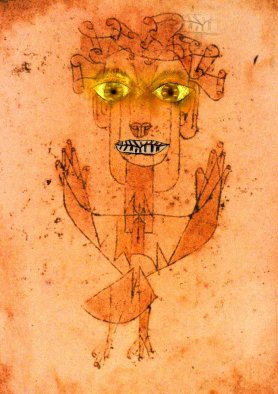
Variant of Paul Klee’s Angelus Novus with the eyes of Paul Klee’s Baroque Portrait and the mouth of Paul Klee’s Absorption,  Carl Djerassi and Gabriele Seethaler, 2008 - by kind permission of Carl Djerassi

Variant of Paul Klee’s Angelus Novus with the eyes of Paul Klee’s Baroque Portrait and the mouth of Paul Klee’s Absorption (see below);  Carl Djerassi and Gabriele Seethaler, 2008
– by kind permission of Carl Djerassi

Absorption, self-portrait by Paul Klee, 1919

Absorption, self-portrait by Paul Klee, 1919

Baroque Port.

Baroque Portrait, Paul Klee, 1920

This is a small selection of the images referred to or created by Carl Djerassi – in collaboration with Gabriele Seethaler — in his Four Jews on Parnassus, introduced in part 1, on another page of this blog. Brief extracts from the dialogue they illustrate: part 3.

Carl Djerassi’s sumptuous foretaste of publishing’s mixed-media future, part 3 (extract)

A Spirit Serves a Little Breakfast, Angel Brings What is Desired, Paul Klee, 1920

A Spirit Serves a Little Breakfast, Angel Brings What is Desired, Paul Klee, 1920

As noted in part 1, in Four Jews on Parnassus, Carl Djerassi – through his invented conversation between four immortal German-speaking Jewish intellectuals and playful digital graphics (part 2) – justified his feeling that Paul Klee’s ‘Angelus Novus’ does not deserve its iconic status quite as much as some other picture in the painter’s angel series (about fifty works) might have done.

He offers his own graphic suggestion of an angel more expressive of Walter Benjamin’s idea of an angel of history with ‘wreckage upon wreckage’ piled at its feet, mouth open wide in horror.

His imaginary dialogue is often reminiscent of Tom Stoppard’s wiser, as opposed to merely clever, dramas.

Here are short extracts from that conversation – which nimbly avoids lecturing, as it introduces readers to Benjamin’s sad and beautiful metaphor for the story of mankind. German philosophers seem wonderfully preoccupied with winged beings. Think of Hegel’s conception of the owl of Minerva, flying only at dusk – to convey his idea of philosophy as inevitably retrospective – only capable of enlightening us about reality after we experience it: ‘When philosophy paints its grey in grey, then has a shape of life grown old. … The owl of Minerva spreads its wings only within the falling of the dusk.’

[…]

ARNOLD SCHOENBERG [addressing Walter Benjamin] : … “Angelus Novus” was the title of a literary journal you founded.

BENJAMIN: Indeed. (Draws quotation marks in the air.) “We are touching now on the ephemerality of this magazine, for it is the just price to be paid for promulgating genuine topicality.” That’s what I wrote in the prospectus. […] And why did I choose the title? Because Gerhard [Scholem], the Talmudic scholar –

SCHOLEM: Gershom the Talmudic scholar!

BENJAMIN: Because Gershom … steeped as he is in angelology … pointed out that, according to the Talmud, angels are created all the time … just to utter praise before God … and then to disappear into nothingness. One issue of the magazine after another.

[…]

SCHOENBERG: […] You wrote something else about the angel. … You both know what I am talking about (to Benjamin), your “Theses on the Philosophy of History.”

BENJAMIN: The ninth thesis. (He quotes.) “There is a painting by Klee called Angelus Novus. It shows an angel who seems about to move away from something he stares at. His eyes are wide, his mouth is open, his wings are spread. This is how the angel of history must look.”

SCHOENBERG: One moment. Now really look at him. It is true his eyes are wide and his mouth open, but what made you write, “This is how the angel of history must look?”

BENJAMIN: Please let me continue. I then wrote, “His face is turned toward the past. Where a chain of events appears before us, he sees only single catastrophe, which keeps piling wreckage upon wreckage and hurls it at his feet.”

SCHOENBERG: Okay … understood. But what do these words have to do with Klee’s image? I don’t see the angel’s face turned toward the past! I see no wreckage before his feet! And how are you going to convince me that his hapless Angelus sees a catastrophe? You may see one, but Klee’s Angelus?

BENJAMIN: (becoming irritated) You must simply let me finish quoting my own essay. “The angel would like to stay, awaken the dead, and make whole what has been smashed. But a storm has been blowing from Paradise and has got caught in his wings. It is so strong that the angel can no longer close them. This storm drives him irresistibly into the future to which his back is turned, while the pile of debris before him grows toward the sky. What we call progress is this storm.”

SCHOENBERG: And you see all that in this image? I don’t see any storm. I don’t think his wings are caught in it. … I don’t see him driven anywhere. I didn’t see any debris at his feet … and I certainly don’t see any rising toward the sky. I see an angel looking sideways timidly towards God, raising his wings to his praise –

BENJAMIN: That’s all?

SCHOENBERG: That’s all. Now I do not question the text of your “Theses on the Philosophy of History” … not even this rather emotional ninth one. All of us, including Klee, have passed through this type of history, but putting these words into the image of this Angelus? You needed a metaphoric illustration and because this is the only Klee you owned –

BENJAMIN: Not the only one.

SCHOENBERG: I forgot! Your wife had bought you Vorfuehrung des Wunders … […] Here … let me show you another angel … one I might call Angelus Benjaminianus …

BENJAMIN: Good God. I had never seen that one before!

SCHOENBERG: I was sure none of you had. But this one* does do justice to your labored interpretation. Notice how you say, “His eyes are wide … his wings are spread.” But these wings are really spread and come from another Angel by Klee, which he also created in 1920.

[…]

* ‘A Spirit Serves a Little Breakfast, Angel Brings What is Desired’.

Log-rolling turns transparent as e-publishing and online art promotion come of age

'Spanky' and N -- LCM 2

‘Niko and Spanky’ - photographs by Willodel http://www.facebook.com/Willodel

‘Niko and Spanky’
– photographs by Willodel http://www.facebook.com/Willodel

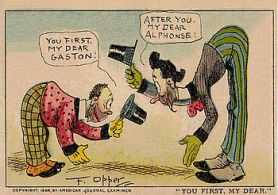
‘Alphonse et Gaston’ – the gold standard for mutual feather-stroking – from the Wikipedia

‘Alphonse et Gaston’ – the gold standard for mutual feather-stroking – from the Wikipedia

‘She is too reserved for the big internet world,’ read the message pounded into a keyboard a fortnight ago at hypersonic speed typical for B, post-Gutenberg’s inseparable friend at roughly ten years old. ‘She does not promote herself at all, but all the same has a whole lot of faithful admirers and buyers, so she remains old style.’

This description of a shy artist, K, lucky enough to have been born into a family exceptionally well-connected with prosperous buyers of art, gave us pause. Our immeasurably dear B — who only ever posts her own work online in disguise — was signalling a preference for arts workers who adopt the old unwritten creed of aristocratic reserve. Once, this might have been our choice, too – because we share K’s innate, incontestably genetic, cringing-violet introversion and dislike of egotistical puffery. These days, we are less sure of its rightness – for at least three reasons.

• Everything to do with attracting attention to new art and literature, even mere blogs, has become confusing — at least as perplexing as those members of the ancien régime marched to the guillotine in revolutionary France in spite of siding openly against their lofty origins. B, for example, had introduced us to K’s work with a link to one of her pictures – a serene, meditative portrait in the yellow-brown-ochre palette that Paul Gauguin often used in his time in the South Seas – and a request to vote for it on the web site of a gallery using a contest as a promotional device.

By coincidence, this happened in the same week in which we witnessed a fight between two writers who had entered one of the many online literary contests nowadays, also designed for audience-building. One of them was accusing the other of an attempt at vote-rigging – a charge that struck us as dubious. The accused writer had done no more than openly suggest reciprocal voting – that they each vote for each other’s entries.

How, we wondered, is that any different from the latest evolutionary leap of the old ‘gentleman’s game’ of traditional, print publishing – behaviour to which Private Eye routinely draws its readers’ attention, with nearly audible guffaws? In its 26 July-8 August issue, for instance, spotlighting recommended summer reading by literary power brokers in London newspapers:

”Tasha is my sister-in-law,” declared Lee Child, selecting a Tasha Alexander novel in the [Mail on Sunday]. Robert Winder’s book about Wisden, “for which I wrote a foreword”, was David Kynaston’s pick (Times). And “I can’t wait to read my friend Mark Lawson’s astonishingly expansive, hilarious and heartbreakingly dark The Deaths,” gushed Julie Myerson (Observer), enthusing too about a novel from “the latest to be published from my husband’s creative writing MA”.

Such advice was most influential – with the naïve and unsuspicious — when the recommenders hid their ties to authors. Post-Gutenberg is all for letting in the sunlight and dropping the pretence of objectivity. But after that, the point of such recommendations is – precisely what?

• Aristocratic reserve has passed its sell-by date — for aristocrats. Long before the internet sped up the digitisation of human life in every pore, the Duke and Duchess of Devonshire, avidly promoting tours of Chatsworth, his ancestral pile, were only among the most successful English grandees hawking their ‘brand’.

With unabashed Teutonic frankness, the home page of a successful expatriate painter (and wife of a friend lost to distance and time) announces its owner, in gold-on-black lettering, as ‘Antoinette Baronesse von Grone’. From there, she proceeds immediately, without any timorous beating about the bushes, to

ARTIST BIOGRAPHY

I was born and raised in Northern Germany, in a village that has been the seat of my family for over 500 years.

• Declining to dirty your hands with audience-building for yourself can mean failing to acquire any power to help other people.

Post-Gutenberg has long discouraged friends from initiating even semi-intimate conversations in the comments section of this blog because we can find clubbiness on other blogs off-putting. Even so, we liked last week’s justification of e-barn-building by Cally Phillips, an engagingly exuberant, extempore Scottish blogger (yes, we follow each other’s blogs):

It’s an interesting thing this ‘you read my book I’ll read yours’  It seems that there’s a notion that we  should think there’s something a bit suspect in that  (like trolls or sock puppet alerts) but hey folks, that’s part of what ‘indie’ writing is about. It’s about finding people you have some kind of a connection with – and guess what – you’ll probably find you might like their writing.

Of course sometimes they write in genres you’re not that familiar with (or claim not to like – for me thrillers and sci fi) But sometimes it’s worth stepping out of your comfort zone.  And when folks bother themselves with my writing, yes I do feel some compunction to ‘explore’ the worlds they have created and ‘meet’ them through their writing. I’m not ashamed to say that. […] I don’t think that being mediated by gatekeeper, guardian mainstream publishers guarantees me a ‘good read’ and I’m happy to take the responsibility on for myself to find what I want to read.  And if, in the process I make virtual (or real) friends of other writers, I’m not going to be embarrassed about that. It’s a good thing.

[Y]ou can read things you’d never have read while you grazed from the mainstream trough.  And that’s no bad thing.  Unless you want all your reading pre-packaged and homogenised off the supermarket shelves (in which case I’m sure you’re not even reading this!)  […] If you like what someone writes TELL THEM.  And tell other people.

Anyone who resists the new honesty about connections and self-interest risks being outed anyway, as in a delicious item in the other edition of Private Eye last month – featuring one Sam Baker, a columnist for Harper’s Bazaar, recommending a novel by Jonathan Grimwood:

”From the moment I encountered four year-old Jean-Marie d’Aumout sitting on a dung heap eating beetles, I was obsessed by this sensuous tale of one man’s search for the perfect taste,” she raves. “Part Perfume, part Pure, 100% original.” In a fit of absent-mindedness, Baker omits to add that Grimwood is also 100% her husband.

No publication pretends to despise the internet more than the net-spurning Eye does. Yet – as we have shown in an earlier entry, here – no rag is more gloriously infused with the take-no-prisoners spirit of the blogging world.

Why art needs more scientists like Carl Djerassi — not just as patrons but for visceral understanding

'DO NOT DISTURB:  Cultural transmission in progress'

‘Do Not Disturb:
Cultural transmission in progress’

'Sun in the mist' Claude Monet, 1890

‘Sun in the mist’
Claude Monet, 1890

To know a thing by its parts is science, to feel it as a whole is art.

— Lewis Mumford (1895-1990 — American critic most admired for his commentary on architecture)

We tell ourselves stories in order to live…

— Joan Didion, The White Album, 1979

… and one more thought for the mill: ‘We don’t treat artists well in this country.’ That was Margot H. Knight – talking to post-Gutenberg about the gap that arts foundations like hers strain to fill in America. She directs the Djerassi Resident Artists Program, a retreat on a converted cattle ranch on six hundred-odd idyllic acres of rolling uplands looking onto the Pacific Ocean, about an hour’s drive south of San Francisco.

In spite of her remark about the lack of respect for arts workers in the U.S., she had startling news. This was in her impression – from, she said, recent conversations — of an explosion in approaches to organisations like Djerassi for advice on turning farms, ranches, and other property in inspiring settings — some of them urban — into places for artists to make temporary or permanent homes. She considers the trend she perceives as a sign that many of her fellow-Americans are recognising, better late than never, how hard it can be for even outstanding artists to endure the struggle for time and money to make art. She predicts that the word eleemosynary – ‘meaning, the impulse to be generous, is one we’re going to be hearing a lot, soon, because of the huge transfer of wealth between generations that has begun.’

Why does this surprise us – even as an observation by just one alert cultural curator that we do not have time to compare with the impressions of others? No matter how clichéd mentions of starving scribblers or daubers in garrets are, there has always been a shortage of people willing to do more than throw them the odd crust – and nothing, not even the noise about Kickstarter and crowd-funding, has shown us any real evidence of a change. We would love to be mistaken.

We wish someone would study how attitudes to artists have been evolving. In a popular post here last summer, we suggested that audience jealousy of artists, of which we reproduced some hair-raising expressions, could explain why those in favour of destroying copyright protection apparently outnumber all of us anxious to defend artists’ right to eat – and why these opponents pretend as if the fight is all about preventing conglomerates in the music business from reaping obscene profits from selling millions of copies of the same CD.  The success of the anti-copyright campaigns is hard to reconcile with Margot Knight’s trend, unless there is a generation gap – with most anti-s belonging to the age-group after the one that might, or might not, contain growing numbers keen to focus their eleemosynary on artists.

Which of us know consciously how much human beings depend on art to get through life – that it is as indispensable as oxygen and calories?

Not many, in any generation, we suspect. It is still rare even for people with the wherewithal to acknowledge in tangible, practical ways, the extraordinary gift from, say, a musician, in the musical composition that ‘draws the sorrow out of you,’ as one sweet friend of this blog put it, the other day — or from a novelist, in the story or fictional character into which some of us made a habit of disappearing, imaginatively, in childhood, to survive or improve reality; or from a painter, in the alchemy capable of rendering joy on canvas with paint through a depiction of, say, light exalting a haystack, as Claude Monet could.

Carl Djerassi – born in Vienna in 1923, educated in the U. S., and still sprinting between continents at eighty-nine, lecturing and attending conferences – gave humanity chemical contraception in the form of ‘the pill,’ from whose manufacture he made a fortune. He proves how right C. P. Snow was to bewail an educational system in 1950s England that reflected a ‘two cultures’ divide in which workers at the literary coalface were seen as deeply incompatible with those in science – a prejudice that persists, especially in the Anglophone-Anglophile universe, to this day.

In his own life, Djerassi has demonstrated that operating in both spheres can be a perfectly natural switch between mental states (or neurocircuitry), and by no means as improbable as balletomane pigs dancing Swan Lake. He has published five novels, several short stories – and, with sculpture strewn across the grounds of his artists’ retreat, could hardly identify with the technologists complaining in the New York Times earlier this month about finding the arts community unwelcoming and intimidatingly clubby.

His ease in it is partly because he reacted to a family tragedy in the late 1970s by setting off on a quest to understand the lives of artists, and their realm. His daughter Pamela Djerassi, a painter and poet, died by suicide in 1978, and the Artists-in-Residence scheme is a memorial dedicated to her.

Reflecting on artists and scientists, Gustave Flaubert wrote, in an 1852 letter to his lover, Louise Colet, that ‘[t]he time for beauty is over … The more Art develops, the more scientific it will be, just as science will become more artistic. Separated in their early stages, the two will become one again when both reach their culmination.’

Flaubert could be wrong, but something important about the split has altered. In the England of C. P. Snow’s day, scientists were the underdogs. When British cultural influence was at its zenith, Britain was mostly run by clever people educated in the humanities.

Today’s heroes are rich American technologists and scientists, and one counter-complaint in the NYT article we mentioned – ‘Does Anyone Here Speak Art and Tech?’ – came from an art expert asking, ‘If these are our next Rockefellers, Carnegies, Fricks, … our wealthy American elite, why aren’t they supporting culture?’

A social media entrepreneur confessed that he would never mention collecting art to his fellow-technologists, who are ‘all so business-minded.’

Other techies fumed about being treated as nouveaux-riches trying to buy their way into acquiring reputations for taste and discrimination – and were appalled to encounter galleries selling works of art to people offering smaller sums of money than they had.

We know people like these technologists, even likeable ones, and their behaviour is consistent with the shift in social status that – to our alarm, and on both sides of the Atlantic — has led nearly all the highly-educated children of post-Gutenberg’s friends into careers in some branch of finance. We have begun to think of ‘quants’ as people who see themselves as being at the top of the social pyramid – not using the word exclusively in the sense in which it was coined in 1979, to mean ‘an expert at analysing and managing quantitative data,’ (Merriam-Webster) but also covering those most attracted to work whose value is easily quantifiable in numbers preceded by currency symbols.

That would leave out most artists and writers, as well as … well, mothers, or people including men who now do the essential, life-sustaining ‘home-making’ that only women once did.

If what we think of as art today is to have a future, any quants who care might look to Djerassi as a model for supporting its continuation — as he has had the intelligence and good luck to also prove himself a super-quant. A recent study confirmed the power of ‘monkey-see-monkey-do cultural shifts’ – certainly for Vervet monkeys. A Swiss primatologist commenting on it in the NYT said,

[I]f you define culture as socially transmitted knowledge, skills and information, it turns out that we see some of that in animals …