How would introverts like Beckett — and Wittgenstein, Kafka and P.G. Wodehouse — have survived social media?

Samuel Beckett drawn by Edmund Valtman

[ part I;  part  II is here ]

We like talking so much because we hope by our conversations to gain some mutual comfort, and because we seek to refresh our wearied spirits by variety of thoughts. And we very willingly talk and think of those things which we like or desire, or else those which we most dislike … But alas! it is often to no purpose and in vain.

Thomas à Kempis (1379-1471), ‘Of the Danger of the Superfluity of Words’ 

The most riveting collection of words I have come upon this winter is in a 1935 letter from a twenty nine year-old Samuel Beckett, whose work would later be translated into at least twenty languages and stimulate conversations all over the world. He was writing to his closest friend, Thomas McGreevy, about his sceptical reading of the medieval German theologian, Thomas Haemmerein, known as Thomas à Kempis – who, in the passage I have quoted, plainly anticipated Facebook’s  ‘like’  button. Beckett confesses:

For years I was unhappy, consciously & deliberately ever since I left school & went into [Trinity College Dublin], so that I isolated myself more & more, undertook less & less & lent myself to a crescendo of disparagement of others & myself. But in all that there was nothing that struck me as morbid … It was not until that way of living, or rather negation of living, developed such terrifying physical symptoms that it could no longer be pursued, that I became aware of anything morbid in myself.

The year before, a plague of boils, cysts and heart palpitations that Beckett perceived as psychosomatic had led him into treatment with a psychoanalyst, W. R. Bion. After that, he says, he forced himself to be less reclusive. He is not especially convincing on this score, as he reports in the same letter that ‘I spend most of my time, when not with Bion or walking, reading on top of the fire.’ At the end of his life, it was plain that his true sentiments were closely aligned with those of  à Kempis, only bleaker. He wrote, not long before he died, that each word spoken seemed ‘an unnecessary stain on silence and nothingness.’

Yet he was an avid reader. I have found myself wondering whether the internet could ever be the true friend of introverts that books have been for centuries – not just making it possible to get lost in stimulating new information, ideas and vicarious feeling, but because opening one can serve as a polite ‘keep out’ sign when, as Beckett expressed the condition of being emotionally drained, ‘the bath is nearly empty’.

What are introverts supposed to do in the age of social media? Specifically, how are they supposed to respond to the pressure to join the unending exchange of news and views and intimate disclosures – or pretence thereof – in tweets and postings? An alarming index of the growing coerciveness of these media is a report that the more enthusiastically a blogger joins the great conga line in the ether, the higher the rank assigned to the blog in Google’s search results – supposedly because of a change in Google’s algorithm. Someone posted a link to this news I don’t remember exactly where, last week. When I looked up the reference it turned out to be six months old, an eternity for a company that appears to tweak its policies every quarter, but perhaps Steve Olenski of Social Media Marketing was not merely grinding an axe when he quoted someone in his business pronouncing,

‘If you don’t have a presence in social, you’ll lose your presence in search.’

It certainly fits the repetitious, mind-numbing reminders that have begun to recall the lovely old Private Eye series, ‘Great Bores of Today’, to the effect that

[t]he internet is […] a code for the collective conscious or “distributed networked intelligence”. The internet is our collective externalised mind.

Or, as William Gibson, the science fiction writer and inventor of the word ‘cyberspace’ has been quoted,

… humans, as a species, are ‘in the process of growing itself an extended communal nervous system.’

But even if there is a great mind-meld into a single system in the offing, surely that giant organism will need long respites from chatter – whether that is something like sleep, if not interludes of Beckettian ‘silence and nothingness’? Parts of our individual brains do crucial work in the background,  and unobtrusively:  surely we can acknowledge and accept that there are vital contributors to society ill-suited to social media, who deserve protection from their coercive promotion?

Or,  should we simply let evolution favour extroverts, so that social media’s influence on natural selection will, as someone witty has said in another context, render introverts ‘genetically speaking … a cul de sac’ in the future?

Worry about that possibility does not seem to be getting much attention. Critics of the internet like Nicholas Carr tend to focus on its effect on concentration and mental acuity – as in, ‘Is Google Making Us Stupid?’. There are  introverts pointing out that social media are more congenial because they spare them the trauma of going out and meeting actual, embodied, human beings. I must respectfully disagree. That might have been true before social media took off in earnest. Following the Twitter streams of the champions in these channels shows them at it — I mean, extraverting madly — from early in the morning. They do not stop for weekends or public holidays – and they appear to have fostered the expectation that we should all be equally tireless witterers, which can hardly be attractive to lovers of solitude and introspection.

What might we lose by discouraging introversion?

The psychiatrist Anthony Storr, a lucid and honest thinker, confessed to reversing himself on the subject of introversion in Solitude (1988):

In an earlier book, I stressed the need for interpersonal relationships in the maturing of personality:

[C]reative artists may believe that it is in the ivory tower of the solitary expression of their art that their innermost being finds its completion. They forget that art is communication, and that, implicitly or explicity, the work which they produce in solitude is aimed at somebody.

I still believe this; but I want to add a rider to the effect that … [t]he great introverted creators are able to define identity and achieve self-realization by self-reference; that is, by interacting with their own past rather than by interacting with other people.

He made his point with deft sketches of a long list of writers and philosophers, including

… the biggest surprise, for me … P.G. Wodehouse, who ‘[dreaded] individual social contacts, hated being interviewed, loathed clubs (though he belonged to a number of them), and lavished on animals the affection which he could not give to his fellow-creatures.’

… the dazzling satirist Saki (H. H. Munro) and Franz Kafka: ‘Both were story-tellers, but their stories were hardly ever concerned with intimate human relationships, and neither man established any prolonged intimate relationship in reality.’

Immanuel Kant, who believed ‘that every rational being existed as an end in himself, and that is how we ought to treat each other … [H]e did not form any close relationship with either sex … Although generous to his relatives, he took care to keep well away from them.’

Ludwig Wittgenstein, ‘who must have been one of the most profoundly introverted men of genius who has ever existed. What was taking place in his own mind was, to him, far more important than anything taking place in the external world. … [He] was indifferent to social conventions, disliked the small talk of academic life, and hated social pretensions.’

Isaac Newton, who was ‘predominantly a recluse, preoccupied with his work to the exclusion of almost everything else, with little social contact with other human beings, and no close relations with either sex.Newton’s distrust of others is attested by his reluctance to publish his work.’

If any of these people swooped down in a time machine, would anyone sensible recommend labouring at a Facebook wall to them, or Twittering in the dawn tweetastic?

I see that I am getting silly, but that might be because prolonged head-scratching about the attractions of social networking has left me perfectly witless.

Will 2012 be the year of a great leap forward into media’s future — even at The New York Times?

Back to the future 1: barn-raising

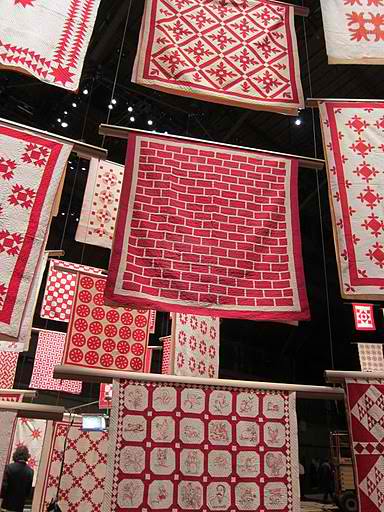
Back to the future 2: the work of quilting bees -- Steven Heller

My new year will begin not with a resolution but a hope.

It has been a bit lonely, trying to persuade other people intimately acquainted with mainstream media to discuss specific proposals for media reform. But three short essays published in the last month – to which I am about to post links – show that I am in good company in suspecting that co-owning media with readers and viewers could be the most realistic route into the future. It is no longer quixotic to hope that the most rigid opponents of reform will give alternatives to the status quo a friendlier reception.

With any luck, I will soon be able to drop the subject of media restructuring from this blog because powerful media people persistently refusing to discuss it have, at last, picked up the torch.

My personal high-water mark for the media establishment’s resistance to the new dates from the spring of 2010, when I emailed a question to an editor near the top of The New York Times.

The press has been critical to the success of democracy as a form of government; how is it responding to its own democratisation, and how far would it be prepared to go on that road — voluntarily? If you could recommend the right person at the paper for these questions, I’d be immensely grateful.

Zzzzzzzzzing! … the editor’s reply came fast enough to set heads spinning:

I don’t know that anyone would have a specific opinion on this, at least not one that represented the Times in general. You might look to see if an editorial has ever been written about it. If not, I suspect your question doesn’t have an answer.  [my ital.]

No search engine brings up any such NYT editorial. What that response was surely supposed to impress on me was that ‘our’ never having addressed the question meant that it was inherently unanswerable.

Which is patently untrue – but that was then, and I cannot believe that anyone with a senior role in running the newspaper would respond so loftily today. The subject of co-owned institutions is not apparently off-limits for the editors there, as it is for large numbers of their fellow-citizens. Nor do they automatically dismiss it as ‘socialism’, very nearly a term of abuse in much of the U. S. — a fact that has always struck me as a bit odd about a country that is not only the home of capitalism and Ayn Rand’s woolgathering about the ‘virtues of selfishness,’ but of cherished memories of communal barn-raising and quilting bees.

On 14 December, the NYT  gave Gar Alperovitz, the author of America Beyond Capitalism, the chance to tell us, in ‘Worker-Owners of America, Unite!’:

[M]ore and more Americans are involved in co-ops, worker-owned companies and other alternatives to the traditional capitalist model. We may, in fact, be moving toward a hybrid system, something different from both traditional capitalism and socialism, without anyone even noticing.

Some 130 million Americans, for example, now participate in the ownership of co-op businesses and credit unions. More than 13 million Americans have become worker-owners of more than 11,000 employee-owned companies, six million more than belong to private-sector unions.

Out in the blogosphere, these posts were waiting to be discovered:

In a 9 December entry on the site of Harvard’s Nieman Journalism Lab, Tom Stites, the president and founder of the Banyan Project — which is building a model for web journalism as a reader-owned cooperative focusing on local news — asked: ‘Might the new web journalism model be neither for-profit nor nonprofit?’ He said, in part:

In this era of rampant deceptive business practices,[…] a significant source of co-ops’ strength is the trustworthiness inherent in their democratic and accountable structure.

This is also an era of rampant mistrust of journalism, so co-op news sites’ trustworthiness has the potential to add value to what they publish. Further, the co-op form allows, or rather demands, that news coverage decisions arise from the what a community’s people need rather than from today’s dominant approaches […] The web is inherently collaborative — just as co-ops are — and at the local level this creates the potential for civic synergy that could add still more value to co-op community journalism.

On 19 December, Jeff Jarvis, a new media expert, suggested that The New York Times should consider using a ‘reverse pay meter’.

As I ponder the future of The New York Times, it occurred to me that its pay meter could be exactly reversed. I’ll also tell you why this wouldn’t work in a minute. But in any case, this is a way to illustrate how how media are valuing our readers/users/customers opposite how we should, rewarding the freeriders and taxing—and perhaps turning away—the valuable users.

[…]

Imagine that you pay to get access to The Times. […] But whenever you add value to The Times, you earn a credit that delays the next bill.

»  You see ads, you get credit.

»  You click: more credit.

»  You come back often and read many pages: credit.

»  You promote The Times on Twitter, Facebook, Google+, or your blog: credit. The more folks share what you’ve shared, the more credit you get.

[ … and several other suggestions along these lines …]

He said in closing:

Readers bring value to sites if the sites are smart enough to have the mechanisms to recognize, exploit, and reward that value, which comes in many forms…

Regular visitors to post-Gutenberg.com will have noticed a striking overlap between the essence of the Stites and Jarvis schemes and the proposal for a ‘keiretsu-cooperative’ as the ideal structure for media of the future. (New readers will want to see: The Keiretsu-Cooperative: A Model for Post-Gutenberg Publishing.)

May this most welcome parallelism lead to actual change — soon.

In the meanwhile,  Happy New Year!

A reply to Richard Stacy: the keiretsu-cooperative is at the opposite pole from a ‘walled garden’

A keiretsu-cooperative for Santas? Despite the mist, they were travelling too fast to ask

Since I posted this entry, Richard Stacy has written ‘A Futher Reply …’ well worth reading, and I have responded in his comments section, also explaining why post-gutenberg.com is unfortunately not open for commenting.

Richard,

I have enjoyed thinking about your answer. It has been impossible to discard this idea for a keiretsu-cooperative because practical people – including, as I am about to explain, a young technologist working for Barack Obama  – keep telling me that it could just work.

First and quickly, some clarifications: the keiretsu-cooperative would let large conventional publishers collaborate to share the costs of setting up — or extending — a publishing and discussion site designed to attract the indie writers we call bloggers. To enlist the help of these bloggers and make the site a success, the large publishers would allow each of them to acquire a small financial stake. The stake could take the form of a subscription to the site. No one would be excluded from reading or looking at the site’s contents, so it would not be what you called, in the first, fast, version of your reply, ‘a walled garden.’ I mention this because it is a misconception that keeps cropping up elsewhere, but what I have in mind is at the other pole. Stakeholders would have just two important advantages over those who chose not to subscribe: (i) chances to participate in the management of the site and vote on decisions affecting it; (ii) a share of any future profits. You might not agree, but I do not see any of this as inconsistent with your vision of media being transformed from a collection of rigid and exclusive institutions to a process – since the keiretsu-cooperative would be flexible, mutable and inclusive, with porous boundaries.

Publishers could test co-ownership inexpensively by running an experiment in a comments section of an existing site.

It was never my ambition to be a designer of futuristic structures for publishing. This proposal for ways of injecting ‘plurality’ into the ownership of publishing simply grew out of observing for five years how much commenters contributing posts to a ‘liberal’ newspaper resented being censored — not for obscene or rude remarks, but for challenging in civil tones the paper’s vested interests, both the political and commercial varieties.

I wondered, when did we ever give newspapers the right to tell us what thoughts were acceptable? I found myself reading widely about the start of the social revolutions we know as the Renaissance, for which the newly-invented Gutenberg press acted as a fulcrum. My most startling discovery was that censorship was practically invented with printing. Of course that seemed obvious after a few moments’ reflection, but what it underlined, for me, was the extent to which control of the levers of mass communication – or what we call the media – can undermine democracy, even in societies proud of their tradition of licensing free speech.

Then I considered another question: what arrangement for running media could best accommodate a democracy’s need to give people the facts they must have to vote wisely?

I was pleased to find your paper for proof that someone in the business world has also been reflecting on today’s crisis in publishing with history for a lens. From a realm far removed from mine, you reached the identical conclusion: that today’s leaders in traditional media are failing to understand that ‘[P]ower and influence in the world that is now forming […] will have a tendency to exclude any forms of institutional interference, control or ownership.’

Another new media consultant, like you, surprised me by instantly grasping the logic of the keiretsu-cooperative. Anil Dash, a 36 year-old technocrat entrusted by the White House with leading Expert Labs – a non-commercial organisation helping Barack Obama to democratise governing by exploring ways of using digital tools to let citizens assist the government with their expertise – sent this reaction to the scheme:

This is a topic that’s near and dear to my heart, since I’ve worked at a newspaper and helped making new publishing platforms online.

[…]

I have had far too many years in the trenches with the cynics and the naysayers and the slowly-failing publishers. But what I *love* about the idea is that it’s new, and provocative, and not the same old proposals we hear bandied about all the time.

A lot of the dialogue is dominated by the legacy issues of older publishers, and that makes it hard to propose relatively radical new ideas.

I think you accurately capture the motivations of all the parties involved, and I share your optimism that various parties would want to pay for participation.

He did have one reservation:

[W]here I struggle a bit … is in seeing an iterative path that gets us to this eventual keiretsu. I am not sure if we can make incremental steps, or if we have to start with this radical new point all at once, but I do think the former is a lot easier to get funded than the latter.

I do hope you’ll pursue this, though.

In last week’s entry in this blog, I mentioned that I was waiting to hear from another correspondent, ‘A’. I wanted to know whether it was ever part of his collaborative publishing plan to offer readers (not just editorial staff, early investors and managers) the opportunity to become stakeholders in the thriving specialist magazine, The Journal of Light Construction (JLC), that he developed with a few partners – and which has at the heart of its online site a lively forum for exchanging technical information. His reply said, in part:

The “readers” (more on that in a moment) of JLC were going to be the primary people offered ownership of the company (remember my mention of a DPO [direct public offering]?). After all, the company was really little more than a pot into which all of them had tossed their experience, know-how and money. How could it not be theirs to own?

Regarding the “readers” thing…this seems to be the biggest intellectual hurdle the old-media, Gutenberg folks have to overcome. Print, TV and most radio are a one-way, I’ll-give-you-what-I-want-to-give-you-when-I-want-to-give-it-to-you street, when the “customer’s” (more on that in a moment) need is to-have-what-I-want-when-I-want-it. From a business perspective you will note the potentially irresolvable dichotomy between media’s mission statement and that form of practice.

[…]

Regarding the “customers” thing, see the paragraph above…and note that the internet is a two-way street. The one-way signs no longer apply. Just as its advent revealed print in that realm is dead, so is “the customer.” There’s a community on that block, and they’re all in it together. So remember, look both ways before crossing.

No sooner had I digested that than an announcement from Amazon.com popped up in my email inbox. It was about Kindle Select, a new addition to its Kindle Direct Publishing enterprise for independent writers of e-books:

We’re excited to introduce KDP Select – a new option dedicated to KDP authors and publishers worldwide, featuring a fund of $500,000 in December 2011 and at least $6 million in total for 2012!  KDP Select gives you a new way to earn royalties, reach a broader audience, and use a new set of promotional tools.

Here’s how KDP Select works:

When you make any of your titles exclusive to the Kindle Store for at least 90 days, those with US rights will automatically be included in the Kindle Owners’ Lending Library and can earn a share of a monthly fund.  The monthly fund for December 2011 is $500,000 and will total at least $6 million in 2012.

[…]

How your share of the monthly fund is calculated:

Your share of the monthly fund is based on your enrolled titles’ share of the total number of borrows across all participating KDP titles in the Kindle Owners’ Lending Library.

This is a very different proposition from the keiretsu-cooperative, but the schemes do overlap in giving writers a financial incentive – by way of micropayments – to participate in a type of collaborative publishing experiment. I am still making up my mind about the attractiveness of Select. Though I am on record as a fan of Kindle Direct Publishing, I do not like Amazon’s requirement that writers who join this new scheme give it exclusive rights, even for 90 days. I would be more attracted by a plan that gave writers some say in the running of Kindle Select. Amazon also tends to be stingy with information about how it manages its e-book publishing – refusing, for instance, to explain its system for ranking e-books in various categories.

I think you would agree, Richard, that plurality, transparency and accountability are the forces we want to see shaping publishing in the future.

But at least this news from the book retailing giant is proof of its continuing willingness to stick its neck out for a bold experiment. Google also experiments endlessly – promptly euthanising ideas that prove to be duds.

New media specialists like these do understand that adventurousness is the key to success. Old media institutions, as you point out, only feel safe making small, incremental changes. You and ‘A’ could easily be singing in two-part harmony on this point:

Alan Rusbridger at The Guardian has talked about involving “Our Readers” in producing “Our Product”.  The problem is that news is no longer Alan’s product – it belongs to the people (he likes to call) readers and it doesn’t really live in fixed places (websites, newspapers) anymore, it lives in digital spaces (Google search terms).

As the oldies are more inclined to trust leaders in tangible, bricks-and-mortar businesses, they could do worse than consider the innovative appliance king, James Dyson. He was told by every vacuum cleaner manufacturer under the sun that his ‘business model’ for selling a dirt sucker without a dirt-collecting bag was unworkable – even if such a product could ever be designed and made to work. He and his engineers discarded thousands of prototypes on their way to success …  of which I am now a sub-microscopic beneficiary. Last year, the 25 year-old Electrolux in my house was replaced by a yellow-and-purple Dyson with a look of R2D2 about it. It works like – yes, the dream with which James Dyson began.

I think it’s too soon to conclude, as you suggest, that ‘media may be becoming something that can’t actually be owned in a way which allows any form of monetary benefit’. If you mean, owned by a privileged few, or moguls like Rupert Murdoch and Conrad Black, I agree, but not if you mean, shared by a large, loosely affiliated group of citizens. How could you, or any of us, know? There simply have not been any experiments exactly like, or closely resembling, the keiretsu-cooperative – so far.

Here is a song I suggest that old media types might try singing together at their meetings about surviving the future (with apologies to Cole Porter):

Experiment.
Make it your motto day and night …

Experiment and you’ll see. 

P.S. I almost forgot to say — by my definition, you are a blogger, just as you are a writer, in a part of your life – since I think of a blogger as being anyone who publishes unmediated texts on the internet, including comments on newspaper and other sites. ‘A rose by any other name,’ etc..

Co-owning media is on the horizon — and press coverage of the Leveson Inquiry shows why we need this

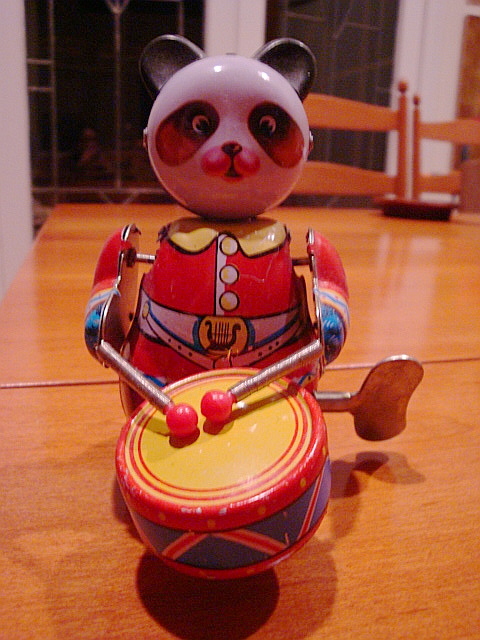
Panda drummer: who can speak?

Blindly they saw themselves and deaf they heard —

But who can speak of this?

        –Farid ud-Din Attar, The Conference of the Birds, 12th c.  A.D.

                 Persian trans. by Dick Davis and Afkham Darbandi, 1984

A stranger, someone astute and entrepreneurial, emailed me about a comment posted in a discussion about the future of journalism on the site of Harvard’s Nieman Lab. ‘I think you’re on the right track with your focus on the business-model issue,’ he said.

He was referring to an outline of a means for old media organisations to move into post-print publishing in a Networking Age in which readers want to be more than passive audiences – to do more than influence stage management and be free to perform themselves. I set out a scheme for turning readers into financial stakeholders or co-owners – experimentally, at first, on parts of newspaper sites – suggesting that this might be an ownership structure for the future.

The essence of the idea was that every subscription would also be a share or financial stake in prospective profits. It would be an inducement for each reader or viewer to help bring many more visitors to a site. It would both help the site owner to attract more advertising and – implicitly – reduce dependence on advertising, if the concept of subscription-stakes caught on and went viral.

‘I tried an experiment along the lines of the one you are proposing,’ my correspondent continued. ‘It was a tremendous success … as far as it went.’

I shall call this correspondent ‘A’, as he does not want more recognition for what he did than his fellow-experimenters. The link to wallets and handbags for their plan was so clear that it had venture capitalists salivating. The idea was to monetise a publication and online forum on building for professionals and amateurs – an offshoot of the Journal of Light Construction (JLC), a magazine now 24 years old that is also the marquee name for a popular trade show. You can tell that it is thoroughly up-to-the-minute from the table of contents, where the offerings can range from ‘Pouring Complicated Slab Foundations’ to ‘Promoting Yourself With YouTube’.

The Journal of Light Construction

The forum on the magazine’s website is divided by specialisations. Each section has its own moderator – and in an innovation I have seen nowhere else, the specialist’s name is posted prominently beside the category. When the combined on- and off-line components of JLC were on their way to becoming a publicly traded company roughly ten years ago, ‘A’ and his confederates introduced the possibility of making JLC’s contributors and employees co-owners. I do not yet know whether readers would also have been invited to become stakeholders. If ‘A’ sheds any light on that question after he reads this, I will include what he says here with any other details of the adventure and corrections of this account.

For the moment, it is enough to say that the idea of co-ownership so appalled the lead investment banker working on the public offering that the whole plan was scuppered. The points ‘A’ most wanted to impress on me were these:

Ownership can be transferred at any time. The trick is to have something worth transferring first. … There could be NGO funding possibilities from which a larger community trust with cooperative member ownership could emerge…

And that, strangely enough, is very close to the proposal for a ‘keiretsu-cooperative’.  A publishing enterprise with a thriving community of reader-commenters could easily progress to sharing ownership of the commenting sites where readers already supply most of what there is to read or watch.

It would ask that many newspapers make just one more leap forward after this change announced by the New York Times last week, but already in place for some time on other digital news sites:

We have started using an improved comment section. It will put readers’ responses on the same page as the article, provide threading of comments so readers can respond directly to one another, and allow them to share their comments and those of others, to Twitter and Facebook.

To understand why readers want more than that, I recommend an excellent paper, ‘Gutenberg and the social media revolution,’ by a new media consultant, Richard Stacy**, which puts all these developments in their historical context, then offers a clear-sighted vision of the way ahead. Serendipity led me to it last week, when it came up with some Google links to my own site. His conclusion:

It is unlikely that power and influence in the world that is now forming will lie in the control of channel.  Instead it will be vested in forms of community, which will have a tendency to exclude any forms of institutional interference, control or ownership.

He also said,

It is not that people are going to reject institutionalised trust, but the task of sustaining institutionalised trust is going to become much harder in the world of transparency brought about by social media.

I would welcome anything that reversed my own fast-diminishing trust in mainstream, 21st-century journalism’s ability to live up to the ideals of the Fourth Estate – of which the highest are impartiality and rigorous self-scrutiny. To my dismay, most of  the British media – not just the tabloids – have failed to report every important criticism of the media made in the hearings for the Leveson Inquiry, except for the sensational details of the phone hacking scandal.

Giving evidence last week, Alastair Campbell, Tony Blair’s political adviser and communications director – that is, chief ‘spin doctor’ – did draw attention to some problems of the very greatest importance:

The. principle of the freedom of the press is always worth fighting for. The quality of that freedom however is questionable when the quality of so much journalism is so low, and when so few people — just a handful of men until now seemingly unaccountable to anyone but themselves and to anything but their own commercial and political interests – have so much say over the tone and nature of public discourse, and so much responsibility for the decline in standards. It is also worth fighting therefore – politicians, journalists and public alike – to change the press we have.

What he said before that at considerable length – about the collapse in standards – was not addressed in any press report of the Inquiry I have seen.  A former editor of the Daily Telegraph, Max Hastings, said in his 2002 memoir about his career that it is the job of a political press officer ‘to act as a purveyor of half-truths to the nation’s journalists, but it is the business of the journalists to seek out the missing 50%.’

At least half of what Alastair Campbell said is true and his critique deserves intense scrutiny and wide discussion by the press – in public. It dovetailed perfectly with the testimony in the same week by Nick Davies, the freelance writer for The Guardian who broke the phone hacking story and pursued it with ferocious determination. He said unequivocally that the press can no longer be trusted to regulate itself.

Is a thorough airing of such opinions possible with today’s media ownership structure? Is it possible when the authority to disseminate the information people need in a democracy — to make decisions for the common good — is concentrated in so few hands?

Surely we need a new ‘business model’ – of which the keirestu-cooperative could be a very rough first draft – not just to accommodate readers in their wish to share the stage, but to protect our form of government?

______________________________________________________

** who has already posted a magnificent response to this piece on his own site. I shall be replying in next week’s blog entry – underlining some of his points and clarifying aspects of the keiretsu-cooperative that have been imperfectly transmitted (mea culpa). I will put that up sooner than next Tuesday if I can interrupt what I am writing off-line.