Does copyright law turn art into commodities? part 1: an answer with help from Albrecht Dürer, ARTICLE19, Salman Rushdie and Anthony Storr

Artists who can control copying with copyright have more creative freedom - photograph by postgutenberg@gmail.com

Artists who can control copying with copyright have more creative freedom
– photograph by postgutenberg@gmail.com

Albrecht Dürer: self-portrait, aged 13

Albrecht Dürer: self-portrait, aged 13

How does newness enter the world?

Joseph Anton, Salman Rushdie, 2012

Dear Copyright-Haters,

How about picketing Tupperware?  Yes, … we are perfectly serious. Imagine the Facebook updates of yourselves holding giant sock-it-to-‘em placards shouting, ‘STOP COMMODIFICATION NOW!’ … What’s that? … Right. How, you ask, would you store your left-over microwaveable meals in this post-cooking age without plastic boxes so much alike that, even with brand names, they are virtual commodities? You could try porcelain bowls covered with plates or tin foil for an alternative – but no, you say, no one does that any more … muttering to yourselves, inaudibly, ‘Idiot!

We’ve been hearing that you hate commodification. After last week’s post with Jaron Lanier warning about the consequences for other professions of destroying artists’ rights to control the use of their work, a friend emailed us to say that enemies of copyright are not playing Scrooge when you refuse to contribute even micropayments to enjoy art. (Most of you agree merrily with, eg., the blithe prediction by the editor of Wired: ‘ I think most music will soon be free, …’).

The problem, this friend explained, is that you fear the commodification of the arts. We have heard similar thoughts expressed as, more or less, this: ‘Why should a musician get to charge every time he or she sells a replica of a single performance on cheap plastic CDs over and over again – and get obscenely rich from the proceeds, in some cases?’ Well. Just as a thought experiment, how about putting music CDs lower down on your hit list and starting with obvious horrors – those containers made of processed petroleum, clogging landfill in their millions? One day last month, Tupperware’s share price went rocketing into the heavens – hitting ‘a new 52-week high,’ we noticed. Now, that’s encouragement for commodification!

Why pick on artists instead of finding some way to hijack the profits from  (comparatively) mindless replication elsewhere? The new digital technologies were supposed to relieve some of the pain and hardship behind the centuries-old ‘starving artist’ cliché. They introduced the possibility of financial independence for more artists than ever before — linked to their ability to control how they work, and own the results. By, for instance, recording and distributing their own musical performances; or publishing or exhibiting their e-books, paintings, sculpture, and so on.

On the blog of The New York Review of Books, there is a perfect example from medieval Europe of an artist using new technology as an aid and spur to artistic independence, creativity and an evolutionary leap in drawing and painting. About the sublime German, Albrecht Dürer (1471-1528), whom the Wikipedia reasonably pegs as ‘the greatest artist of the Northern Renaissance,’ the NYRB blogger Andrew Butterfield writes:

Dürer was perhaps the first artist in history to work primarily at his own direction, rather than on commission and at the pleasure of princes and other exigent patrons. The change was made possible by his concentration on printmaking rather than painting as his main artistic and commercial endeavor. Most paintings of this time, such as altarpieces, were made for well-established religious or civic purposes, and the patrons and other viewers had specific needs and strong expectations regarding both what was depicted and how it was represented. But printmaking was a completely new medium, little beholden to tradition. Even when treating Biblical themes, Dürer was comparatively free to pursue a more personal investigation of subject matter.

The painters of Dürer’s time who specialised in portraiture worked like – shall we say, analogue precursors of photo-editing software, who did all the retouching in the act of image-creation rather than after it. The most talented of them could grow rich themselves by following the conventions for flattering their powerful, wealthy subjects in oils – but with their creativity as constrained as the ‘lotus feet’ tortured into existence by foot-binding. Printmaking allowed Dürer  to flout those rules to develop an entirely new, realistic style in portraiture:

Typically portraiture was honorific and meant to represent the exemplary virtues of the person shown; Dürer instead often sought to capture the idiosyncratic and psychological characteristics of the people he portrayed. He was fascinated with the close scrutiny of dark and brooding emotion.

The Wikipedia explains the effect of his independence:

Dürer exerted a huge influence on the artists of succeeding generations, especially in printmaking, the medium through which his contemporaries mostly experienced his art, as his paintings were predominately in private collections located in only a few cities. His success in spreading his reputation across Europe through prints were undoubtedly an inspiration for major artists such as Raphael, Titian, and Parmigianino, all of whom collaborated with printmakers in order to promote and distribute their work.

Copyright laws were one invention that accompanied the replication that the printing press and printmaking introduced. Before reproducibility could be taken for granted, only the wealthy could afford to adorn their walls with the work of painters; after it, peasants could have their own woodcuts of saints and angels.

This makes your association of copyright with elitism, o copyright-smashers – and your attempts to cast artistic ownership as stifling or destructive of creativity — alarmingly batty, to say the least.

ARTICLE19’s excellent prescriptions for bloggers’ rights — putting them on a par with those of professional journalists — were recently the subject of a post in this spot. This same organisation has also made thoughtful recommendations for the evolution of copyright laws in another paper. Perfectly in keeping with what copyright allowed Durer to do, this document says:

Freedom of expression and copyright are complementary inasmuch as the purpose of copyright is the promotion of literary, musical and artistic creativity, the enrichment of cultural heritage and the dissemination of knowledge and information goods to the general public.

Some of us can only pray that protecting copyright as its rules are revised for the digital age will free arts workers from paymasters. From the domain of musical composition, the psychologist Anthony Storr offers in The Dynamics of Creation (1972) an elegant example of what financial dependence costs creativity:

Some very good music has been written for film … but the limitations imposed by having to tie the music strictly to the action means that the composer cannot choose for himself a vital dimension of the composition, its length. Most composers, therefore, rate film music as ‘incidental’ music, and separate it sharply from original compositions which truly reflect their own creative personality.

… In the last few days, we have learnt from Salman Rushdie’s riveting autobiography, Joseph Anton, about ARTICLE19’s crucial support in his years of enforced hiding from assassins trying to carry out his death sentence, the Iranian fatwa. Curiosity about this organisation’s backers led us to discover that these include Britain’s Foreign Office, the Department for International Aid (DFID) / UKAID, the Dutch Ministry of Foreign Affairs, the European Commission, the Norwegian Ministry of Foreign Affairs, the Open Society Institute (OSI), the Ford Foundation, the Swedish International Development Cooperation Agency (SIDA) and in Silicon Valley, the William and Flora Hewlett Foundation.

That was a real comfort – knowing of the existence of an organisation with international financing that advocates both blogging as a form of free speech and copyright protection.

Now about your Tupperware march …

… over to you,

post-Gutenberg
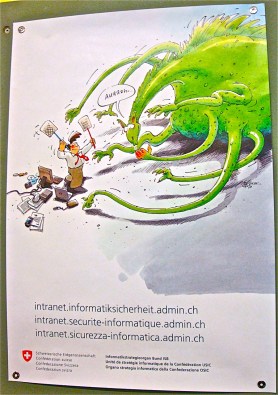
The message from ‘High tech’s missionaries of sloppiness’ about blogging’s future status is encouraging. As for its transformation of computer (in)security – bah!

One lovely child of flawed software: poster in an office of the Swiss Federal Department of Foreign Affairs, Bern, postgutenberg@gmail.com

One lovely child of flawed software:
poster in an office of the Swiss Federal Department of Foreign Affairs, Bern, postgutenberg@gmail.com

Seven years ago, Elinor Ostrom — a winner of the 2009 Nobel prize for economics — cited an article on computer unreliability in a paper on knowledge-sharing that she wrote with Charlotte Hess. The angry essay they mentioned ran in late 2000 in an e-zine, the online magazine Salon. Their thirty-nine citations included only one other in a general-interest publication, a decades-old New Yorker piece by E. B. White.

More on that in a moment …

Long before print journalists shrank from crediting or citing blogs as sources of good ideas and information, they refused to acknowledge debts to e-zines and other online-only publications. If they gave them any credit at all, it was for being brave enough to dip their toes in the digital future – in which, from print’s Olympian perch, it seemed as if these pioneers were bound to fail. Their cold-shouldering will soon have to end, thanks to the example set by unprejudiced, fair-minded thinkers.

In post-Gutenberg’s experience, intellectual greatness is in direct proportion to the trouble a powerful brain worker takes over acknowledging useful information or inspiration found absolutely anywhere – whether or not the source meets old-fashioned, conventional criteria for respectability. Only shallow snobs care about labels.

With a quotation of just three words about a growing ‘culture of carelessness,’ Ostrom and Hess directed readers of their paper about obstacles to sharing research findings to the Salon article — ‘High tech’s missionaries of sloppiness’ (‘HTMOS’) — whose subject has been making front-page headlines, lately.

For instance, yesterday’s ‘Chinese Hackers Resume Attacks on U.S. Targets’ followed by only a few weeks a long profile in the same newspaper about the über-Cassandra on this topic, an octogenarian computer scientist called Peter Neumann who is leading a team of researchers trying to make computers less vulnerable to security breaches. His interviewer noted that

… the increasing complexity of modern hardware and software has made it virtually impossible to identify the flaws and vulnerabilities in computer systems and ensure that they are secure and trustworthy. The consequence has come to pass in the form of an epidemic of computer malware and rising concerns about cyberwarfare as a threat to global security …

We would name the newspaper we have quoted in linking to it, as we usually do, except that we are trying to make a point about the churlishness of print journalists’ tendency to – shall we say, forget to credit e-zines and blogs as sources. In April, the same daily ran an opinion piece by a hacker-turned-security-consultant, Marc Maiffret, who made our eyes pop in one paragraph (our italics):

The unspoken truth is that for the most part, large software companies are not motivated to make software secure. It’s a question of investment priorities: they care more about … developing the latest features and functions that consumers and businesses are looking to buy.

Unspoken, eh?

‘High tech’s missionaries of sloppiness’ certainly spoke, twelve years ago:

A culture of carelessness seems to have taken over in high-tech America. The personal computer is a shining model of unreliability because the high-tech industry today actually exalts sloppiness as a modus operandi.

[…]

American companies accept “good enough” quality for the sake of speed. Being first to market with new products is exalted as the highest goal here, and companies fall back on huge technical support and customer service staffs to cope with their many errors of commission and omission.

“Don’t worry, be crappy,” was how Silicon Valley veteran and pundit Guy Kawasaki expressed the same idea two years ago, in a speech that won him a standing ovation.

Programmers, hackers, and technologists of every stripe were incensed by the Salon essay. After a link to it was posted in the week of its publication on Slashdot.org — then the most popular computerists’ chat-forum – they swarmed aboard, so furious that at least a third of the posts denounced the author of ‘HTMOS’ as ‘he,’ in spite of her unambiguously female name. The explosion was partly owed to the genius of Andrew Leonard, the Salon editor on the job, who barely scratched the piece’s text but wrote its headline and dreamt up a standfirst borrowing none of its actual words, which read,

Computer companies specialize in giving consumers lousy products — it’s the American way of techno-capitalism.

Maiffret and his editors might simply have failed to check the antecedents for his condemnation of Silicon Valley’s lack of interest in safe computing. A lone editor from the print world, Simon Caulkin – renowned in British journalism not just for his talent but peerless integrity (and a former colleaugue of the Salon contributor) – did cite ‘HTMOS’ in one of his Observer columns on management, titled, ‘Software must stop bugging us’.

For the most part, it is in books and university curricula that the essay has been marked for attention. Even if the world is still a long way from curing computers of their flaws, the citations that come up on the first page of Google results for the essay’s title are in, for instance:

Adapting Buildings and Cities for Climate Change, Sue Roaf, David Crichton and Fergus Nicol, Routledge, 2012

Why Programs Fail – A Guide to Systematic Debugging, Andreas Zeller, Elsevier, 2009 [also a Google e-book]

Geekonomics: The Real Cost of Insecure Software, David Rice, Pearson Education, 2007

Quality software project management, Robert T. Futrell, Donald F. Shafer and Linda Isabell Shafer, Prentice Hall Professional, 2002

‘HTMOS’ also continues to find its way into arguments between technophiles, as in 2007, on the site of the ‘Central West End Linux Users Group’ – where it was used to slap down a debater who declared airily, ‘Every OS [operating system] has its faults. Pick your poison.’

That Ostrom-Hess paper with which this post began was, as it happens, about tribalism getting in the way of sharing information critical to human life – in microbiology research. The authors noted, in their abstract, that ‘there are many, diverse participants in producing and consuming information who often have conflicting interests …’.

Conflicting interests indeed. It is obvious from the rarity with which print journalism acknowledges good work published online in e-zines and blogs that its workers are afraid of their new competitors. And then, of course, programmers are not particularly fond of that article. We at post-Gutenberg are not much interested in conspiracy theories, but could not help smiling when we noticed that someone at both The Observer and Salon appeared to have gone to pains to make it harder to find ‘HTMOS’ and the Caulkin column on flawed software. The London newspaper misclassifies his eloquent jeremiad with the work of a political writer, Madeleine Bunting. And for years, the Salon essay has been indexed not with its collections of pieces on computers, software or Silicon Valley but under ‘AUTO INDUSTRY, ENTERTAINMENT NEWS’.

Of course we imply no conspiracy… the culprit could only be a dear little sloppiness gremlin piling up overtime hours.

Bloggers’ rights, and blogging vs. traditional journalism: let a hundred flowers bloom and a hundred schools of thought contend

'Let a hundred schools of thought contend' postgutenberg@gmail.com

‘Let a hundred schools of thought contend’
postgutenberg@gmail.com

'Let a hundred bloggers bloom' postgutenberg@gmail.com

‘Let a hundred bloggers bloom’
postgutenberg@gmail.com

Blogging as one of our rights to free expression was the subject of an important and excellent ARTICLE 19 paper published earlier this month. ARTICLE 19 ‘is an international human rights organisation, founded in 1986, which defends and promotes freedom of expression and freedom of information worldwide.’

Highlights — to some of which we have added extra emphasis, in italics:

Who is a blogger?

In the most basic sense, a blogger is any person who writes entries for, adds materials to, or maintains a ‘blog’ – a web log published on the Internet. Blogs allow anyone to self-publish online without prior editing or commissioning by an intermediary (e.g. someone like a newspaper editor). They can be immediate and also anonymous if the blogger so desires.

What matters most about the right to blog?

Blogging plays an invaluable role in the free flow of information worldwide. It enables a true exchange of information in ways that traditional media did not in the past. It also allows an immediate sharing of information with its audience and immediate feedback. It represents a valuable form of alternative journalism and is an example of the Internet’s ‘democratisation of publishing.’

In the 21st century, many bloggers will take their place as watchdogs, alongside traditional media. The international community and individual states must develop protection for bloggers, just as they have developed protection for traditional media, despite the many constraints. Throughout history, the traditional media have obtained protection as a group although, at the individual level, many members of the media are not concerned with advancing public interest. Similar protection must be provided to bloggers.

How are bloggers different from journalists?

ARTICLE 19 has long argued that ‘journalism’ and ‘journalists’ should not be defined by reference to some recognised body of training, or by affiliation with a media entity or professional body.5 We have argued that journalism is an activity that can be exercised by anyone, and that it is important that any legal standards and principles applicable to the activity should reflect this.

In particular, the definition of the term ‘journalist’ should be broad to include any natural or legal person who is regularly or professionally engaged in the collection and dissemination of information to the public via any means of mass communication.

At the same time, any person who seeks to publish information on matters of public interest should benefit from the same protection and privileges given to professional journalists under existing case law, including prohibiting any requirement for journalists to be registered, requiring the authorities to investigate attacks on them, and protecting their sources.

Key recommendations

– Relevant legal standards should reflect the fact that ‘journalism’ consists

of disseminating information and ideas to the public by any means of communication. As such, it is an activity which can be exercised by anyone.

– Any definition of the term ‘journalist’ should be broad, to include any natural or legal person who is regularly or professionally engaged in the collection and dissemination of information to the public via any means of mass communication.

– Bloggers should never be required to obtain a licence to blog.

– Bloggers should never be required to register with the government or other

official bodies.

– Accreditation schemes must meet international freedom of expression standards and should ensure that:

– all applicants, including bloggers, who meet the minimum requirements defined in the law should be automatically issued with a ‘press’ facilitation card;

– press cards should only be required to get access to events or premises where there is a clear need to limit attendance based on limited space or the potential for disruption;

– the conditions for obtaining a press card should be based on the overall public interest and not on considerations such as affiliation with a professional association or degree in journalism.

– Legal commentators, including bloggers, should be allowed to use social media from court rooms if the hearings are open to the public.

– To the extent that they are engaged in journalistic activity, bloggers should be able to rely on the right to protect their sources.

– Any request to disclose sources should be strictly limited to the most serious cases. It should be approved only by an independent judge in a fair and public hearing with a possibility of an appeal.

– State authorities must guarantee the safety of bloggers using a variety of measures, including the prohibition of crimes against freedom of expression in their domestic laws.

– States must take reasonable steps to protect bloggers and other individuals actively engaged in online communities when they know or ought to know of the existence of a real and immediate risk to the life of an identified blogger as a result of the criminal acts of a third party;

– State authorities must carry out independent, speedy and effective investigations into threats or violent attacks against bloggers or other individuals engaged in journalistic activity online.

– The laws governing the liability of bloggers, including defamation law, incitement and other speech-related offences, must comply with international freedom of expression standards.

– As a general rule, bloggers should not be held liable for comments made by third parties on their blogs in circumstances where they have not intervened or modified those comments.

– For certain types of content, for example content that is defamatory or infringes copyright, consideration should be given to adopting ‘notice-and-notice’ approaches whereby bloggers would be required to pass the complaint to the original maker of the statement at issue, without removing the material upon notice.

– The term ‘duties and responsibilities’ in Article 19 of the ICCPR and Article 10 of the European Convention must be interpreted flexibly to take into account the particular situation of the blogger in question.

– Bloggers should not be forced to abide by the ethical codes or codes of conduct developed by traditional media and should not be coerced or given an incentive to join self-regulatory bodies for traditional media.

– Bloggers may decide to follow the ethical standards of traditional media of their own accord. They can also develop their own code of practice either for their own blogs or for associations they voluntarily join. Alternative dispute resolution systems should also be encouraged.

– When bloggers produce a piece for a traditional newspaper, they should be subject to the newspaper’s editorial control, and abide by the ethical standards of journalists.

Why have The Economist and The New York Times gone silent on ♯Leveson — since 2012? Why is a media columnist writing about manholes, instead?

photograph in honour of the Chinese Year of the Snake: www.sheffieldkungfu.com

photograph in honour of the Chinese Year of the Snake: http://www.sheffieldkungfu.com

Abdication of responsibility is a serious charge.

Even as we type, we are close to fainting from disbelief that The Economist and The New York Times deem the deliberations about press reform in a leading democracy – negotiations in which a prime minister is directly engaged – unworthy of either reportage or commentary. Neither of these leaders in print journalism has run a single piece about the Leveson Inquiry since they recorded the publication of its report.  Unless Google is mistaken, the scintillating newspaper in St. James’s last pronounced on the subject on 8 December; the grey lady, proud of treating the world as its oyster on other subjects, on 5 December

For reasons explained here in two earlier posts – passing on advice from the Chinese sage Lao Tse, and pointing to the pointlessness of making new rules for a dying institution – post-Gutenberg sees press regulation as wasted effort. But over 75 per cent of the British public does seem to want the recommendations of the Leveson report put into practice. Surely this, and the haggling over Leveson’s conclusions by the British government, politicians and media, merit analysis and debate?

Skilled and eminent doctors have to treat and be treated by other doctors, when they fall ill. Judges are not above the law; lawyers must be prosecuted and defended by other lawyers.  The equivalent, for the press, of ‘Physician, heal thyself,’ has to be ‘Journalist, your work is not above dissection and condemnation by colleagues, without fear or favour.’

We once admired the NYT’s media columnist David Carr for his apparent fearlessness and perspective (see ‘Why not occupy newsrooms?’ 23 October 2011). For over a year, most of his columns have left us wondering just who tied and gagged him. Yet none of his timid recent work has been as alarming as his bizarre focus yesterday on the lengths to which an energetic Midwestern newspaper columnist went to trace the hands that took a photograph of an exploding manhole cover in Omaha. That’s right — not a column about, say, media coverage of  the responsibility for the explosion; just a mildly entertaining ramble about the origin of the image. There have been reports over the years of infinitely more ingenious sleuthing that has, for instance, united the finder of a camera lost in one country with an owner thousands of miles away in another – by altruistic amateur detective work by strangers that entailed uploading pictures from the device to the net and posting requests for help on social media.

As for Carr’s subject, surely it was the photographer with the fast reflexes of a citizen-journalist who deserved his praise, and not ‘[gums]hoe leather’ that, according to this NYT columnist, ‘never looked or smelled so good.’  The reader is left baffled by his conclusion: ‘And it’s a useful reminder that even though daily newspapers are a threatened species, they continue to have value in the informational narrative.’ Phew.

More to the point, what is Carr doing, writing about manholes but not ♯Leveson – a subject of keen interest to the planet, judging by the attention the Inquiry has been getting on every continent? (as search engine analysis of traffic brought to this blog, for one, confirms). Was his upgrading of an amusing dinner table anecdote to the focus of a whole media column actually an encoded scream for help – a demonstration of the humble scraps that a good reporter like him is obliged to offer his readers because barred by someone (precisely who?) from doing his job?

If the NYT did not anticipate reactions exactly like ours to its media columnist’s disappearance down a manhole – façon de parler — why is the column closed to comments? (or certainly was, when we last checked a few hours ago?)

But as for the infinitely more critical cause for anxiety, what vital information is that newspaper, like The Economist, failing to give audiences?

Go to the website of the International Forum for Responsible Media (INFORRM) – run by lawyers – and look up:

Hacked Off responds to the draft Royal Charter: “a surrender to press pressure”’, 12 February 2013

… and …

Leveson: It is impossible to overstate the Daily Mail’s fear of proper press regulation’,  17 February 2013

You will be afraid, very afraid, when you read what highly regarded publications do not want you to see — and of what there would be no record of at all, without blogs like INFORRM’s.

… Only psychologists, Chinese mystics and lovers of poetry will want to know that as post-Gutenberg awoke last Sunday, the exquisite final lines of a D. H. Lawrence poem came floating to mind, out of the blue, on an unexpected wave of the sort of happiness with which we witness beauty:

And I have something to expiate:
A pettiness.

They belong to ‘Snake,’ poetry at its greatest, for more reasons than we have time to suggest. As we puzzled over the mysterious reminder of them, fingers tapping into a search engine box, we found that the poem had been the subject of a lovely meditation by Jacques Derrida.

The ‘I’ in the poem is overwhelmed by admiration for the way the reptile looks and moves, but, obeying ‘the voices of my accursed human education,’ throws a stone at it – and

… suddenly that part of him that was left behind convulsed in undignified haste.
Writhed like lightning, and was gone
Into the black hole, the earth-lipped fissure in the wall-front,
At which, in the intense still noon, I stared with fascination.

And immediately I regretted it.

[…]

And I thought of the albatross
And I wished he would come back, my snake.

[…]

And so, I missed my chance with one of the lords
Of life …

… About which Derrida proposes, with Gallic convolution, that

‘It is indeed on the side of chance … and toward the incalculability of another thought of life, of what is living in life, that I would like to venture under the old and yet still completely new and perhaps unthought name democracy.’ [his emphasis]

The Chinese Year of the Snake began either on the 4th or 10th of this month, depending on which authority you consult. Did the dream-like entrance of the ‘Snake’ lines have more to do with the private or public sphere? Was it something like a parental warning not to descend to the pettiness of a particular someone whose physical bulk is in direct, inverse proportion to a tendency to small-mindedness and jealousy? In the wider realm, a snake might easily be symbolic of all the forms of competition from citizen-journalists and bloggers so hated and feared by the old press establishment – unwelcome power-sharing.

Yes, democracy.

And that is as far as we will get with de-mystification – for the present.