Carl Djerassi’s sumptuous foretaste of publishing’s mixed-media future, part 2 (images)

Variant of Paul Klee’s Angelus Novus with the eyes of Paul Klee’s Baroque Portrait and the mouth of Paul Klee’s Absorption,  Carl Djerassi and Gabriele Seethaler, 2008 - by kind permission of Carl Djerassi

Variant of Paul Klee’s Angelus Novus with the eyes of Paul Klee’s Baroque Portrait and the mouth of Paul Klee’s Absorption (see below);  Carl Djerassi and Gabriele Seethaler, 2008
– by kind permission of Carl Djerassi

Absorption, self-portrait by Paul Klee, 1919

Absorption, self-portrait by Paul Klee, 1919

Baroque Port.

Baroque Portrait, Paul Klee, 1920

This is a small selection of the images referred to or created by Carl Djerassi – in collaboration with Gabriele Seethaler — in his Four Jews on Parnassus, introduced in part 1, on another page of this blog. Brief extracts from the dialogue they illustrate: part 3.

Carl Djerassi’s sumptuous foretaste of publishing’s mixed-media future, part 3 (extract)

A Spirit Serves a Little Breakfast, Angel Brings What is Desired, Paul Klee, 1920

A Spirit Serves a Little Breakfast, Angel Brings What is Desired, Paul Klee, 1920

As noted in part 1, in Four Jews on Parnassus, Carl Djerassi – through his invented conversation between four immortal German-speaking Jewish intellectuals and playful digital graphics (part 2) – justified his feeling that Paul Klee’s ‘Angelus Novus’ does not deserve its iconic status quite as much as some other picture in the painter’s angel series (about fifty works) might have done.

He offers his own graphic suggestion of an angel more expressive of Walter Benjamin’s idea of an angel of history with ‘wreckage upon wreckage’ piled at its feet, mouth open wide in horror.

His imaginary dialogue is often reminiscent of Tom Stoppard’s wiser, as opposed to merely clever, dramas.

Here are short extracts from that conversation – which nimbly avoids lecturing, as it introduces readers to Benjamin’s sad and beautiful metaphor for the story of mankind. German philosophers seem wonderfully preoccupied with winged beings. Think of Hegel’s conception of the owl of Minerva, flying only at dusk – to convey his idea of philosophy as inevitably retrospective – only capable of enlightening us about reality after we experience it: ‘When philosophy paints its grey in grey, then has a shape of life grown old. … The owl of Minerva spreads its wings only within the falling of the dusk.’

[…]

ARNOLD SCHOENBERG [addressing Walter Benjamin] : … “Angelus Novus” was the title of a literary journal you founded.

BENJAMIN: Indeed. (Draws quotation marks in the air.) “We are touching now on the ephemerality of this magazine, for it is the just price to be paid for promulgating genuine topicality.” That’s what I wrote in the prospectus. […] And why did I choose the title? Because Gerhard [Scholem], the Talmudic scholar –

SCHOLEM: Gershom the Talmudic scholar!

BENJAMIN: Because Gershom … steeped as he is in angelology … pointed out that, according to the Talmud, angels are created all the time … just to utter praise before God … and then to disappear into nothingness. One issue of the magazine after another.

[…]

SCHOENBERG: […] You wrote something else about the angel. … You both know what I am talking about (to Benjamin), your “Theses on the Philosophy of History.”

BENJAMIN: The ninth thesis. (He quotes.) “There is a painting by Klee called Angelus Novus. It shows an angel who seems about to move away from something he stares at. His eyes are wide, his mouth is open, his wings are spread. This is how the angel of history must look.”

SCHOENBERG: One moment. Now really look at him. It is true his eyes are wide and his mouth open, but what made you write, “This is how the angel of history must look?”

BENJAMIN: Please let me continue. I then wrote, “His face is turned toward the past. Where a chain of events appears before us, he sees only single catastrophe, which keeps piling wreckage upon wreckage and hurls it at his feet.”

SCHOENBERG: Okay … understood. But what do these words have to do with Klee’s image? I don’t see the angel’s face turned toward the past! I see no wreckage before his feet! And how are you going to convince me that his hapless Angelus sees a catastrophe? You may see one, but Klee’s Angelus?

BENJAMIN: (becoming irritated) You must simply let me finish quoting my own essay. “The angel would like to stay, awaken the dead, and make whole what has been smashed. But a storm has been blowing from Paradise and has got caught in his wings. It is so strong that the angel can no longer close them. This storm drives him irresistibly into the future to which his back is turned, while the pile of debris before him grows toward the sky. What we call progress is this storm.”

SCHOENBERG: And you see all that in this image? I don’t see any storm. I don’t think his wings are caught in it. … I don’t see him driven anywhere. I didn’t see any debris at his feet … and I certainly don’t see any rising toward the sky. I see an angel looking sideways timidly towards God, raising his wings to his praise –

BENJAMIN: That’s all?

SCHOENBERG: That’s all. Now I do not question the text of your “Theses on the Philosophy of History” … not even this rather emotional ninth one. All of us, including Klee, have passed through this type of history, but putting these words into the image of this Angelus? You needed a metaphoric illustration and because this is the only Klee you owned –

BENJAMIN: Not the only one.

SCHOENBERG: I forgot! Your wife had bought you Vorfuehrung des Wunders … […] Here … let me show you another angel … one I might call Angelus Benjaminianus …

BENJAMIN: Good God. I had never seen that one before!

SCHOENBERG: I was sure none of you had. But this one* does do justice to your labored interpretation. Notice how you say, “His eyes are wide … his wings are spread.” But these wings are really spread and come from another Angel by Klee, which he also created in 1920.

[…]

* ‘A Spirit Serves a Little Breakfast, Angel Brings What is Desired’.

Log-rolling turns transparent as e-publishing and online art promotion come of age

'Spanky' and N -- LCM 2

‘Niko and Spanky’ - photographs by Willodel http://www.facebook.com/Willodel

‘Niko and Spanky’
– photographs by Willodel http://www.facebook.com/Willodel

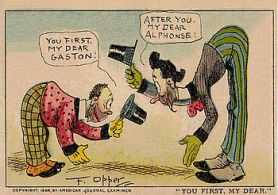
‘Alphonse et Gaston’ – the gold standard for mutual feather-stroking – from the Wikipedia

‘Alphonse et Gaston’ – the gold standard for mutual feather-stroking – from the Wikipedia

‘She is too reserved for the big internet world,’ read the message pounded into a keyboard a fortnight ago at hypersonic speed typical for B, post-Gutenberg’s inseparable friend at roughly ten years old. ‘She does not promote herself at all, but all the same has a whole lot of faithful admirers and buyers, so she remains old style.’

This description of a shy artist, K, lucky enough to have been born into a family exceptionally well-connected with prosperous buyers of art, gave us pause. Our immeasurably dear B — who only ever posts her own work online in disguise — was signalling a preference for arts workers who adopt the old unwritten creed of aristocratic reserve. Once, this might have been our choice, too – because we share K’s innate, incontestably genetic, cringing-violet introversion and dislike of egotistical puffery. These days, we are less sure of its rightness – for at least three reasons.

• Everything to do with attracting attention to new art and literature, even mere blogs, has become confusing — at least as perplexing as those members of the ancien régime marched to the guillotine in revolutionary France in spite of siding openly against their lofty origins. B, for example, had introduced us to K’s work with a link to one of her pictures – a serene, meditative portrait in the yellow-brown-ochre palette that Paul Gauguin often used in his time in the South Seas – and a request to vote for it on the web site of a gallery using a contest as a promotional device.

By coincidence, this happened in the same week in which we witnessed a fight between two writers who had entered one of the many online literary contests nowadays, also designed for audience-building. One of them was accusing the other of an attempt at vote-rigging – a charge that struck us as dubious. The accused writer had done no more than openly suggest reciprocal voting – that they each vote for each other’s entries.

How, we wondered, is that any different from the latest evolutionary leap of the old ‘gentleman’s game’ of traditional, print publishing – behaviour to which Private Eye routinely draws its readers’ attention, with nearly audible guffaws? In its 26 July-8 August issue, for instance, spotlighting recommended summer reading by literary power brokers in London newspapers:

”Tasha is my sister-in-law,” declared Lee Child, selecting a Tasha Alexander novel in the [Mail on Sunday]. Robert Winder’s book about Wisden, “for which I wrote a foreword”, was David Kynaston’s pick (Times). And “I can’t wait to read my friend Mark Lawson’s astonishingly expansive, hilarious and heartbreakingly dark The Deaths,” gushed Julie Myerson (Observer), enthusing too about a novel from “the latest to be published from my husband’s creative writing MA”.

Such advice was most influential – with the naïve and unsuspicious — when the recommenders hid their ties to authors. Post-Gutenberg is all for letting in the sunlight and dropping the pretence of objectivity. But after that, the point of such recommendations is – precisely what?

• Aristocratic reserve has passed its sell-by date — for aristocrats. Long before the internet sped up the digitisation of human life in every pore, the Duke and Duchess of Devonshire, avidly promoting tours of Chatsworth, his ancestral pile, were only among the most successful English grandees hawking their ‘brand’.

With unabashed Teutonic frankness, the home page of a successful expatriate painter (and wife of a friend lost to distance and time) announces its owner, in gold-on-black lettering, as ‘Antoinette Baronesse von Grone’. From there, she proceeds immediately, without any timorous beating about the bushes, to

ARTIST BIOGRAPHY

I was born and raised in Northern Germany, in a village that has been the seat of my family for over 500 years.

• Declining to dirty your hands with audience-building for yourself can mean failing to acquire any power to help other people.

Post-Gutenberg has long discouraged friends from initiating even semi-intimate conversations in the comments section of this blog because we can find clubbiness on other blogs off-putting. Even so, we liked last week’s justification of e-barn-building by Cally Phillips, an engagingly exuberant, extempore Scottish blogger (yes, we follow each other’s blogs):

It’s an interesting thing this ‘you read my book I’ll read yours’  It seems that there’s a notion that we  should think there’s something a bit suspect in that  (like trolls or sock puppet alerts) but hey folks, that’s part of what ‘indie’ writing is about. It’s about finding people you have some kind of a connection with – and guess what – you’ll probably find you might like their writing.

Of course sometimes they write in genres you’re not that familiar with (or claim not to like – for me thrillers and sci fi) But sometimes it’s worth stepping out of your comfort zone.  And when folks bother themselves with my writing, yes I do feel some compunction to ‘explore’ the worlds they have created and ‘meet’ them through their writing. I’m not ashamed to say that. […] I don’t think that being mediated by gatekeeper, guardian mainstream publishers guarantees me a ‘good read’ and I’m happy to take the responsibility on for myself to find what I want to read.  And if, in the process I make virtual (or real) friends of other writers, I’m not going to be embarrassed about that. It’s a good thing.

[Y]ou can read things you’d never have read while you grazed from the mainstream trough.  And that’s no bad thing.  Unless you want all your reading pre-packaged and homogenised off the supermarket shelves (in which case I’m sure you’re not even reading this!)  […] If you like what someone writes TELL THEM.  And tell other people.

Anyone who resists the new honesty about connections and self-interest risks being outed anyway, as in a delicious item in the other edition of Private Eye last month – featuring one Sam Baker, a columnist for Harper’s Bazaar, recommending a novel by Jonathan Grimwood:

”From the moment I encountered four year-old Jean-Marie d’Aumout sitting on a dung heap eating beetles, I was obsessed by this sensuous tale of one man’s search for the perfect taste,” she raves. “Part Perfume, part Pure, 100% original.” In a fit of absent-mindedness, Baker omits to add that Grimwood is also 100% her husband.

No publication pretends to despise the internet more than the net-spurning Eye does. Yet – as we have shown in an earlier entry, here – no rag is more gloriously infused with the take-no-prisoners spirit of the blogging world.

Who’s afraid of getting intimate with Chinese philosophy and world views? Nearly everyone Western, apparently

Traditional wooden Chinese lunch box. A far grander bronze cauldron is anciently symbolic of civilisation -- cultural and spiritual nourishment - photograph by postgutenberg@gmail.com

Traditional wooden Chinese lunch box. A far grander bronze cauldron is anciently symbolic of civilisation — cultural and spiritual nourishment
– photograph by postgutenberg@gmail.com

The ting (cauldron), cast of bronze, was the vessel that held the cooked viands in the temple of the ancestors and at banquets [… and … ] refers to the cultural superstructure of society.

– oracular philosophy in the I Ching (3000-2000 BCE); trans.: Richard Wilhelm (Chinese to German); Cary Baynes (German to English)

If a rival for economic and military supremacy is always potentially a foe, could a diluted version of the old adage, ‘Know your enemy’ – from Sun Tzu’s 6th century BCE classic, The Art of War — still be sensible advice to follow?

Obviously, yes.

So you — or certainly anyone paying attention to world affairs – might suppose. Bizarrely, though, adults in the West seem to be leaving the job of understanding China to future generations, starting with the one in junior schools today. In an interview seven years ago with America’s National Public Radio, a headmaster of a British public school and biographer of two recent prime ministers said, ‘I think, within 10 years we need to have as many children in Britain learning Mandarin as are currently learning French.’

But what if one of those little brows perspiring over her ideograms was a grandchild of, say, Dennis Overbye, the fizzing, often very funny, New York Times science writer? In a brief aside in his column yesterday, sketching the big questions now perplexing physicists – every bit as much as they have for the entire history of philosophy and science — he asked:

The latest cosmological wrinkle is dark energy, which is speeding up the flight of galaxies from one another. And the great question is whether this dark energy is going to suck the light and energy out of the universe so completely that some day billions of years from now nothing is left: no memory even of Homer, Jesus, Mozart, Elvis or Nelson Mandela, not to mention the rest of us.

Especially as a light-hearted throwaway remark, that was proof of stunningly unconscious and blinkered Eurocentricity, never mind his token tossing-in of Mandela — or any pedant who cares to bark that Christianity’s founder was Middle-Eastern. If Overbye were to insist to a school-going relation of his that a C+ grade in Mandarin was simply not good enough, there could hardly be a more discouraging example of the admonitory, ‘… not as I do, but as I say.’

If members of the intelligentsia were paying proper attention, Chinese Dreams, a revelatory short book or long essay by the Indo-American writer Anand Giridharadas – whose work has appeared in The Wall Street Journal and The New York Times – would have been reviewed within an inch of its life by every high-profile current affairs publication in the English language, for a start.

It should have made no difference that Chinese Dreams – containing critical information distilled from a series of interviews with mostly young Chinese thinkers in the urban elite, ranging from academics to entrepreneurs – was self-published two years ago exclusively as a post-print e-book. As scores of reviews on the Amazon sites testify, though it is acutely disturbing, in parts — because of its implications for philosophical principles the West holds most sacred – it is a completely engaging fast, lively read that slips down as easily as dim-sum prawn dumplings.

Large, mainstream Western publishers have long shrunk from publishing books that delve into the roots of Chinese and Indian cultural traditions and perspectives – claiming that their readers have no interest in these, so perpetuating, if not setting up, a circle of willed ignorance. In no general-interest publication has post-Gutenberg heard from Chinese voices like the ones Giridharadas coaxed into his recording device.

A sample, from post-Gutenberg’s Kindle ‘notes and marks’:

Eric X. Li is a successful and well-connected venture capitalist in Shanghai. He was once a believer in the American Dream, he now wants to help create a Chinese Dream all its own.

[…]

While Westerners focus on how China has failed to measure up to Western principles – for example, its resistance of democracy or the capriciousness of its legal system – Li believes that China is inventing ‘an alternative set of organizing principles for human affairs that are fundamentally different – not in opposition – but fundamentally different from what the world has been looking to the West for in the last three-four hundred years.’

[…]

[T]he ideas of Li’s circle are now referred to as the ‘Beijing Consensus’ in some quarters, to rival the Washington one, and are, at the least, taken seriously in some of the countries that have struggled to implement Western political and economic formulas in contexts very different from the West’s.

[…]

These were the four core principles I was able to glean from Li, Jin, Rao, and others.

1. Individualism isn’t universal.

[…] The West … does not understand societies – for example, Iraq – where tribal or sectarian or neighbourhood loyalties overwhelm simple individualism. […I] n Li’s view, China has, at a minimum, shown the world something new: that a large society can be successful and bring peace and prosperity to its people without an understanding of the individual derived from the European Enlightenment. […]

2. Pragmatism over abstraction.

… [A]s the members of this circle view it, it is China that lives by pragmatism as a way of life and the West that believes, and is defined by a belief, in abstract, universally applicable truths.

In reality, of course, no one has a monopoly on either pragmatism or principle. But it can be observed that the culture of China, like that of India, is generally less comfortable with the kind of sweeping, true-in-all-cases ideology of the kind you find in the Declaration of Independence and the Declaration of the Rights of Man. ‘Our framework is more down to earth,’ said Fu, the political scientist. ‘We lack metaphysics. We are not interested in idea-based searches. We practice first.’ […]

3. Meritocracy over democracy.

[…] The members of Li’s circle are also seeking to revitalize the Confucian idea of meritocracy over democracy as the fount of political legitimacy. ‘Americans believe in election; the Chinese, if I simplify, believe in selection,’ said Zhang Wei-Wei, an international relations scholar who divides his time between Geneva and Beijing and once served as a translator for Deng Xiaoping, the paramount leader who opened China’s doors to the world in 1978. […]

4. Representing the future.

… China’s senior leadership, for all its other faults, has struck a healthier balance between the country’s short- and long-term interests than many Western democracies

[…]

China’s relationship with the environment … is on the one hand, ravaging the planet … It should be excused, its leaders say, because they have to secure economic growth for its people. But China has also pivoted more speedily than many democracies toward building a renewable energy industry – something for which the short-term payoff is minimal, as Western politicians know, but the long-term societal benefits potentially massive.

… and to fill in the gaps and glean everything else Giridharadas’s book has to say, we suggest a quick hop over here, after which we hope readers will ask: why haven’t I read about any of this in – The New York Times? The Economist, … ?

[ For the record: no, post-Gutenberg does not know this author, and we have no acquaintances in common, as far as we know … ]