Does copyright law turn art into commodities? part 1: an answer with help from Albrecht Dürer, ARTICLE19, Salman Rushdie and Anthony Storr

Artists who can control copying with copyright have more creative freedom - photograph by postgutenberg@gmail.com

Artists who can control copying with copyright have more creative freedom
– photograph by postgutenberg@gmail.com

Albrecht Dürer: self-portrait, aged 13

Albrecht Dürer: self-portrait, aged 13

How does newness enter the world?

Joseph Anton, Salman Rushdie, 2012

Dear Copyright-Haters,

How about picketing Tupperware?  Yes, … we are perfectly serious. Imagine the Facebook updates of yourselves holding giant sock-it-to-‘em placards shouting, ‘STOP COMMODIFICATION NOW!’ … What’s that? … Right. How, you ask, would you store your left-over microwaveable meals in this post-cooking age without plastic boxes so much alike that, even with brand names, they are virtual commodities? You could try porcelain bowls covered with plates or tin foil for an alternative – but no, you say, no one does that any more … muttering to yourselves, inaudibly, ‘Idiot!

We’ve been hearing that you hate commodification. After last week’s post with Jaron Lanier warning about the consequences for other professions of destroying artists’ rights to control the use of their work, a friend emailed us to say that enemies of copyright are not playing Scrooge when you refuse to contribute even micropayments to enjoy art. (Most of you agree merrily with, eg., the blithe prediction by the editor of Wired: ‘ I think most music will soon be free, …’).

The problem, this friend explained, is that you fear the commodification of the arts. We have heard similar thoughts expressed as, more or less, this: ‘Why should a musician get to charge every time he or she sells a replica of a single performance on cheap plastic CDs over and over again – and get obscenely rich from the proceeds, in some cases?’ Well. Just as a thought experiment, how about putting music CDs lower down on your hit list and starting with obvious horrors – those containers made of processed petroleum, clogging landfill in their millions? One day last month, Tupperware’s share price went rocketing into the heavens – hitting ‘a new 52-week high,’ we noticed. Now, that’s encouragement for commodification!

Why pick on artists instead of finding some way to hijack the profits from  (comparatively) mindless replication elsewhere? The new digital technologies were supposed to relieve some of the pain and hardship behind the centuries-old ‘starving artist’ cliché. They introduced the possibility of financial independence for more artists than ever before — linked to their ability to control how they work, and own the results. By, for instance, recording and distributing their own musical performances; or publishing or exhibiting their e-books, paintings, sculpture, and so on.

On the blog of The New York Review of Books, there is a perfect example from medieval Europe of an artist using new technology as an aid and spur to artistic independence, creativity and an evolutionary leap in drawing and painting. About the sublime German, Albrecht Dürer (1471-1528), whom the Wikipedia reasonably pegs as ‘the greatest artist of the Northern Renaissance,’ the NYRB blogger Andrew Butterfield writes:

Dürer was perhaps the first artist in history to work primarily at his own direction, rather than on commission and at the pleasure of princes and other exigent patrons. The change was made possible by his concentration on printmaking rather than painting as his main artistic and commercial endeavor. Most paintings of this time, such as altarpieces, were made for well-established religious or civic purposes, and the patrons and other viewers had specific needs and strong expectations regarding both what was depicted and how it was represented. But printmaking was a completely new medium, little beholden to tradition. Even when treating Biblical themes, Dürer was comparatively free to pursue a more personal investigation of subject matter.

The painters of Dürer’s time who specialised in portraiture worked like – shall we say, analogue precursors of photo-editing software, who did all the retouching in the act of image-creation rather than after it. The most talented of them could grow rich themselves by following the conventions for flattering their powerful, wealthy subjects in oils – but with their creativity as constrained as the ‘lotus feet’ tortured into existence by foot-binding. Printmaking allowed Dürer  to flout those rules to develop an entirely new, realistic style in portraiture:

Typically portraiture was honorific and meant to represent the exemplary virtues of the person shown; Dürer instead often sought to capture the idiosyncratic and psychological characteristics of the people he portrayed. He was fascinated with the close scrutiny of dark and brooding emotion.

The Wikipedia explains the effect of his independence:

Dürer exerted a huge influence on the artists of succeeding generations, especially in printmaking, the medium through which his contemporaries mostly experienced his art, as his paintings were predominately in private collections located in only a few cities. His success in spreading his reputation across Europe through prints were undoubtedly an inspiration for major artists such as Raphael, Titian, and Parmigianino, all of whom collaborated with printmakers in order to promote and distribute their work.

Copyright laws were one invention that accompanied the replication that the printing press and printmaking introduced. Before reproducibility could be taken for granted, only the wealthy could afford to adorn their walls with the work of painters; after it, peasants could have their own woodcuts of saints and angels.

This makes your association of copyright with elitism, o copyright-smashers – and your attempts to cast artistic ownership as stifling or destructive of creativity — alarmingly batty, to say the least.

ARTICLE19’s excellent prescriptions for bloggers’ rights — putting them on a par with those of professional journalists — were recently the subject of a post in this spot. This same organisation has also made thoughtful recommendations for the evolution of copyright laws in another paper. Perfectly in keeping with what copyright allowed Durer to do, this document says:

Freedom of expression and copyright are complementary inasmuch as the purpose of copyright is the promotion of literary, musical and artistic creativity, the enrichment of cultural heritage and the dissemination of knowledge and information goods to the general public.

Some of us can only pray that protecting copyright as its rules are revised for the digital age will free arts workers from paymasters. From the domain of musical composition, the psychologist Anthony Storr offers in The Dynamics of Creation (1972) an elegant example of what financial dependence costs creativity:

Some very good music has been written for film … but the limitations imposed by having to tie the music strictly to the action means that the composer cannot choose for himself a vital dimension of the composition, its length. Most composers, therefore, rate film music as ‘incidental’ music, and separate it sharply from original compositions which truly reflect their own creative personality.

… In the last few days, we have learnt from Salman Rushdie’s riveting autobiography, Joseph Anton, about ARTICLE19’s crucial support in his years of enforced hiding from assassins trying to carry out his death sentence, the Iranian fatwa. Curiosity about this organisation’s backers led us to discover that these include Britain’s Foreign Office, the Department for International Aid (DFID) / UKAID, the Dutch Ministry of Foreign Affairs, the European Commission, the Norwegian Ministry of Foreign Affairs, the Open Society Institute (OSI), the Ford Foundation, the Swedish International Development Cooperation Agency (SIDA) and in Silicon Valley, the William and Flora Hewlett Foundation.

That was a real comfort – knowing of the existence of an organisation with international financing that advocates both blogging as a form of free speech and copyright protection.

Now about your Tupperware march …

… over to you,

post-Gutenberg

Jaron Lanier, a web pioneer, recants the ‘information-wants-to-be-free’ doctrine: parallel thinking about rescuing ‘the creative class’

The clay will be wet for a long time yet in the digital revolution postgutenberg@gmail.com

The clay will be wet for a long time yet in the digital revolution
postgutenberg@gmail.com

unfinished spools postgutenberg@gmail.com

Why are the dreadlocks of the computer scientist Jaron Lanier a 21st-century counterpart of 1960s bra-burning (or rumours thereof) by women desperately seeking justice for women?

Because a snaky Medusa hairdo can help to draw attention to a cause whose importance too many people fail to understand.

Lanier’s super-hairy look long preceded his campaign of the moment: he wants remedies for the internet’s decimation of the ability of musicians, one tribe to which he belongs, to earn a living. By empathetic extension, he is just as worried about what the net has done to the livelihoods of artists, writers, and the rest of their unworldly kin. Like Carl Djerassi — the chemist and birth-control inventor recently mentioned on post-Gutenberg – his unusual creativity spanning art and technology has taught him how much arts-workers need the help of practical scientists.

Why should other non-artists care? Because, as he warns shrewdly – and, we suspect, accurately – without defensive action, the net could prove just as destructive to other professions, including some too smug to see themselves ever sharing the insecurity of the traditionally bohemian occupations.

Summarising the new Lanier book, Who Owns the Future, on the blog of Harvard’s Nieman Journalism Lab, Eric Allen Been says in his introduction to an interview with the author:

[I]t places particular emphasis on the ways digital technology has unsettled the so-called “creative class” — journalists, musicians, photographers, and the like. As he sees it, the tribulations of those working in such fields may be a premonition for the middle class as a whole. It’s “urgent,” he writes, “to determine if the felling of creative-class careers was an anomaly or an early warning of what is to happen to immeasurably more middle-class jobs later in this century.”

Particularly welcome is a grand mea culpa from Lanier – in which he offers artists the best possible defence against all those technologists bent on depriving them of the protection of copyright. In January, the Smithsonian magazine recorded his appalled witnessing of some tragic effects of removing that shield in the music world:

[A]ll of a sudden there was this weekly ritual, sometimes even daily: ‘Oh, we need to organize a benefit because so and so who’d been a manager of this big studio that closed its doors has cancer and doesn’t have insurance. We need to raise money so he can have his operation.’

And I realized this was a hopeless, stupid design of society and that it was our fault.

His confession to his Nieman interviewer was a model of forthrightness:

Eric Allen Been: You were one of the early advocates of the notion that “information wants to be free.” […] Could you talk a little bit about why you changed your mind […]?

Jaron Lanier: Sure. It was based on empirical results. The idea sounded wonderful 30 years ago. It sounded wonderful in the way that perfect libertarianism or perfect socialism can. […] Empirically, […] there is an absurdity to the way it’s going.

Or, as he put it to Salon:

If you go way back I was one of the people who started the whole music-should-be-free thing. You can find the fire-breathing essays where I was trying to articulate the thing that’s now the orthodoxy. Oh, we should free ourselves from the labels and the middleman and this will be better.

I believed it at the time because it sounds better, it really does. I know a lot of these musicians, and I could see that it wasn’t actually working. I think fundamentally you have to be an empiricist. I just saw that in the real lives I know — both older and younger people coming up — I just saw that it was not as good as what it had once been. So that there must be something wrong with our theory, as good as it sounded.

Like the most inventive thinkers, he knows that many of the best ideas in any sphere have a long trail of discarded bad ideas behind them – and he might have been shaped by Samuel Beckett’s famous advice in Worstward Ho: ‘No matter. Try again. Fail again. Fail better.’

So, how does he think we can stop the damage from the information-wants-to-be-free – ‘freemium’ – movement?

Been: […] [A] lot of what you’re proposing strikes me, in some senses, as a freelance economy.

Lanier: That’s right. What I’m proposing is actually a freelance economy, but it’s a freelance economy where freelancing earns you not just income but also wealth. That’s an important distinction to make. What I think should happen is as you start providing information to the network, it then will become a part of other services that grow over time.

So, for instance, let’s suppose you translate between languages, and some of your translations provide example phrase translations that are used in automatic translators. You would keep getting dribbles of royalties from having done that, and you start accumulating a lot of little ways that you’re getting royalties — not in the sense of contractual royalties, just little payments from people that are doing things that benefited from information you provided. […] What should happen is you should start accumulating wealth, some money that shows up because of your past as well as your present moment.

Been: So if I simply shared a link to a New York Times article on Twitter, for instance, would there be a payment exchange? If so, who would it go to?

Lanier: It would be person-to-person payments. Right now, we’re used to a system where you earn money in blocks, like a salary check, and you’re spending on little things like coffee of something. And in this system, you’d be earning lots of little micropayments all the time.

Ah, micropayments. … Lanier is singing in the same key as post-Gutenberg was in March of last year, in our entry titled, ‘Do we need a campaign for micropayments to support lyric perception?

Because Lanier’s cross-cultural sympathy so perfectly confirms our speculation in that mini-post – that artistic copyright could be saved by growing numbers of amateurs beginning to use the freedom of the net to start selling art themselves – we hope to be indulged in this re-blogging:

photograph by MIL22

photograph by MIL22

As more writers and artists without formal qualifications but with undeniable gifts find audiences for their work on the net, will micropayments finally take off?

By micropayments I mean fractions of euros or dollars – or their equivalent – paid through a transactional service like Kachingle or Flattr to look at an image or video, read a text, or listen to a musical performance or composition. These are payments so minuscule that they barely register with our pocketbooks, but do earn their creators some measurable income in the aggregate.

Popular writers and artists would still far out-earn rivals who cater to more specialised tastes, but some of those appreciated by smaller audiences might be able to retain more of the earnings that they must give away, at present, to middlemen they cannot really afford to pay at all – intermediaries who rarely have the time or inclination to spend much time promoting their work.

So far, so-called Millennials – the generation in their twenties and early thirties now shaping our experience of the net — have shown little enthusiasm for micro-transactions. Their complaints about feeling cheated by corporate middlemen in the music business, when obliged to pay for the pleasure of ‘sharing’ a song, are not completely incomprehensible.

But why are they so unenthusiastic about experimenting with micropayments — direct transactions between buyers and sellers?

Many ardent campaigners for the so-called ‘Freemium’ economy willingly pay small ransoms for the latest gadgets – even when these are only minor improvements or enhancements of last year’s versions, and are designed to fatten the profits of the hated capitalists. Few of them learn to cook simple meals from scratch: they are happy to pay huge mark-ups for bland microwaveable fare cooked and packaged by giant corporations, or to patronise fast-food chains.

Why is it seemingly only art that turns them into Scrooges?

If more Millennials come to see themselves as artists, writers and musicians in years to come – using the democratic new publishing tools – will they become less unsympathetic?

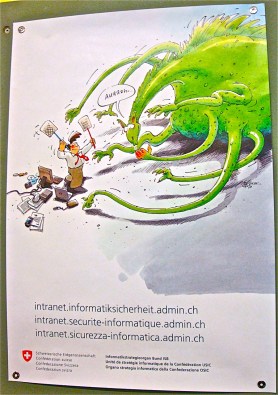
The message from ‘High tech’s missionaries of sloppiness’ about blogging’s future status is encouraging. As for its transformation of computer (in)security – bah!

One lovely child of flawed software: poster in an office of the Swiss Federal Department of Foreign Affairs, Bern, postgutenberg@gmail.com

One lovely child of flawed software:
poster in an office of the Swiss Federal Department of Foreign Affairs, Bern, postgutenberg@gmail.com

Seven years ago, Elinor Ostrom — a winner of the 2009 Nobel prize for economics — cited an article on computer unreliability in a paper on knowledge-sharing that she wrote with Charlotte Hess. The angry essay they mentioned ran in late 2000 in an e-zine, the online magazine Salon. Their thirty-nine citations included only one other in a general-interest publication, a decades-old New Yorker piece by E. B. White.

More on that in a moment …

Long before print journalists shrank from crediting or citing blogs as sources of good ideas and information, they refused to acknowledge debts to e-zines and other online-only publications. If they gave them any credit at all, it was for being brave enough to dip their toes in the digital future – in which, from print’s Olympian perch, it seemed as if these pioneers were bound to fail. Their cold-shouldering will soon have to end, thanks to the example set by unprejudiced, fair-minded thinkers.

In post-Gutenberg’s experience, intellectual greatness is in direct proportion to the trouble a powerful brain worker takes over acknowledging useful information or inspiration found absolutely anywhere – whether or not the source meets old-fashioned, conventional criteria for respectability. Only shallow snobs care about labels.

With a quotation of just three words about a growing ‘culture of carelessness,’ Ostrom and Hess directed readers of their paper about obstacles to sharing research findings to the Salon article — ‘High tech’s missionaries of sloppiness’ (‘HTMOS’) — whose subject has been making front-page headlines, lately.

For instance, yesterday’s ‘Chinese Hackers Resume Attacks on U.S. Targets’ followed by only a few weeks a long profile in the same newspaper about the über-Cassandra on this topic, an octogenarian computer scientist called Peter Neumann who is leading a team of researchers trying to make computers less vulnerable to security breaches. His interviewer noted that

… the increasing complexity of modern hardware and software has made it virtually impossible to identify the flaws and vulnerabilities in computer systems and ensure that they are secure and trustworthy. The consequence has come to pass in the form of an epidemic of computer malware and rising concerns about cyberwarfare as a threat to global security …

We would name the newspaper we have quoted in linking to it, as we usually do, except that we are trying to make a point about the churlishness of print journalists’ tendency to – shall we say, forget to credit e-zines and blogs as sources. In April, the same daily ran an opinion piece by a hacker-turned-security-consultant, Marc Maiffret, who made our eyes pop in one paragraph (our italics):

The unspoken truth is that for the most part, large software companies are not motivated to make software secure. It’s a question of investment priorities: they care more about … developing the latest features and functions that consumers and businesses are looking to buy.

Unspoken, eh?

‘High tech’s missionaries of sloppiness’ certainly spoke, twelve years ago:

A culture of carelessness seems to have taken over in high-tech America. The personal computer is a shining model of unreliability because the high-tech industry today actually exalts sloppiness as a modus operandi.

[…]

American companies accept “good enough” quality for the sake of speed. Being first to market with new products is exalted as the highest goal here, and companies fall back on huge technical support and customer service staffs to cope with their many errors of commission and omission.

“Don’t worry, be crappy,” was how Silicon Valley veteran and pundit Guy Kawasaki expressed the same idea two years ago, in a speech that won him a standing ovation.

Programmers, hackers, and technologists of every stripe were incensed by the Salon essay. After a link to it was posted in the week of its publication on Slashdot.org — then the most popular computerists’ chat-forum – they swarmed aboard, so furious that at least a third of the posts denounced the author of ‘HTMOS’ as ‘he,’ in spite of her unambiguously female name. The explosion was partly owed to the genius of Andrew Leonard, the Salon editor on the job, who barely scratched the piece’s text but wrote its headline and dreamt up a standfirst borrowing none of its actual words, which read,

Computer companies specialize in giving consumers lousy products — it’s the American way of techno-capitalism.

Maiffret and his editors might simply have failed to check the antecedents for his condemnation of Silicon Valley’s lack of interest in safe computing. A lone editor from the print world, Simon Caulkin – renowned in British journalism not just for his talent but peerless integrity (and a former colleaugue of the Salon contributor) – did cite ‘HTMOS’ in one of his Observer columns on management, titled, ‘Software must stop bugging us’.

For the most part, it is in books and university curricula that the essay has been marked for attention. Even if the world is still a long way from curing computers of their flaws, the citations that come up on the first page of Google results for the essay’s title are in, for instance:

Adapting Buildings and Cities for Climate Change, Sue Roaf, David Crichton and Fergus Nicol, Routledge, 2012

Why Programs Fail – A Guide to Systematic Debugging, Andreas Zeller, Elsevier, 2009 [also a Google e-book]

Geekonomics: The Real Cost of Insecure Software, David Rice, Pearson Education, 2007

Quality software project management, Robert T. Futrell, Donald F. Shafer and Linda Isabell Shafer, Prentice Hall Professional, 2002

‘HTMOS’ also continues to find its way into arguments between technophiles, as in 2007, on the site of the ‘Central West End Linux Users Group’ – where it was used to slap down a debater who declared airily, ‘Every OS [operating system] has its faults. Pick your poison.’

That Ostrom-Hess paper with which this post began was, as it happens, about tribalism getting in the way of sharing information critical to human life – in microbiology research. The authors noted, in their abstract, that ‘there are many, diverse participants in producing and consuming information who often have conflicting interests …’.

Conflicting interests indeed. It is obvious from the rarity with which print journalism acknowledges good work published online in e-zines and blogs that its workers are afraid of their new competitors. And then, of course, programmers are not particularly fond of that article. We at post-Gutenberg are not much interested in conspiracy theories, but could not help smiling when we noticed that someone at both The Observer and Salon appeared to have gone to pains to make it harder to find ‘HTMOS’ and the Caulkin column on flawed software. The London newspaper misclassifies his eloquent jeremiad with the work of a political writer, Madeleine Bunting. And for years, the Salon essay has been indexed not with its collections of pieces on computers, software or Silicon Valley but under ‘AUTO INDUSTRY, ENTERTAINMENT NEWS’.

Of course we imply no conspiracy… the culprit could only be a dear little sloppiness gremlin piling up overtime hours.

Personal proof from watching Margaret Thatcher’s funeral: the time of passive, captive, media-gazing has passed

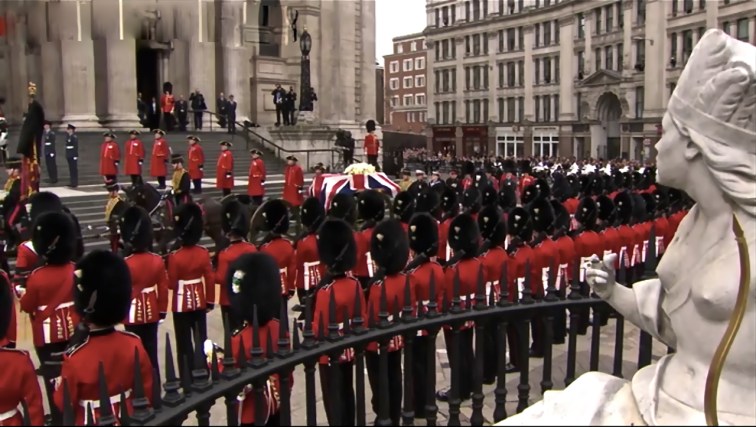
Procession arrives at St. Paul's Catherdral

Procession arrives at St. Paul’s Cathedral: the most graceful onlooker

The irresistible pull of old turf

The irresistible pull of old turf

In our age of pixels, one versatile midget-screen is worth more than cable television with two thousand and one channels on a hulking, high-definition display. This dawned on us as we said a silent, heartfelt thank-you to the BBC last week for the banner at the top of every frame of its ‘red button’ broadcast of Margaret Thatcher’s funeral: BBC LIVE. NO COMMENTARY.

Post-Gutenberg has not owned a working TV set for decades, by choice. But we were grateful to be lent one last Wednesday, hoping for deep absorption by London’s farewell to the steely, scrappy baroness, and the chance to imagine why people insist that Winston Churchill’s funeral was the most sublime, moving event in British public life in recent history. As she was accorded the military honours he was – in spite of a clinching argument against doing so by the right-wing political journalist Peter Oborne – we knew we would be observing similar, if not identical, rites of homage.

No sooner had we begun to watch the large screen than we felt irritable, as if we had ants crawling up our sleeves, anticipating the artificial voices of commentators bent on pre-digesting everything we saw. Because of these maddening intermediaries, the Beeb’s religion correspondent, Robert Pigott, would ordinarily have been quite right to say as he did – after the service in St. Paul’s – that no one outside the cathedral’s walls could have experienced the extraordinary ‘sense of occasion’ there. Yes, the talking heads have always had an annoying habit of proclaiming, ‘You really have to be here to know what the atmosphere is like’ – never acknowledging that this is at least in part because their chirping gets in the way. This time, Pigott was wrong. Possibly because his employer was savaged for its commentary on the last royal wedding, there were no all-knowing chirps at all.

In the great hush broken only by music and ceremonial words, occasional shouts of protestors, clumping horses, saluting guns, crunching military boots and church bells, any viewer of the BBC feed was free to get lost in personal trains of association — verses of hymns remembered from school assembly halls; watching someone close and dear on a parade ground when tiny; other memories and imagery. Just like anyone in the congregation. Bliss! … When we found the definition on our tablet screen crisper and truer to life than the one on the television display, we switched to viewing only the small screen.

This also had something to do with seeing the procession skirt the edge of our old London neighbourhood, a street ten minutes away on foot from the flat that was home – and in a flash, realising that we could take a screen shot on the tablet computer for a personal reminder of grey spring mornings in Holborn. After that, we captured images from every angle, of every scene in the funeral service that interested us – and except for the frustration of being constrained by the exclusively horizontal orientation of the feed, were delighted by the perspectives Auntie offered us from her staggering twenty-four cameras inside St. Paul’s, alone.

We loved the active watching on the small screen, so much better for noticing. We love having our own visual records to inspect at leisure, blowing up details for closer deconstruction.

Other people probably listened to the drone of interpreters in war paint and plastic styled hair, switching back and forth between their TVs and laptops; followed the textual explanations of what we were looking at, on the BBC site, even as they tweeted reactions to their friends, and updated pages on social networking sites throughout the ceremony. And why shouldn’t they have done what suited them?

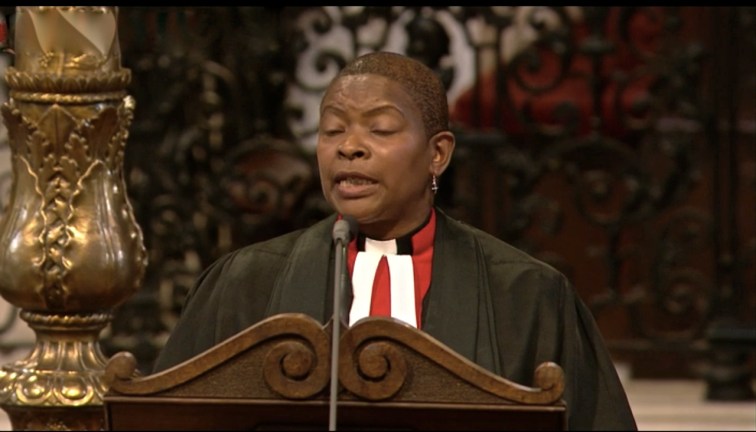
We only listened to a single stream of sounds; reflected; and made a scrapbook, from which this idiosyncratic selection of images comes – each screen re-touched to remove the BBC logo. At the funeral of Britain’s first and only woman prime minister, it was chiefly women’s faces that we found most engaging.

H.M. QE II

H.M. QE II

Mrs T's daughter-in-law, flanked her son and grandson

Mrs T’s son, daughter-in-law, and grandson

Marvellous eyebrows: the carving competes

Marvellous eyebrows: the carving competes

Young woman, officiating

Young woman, officiating

MT going where we all do -- to 'the cloud,' as the Bishop of London (not pictured) put it

MT going where we all do — to ‘the cloud,’ as the Bishop of London (not pictured) said

Cameras of every kind

Cameras of every kind