Gustave Flaubert’s multitasking score: 0 — and ‘flow,’ Mihaly Csikszentmihalyi’s secret of happiness

'Flow, don't freeze' postgutenberg@gmail.com

‘Flow, don’t freeze’
postgutenberg@gmail.com

Of all the anxieties related to the effects of digital culture on our brains – the way people reason, comprehend, do cerebral work, create and invent – the only one that we at post-Gutenberg truly share is the worry about attention. Especially, sustained attention. We have long found one facet of this – closer to immersion –  the most dependable font of happiness. It has been studied and named ‘flow’ by the Hungarian psychologist Mihaly Csikszentmihalyi, whose book on the subject was a birthday present to us from a vanished friend (Dessa, where are you?). Over to the Wikipedia:

In his seminal work, Flow: The Psychology of Optimal Experience, Csíkszentmihályi outlines his theory that people are happiest when they are in a state of flow— a state of concentration or complete absorption with the activity at hand and the situation. It is a state in which people are so involved in an activity that nothing else seems to matter. The idea of flow is identical to the feeling of being in the zone or in the groove.

Everyone accepts that our attention is being chronically, woefully, and hopelessly fractured by mobile telephones, email, tweeting, blogging, Googling, Binging (as opposed to bingeing) and so on – no matter how successful some of us are at glamorising the e-jitterbugging as ‘multitasking’.

How would a Gustave Flaubert write a novel of the depth and (depressing) intricacy of Madame Bovary? Whatever you think of the book – p-G sympathises with the critics who complain that the story lacks a single likeable or, we would say, engaging character – it probably deserves its renown, and its author his place among les immortels.

We have no answer to that question, but we do believe that no one has described the ‘flow’ state and its joys more gorgeously or entertainingly (definitively ‘over-the-top’) than Bovary’s inventor. The other day, opening our copy of The Letters of Gustave Flaubert 1830-1857 – only because we happened, for the first time for a decade and a half, to both look at and see it on its shelf, we entered a flow state ourselves, completely absorbed by the novelist’s words, beautifully translated and edited by Francis Steegmuller. The proof of the addictiveness of ‘flow’ is in these extracts, as is evidence that it is not always a picnic.

Highlights might be all most of us have time for, soon, the literary equivalent of what is well on its way to becoming the most popular convenience food, worldwide — sushi:

[ … to his friend — the lawyer-turned-dabbler/dilettante — Alfred LePoittevin; 13 May, 1845, Milan …]

You are wasting away with boredom, you say? Bursting with anger, dying of depression, stifling? Have patience, oh lion of the desert! I myself suffered a long period of suffocation, the walls of my room in the rue de l’Est still echo with the frightful curses, the foot-stampings, the cries of distress I gave vent to while I was alone there. How I roared in that room! And how I yawned! … Think, work, write, roll up your sleeves and cut your marble, like the good workman who refuses to be diverted from his task and keeps at it with sweat and good humour. … The only way not to be unhappy is to shut yourself up in Art and count all the rest as nothing. … I do not regret the absence of riches, or love, or the flesh, and everyone is astonished to see me behaving so sensibly. I have said an irrevocable farewell to the practical life. … From now until a day that is far distant I ask for no more than five or six quiet hours in my room, a good fire in winter, and a pair of candles to light me at night.

[ … to Louise Colet, a writer of recognised ability, also Flaubert’s mistress and – as most, though not all, authorities agree, the model for his tedious adulteress; 24 April 1852, Croisset … ]

… I have been in a great fit of work. The day before yesterday I went to bed at five in the morning and yesterday at three. Since last Monday I have put everything else aside and done nothing all week but sweat over my Bovary, disgruntled at making such slow progress. … You speak of your discouragement, if you could see mine! Sometimes I don’t understand why my arms don’t drop from my body with fatigue, why my brain doesn’t melt away. I am leading an austere life, stripped of all external pleasure, and am sustained only by a kind of permanent frenzy, which sometimes makes me weep tears of impotence but never abates. I love my work with a love that is frantic and perverted, as an ascetic loves the hair shirt that scratches his belly.

Sometimes, when I am empty, when the words don’t come, when I find I haven’t written a single sentence after scribbling whole pages, I collapse on my couch and lie there dazed, bogged in a swamp of despair, hating myself and blaming myself for this demented pride that makes me pant after a chimera. A quarter of an hour later, everything has changed; my heart is pounding with joy. Last Wednesday I had to get up and fetch my handkerchief; tears were streaming down my face. I had been moved by my own writing: the emotion I had conceived, the phrase that rendered it, and the satisfaction of having found the phrase – all were causing me the most exquisite pleasure. At least I think that all those elements were present in this emotion, which after all was predominantly a matter of nerves. There exist even higher emotions of this same kind: those which are devoid of the sensory element. These are superior, in moral beauty, to virtue – so independent are they of any personal factor, of any human implication. Occasionally (at great moments of illumination) I have had glimpses, in the glow of an enthusiasm that made me thrill from head to foot, of such a state of mind, superior to life itself, a state in which fame counts for nothing and even happiness is superfluous.

Surfer, passing by: will you pause to list the three Beatles songs you like best, today?

‘Happy Birthday, MIL22!’Photograph by postgutenberg@gmail.com

‘Happy Birthday, MIL22’

Elderly intellectual Parisian piano teachers married to each other in the latest Michael Haneke film, Amour, are exercising their right to musical snobbery when they sniff disdainfully at the idea of someone playing a tape-recording of Yesterday’ at the funeral of a member of their elevated social set. It takes less than two seconds to realise that this exchange could easily have been stolen from real life — the Beatles having been, arguably, the 20th century’s most irresistible agents of cultural democracy before the internet took off.

The letters of Samuel Beckett starred in last winter’s reading at post-Gutenberg — and made our blog’s most popular entry. This winter, the essays of a fastidious, spinsterly Cambridge don psychologically married to his mother for much of his life (or so it always seemed to us) have been our special delight. It hardly matters how E. M. Forster came by his understanding when, in 1940, he answered his own question, ‘Does Culture Matter?’:

Culture is a forbidding word. I have to use it, knowing of none better to describe the various beautiful and interesting objects which men have made in the past … Many people despise them.

[…]

I know a few working-class people who enjoy culture, but as a rule I am afraid to bore them with it lest I Iose the pleasure of their acquaintance. So what is to be done?

It is tempting to do nothing. Don’t recommend culture. Assume that the future will have none, or will work out some form of it that we cannot expect to understand. … The difficulty here is that the higher pleasures … rather resemble religion, and it is impossible to enjoy them without trying to hand them on. The appreciator of an aesthetic becomes in his minor way an artist; he cannot rest without communicating what has been communicated to him … It is therefore impossible to sit alone with one’s books and prints, or to sit only with friends like oneself, and never to testify outside.

… So, reader surfing by, this month, this year, or as long as this blog is alive … are you moved to testify on behalf of the Beatles oeuvre – put your three most beloved songs from it into a comments box below, with or without an explanation or any expectation of a reaction? … A message in a bottle cast out to sea?

Marcel Proust, punk rocker avant la lettre (… a post about, well, … language)

Fasnacht in Switzerland's MittellandPhotograph by postgutenberg@gmail.com

Fasnacht in Switzerland’s Mittelland

In some lucky, freezing parts of the world, this is a time for the licensed collective madness called winter carnivals. In German-speaking Switzerland, the prelude to Lent named Fasnacht or Fastnacht gives the famously orderly Swiss an excuse for escaping their usual selves in ritualised abandon and disciplined bacchanals – all dressed up in fantasy.

We suspect that it was in this state of mind that a Swiss correspondent of post-Gutenberg’s sent us a link to one of the most unlikely obituaries we have ever read. It might have been written specially for Fasnacht – in deepest sympathy with the spirit of this celebration – even if it is an actual encapsulation in a London newspaper of the life of a 1960s English rocker we confess we had never heard of.

What is it about the life of Reg Presley of the Troggs that makes us especially ashamed of our ignorance? These extracts (below) will explain, to anyone too busy to read the original — who will want to know that the Larry Page mentioned in our first clip was the group’s manager.

Two conclusions occurred to us when, frantic for oxygen, we reached the obituary’s end:

(i) It would seem that long before the villainous internet killed culture — if you believe some of our fulminating, fuddy-duddy, cultural guardians — our era’s counterpart for sumptuously graphic Chaucerian language, describing essential functions of the human body, entailed using a single word beginning with the sixth letter of the alphabet a lot. Okay, an awful lot — through mindless, spontaneous repetition.

(ii) It was not some ignorant online – Amazon! — reviewer but a professional dead-tree critic in faraway 1971 who pronounced rocker Reg the equal of the most venerated writer in the French literary canon.

Page dressed his protégés in loud striped suits and urged them to maintain an impeccable image offstage. Presley, a moderate drinker who smoked, by his own estimation, an average of 80 a day for most of his life, never took illegal drugs. But Page was also particularly insistent that the group refrain from swearing. With time, the musicians found this stricture more difficult to adhere to.

In the late 1960s, a studio engineer secretly kept the tape rolling while The Troggs were airing musical differences between takes. The recording begins on an optimistic note, with one member explaining that: “This is a f—— number one. It f—— is. This is a number f—— one, and if this bastard don’t go, I f—— retire. I f—— do. Bollocks. But it f—— well won’t be unless we spend a little bit of f—— thought and imagination to f—— make it a f—— number one. You’ve got to sprinkle a little bit of f—— fairy dust over the bastard.”

Later in the discussion (ironically the song in question, never released, was entitled Tranquillity) a note of disharmony begins to creep in. Presley offers some advice to Ronnie Bond, the band’s drummer. “You can say that,” Bond responds, “all f—— night. Just shut your f—— mouth for five minutes. Don’t keep f—— ranting down that f—— microphone. F— me, Reg. Just f— off and let me keep going f—— through it. I know it ain’t f—— right. I can f—— hear it ain’t right you —-. F— me. When I f—— hear it in my f—— head, that that’s what I’ve gotta f—— do, then I’ll do it. You big pranny.”

“The Troggs’ Tapes”, as the bootlegged session became known, became one of their most enduringly popular recordings. Parodied in a scene of Rob Reiner’s 1984 comedy This is Spinal Tap, it was eventually issued legally, as a bonus CD in Archaeology, a 1992 boxed set of the group’s collected works. “I was a bit annoyed about the tape at the time,” Reg Presley said, “because it was a while before we knew it even existed. We found out in a pub, in west London. This bloke came up to us and said: ‘You’re the Troggs, aren’t you? Have a listen to this.’”

Presley was informed that pirated copies of the 11-minute tape, unpurged of its 114 expletives, had been eagerly purchased by his rivals in the music business, and that black market vendors were reporting a more satisfactory level of customer feedback than was usual with a Troggs recording.

This was unfair. For Wild Thing, With a Girl Like You and Any Way That You Want Me were outstanding singles which inspired a host of performers, including Iggy Pop. The late American writer Lester Bangs even went so far as to publish a 25,000 word eulogy to The Troggs, which hailed them as the godfathers of punk and called their music “holy”. At one point Bangs, whose critical instincts occasionally betrayed his prodigious consumption of narcotics, compared Reg Presley to Marcel Proust.

[…]

When discussing space travel, Presley tended to depart from the standard vernacular, referring to interstellar craft as “the bugger” or “the bastard”, and to interplanetary communications systems as “tackle”. In 1994 he claimed to have obtained footage of a metallic disc seen hovering over crops, an object which, he said, was “nosin’ around at corn height”, and “sniffin’ around the field”. This, he argued, was “one of the little fellers – the ones with the big cow eyes, which in UFO circles we call the greys. I’ve got a sneaking feeling that they are engineered by aliens who can see the future; if they know a woman is going to lose a baby they take it and they convert it. They put in a bit of extra brain. Maybe no vocal. But they can mind-read you.”

If an alien craft landed and offered to abduct him, Presley reflected in 2006, “I hope I would have the bottle to go. Because I’d like to ask them a lot of bloody questions. And they’ve probably got all the answers. These beings may be 20 million years in advance of us. What kind of technology must they have? You could come back to earth and not know a soul on the planet. But perhaps you would have seen something that would help save the whole human race. And maybe some people have done that.”

Book publishing’s future: a distinguished Spanglish record of a catastrophe foretold

 Giorgio De Chirico, the founder of the Metaphysical school of painting -- a forerunner of Surrealism -- created this sculptural work, 'The Mysterious Baths,' in 1973 -- when he was eighty-five. Photograph by MIL22


Giorgio De Chirico, the founder of the Metaphysical school of painting — a forerunner of Surrealism — created this sculptural work, ‘Fontana dei Bagni Misteriosi’ (‘The Mysterious Baths,’) in 1973 (aged 85).
Photograph by MIL22

A dig through papers stored in cardboard boxes on a freezing day in silver January light yielded a forgotten scrap of treasure. Who would deny that there is a touch of divine Borgesian surrealism about the circular below, from July, 1994?

Two years ago, we found ourselves arguing with a handsome Swiss nineteen year-old, the son of a novelist, who haughtily condemned the efforts of Google Translate — and was impervious to any suggestion that the translator-robot might be better than nothing, and improving steadily. What, we wonder, would that Adonis make of our vintage circular from the Spanish publisher of the likes of Octavio Paz, Gabriel Garcia Marquez, Mario Vargas Llosa, Milan Kundera and Italo Calvino? This relic, though unsigned, was clearly the work of one of those gentlemanly, perfectionist luminaries of the old print-book publishing world who could — at the drop of a sombrero — have summoned any number of helpers capable of a more straightforward rendering of Spanish thoughts into English.

It is astonishing to read this author complaining about excessive haste — the hurried new tempo being born, for people in his trade — even though no literary proletarian of the time was obliged to answer email around the clock, or multi-task, or check thought-streams in social media.

Still, we are delighted with our discovery. No text we have read, for days, has lifted our spirits to quite the same degree. This is not so much because it reminded us of the high comedy of our own inept attempts to communicate in, say, rusty French. It is the writer’s gung-ho, embrace-the-future-or-perish sentiments about the future of publishing — and eagerness to join forces across cultural borders, for the transition — that we find both moving and endearing.

TUSQUETS EDITORES

PUBLISHERS MEETING ON THE 25TH ANNIVERSARY OF TUSQUETS EDITORES

the 5th July from 10.00 to 13.30 hours
at the Museum of Science (Museu de la Ciència de la Fundaciò de ‘la Caixa’)

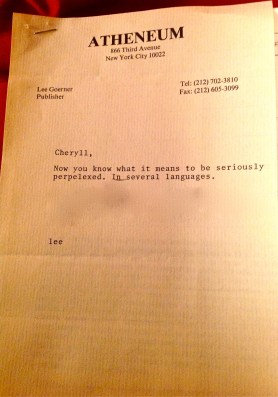
The perplexity of the publisher at the end of the century
Proposal for a debate

Our starting point is the fact that we have been living, on last years, great, swift changes which depthly affects the habits in publishing within the field in which we usually work, which is essentially the literary one, under whichever its forms. I think that all of us, now and then and in one way or another, have plunged into perplexity when faced to some of these changes, sometimes rude. From a special way of working, in which time was that of reading and the mechanisms of making contracts, of production, distribution, advertising and selling were relatively clear and simple, we have gone over to a new way of working, mastered by a hurried tempo and increasingly more complex mechanisms. This has often been generating into us doubts and hesitations concerning the future of our very activity as literary publishers and editors, whose activity, fundamentally based on risk, is to discover and experiment, both of them functions which need most of all, at first sight, different manners and time from those of an uniformised and accelerated production, distribution, advertising and selling. I suppose that this approach is valid, although very different nuances, whatever might be the kind of company in which usually works a literary publisher or editor, either an independent one, or a national or multinational group.

Therefore I suggest to divide our contributions into two interacted blocks:

1. Considerations on the present situation and analysis — avoiding as far as possible useless nostalgias — of those aspects from the past which we consider indispensable to safeguard, and even to fight for and maintain, and which complement or come into conflict with the steps each of us has been taking to grapple with the changes of these last years.

2. Reflections on how and what could be done in forthcoming years for the survival of this vocationally cultural activity, intact in its original purpose and spirit, but integrated into the new habits of both publishing and new reading communities, which already became unavoidable and are a part, like it or not, of our everyday task.

The contributions and the debate will be held either in English, French or Spanish, and we’ll have at our disposal, whenever needed, a simultaneous translation service to and from the three languages.

photo

lee to cb