Post-Gutenberg literary dilemmas: trick or treat?

Photograph by Mark Barron

Halloween is not part of our tradition at post-Gutenberg. Never mind, we feel uniquely privileged, posting this text and image sent to us as unsought bounty – yes, a surprise, in each case.

What are the most interesting arguments about literature’s transition to the post-print world? The extract from Sean McNulty’s Twentieth Century Transmissions – the novel he has just completed — came in email with shades of one debate for a preface:

I’ve attached the opening pages but FYI have taken out of copyright works by Sherwood Anderson, F. Scott Fitzgerald, Lewis Grassic Gibbon, James Joyce, D.H. Lawrence, Bruno Schulz, Nathanael West, Virginia Woolf and others and remixed them into my own story, pretty much as China Miéville was talking about here just as I was finishing the novel:

http://www.guardian.co.uk/books/2012/aug/21/china-mieville-novels-books-anti-piracy

The language of Sean’s text struck our inner ear as exceptionally fine — suggesting that the pessimism in our last post might not be entirely warranted. We found his manuscript original in the best way, as well as acutely disturbing. As a Halloween offering, it is the equivalent of the original Grimm’s fairy tales – galaxies removed from the sanitised, saccharine revisions commissioned to protect the tender psyches of 20th– and 21st-century children.

Before we leave you to read it, we have a message for regular readers here who have admired our clip, two posts ago, from The AdorataThat was by Sean Murray, a pen name Sean McNulty says he was forced to use when he wrote that first novel – to avoid upsetting his employer at the time. As we have never met either Sean in person, we can only take him at his word.

Perhaps Halloween will in the future be celebrated as commemorating not just ghosts but the remembrance of indecipherable pseudonyms past.

Twentieth Century Transmissions

A novel based on works by

Sherwood Anderson, F. Scott Fitzgerald, Lewis Grassic Gibbon, James Joyce, D.H. Lawrence, Bruno Schulz, Nathanael West, Virginia Woolf and others.

Denying temporal succession, denying the self, denying the astronomical universe, are apparent desperations and secret consolations. Our destiny is not frightful by being unreal; it is frightful because it is irreversible and iron-clad.

Jorge Luis Borges

We always find something, eh Didi, to give us the impression we exist?

Samuel Beckett

Bad Friday

Lenny’s Austin followed the Moray Cycling Club, the same half mile behind it had kept all morning. He watched through the windscreen’s muck as the Great Comet rose pale blue over the mountains, half earthly, half heavenly banners with slits of blued snow in the peaks. It felt almost supernatural, this world about to end.

The Club’s fanatics were allowing themselves one last ride before the Comet hit. A blonde woman brought up their rear, ringing her bell and grinning till she caught her reflection in a farmhouse window. She’d glimpsed fine enough features there but they were also red with lack of breath and gaudier than they ever were, the features that had shed those masks – Maglemosian, Egyptian, Greek, Spanish, all the way down to this last reality, the final mortal mask of the thing now called Maggie Guthrie.

Well, nothing endures, does it? Without this Comet Pessaria business, without big Lenny to kill her off and send her on to pastures new, she doubted she could have faced more masking on this Earth and not felt sick to the pit. Once it had been wearying to think of yet more years of masks of skin and bone keeping hidden her essentials, but now with the Great Collision here at last she wasn’t sick or sorry, not sad at all, just too much time to think as she pumped away at these pedals.

With the sun the Comet went on rising through the sky, one going southward from the east, the other northward from the southwest trailing its colossal tail. And now Maggie’s bike slowed as she caught her breath and took in the sights around her. Roadside birds swerved up when they heard gunfire in the direction of Kingussie, then swooped back down and sat silent on the trees and fence-posts, highly conscious of one thing or another. For some it was wild flowers or stalks of grass casting double-shadows, their sun-shadow and their Comet-shadow. For others it was dewdrops with the entire sun or Comet trapped inside.

Other birds sang in the warming sunshine. They sang on the twigs of bushes and perched in trees’ upper branches, letting the chirps and whistles burst out of them. Their eyes bulged and their claws gripped twigs and they sang to the Comet as though releasing all the pressures of its long Approach.

When the cyclists got off for a break Lenny’s exhausted head began to revolve slowly, rhythmically, and to hum at his bruised temples. As he parked the car something moved into his line of sight. In her sweat-soaked vest and shorts Maggie’s figure was the glamorous thing that attracted all the morning light, casting curving shadows left and right. She walked her bike into a wood. He left the car and followed.

His head blazed as he plodded between the trees. He saw her wipe mud from her bike and legs, leaves’ double-shadows dancing on her hair and skin, woodchips littered beneath her like splashed light. A pulse passed through his bruises and he ran toward her.

She let her bike fall and backed away. Her foot caught on a root, then she went down backward and her spine thudded against a stump.

He got his knees on her chest, pressed her chin back over the stump’s edge and with the base of his palm shoved it hard. She wheezed out, ‘Nothing endures.’

As he kept on kneeling there and shoving, everything blurred for a moment and became a painted film-set, the blue Comet and golden sun its glaring spotlights. Memories came of Maggie with his father, Maggie desecrating his dead mother, Maggie sneering as he came. He wondered how his contorting face might look on camera.

Though the base of his palm pressing at that upturned chin, that woman wheezing there and gurgling – that wasn’t acting. He heard a little cluck and crunch and his head turned to vapour as convulsions shook her body. The limbs twitched and sprawled and blood brimmed from the nostrils, hesitated and ran back into her dead eyes. That was fine. That was as it should be.

He found himself brushing leaves off the body as it lay with a strip of Comet light along the chest. He sat beside it, surprised that the leaves were glittering and the woodchips reflected blue. In the glare he imagined he saw the glowing hair of his murdered wife.

He looked around and tried to remember where he was. Not a film-set. He got on Maggie’s bike and rode it along the nearest path. A doe, a moving bit of reflected light, went running through the shade. Lenny, transfixed by it, went crashing into a tree and fell.

He stayed there on the ground with his temples throbbing, his mind busy with delirium. His mouth was dry and hard and blood was darting in his head. There was something knocking. Trees and other greenery, streaks of weird light across the ground, something knocking. He saw something creep up a treetrunk, a whistling bird that rapped on the trunk and then ran out of the shadow, its head bobbing and its white legs twinkling. Its build was neat, compact. Well, that’s birdlife for you, Lenny thought.

So I have done it, he thought. I have murdered Maggie Guthrie.

A kind of wonder came on him, followed by low animal exultation at that cluck and crunch and those sprawling, twitching convulsions. A little grief came too, but it was all right, he told himself, it wasn’t really Maggie. That dead husk with blood pooled in its eyes wasn’t Maggie and never had been. Whatever dark spark constituted Maggie Guthrie, it wasn’t that. And he wasn’t really Lenny Uath either. Wasn’t that what she always told him?

Something scuffled and he sat up and watched a squirrel run in bounds over the ground. It flew at another squirrel and they chased each other until he had a coughing fit and sent them up a tree. One peered round at him halfway up a trunk, clinging to the bark.

Darkness fell like a shutter. He had killed Maggie as she said he would and the Comet was here at last. He was arriving on the real dark bottom but it was all fine, fine.

He thought he saw lightning flutter around the rippling, shimmering Comet and visions came of tonight’s Collision and the last few minutes he’d now have to face, priests and ministers gazing upward and wailing psalms, some tearing off their clothes and sending up curses or hallelujahs, some scourging their backs bloody and collapsing on the ground in fits, prostitutes flicking tongues and blowing the Comet kisses, tramps gossiping about last-minute escape rockets and rescues by Archangels. The delirium went on and on, his mind flickering like the lightning.

Then a hunt for water, and surges of now pointless hate for Maggie. Then moments of calm and ease and his father’s voice somewhere, approving of her murder: ‘Fine, boy, fine.’

His brain was flaming with thirst. There the Cairngorm mountains ranged across the pale edge of the sky, double-shadowed and solid with blue snowy markings. He was twisting in a paroxysm on the grass.

His thoughts had split from him. There was also the clog of his body, another splitting thing. He was dividing. There was maybe some connection between the different parts, or maybe not. Either way all the shapes were going. Pale blue rays were drilling through their bonds.

The year was 1943. So was the Comet real? Was Maggie real?

These are not simple questions. Others who’ll tell this story may answer them conclusively, but for now we’ll just say this. Certain events, entities, things, lack what might be called precision. They’re too large to be contained by the world of facts, and occur partly to find out if that world can bear them. Think of those strange gaps in the history of your own world, those Marie Celestes and Tunguskas that manifested and then quickly faded.

Normal events are strung along time like carriages on a railtrack. They have their causes and their effects, pushing and pulling one another forward and forming all our stories. But what about events too large for that railtrack, that maybe need a different gauge? Well, time has many parallel tracks, my friend, and the fact is that down certain secret tracks these larger events await us all. And in this sense they are real.

We must come to terms with the Great Comet. We must come to terms with Maggie Guthrie. We must not let their reality embarrass us into silence.

Och for God’s sake, let’s shut up and get started.

The Broadcast  

 1918

The Reverend Don Uath’s next ministry after the Western Front was in the Shaugh, the village of his birth. His family made the flit from Tomintoul in carts. Lenny was two years old.

The going was wild the night they set out, and several times they skidded badly in drifts of sleet before the horses brought them to the hills. Don watched his wife Willa in her nook in the leading cart with Lenny at the breast, her skin cold and blueing and strands of her red-gold hair draped into the light of the swinging lantern. When the horses skidded again she held off Lenny with milk dripping creamily from his lips.

Don called out to her, ‘We’d better get beds at the next village and not try the hills in this weather.’

But Willa called out at that, ‘Beds? Think we’re made of money?’

‘No,’ Don answered, ‘but maybe we’ll skid again and all die this night.’

A bellow arose where old horse Mo had halted, tail to the wind and refusing to pull his cart any further into the hills and sleet. Willa laid Lenny on his back and climbed down and went past the head of Mo, and there she uncoiled the length of hide she used as a whip. It crackled through the sleet and made the hair rise across Mo’s back, and he began to neigh and fall into a trot, the younger horse Tod following after, slipping and sprawling on his hooves.

So, creaking and bending beneath their loads, the carts plodded into motion again, full of gear and furnishings for the manse the family would occupy in the Shaugh. Head down to the wind went the horses in the moonlight, in this mile and that Don calling, ‘Fine, you two, fine. Come on then, boys.’

The road kept winding up and sometimes he sat huddled in his nook as the sleet went past in the darkness, and sometimes he climbed down and walked beside Tod and watched the lights across the moors where folk lay dry and warm. Then the road would swerve and the wind would be at him again and he’d climb back on the cart with freezing feet and hands, urging Tod on to their new home.

In a few hours the carts had cleared the hills and through the sleet Don saw the Shaugh’s scattered points of light. Willa stood on her cart holding Lenny and took in the nearby lochs, where night fishermen in cockleshell boats were braving the weather and casting out their nets. On the banks others carried baskets full of flapping catch and looked up at the northern sky.

Tiny smears swirled and floated up there among the sleet, an enormous flock of swallows. The scene looked like some old fresco, full of birds not intended for the Moray sky in the depth of winter, criss-crossing it in graceful climbs and swoops.

A few hundred roofs stood out clear below them, and yews around a steepled church and manse set round with gravestones and grass in tufts that a fox slunk through shedding sleet.

Maggie Guthrie watched the same scene from the standing stones, then rode down toward it on her bike.

[…]

Harry Potter Politics for Dummies — or why professional book critics forced Joanne Rowling to write The Casual Vacancy

Mystery portraitist: write to postgutenberg@gmail.com for credit, please

Once upon a time, a few decades ago, no self-respecting novelist or aspiring or actual literary star spoke of writing book reviews except as work dashed off to pay the grocer, replenish a wine cellar, or finance the abortions of a careless mistress. Editors doled out book reviewing assignments to support writers they believed in, who got drunk in the same watering holes or clubs, or had long ago been cricket or baseball-playing mates.

Some book reviews might have been incisive and elegant enough to be described as lapidary, but what mattered infinitely more than fairness to the book and writer under inspection was showing off well. Showing off about what? The speed at which a charming prose confection was constructed – the ideal result being the literary equivalent of iron claws in a velvet glove; an attack on a book that every chatterer who cared about remaining a member of the chattering classes was obliged to buy, boosting the circulations of book-reviewing publications. Complaints by authors about mistaken characterisations of their books, misquoting, abysmal incomprehension of them or other consequences of arrogant or desperate skim-reading, were treated as unsporting and ungrateful.

Now, that was book reviewing in the glory days of literary print culture, when its power was at its zenith. It has not lost all its sway yet. There is still a literary establishment and, as the example we will soon supply demonstrates, it was sufficiently self-confident a decade ago to imagine that its judgments would pass unchallenged.

That establishment is feeling rather insecure these days, as anyone following the spate of recent attacks on ‘citizen-reviewers’ and blogging book critics will have noticed.

Some of its arguments are eye-popping in their hollowness. We quote, for illustration, the tack of one of the most likeable old print pundits – Robert McCrum, the former literary editor of The Observer, who has endeared himself to many a commenter by replying politely to ferocious attacks on his credibility, even when addressed as ‘McCrumble’. Imagine post-Gutenberg’s astonishment at reading on the books-blogging site of a newspaper, last week, this McCrumbly description of a professional book review:

Before publication, it will be subjected to a prolonged and intense process of subediting. Crucially, it will be signed, and usually paid for. Compared with the raw material of your average blog, it has been refined and distilled to within an inch of its life.

None of this guarantees that such a review will not be savage, destructive, ad hominem or partisan, but it will be considered, …

Considered? … Really? That would mean putting the actual reading of subjects of reviews, and pondering, weighing and reflecting, above dashing off – cloddish clog-dancing by comparison with the impeccably executed, once-over-lightly pirouette still sanctioned in many a respectable home for print.

… Which brings us to the subject of Joanne Rowling, who has just published The Casual Vacancy, her first novel for adults, to deafening fanfare. The print literary establishment, discovering that she has, in spite of her success, written a better than respectable novel campaigning fiercely for have-nots, might have been a lot less astounded if its members had gone to the trouble of reading the books that made her famous. Because so many of them only deigned to notice her at all when she became odoriferously rich, they fell into the error of confusing her work with dim and, or, absurd mega-bestsellers, like the one built around a witless ‘code’ poor old Da Vinci would have choked on – which could only have been invented to make Dan Brown the agreeably tweedy and self-deprecating fat cat author he has become.

By contrast, any actual — adult — reader of the Harry Potter series might, like post-Gutenberg, have been most amused not by either the wizards or monsters but the social commentary at the edges of J. K. Rowling’s picture. Could any Londoner who has ever visited, say, the Department of Industry in Victoria Street, fail to explode in laughter, meeting its perfect fictional twin in Rowling’s Ministry of Magic – not just because of her descriptions of its atmosphere, its corridors and the attitudes and work ethic of the dispirited bureaucrats shuffling down them, but because of the delicious wheeze of including such an institution in this particular story?

At the start of the Harry Potter mania, one book-reviewing journalist and essayist, Pico Iyer, was given enough space in The New York Times to hang himself comprehensively – having managed, somehow, to read Rowling’s cod obvious political sympathies back-to-front. The most obvious point of his contribution in the dashed-off tradition was boasting about his educational pedigree. In his eagerness to use a consideration of Harry Potter’s success as a peg and excuse, he forgot to check that the parallels he drew were justified by any part of the boy magician’s adventures, or their framing.

As a boy, I went for many years to the Dragon School in Oxford. The rooms in which we lived were called ”Leviathan” and ”Pterodactyl” and ”Ichthyosaurus”

[…]

I mention all this because, as Harry Potter’s adventures conquer the nation … readers on this side of the Atlantic may not appreciate how much there is of realism, as well as magic, in the exotic tales of young sorcerers being trained at the Hogwarts School of Witchcraft and Wizardry. The classical boarding-school process favored by the English middle classes is esoteric […]and Friday nights would find us bouncing up and down in our pajamas, reciting the principal parts of Greek irregular verbs. Every Sunday night, in our flowing black robes (we were known as ”tugs”), we would gather in a classroom dating from 1441 to sing hymns in Latin …

[…]

When I was at school, it was always assumed that all the years of quasi-military training (”Hard work and pain are the best teachers if you ask me,” the Hogwarts caretaker says) were meant to teach us how to rule the Empire and subdue the natives around the world.

Well done, you!  the weary reader of that extended exercise in feather-fluffing is liable to have exclaimed, as it ran on … and on. To the credit of the NY Times – never mind that it failed to vet Iyer’s reflections on Rowling the way Robert McCrum claims professional book reviews do — it promptly published, the following week, this deflating reaction:

October 31, 1999

To the Editor:

In his essay ”The Playing Fields of Hogwarts” (Oct. 10), Pico Iyer reveals a blinkered — i.e., thoroughly Mugglesian — misreading of J. K. Rowling’s intentions. Her Harry Potter books don’t ”recast” the elitist English boarding school experience ”in a positive light”; they are gloriously subversive.

Whereas English public schools have traditionally subjected their pupils to lives of Spartan deprivation, the food at Hogwarts is delicious and abundant. Students sleep in four-poster beds hung with velvet curtains. More telling than these details is that Hogwarts resembles a conservatory or any other meritocratic school for gifted children, not an establishment designed to train the children of the elite ”to rule the Empire and subdue the natives around the world.”

Belonging to old magical families confers no special advantage on Hogwarts pupils; only talent counts. Both Harry and Hermione, one of his two best friends, receive letters inviting them to attend the school — and are plucked out of Muggles families because their innate talent for wizardry has mysteriously been discerned by Hogwarts administrators.

The prodigiously gifted J. K. Rowling is doing a great deal more than tweaking Iyer’s Etonian experience ”in a magical direction.” Contrary to his assertion, her theme is absolutely universal. She tells about both the vulnerability and the protective insulation that come with artistic talent, about the escape route that an imagination offers from the horrors of real life. To say that the charm of the Harry Potter books lies in ”their fidelity to the way things really are” is to grievously shortchange Rowling’s brilliance.

The writer of that old-fashioned, mediated citizen-review known as a ‘reader’s letter to the editor’ – the only chance a member of the public once had to draw the same reading audience’s attention to mistakes or idiocy inflicted on it – has scrupulously avoided becoming a professional assessor of books.

We could not agree more with Robert McCrum, pronouncing,

[T]he citizen journalist’s review is not the same as the professional critic’s.

Indeed not. As the woman who brought Potter to life said, in a BBC interview on her reasons for writing The Casual Vacancy:

Ultimately, the people who have read the book, who are not paid to have an opinion, are generally the best benchmark of whether you have done what you set out to do.

A boatload of words, part 2: new media experiments suggest how lost languages might be saved

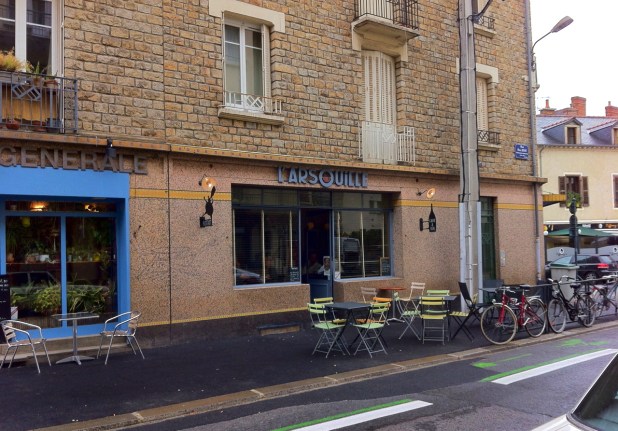
‘L’Arsouille’, Rennes, Brittany
Photographs by Mark Barron

Owing to chronic disruptions beyond our control, our usual timetable for new posts – roughly every six to seven days – must regrettably be abandoned for a while. ]

[ part 1 of ‘A boatload of words …’ is here ]

We are experimenting again — this time, with 21st-century ways of long-distance literary exploration. We are doing this in a multi-media collage — additions to some lines of poetry that we featured here last month.

Suppose that you discovered a beguiling poem that was a call to arms on behalf of an endangered language — lines saturated with the emphatically anti-glamorising spirit of a place, and adding up to a sort of love letter to its culture? Suppose that this place was Brittany, and that before you found the poem, you had only ever read the same clichés about its resilient, courageous, resourceful and fiercely independent people and been served, ad nauseam, the same images of its rugged coastline, its boats, its mizzling North Atlantic skies — without ever having heard a Breton speak?

Language arguably is culture.

Its sounds contain revelations inaccessible except by listening — a thought that came to mind playing back a recording of Roy Eales’s exemplary, playful-yet-serious reading of his own poem in its English original, then hearing his friend Fañch Peru recite his translation of it into his native Breton in ringing tones that are somehow both gritty and embracing. You can almost feel the inhospitable roughness of rock on your skin and taste acrid brine, halfway through the Breton version.

Beneath audio clips that any visitor to this blog can compare is the Breton text of Peru himself, a scholarly authority on the language – offered for listeners curious enough to read along. (Scroll down to the bottom of this post.)

( … The audio files that follow work on some machines; not on others. … We are still digging to get to the bottom of the mystery. )

Roy Eales reads ‘A boatload of words:

Fañch Peru reading his translation of the poem into Breton:

Near relations of ours were in Brittany earlier this summer, and to one of them we are indebted for the photographs at the start of this post. They were taken in Rennes, where the native people speak not Breton but Gallo, the other regional language of Brittany, but whose look and mien — in the images we were lucky enough to receive — do fit Roy Eales’s descriptions of the preference for substance over style in the culture of this province.

The correspondences between sound and meaning in Breton are so unexpected, to these post-Gutenberg ears, so captivating, that we consider ourselves enlisted in the cause of saving a language we have never heard in its own home – ‘virtual’ allies. In our last post about Breton and ‘A boatload, …’, we proudly displayed a drawing by the artist Sascha Juritz, another foreign campaigner, but one who considered Brittany a home for years before he died in 2003. It has taken a while for the photograph of him that we requested to reach us, but here it is – an image well worth waiting for:

Portrait of Sascha Juritz by Ursula Leipold

The Wikipedia entry for this region – Europe’s northwestern corner — says, in part:

In 1956, Brittany was legally reconstituted as the Region of Brittany, although the region excluded the ducal capital of Nantes and the surrounding area. Over this period the Breton language declined precipitously. Children were not allowed to speak Breton at school, and were punished by teachers if they did. Famously, signs in schools read: “It is forbidden to speak Breton and to spit on the floor” (“Il est interdit de parler breton et de cracher par terre”). As a result, a generation of native Breton speakers were made to feel ashamed of their language and avoided speaking it or teaching it to their children.

Victor Hugo (Les Misérables), who had a Breton mother he adored, unfortunately identified with the French capital’s prejudice against the place. As one of his biographers, Graham Robb, has explained:

According to Hugo, … his mother was a half-wild royalist Amazon, chased through the Breton undergrowth by republican soldiers, risking her life to rescue persecuted priests. Brittany itself, in Hugo’s Parisian view of the country, was an antediluvian land inhabited by hairy, tattooed peasants, squatting in their cottages or holes in the ground, surviving on milk and chestnuts, fanatically loyal to King and Church, their worldview bounded by the horizons of the ancient forests in which they hid, bristling with Druidic superstition and mindless animosity — a contrast, in Hugo’s personal mythology, to the mountain-born genius. Only the `wash-basin’ of the Atlantic Ocean was equal to the filth of Brittany, he wrote on a visit in 1836.

Oh, the obtuse pointlessness of prejudice … Here, two centuries after Hugo was born, is an extract from a Breton poem – Fañch Peru’s rendering into English of his eulogy for Sascha Juritz:

The black knight of summer

Every summer

The black knight

Came galloping to our country.

In clothes of velvet corduroy

And leather boots

He rode his white horse

Along green paths,

[…]

To meet friends

And talk together

With fervour and passion

Of art,

Of poetry,

Of the force of words,

Of Brittany, its language,

Of black and of white,

His chosen colours,

Of the wide world

Which turns the wrong way.

.

And we were happy.

[… continues in What matters most is what you make ]

En ur porzh-mor kozh e Breizh un den, ur gasketenn martolod gantañ war e benn harpet war e c’har zehou a selle pizh ouzh un dra bennak a bouez bras.

Treiñ a reas e benn hag ober a reas un hanter tro war e c’har gleiz evit cheñch plas hag e chomas aze war e c’har zehou adarre.

Tanañ a reas e gorn ha kontañ a reas ur marvailh. Setu petra ’ oa c’hoarvezet.

Ur beurevezh yen er goañv en hevelep porzh-mor e kludas un evn mor du war e skoaz hag e kontas dezhañ e brezhoneg penaos ul lestr bras tre ruilhet ha diruilhet e-maez da Vreizh war ur Mor Atlantel rust a reas peñse abalamour d’un taoldispac’h -eus e lestrad – ur sammad gerioù, e gwirionez, holl c’heriaoueg yezh ar ro.

Richanañ a rae an evn du en ur ziskleriañ penaos ar gerioù a oa da vezañ diskarget er mor, ul lev vat er-maez e seier du krouget start merket warne e ruz: DIEZHOMM dre urzh Ministrerezh ar C’hontrollerezh Diharz.

Evel-just ne voe ket laouen ar gerioù gant se. Bet e oant trec’het kent met biskoazh ken gwazh kinnig marv n’o doa bet.

En ur brezegenn nerzhus, Gwendal, e-penn al lestrad gerioù a c’houlennas digante sevel da stourm. Ijinañ a reas ur mod d’en em zifenn. Dieubiñ an holl a rafe an ampartañ gerioù, kas al lestr d’ar strad a rafe ar re bounnerañ. Goude e tistrofe an holl c’herioù war-varin d’o bro c’henidik.

Evned mor o nijal a – us d’al lestr a glevas dre guzh komz eus difennerezh ar gerioù. Goulenn a reas ar re-mañ digante skignañ buan ha buan kemennadoù e brezhoneg e touez ar bobl.

Evel-se e voe embannet prim ar c’heleier a-dreuz ar vro ha prestik holl aodoù Breizh a virvilh, beuzet a don hag a son hag a dud o koroll hag o kanañ dirak ar mor hag al lestr o vont d’ar strad en dremmwel.

Hag o tont davete ul liñsel eonenn gwenn war ar mor, un eonenn gerioù, yezh ar vro en he fezh a voe charreet gant lorc’h betek an aod gant ar gwagennoù evel un harozez.

Adalek an deiz-se e touas ar bobl ne lezfe biken ken he yezh he-unan da rentañpenn da n’eus forzh peseurt degouezh arvarus war ar mor pe e-lec’h all.

Translation, English to Breton : Fañch Peru, Breton poet and professor of the Breton language. From the book, What matters most is what you make …