Micro-funded advances for artists is good news: micropayments for finished work — like paying for mobile apps — would be better

The tall droid was originally a female bimbo. Photograph: http://www.zazzle.com/starwarselection

Creativity needs flexibility, as I was reminded through the demise of someone who had a hand in creating robots who inhabit a patch of my dreams.

R2D2 is the fictional character of the last hundred years I would choose to give the run of my house – in an eye-blink – although I would settle for his Star Wars comrade, C3PO.  A domestic cleaner-robot with charm is my only hope of indoor snow – of experiencing inside my house the supreme happiness of watching frozen H2O blanket everything messy and unsightly in a landscape and turn it into a serene Japanese garden. Yes, reader, untidiness is one of my besetting sins. I like the idea of being pandered to by a droid whose raison d’être is serving humans, and it hardly matters that Threepio’s responsibilities in the George Lucas series are protocol, etiquette and translation (from ‘six million forms of communication’ – really, just look up his wiki). He is programmable. He is sophisticated. Being so much more intelligent, he would sail over the hurdle before which I always collapse – I mean, work out how to de-clutter my existence without hobbling my attempts to do the few things that justify it. He would strap his frilly apron in place and get on with it, expecting me to do no more than keep his antivirus software up-to-date.

But Threepio might never have found his way onto cinema screens. If not for a sort of creative miscarriage, he would not have been born, and this relates to a question I have been weighing since last week’s post about micropayments. Could crowd-funding art with cash advances amassed from micropayments be less helpful than getting artists decent compensation from micropayments collected for finished work?

Let me explain.

You can pay a carpenter an advance on a set of kitchen shelves, agree on a design and choice of wood, and receive more or less what you thought you would. Though the best carpenters are unquestionably artists of a kind, they rarely derail expectations comprehensively – delivering, say, a four-poster bed in pine instead of the birch shelving grid promised for your heirloom pots and pans. Things are rather less predictable in the arts – even in the most extroverted and collaborative branches, like film-making for mass audiences. Capricious flitting about is of the essence of imagining.

C3PO, you see, was originally a woman – not just an anyone with breasts, but ‘a tall, elegant, expression-less Art Decoesque golden female robot’. I made this discovery a few days ago in a New York Times obituary for Ralph McQuarrie,  an artist who served as a sort of medium for directors of science-fiction and fantasy films. He rendered in gouache detailed externalisations, through  interpretation, of their vague imaginative stirrings about characters – a skill he acquired as a technical illustrator and from some years spent at an animation company. The obituary records that his help was crucial to the success of George Lucas’s quest for the financial backing he needed to make Star Wars — to

… persuading the board of directors of 20th Century Fox to finance the first film in the series, and to distribute the others …

“These paintings helped George get the movie approved by Fox because it gave them something to visualize, instead of just a script,” said Steve Sansweet, the author of 16 “Star Wars” books and until recently the director of fan relations for Lucasfilm.

Now, I reckon that those producers made no fuss about a sex-change operation on what is, for some of us, one of the most endearing characters in the series (not Luke Skywalker, Princess Leia or Darth Vader, who are merely archetypes of the hero, heroine and villain as old as mankind). Hollywood has always worked the way small towns do – like publishing does in London or New York. Those producers would have known quite a lot about George Lucas before they invested in him. I could be mistaken, but am guessing that clubbiness would have given him the creative license of a friend who was once so well-connected in literary New York that her publisher made no protest when she used the advance paid for a non-fiction book about wild animals giving birth to submit, instead, a romantic novel involving safaris and social justice.

A cautiously optimistic report last Saturday by Patricia Cohen, an author and arts & culture editor at the NYT, noted surging interest in online backing for artistic projects by small-scale investors being given credit for betting on and supporting talent. Many – if not most of these actual or prospective micro-investors — do not seem to know the artists they are helping.

Some consequences and implications of this particular route to aiding struggling artists are bothering me:

● Seeking and accepting money in advance can constrain creativity. Anticipating prospective backers’ anxiety about squandering even small sums on inconsequential, pig-in-a-poke projects, artists are puffing up their planned works and divulging details of visions that have yet to meet the challenge of execution. How much room for creative manoeuvring and play – or simply changing their minds – will they have when, to reward their micro-investors’ trust, they feel that they must treat proposals as promises?

● Whereas George Lucas had Ralph McQuarrie toiling over the supply of his mock-ups, artists are being diverted from their own work to create elaborate sales pitches – like the multi-media presentations of a bold new British book-funding and publishing site, Unbound. (See, for instance, this lively appeal by five women historians for their planned collaboration on Our Reigning Queens.)

● The clarity and precision required to design and deliver an investment pitch do not fit the fuzzy, dreamlike state that neuroscience is revealing to be ideal for creativity – as Jonah Lehrer has shown in his new book on the subject.  Yes, the fund-raising part of a creator’s life can be separated more or less from doing the actual work, but there is arguably too much inimical to the right frame of mind claiming our attention already — even for people keeping their distance from social media. As Lehrer puts it, ‘… we live in an age that worships focus—we are always forcing ourselves to concentrate, chugging caffeine’, even though this bias of the zeitgeist ‘can inhibit the imagination’.

● People are confusing micro-advances for art and literature with micropayments for  work that has been completed independently and put up for sale – like the small sums that authors of short e-books or long e-essays have begun to ask for, both independently and through conventional publishers.

Of course payments ‘upfront’ and for finished work are not mutually exclusive. But transferring the balance of cash-gathering sweat to work that has yet to be done is surely a bad idea.

There is some danger that disappointment with microfunding could lead to disenchantment with micropayments of every kind. That could delay the shift from conventional ways of selling art (through publishers, galleries and so on) to the liberating alternatives that new technological inventions have begun to bring us.

I am thinking once again of Threepio’s trans-gender leap. What if one of George Lucas’s backers for a Star Wars script financed by micro-investors had been an ardent feminist who contributed $500 for the pleasure of introducing audiences to a female robot in a key supporting role – and then had to confront  the horror — oh, the horror!  — of a gender re-programming?

… I say, let’s focus on using micropayments to make it easy for painters, film-makers, sculptors, writers, musicians and their kin to be paid for their ‘products’ — as easy as for developers of software apps for our portable electrovices. ( Sorry, that was meant to read, electronic devices.)

The market for apps has been booming. Why should someone who can afford to pay €3.47 — or its equivalent — for an electronic game app not part as readily with the same amount for a short story by an up-and-coming Gabriel Garcia Marquez, and be drawn inexorably, blissfully and unforgettably into an opening like this one, for GGM’s ‘Maria Dos Prazeres’:

The man from the undertaking establishment was so punctual that Maria dos Prazeres was still in her bathrobe, with her hair in curlers, and she just had time to put a red rose behind her ear to keep from looking as unattractive as she felt …

A reply to Richard Stacy: the keiretsu-cooperative is at the opposite pole from a ‘walled garden’

A keiretsu-cooperative for Santas? Despite the mist, they were travelling too fast to ask

Since I posted this entry, Richard Stacy has written ‘A Futher Reply …’ well worth reading, and I have responded in his comments section, also explaining why post-gutenberg.com is unfortunately not open for commenting.

Richard,

I have enjoyed thinking about your answer. It has been impossible to discard this idea for a keiretsu-cooperative because practical people – including, as I am about to explain, a young technologist working for Barack Obama  – keep telling me that it could just work.

First and quickly, some clarifications: the keiretsu-cooperative would let large conventional publishers collaborate to share the costs of setting up — or extending — a publishing and discussion site designed to attract the indie writers we call bloggers. To enlist the help of these bloggers and make the site a success, the large publishers would allow each of them to acquire a small financial stake. The stake could take the form of a subscription to the site. No one would be excluded from reading or looking at the site’s contents, so it would not be what you called, in the first, fast, version of your reply, ‘a walled garden.’ I mention this because it is a misconception that keeps cropping up elsewhere, but what I have in mind is at the other pole. Stakeholders would have just two important advantages over those who chose not to subscribe: (i) chances to participate in the management of the site and vote on decisions affecting it; (ii) a share of any future profits. You might not agree, but I do not see any of this as inconsistent with your vision of media being transformed from a collection of rigid and exclusive institutions to a process – since the keiretsu-cooperative would be flexible, mutable and inclusive, with porous boundaries.

Publishers could test co-ownership inexpensively by running an experiment in a comments section of an existing site.

It was never my ambition to be a designer of futuristic structures for publishing. This proposal for ways of injecting ‘plurality’ into the ownership of publishing simply grew out of observing for five years how much commenters contributing posts to a ‘liberal’ newspaper resented being censored — not for obscene or rude remarks, but for challenging in civil tones the paper’s vested interests, both the political and commercial varieties.

I wondered, when did we ever give newspapers the right to tell us what thoughts were acceptable? I found myself reading widely about the start of the social revolutions we know as the Renaissance, for which the newly-invented Gutenberg press acted as a fulcrum. My most startling discovery was that censorship was practically invented with printing. Of course that seemed obvious after a few moments’ reflection, but what it underlined, for me, was the extent to which control of the levers of mass communication – or what we call the media – can undermine democracy, even in societies proud of their tradition of licensing free speech.

Then I considered another question: what arrangement for running media could best accommodate a democracy’s need to give people the facts they must have to vote wisely?

I was pleased to find your paper for proof that someone in the business world has also been reflecting on today’s crisis in publishing with history for a lens. From a realm far removed from mine, you reached the identical conclusion: that today’s leaders in traditional media are failing to understand that ‘[P]ower and influence in the world that is now forming […] will have a tendency to exclude any forms of institutional interference, control or ownership.’

Another new media consultant, like you, surprised me by instantly grasping the logic of the keiretsu-cooperative. Anil Dash, a 36 year-old technocrat entrusted by the White House with leading Expert Labs – a non-commercial organisation helping Barack Obama to democratise governing by exploring ways of using digital tools to let citizens assist the government with their expertise – sent this reaction to the scheme:

This is a topic that’s near and dear to my heart, since I’ve worked at a newspaper and helped making new publishing platforms online.

[…]

I have had far too many years in the trenches with the cynics and the naysayers and the slowly-failing publishers. But what I *love* about the idea is that it’s new, and provocative, and not the same old proposals we hear bandied about all the time.

A lot of the dialogue is dominated by the legacy issues of older publishers, and that makes it hard to propose relatively radical new ideas.

I think you accurately capture the motivations of all the parties involved, and I share your optimism that various parties would want to pay for participation.

He did have one reservation:

[W]here I struggle a bit … is in seeing an iterative path that gets us to this eventual keiretsu. I am not sure if we can make incremental steps, or if we have to start with this radical new point all at once, but I do think the former is a lot easier to get funded than the latter.

I do hope you’ll pursue this, though.

In last week’s entry in this blog, I mentioned that I was waiting to hear from another correspondent, ‘A’. I wanted to know whether it was ever part of his collaborative publishing plan to offer readers (not just editorial staff, early investors and managers) the opportunity to become stakeholders in the thriving specialist magazine, The Journal of Light Construction (JLC), that he developed with a few partners – and which has at the heart of its online site a lively forum for exchanging technical information. His reply said, in part:

The “readers” (more on that in a moment) of JLC were going to be the primary people offered ownership of the company (remember my mention of a DPO [direct public offering]?). After all, the company was really little more than a pot into which all of them had tossed their experience, know-how and money. How could it not be theirs to own?

Regarding the “readers” thing…this seems to be the biggest intellectual hurdle the old-media, Gutenberg folks have to overcome. Print, TV and most radio are a one-way, I’ll-give-you-what-I-want-to-give-you-when-I-want-to-give-it-to-you street, when the “customer’s” (more on that in a moment) need is to-have-what-I-want-when-I-want-it. From a business perspective you will note the potentially irresolvable dichotomy between media’s mission statement and that form of practice.

[…]

Regarding the “customers” thing, see the paragraph above…and note that the internet is a two-way street. The one-way signs no longer apply. Just as its advent revealed print in that realm is dead, so is “the customer.” There’s a community on that block, and they’re all in it together. So remember, look both ways before crossing.

No sooner had I digested that than an announcement from Amazon.com popped up in my email inbox. It was about Kindle Select, a new addition to its Kindle Direct Publishing enterprise for independent writers of e-books:

We’re excited to introduce KDP Select – a new option dedicated to KDP authors and publishers worldwide, featuring a fund of $500,000 in December 2011 and at least $6 million in total for 2012!  KDP Select gives you a new way to earn royalties, reach a broader audience, and use a new set of promotional tools.

Here’s how KDP Select works:

When you make any of your titles exclusive to the Kindle Store for at least 90 days, those with US rights will automatically be included in the Kindle Owners’ Lending Library and can earn a share of a monthly fund.  The monthly fund for December 2011 is $500,000 and will total at least $6 million in 2012.

[…]

How your share of the monthly fund is calculated:

Your share of the monthly fund is based on your enrolled titles’ share of the total number of borrows across all participating KDP titles in the Kindle Owners’ Lending Library.

This is a very different proposition from the keiretsu-cooperative, but the schemes do overlap in giving writers a financial incentive – by way of micropayments – to participate in a type of collaborative publishing experiment. I am still making up my mind about the attractiveness of Select. Though I am on record as a fan of Kindle Direct Publishing, I do not like Amazon’s requirement that writers who join this new scheme give it exclusive rights, even for 90 days. I would be more attracted by a plan that gave writers some say in the running of Kindle Select. Amazon also tends to be stingy with information about how it manages its e-book publishing – refusing, for instance, to explain its system for ranking e-books in various categories.

I think you would agree, Richard, that plurality, transparency and accountability are the forces we want to see shaping publishing in the future.

But at least this news from the book retailing giant is proof of its continuing willingness to stick its neck out for a bold experiment. Google also experiments endlessly – promptly euthanising ideas that prove to be duds.

New media specialists like these do understand that adventurousness is the key to success. Old media institutions, as you point out, only feel safe making small, incremental changes. You and ‘A’ could easily be singing in two-part harmony on this point:

Alan Rusbridger at The Guardian has talked about involving “Our Readers” in producing “Our Product”.  The problem is that news is no longer Alan’s product – it belongs to the people (he likes to call) readers and it doesn’t really live in fixed places (websites, newspapers) anymore, it lives in digital spaces (Google search terms).

As the oldies are more inclined to trust leaders in tangible, bricks-and-mortar businesses, they could do worse than consider the innovative appliance king, James Dyson. He was told by every vacuum cleaner manufacturer under the sun that his ‘business model’ for selling a dirt sucker without a dirt-collecting bag was unworkable – even if such a product could ever be designed and made to work. He and his engineers discarded thousands of prototypes on their way to success …  of which I am now a sub-microscopic beneficiary. Last year, the 25 year-old Electrolux in my house was replaced by a yellow-and-purple Dyson with a look of R2D2 about it. It works like – yes, the dream with which James Dyson began.

I think it’s too soon to conclude, as you suggest, that ‘media may be becoming something that can’t actually be owned in a way which allows any form of monetary benefit’. If you mean, owned by a privileged few, or moguls like Rupert Murdoch and Conrad Black, I agree, but not if you mean, shared by a large, loosely affiliated group of citizens. How could you, or any of us, know? There simply have not been any experiments exactly like, or closely resembling, the keiretsu-cooperative – so far.

Here is a song I suggest that old media types might try singing together at their meetings about surviving the future (with apologies to Cole Porter):

Experiment.
Make it your motto day and night …

Experiment and you’ll see. 

P.S. I almost forgot to say — by my definition, you are a blogger, just as you are a writer, in a part of your life – since I think of a blogger as being anyone who publishes unmediated texts on the internet, including comments on newspaper and other sites. ‘A rose by any other name,’ etc..

Can e-books return us to the essence of what a book is?

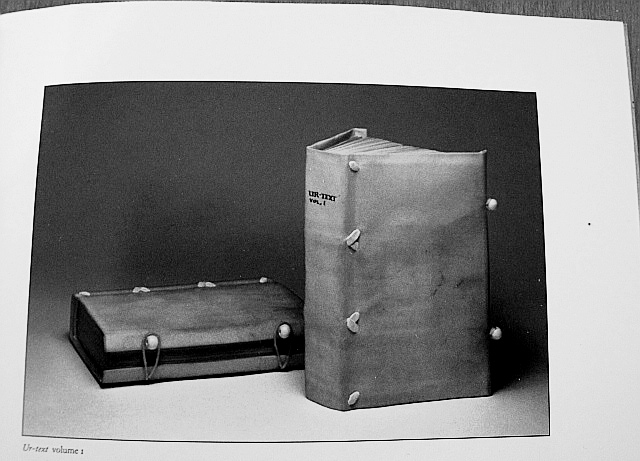
Of course this masterpiece of fetishism crafted with loving irony could never be an e-book:

Peter Koch’s Ur-text, Volume I

Its specifications read : ‘Peter Koch, Printer, 1994 …. Composed in Goudy Text type and printed on handmade paper watermarked with the press logo. Hand-bound by Daniel Flanagan. Sewn onto alum-tawed goatskin thongs, covered in calfskin vellum, with twisted calfskin and Tibetan bone bead clasps. Limited to 25 copies. 248 pp. 10.5 x 16.5 cm.’

The photograph appears beside a quotation from the hallowed past of books, in an essay by the printer-philosopher titled, ‘What I Think When I Think About What I Make’:

In 1540, Alejo Venegas, a Spanish Jesuit, defined the Book as ‘an ark of deposit’ in which, ‘by means of essential information or things or figures, those things which belong to the information and clarity of understanding (entendimiento) are deposited.’ After defining the book, Venegas introduced the distinction between the ‘Archetype Book’ and the ‘Metagraph Book.’ He called the first ‘exemplar’ or ‘dechado’ and the second, ‘transunto’ or ‘traslado’. The first is the uncreated book read only by the angels; the second is the book read by worldly human beings.

Do try and keep up, Nooks, Kindles, and the rest of you e-readers: the angels are waiting. … But seriously, could e-texts take us back to the essence of what a book is – the communication of thoughts and feelings – free of mercantilist calculation and manipulation, and capitalism’s reduction of publishing, too, to the

progressive commodification of life functions, market mediation in successive needs’ satisfaction …

……………………………………………….?

That final quotation is from an article in yesterday’s Guardian, ‘Capitalism has learned to create host organisms,’ by the Polish sociologist Zygmunt Bauman.