Daffy spring doggerel break: from a treasured comments archive on the net, and a beloved doggerelist

Daffodils: postgutenberg[at]gmail.com

daffy cornucopia 2


An experience of helpless laughter … one of the most memorable in that category, ever?

Blame a doggerelist’s contributions to a discussion of William Wordsworth’s best-known poem in a 2007 thread on The Guardian’s books blog, one with no shortage of literary scholars weighing in. It comes to mind every spring — with heartache. We miss the doggerelist, @cynicalsteve — a scientist with a fine Cambridge pedigree and excellent taste in literature; a dearly cherished, cherishing, invisible, net friend snatched before his time by the Reaper.

The tone for the most impish reactions in that comments section was set by an irreverent post by Sam Jordison:

Terrible poet – great museum

Wordsworth’s appalling ‘Daffodils’ seems to me a terrible advertisement for the Lakes. But the Grasmere museum is just terrific.

Before we reproduce a few choice extracts – not necessarily in the right chronological order: please quote this thread whenever you have to suffer yet another blinkered enemy of commenters claiming that virtually all web comments are the work of evil trolls.

Finally, research is supporting those of us insisting for about a decade that comment sections are often friendly and enlightening places. The New York Times reported last month that

Corinne A. Moss-Racusin, a psychology professor at Skidmore College […] and her co-authors Aneta K. Molenda and Charlotte R. Cramer analyzed comments from three sources (The New York Times, the Discover magazine science blog and a Facebook group for science buffs) … They found some encouraging signs: Positive comments were more common than negative ones.

And here’s proof … although anyone appalled by English schoolboy wit gone off-leash will please stop reading after the second comment by @freepoland:

cynicalsteve 25 Apr 2007 1:35

I thought it was only me that thought the daffodil poem was a piece of third rate doggerel. It’s main drawback is the schoolboy-like monotonous rhythm of the piece – “I WANdered LONEly AS a CLOUD…”

Anyhow, it’s much improved in the real schoolboy version:

I wandered lonely as a cloud That floats on high oer hill and dale When all at once I saw a pub And went in for a pint of ale.

liberaldogooder 25 Apr 2007 2:22

Seems just a little unfair to slag off a great writer by more or less sole reference to perceptions of their most popular work, which by its nature isn’t normally going to be their most challenging. (with Wordsworth ‘The Preludes’ already been mentioned, but then you have ‘Immortality’, ‘Tintern Abbey’, ‘The Leech Gatherer’, etc, where tons of stuff are going on under the hood). By these standards Dickens is a writer of sentimental childrens’ tales, Chaucer a teller of dirty stories and TS Eliot a dyed-in-the-wool registered cat fetishist.

But having said that it’s a great way to cause controversy – I think you should put up a thread entitled ‘Shakespeare was shit’, and then we can play ‘The Ride of the Valkryes’, as the ranters come down on you like a wolf on the fold.

Henuttawy 25 Apr 2007 4:08

Well I blame anthologies for endlessly re-printing “Daffodils”. It appears so often, we are led to think that it’s great verse. But I personally think it comes so perilously near to doggerel that I wonder if Wordsworth was actually being a bit tongue-in-cheek when he wrote it.

Still, I wouldn’t say that he’s the best of the Romantics anyway – not by a long, long way. Keats was much better. And Byron, of course.

freepoland 25 Apr 2007 4:16

Nobody has improved on J.K.Stephen’s commentary on Wordsworth:

Two voices are there: one is of the deep; It learns the storm-cloud’s thunderous melody, Now roars, now murmurs with the changing sea, Now bird-like pipes, now closes soft in sleep: And one is of an old half-witted sheep Which bleats articulate monotony, And indicates that two and one are three, That grass is green, lakes damp, and mountains steep And, Wordsworth, both are thine. […]

israelvisitor 25 Apr 2007 4:20

I like “Daffodils”; I even knew it by heart once. Not maybe one to be put to a class of ten-year-old boys, though, who would instinctively vie to be the most openly unimpressed by it.

The rhyme of “gay” with “company” could quite easily be seen as bold and innovative, for what it’s worth.

The wild daffodils beside Ullswater – were they the ones that inspired Wordsworth? – certainly impressed me, when I saw them in 1980: they are not your garden King Alfreds, but delicate little wild ones that do flutter in the breeze, and are present in seemingly illimitable numbers along the shore. (In this way they contrast with WW’s solitude – and I am sure that even in the pluvial Lake District, solitary clouds are to be seen.)

[…]

No, I don’t think “Daffodils” is a crap poem. I think it’s nice. But I’m aware that many would say that means the same thing…

freepoland 25 Apr 2007 5:39

… Wordsworth and money were a curious combination. Raisley Calvert’s legacy enabled him to live out an idyll at Dove Cottage, where it is usually said he did his best work. Later, he took Lord Lonsdale’s shilling and the post of controller of Stamps for Westmorland. Poets shouldnt be wealthy. His career trajectory was rather modern, and his ideals probably suffered, but it is difficult to locate a socialist poet in the period 1800-1850. Ideals were a good deal more cerebral than fifty years later. Above, I suggested he was not perhaps worthy of the title of 3rd best poet, but at least he had a crack at the epic, and The Prelude has some good things in it. A useful comparison is with Tennyson, whose command of the technicalities of language were as good as WW’s, but who reads Idylls of the King now? Undergraduates are still subjected to the Prelude, and usually come out with something worthwhile. My favourite is Michael, and if you stroll up Helvellyn out of Grasmere and sit down there to read it, you get a real feel for what Wordsworth thought of as the rustic life and its disappointments.

cynicalsteve 26 Apr 2007 4:51

I wandered, desperate for a piss Whilst walking by the Canyon Grand Dare I let fly o’er the abyss? Or should I use a rubber band….

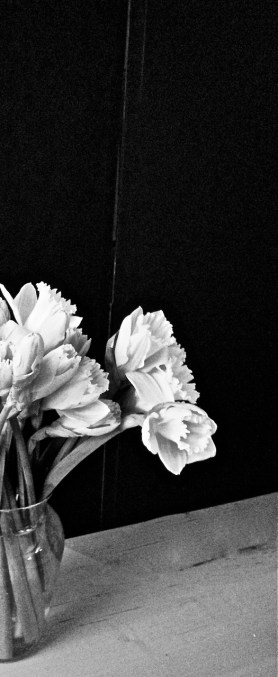
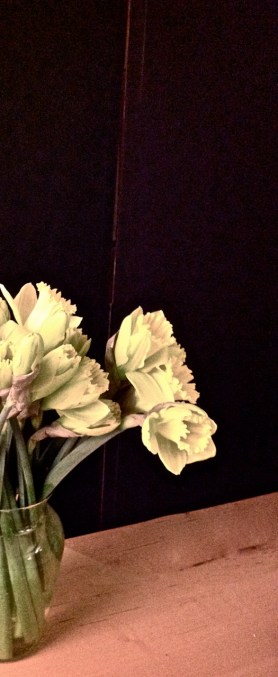
bouquet black backdrop


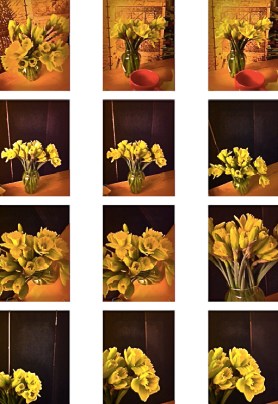
daffy long Screen Shot 2014-03-23 at 00.47.37

Could social, network-centred art knit sensuality, intelligence and the sublime into a John Heath-Stubbs love-at-dawn poem – or a Jane Wilson cloudscape?

IMG_6148

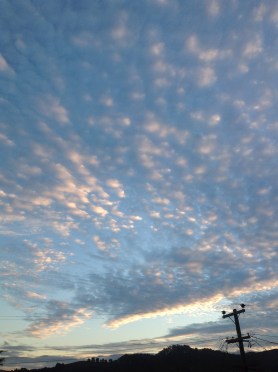
January sky  -- postgutenberg[at]gmail.com

January sky
— postgutenberg[at]gmail.com

Jane Wilson obituary in The New York Times, 20 January 2015

Jane Wilson obituary in The New York Times, 20 January 2015

As if bent on making sure that arts workers glimpsed nothing as frivolous as a ray of hope in entering a new year, the dear old Atlantic ushered in 2015 with this fanfare for a new order:

The Death of the Artist—and the Birth of the Creative Entrepreneur

Hard-working artisan, solitary genius, credentialed professional—the image of the artist has changed radically over the centuries. What if the latest model to emerge means the end of art as we have known it?

The pessimism of William Deresiewicz, who wrote the piece, is understandably fiercest in passages weighing the most common advice meted out to anyone instructing artists, writers, musicians and their kin about the digital transition:

“Just get your name out there,” creative types are told. There seems to be a lot of building going on: you’re supposed to build your brand, your network, your social-media presence. 

… Creative entrepreneurship, to start with what is most apparent, is far more interactive, at least in terms of how we understand the word today, than the model of the artist-as-genius, turning his back on the world, and even than the model of the artist as professional, operating within a relatively small and stable set of relationships.

Yet on the evidence in his well-argued essay, Deresiewicz neither sees nor proposes an alternative to accepting this – and accepts a future with no one crafting jewels like this poem:


THE UNPREDICTED

The goddess Fortune be praised (on her toothed wheel

I have been mincemeat these several years)

Last night, for a whole night, the unpredictable

Lay in my arms, in a tender and unquiet rest –

(I perceived the irrelevance of my former tears) –

Lay and at dawn departed, I rose and walked the streets

Where a whitsuntide wind blew fresh and blackbirds

Incontestably sang, and the people were beautiful.

John Heath-Stubbs (1918-2006)


This poet had no interest in fame — was, in the extreme degree, a solitary worker, and died all but unknown, except in certain poetry circles. He mocked ‘the kind of poet who follows literary fashion,’ according to a biographical note on the Poetry Archive site, He was pigeon-holed ‘first as a Romantic and then as a Classicist,’ but his work defied categorisation – ‘refused the labels critics tried to pin on it,’ and ‘often ran counter to prevailing currents’.

Scholarly critics are apt to draw attention to this failure to mould himself to any slot, even when classing ‘The Unpredicted’ as a species whose existence comes as a revelation to the non-expert reader – the aubade, ‘a song or poem about lovers parting at dawn’. That definition comes from a blog post on this form in The Guardian by Billy Mills –an Irish experimental poet and scholar – who wrote that ‘John Heath-Stubbs, in The Unpredicted, contrives to write an aubade that is both traditional and perfectly of his own moment’.

We at post-Gutenberg enjoyed encountering that description of the poem over a year after we came upon it we forget exactly where, and admired it enough to copy it into the back of our diary in January of 2008. Works of art and their makers always somehow mean more to us when we discover them independently – rather than by being lectured about their importance and place in the canon or, for that matter, by decisions based on counting ‘like’s.

To the joy of accidental discovery, in online life, we can add the more frequent delight of coming across similarities between modest records we make of some phenomenon or other — a striking thought, or a scene or image that arrests our attention — and an expert response to virtually the same phenomenon by a celebrated practitioner of an art or craft in which we claim no expertise whatsoever.

Deresiewicz only barely controls his irritation with the effect of putting digital equivalents of traditional tools of artistic creation into non-professional hands:

The democratization of taste, abetted by the Web, coincides with the democratization of creativity. … Everybody seems to fancy himself a writer, a musician, a visual artist. Apple figured this out a long time ago: that the best way to sell us its expensive tools is to convince us that we all have something unique and urgent to express.

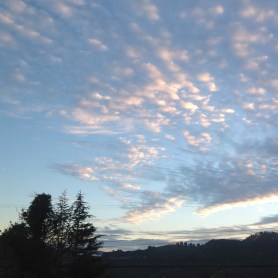
But that is surely the wrong conclusion. We might have absolutely nothing to communicate to anyone else when we turn to those tools. We might be trying to do no more than kiss a sunbeam, metaphorically speaking – when, say, glancing out of the window and being startled by back-lit and under-lit clouds turned epiphanic by a sinking sun.

We spent not much more than five minutes capturing what we could of the skyscape in the photographs in this entry. Imagine the surprise, two days later, of staring at Jane Wilson’s ‘American Horizon’ – over which she, with her paint and canvas, probably laboured for hours, if not days. Her record of what she saw is an artistic feat; ours, capturing what we spotted, the gift of digital cameras and fast reflexes.

We had no idea this striking Jane Wilson had ever existed before we read the obituary that accompanied the photograph of her painting. Now, we are trying to learn more about the evolution of her style.

Tentative conclusions about the Deresiewicz lament:

• Artistic loners like Heath-Stubbs will always exist to make the greatest true art: collaborative originality is rare enough to be virtually an oxymoron.

• The more amateurs – gifted or not – in the audience are allowed to share the stage, or deploy tools for art and craft, the keener and deeper will be their appreciation of mastery.

Think of sports fans. Think of how many David Beckham fans love him all the more for all their years spent kicking footballs in vain – knowing they have no chance of ever learning to ‘bend it’ remotely as he can. Football, like other sports, has always been democratic.


IMG_6142

Be kind to internet trolls who are not vicious in personal ways: one might just leave you a poem, some day

Brunngasse - photograph: postgutenberg[at]gmail.com

Brunngasse
– postgutenberg [at] gmail.com

Even Private Eye – considered an über-troll itself, by literal-minded readers and victims – has awarded trolling a few thoughtful column inches (Issue No. 1378) in the barrage of reports and comment on the subject in recent weeks. It mentioned someone complaining about a troll that ‘carried out a systematic campaign of abuse … calling us fat because we were enjoying eating the grass … and then finally he threatened to gobble us all up and crush us to bits, body and bone.’

Ah, trolls. We find ourselves smiling when we remember being part of a small circle formed spontaneously in the mid-‘00s, on a newspaper web site, to lobby the discussion monitors about reinstating a commenter in our group that they chronically misunderstood and banned – a teasing, free-thinking, occasionally hallucinating Anglo-Irish versifier and blogger they labelled a troll. One day, out of the blue, he posted a gift for us, his supporters: a flawless, beautiful, elliptical poem by another poet — Michael Donaghy, who sadly died at 50, in 2004. In plaiting together technology, music, literature and love, it may very well be unique.

The other day, it came as a welcome surprise to find several copies of ‘Machines’ on the net. Four winters ago, on a walk on which icicles were forming in stone archways, there was a sight that would have made anyone regret not being able to remember enough of that poem’s lines – a bicycle stand that simply had to be photographed without the right camera for snow or twilight, capable of making the photographer come close to taking a tumble, laughing silently about being introduced to ‘Machines,’ and by whom.

Thank you, Des. Thank you, Michael Donaghy, wherever you are: it is not in the least surprising to see the Poetry Foundation fill in this detail about you: ‘In addition to writing and teaching, he played the flute and the bodhrán, specializing in traditional Irish music.’

MACHINES

Dearest, note how these two are alike:

This harpsicord pavane by Purcell

And the racer’s twelve-speed bike.


The machinery of grace is always simple.

This chrome trapezoid, one wheel connected

To another of concentric gears,

Which Ptolemy dreamt of and Schwinn perfected,

Is gone. The cyclist, not the cycle, steers.

And in the playing, Purcell’s chords are played away.


So this talk, or touch if I were there,

Should work its effortless gadgetry of love,

Like Dante’s heaven, and melt into the air.


If it doesn’t, of course, I’ve fallen. So much is chance,

So much agility, desire, and feverish care,

As bicyclists and harpsicordists prove


Who only by moving can balance,

Only by balancing move.


Michael Donaghy, Dances Learned Last Night: Poems 1975-1995
 

Great spring harbinger; brief spring break

spring bend 2013 - photograph by MIL22

– photograph by MIL22

Darling Pietro,

We are supposed to be on a short working holiday

– but cannot stop thinking of

Y-O-U

After the tulip tree that is really a sort of magnolia

erupted in its pink-and-white-and-magenta concatenation,

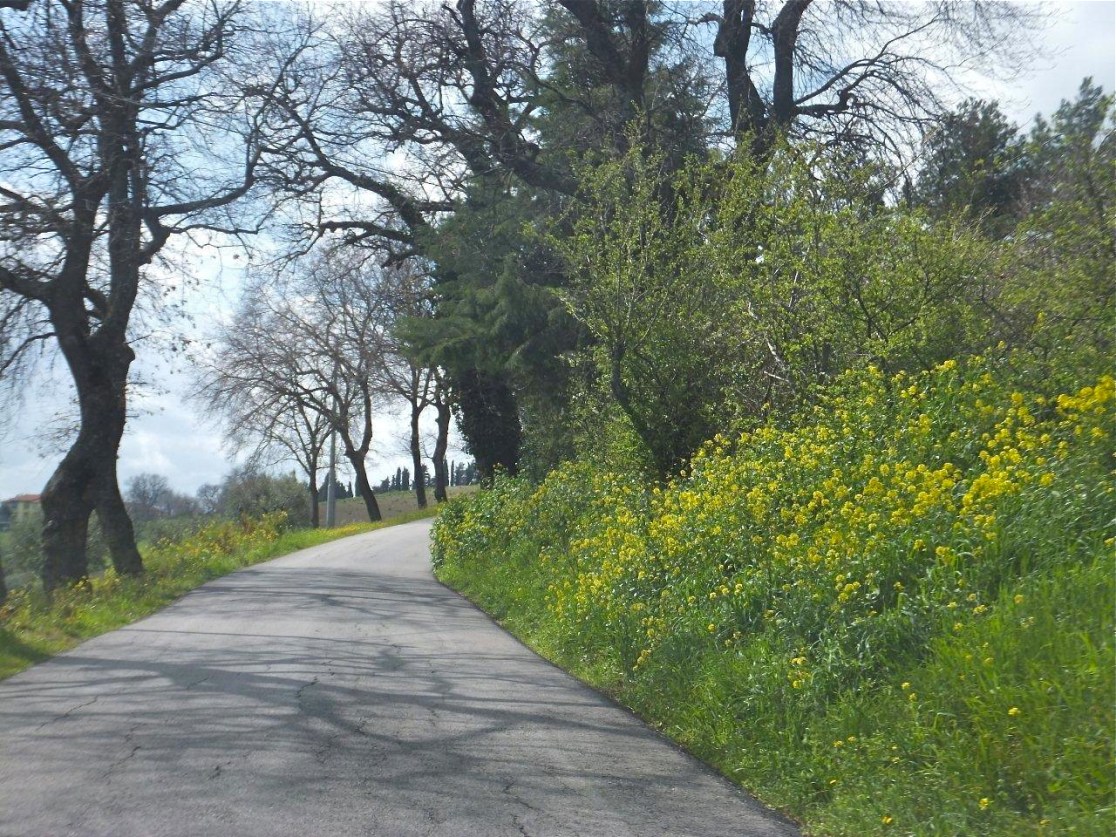
but before the wild mustard sang out in waves of rippling yellow

— weeks overdue —

Y-O-U

— perfectly on time.

Soon, you will be whizzing around that curve … as we, too many thousands of miles away, are gazing at …

mustard, finally 2 - photograph by postgutenberg[at]gmail.com

– photograph: postgutenberg[at]gmail.com

You, Pietro, born into a family that knows the secret-of-secrets better than most:

Keep a close eye on beauty, wherever you are, no matter what happens,

and it will see you through.

Though we, sadly, are no poets, we thought of a fine old one with words in the spirit of what we would like to say –

Labour is blossoming or dancing where

The body is not bruised to pleasure soul.

Nor beauty born out of its own despair,

Nor blear-eyed wisdom out of midnight oil.

O chestnut-tree, great-rooted blossomer,

Are you the leaf, the blossom or the bole?

O body swayed to music, O brightening glance,

How can we know the dancer from the dance?

— Among Schoolchildren, William Butler Yeats

Benvenuto, Pietro.

pear blossoms bark green leaves -photograph by postgutenberg[at]gmail.com

– photograph: postgutenberg[at]gmail.com