Google, bowing to social media, is letting down tomorrow’s Samuel Becketts

Before Google redesigned its search system, good but obscure blog posts often made happy landings. -- Bottle, message and photograph by Jay Little, scuttlefish.com

 [ part II:  part I is here ]

At a celebration in 2010 of the life of the late Norman Macrae, a notoriously wild visionary and deputy editor of The Economist, I learnt that he once tried to promote a nasal spray as a ‘cure’ for homosexuality. I was reminded of his quixotic mission when a flurry of offers to turn introverts into extroverts for the age of networking came up in search results for the title of last week’s post in this spot — about shy people and social media. These services would have seemed pointless before a Google announcement on the 10th. No longer. It is clear that the all-powerful search engine cannot now serve as the greatest boon and crutch, ever, for the socially averse.

Let me illustrate what Google was able to do for introverted writers – before it made its big mistake – by looking at problems in the career of Samuel Beckett. As I mentioned last week, I have been reading his letters , so addictive that they outrank all my other choices for entertainment, even with a wireless broadband link to the net. Having his words and defiant wit for company has helped to blunt the edge of my dismay about the reshaping of the online experience.

Gatekeepers at the pinnacle of publishing would have punched the ‘dislike’ button on Samuel Beckett’s submissions of his early work incessantly — had some version of today’s read-and-react tools existed in the late 1920s and ‘30s. Most improbable about those rejection slip years is that he was supremely well-connected at the time, serving for a while as the research assistant of his good friend, James Joyce. Among his rejectors were Leonard and Virginia Wolf, publishing under their imprint, the Hogarth Press. On 18 August 1932,  Beckett complained,

This month of creeping and crawling and solicitation has yielded nothing but glib Cockney regrets. The book came back from the Hogarth Press, and the poems, with merely the formal rejection slip. Nothing from L. W. He was out of London… I have good reason to believe that the MS never left London and that in all probability he never saw it. But he must have got my letter. Or perhaps it is his turn for the asylum. Anyhow tant piss. I then brought it to Grayson and Cape. It came back yesterday from Cape. Their readers’ report did not encourage them to make me an offer for publication rights. … So far no reply from Grayson. I saw Rupert Grayson when I went round, the ‘author son of Sir Henry’. And a  proper pudding he appeared.

You can sense him fending off despair with exalted rage and nastiness to entertain his friend Thomas McGreevy. I have quoted a mere fraction of the rejections he endured in that particular month. Because his years out in the cold did not go on forever, his anger reads like high comedy. That would be impossible for the epistolary record of, say, Vincent van Gogh’s failure, which had no end in his lifetime.

‘[W]hat is striking about Beckett before the years of “fame,” is how wary he was of the public dimension of the arts, even as he was attempting to gain this dimension for himself and his work,’ notes the introduction to Volume I of the Cambridge University Press edition of his correspondence. In his dealings with publishers, ‘his wariness turns into a disdain or hostility which is all the more notable in that his principal interlocutors at publishing houses tend to be intelligent, patient, learned, supportive, and gentlemanly.’

Yes, yes, …  and as the editors of these letters point out, those gatekeepers were ‘almost unimaginable in the cut and thrust of today’s trade publishing world.’ But they were useless as advisors. On 18 October 1932, Beckett reported, as usual, in prose abounding in impish linguistic play:

The Grayson Bros. were stimulated by my multicuspid stinker to return my MS, ‘circumscribed appeal … Gratuitous “strength”’ What is that? I replied soliciting favour of readers’ reports. Reply to the effect that there was no written record of condemnation, that … my book had been read by 3 most distinguished readers and discussed verbally with the Fratellaci [a play in Italian on the name of the publisher, Grayson]; that their advice to me frankly and without the least desire to wound was to lay aside A Dream of Fair to Middling Women altogether, forget it ever happened, be a good boy in future and compose what I was well-fitted to compose – a best-seller.

Just think of all the wasted time and emotional energy in his struggle. The predictability with which tickets for Beckett’s plays sell out around the globe today – even when the actors are not especially well-known – has proved that the young Samuel did contain the seeds of a Nobel prize winner whose work would indeed find the huge audiences equivalent to those of a bestselling book. But for that, no thanks are owed to the gentlemanly early judges.

They were rejecting writing in which the voice – or voices, themes, perspective and preoccupations – were original; far ahead of their time. It did not conform to the prevailing standards of literary merit. The range of taste on which those standards were founded was constrained by the smallness of the circle of  tastemakers — publishers, editors and other assessors of manuscripts who were mostly men of strikingly similar social backgrounds and education. So when they concurred in judging his work as having ‘circumscribed appeal,’ they were a bit like spaniels chasing their own tails.

And there you have a metaphor for the way print publishing has worked – with rare exceptions – for hundreds of years, until the coming of … search engines!  Suddenly, we could all revel in being able to read opinions and reviews of, and reactions to, texts and works of art from continents away, and from readers as different as possible from people we know well – thanks to the unprecedentedly objective and dispassionate sifting of texts by the information-seeking software we call search technology.

This detachment from the sources of information has been a surpassing agent of democracy – for all art and all knowledge.  ‘The internet enables far wider participation in front-line science,’ observes the astrophysicist Martin Rees, until recently, president of Britain’s most illustrious scientists’ club, the Royal Society, in a new book  about the net’s effects. ‘It levels the playing field between researchers in major centres and those in relative isolation, hitherto handicapped by inefficient communication.’

We got used to postings on blogs like this one — virtually undiscoverable before Google’s refinements of search technology — becoming like messages in bottles finding their way to surprising numbers of welcoming and sympathetic shores. For many of us, unbiased search engines have been so vital to our ability to do our work and reach others with similar interests and obsessions that the internet might almost be Google, as far as we are concerned.

I never met a more ardent fan of the old Google than myself.

But that has gone the way of most passionate love affairs. Last week, the New York Times described how Google has begun to link search results to social networking on services like Facebook and Twitter:

For instance, for most users, a search for “chikoo” would show links about and photos of an Indian fruit. But for friends of Mr. Singhal, it would also show photos and posts about his dog, Chikoo. A search for a sports team would show, in addition to the usual links, conversations about the team among a user’s friends on Google Plus.

When people search for a name, Google will highlight people who are friends with the searcher on Google Plus, or prominent people. And in searches for general topics, like “cooking,” Google will show Google Plus profiles of celebrity chefs on the right side of search results.

One dire effect of Google’s reliance on social media for search results will be to replicate and magnify the old gatekeepers’ spaniel silliness – which works much like the ‘confirmation bias,’ or people’s tendency to prefer and emphasise facts that support their beliefs and prejudices, spurning alternatives that might be closer to the truth.

Before Google tweaked its search system to elevate the conventional and familiar – and socially conformist – above the new, challenging and foreign, a web site’s obscurity or relative isolation would not necessarily bar it from appearing near the top of search results. That was because Google’s search system was designed to favour intellectual substance, and dependable statements of fact – based on the quality of a site’s links to other repositories of knowledge, opinions, and records of fact or effort.  Of course search technology could hardly rank or anticipate literary merit, but anything a contemporary Sam Beckett posted on the web would have had a decent chance of appearing with, at least,  some noteworthy answers to the huge range of possible search enquiries. There was hope for their reaching a far wider variety of judges than members of the old spaniel club.

Now, we must conclude from what we are told about the change in Google’s search techniques that an obscure Beckett of the wilderness years would have to dedicate a large and ever-growing portion of each day to chasing celebrity-status, and to building purely social connections – with the numbers of these mattering more than their quality – to be noticed and read at all.

As noted on this blog last week, relentless self-promotion and hobnobbing are unreasonable requirements of people temperamentally disinclined to socialising – the ones we call introverts. If they do not act against their instincts, the coordinates for their work – no matter how useful or admirable it might be – are condemned to fall steadily from public view. Just as in the bad old days, to them that already hath a lot – fame, attention, praise – more shall be given.

I am not sure what is more distressing about Google’s move – its coerciveness (Get busy on social media, or else!) or the narrowing of everyone’s frame of reference that it implies.

How can it be anything other than a colossal misuse of the world wide web, the supreme tool for broadening intellectual horizons – to make everyone more parochial, narrow, tribal, and inclined to pander to the lowest common denominator?

That strikes me as something like using a jumbo jet to pop in at the grocer’s and buy a bag of apples exactly like the ones you already have growing on the tree in your own back yard , then boiling them to pulp — but with a celebrity endorsement.


Will 2012 be the year of a great leap forward into media’s future — even at The New York Times?

Back to the future 1: barn-raising

Back to the future 2: the work of quilting bees -- Steven Heller

My new year will begin not with a resolution but a hope.

It has been a bit lonely, trying to persuade other people intimately acquainted with mainstream media to discuss specific proposals for media reform. But three short essays published in the last month – to which I am about to post links – show that I am in good company in suspecting that co-owning media with readers and viewers could be the most realistic route into the future. It is no longer quixotic to hope that the most rigid opponents of reform will give alternatives to the status quo a friendlier reception.

With any luck, I will soon be able to drop the subject of media restructuring from this blog because powerful media people persistently refusing to discuss it have, at last, picked up the torch.

My personal high-water mark for the media establishment’s resistance to the new dates from the spring of 2010, when I emailed a question to an editor near the top of The New York Times.

The press has been critical to the success of democracy as a form of government; how is it responding to its own democratisation, and how far would it be prepared to go on that road — voluntarily? If you could recommend the right person at the paper for these questions, I’d be immensely grateful.

Zzzzzzzzzing! … the editor’s reply came fast enough to set heads spinning:

I don’t know that anyone would have a specific opinion on this, at least not one that represented the Times in general. You might look to see if an editorial has ever been written about it. If not, I suspect your question doesn’t have an answer.  [my ital.]

No search engine brings up any such NYT editorial. What that response was surely supposed to impress on me was that ‘our’ never having addressed the question meant that it was inherently unanswerable.

Which is patently untrue – but that was then, and I cannot believe that anyone with a senior role in running the newspaper would respond so loftily today. The subject of co-owned institutions is not apparently off-limits for the editors there, as it is for large numbers of their fellow-citizens. Nor do they automatically dismiss it as ‘socialism’, very nearly a term of abuse in much of the U. S. — a fact that has always struck me as a bit odd about a country that is not only the home of capitalism and Ayn Rand’s woolgathering about the ‘virtues of selfishness,’ but of cherished memories of communal barn-raising and quilting bees.

On 14 December, the NYT  gave Gar Alperovitz, the author of America Beyond Capitalism, the chance to tell us, in ‘Worker-Owners of America, Unite!’:

[M]ore and more Americans are involved in co-ops, worker-owned companies and other alternatives to the traditional capitalist model. We may, in fact, be moving toward a hybrid system, something different from both traditional capitalism and socialism, without anyone even noticing.

Some 130 million Americans, for example, now participate in the ownership of co-op businesses and credit unions. More than 13 million Americans have become worker-owners of more than 11,000 employee-owned companies, six million more than belong to private-sector unions.

Out in the blogosphere, these posts were waiting to be discovered:

In a 9 December entry on the site of Harvard’s Nieman Journalism Lab, Tom Stites, the president and founder of the Banyan Project — which is building a model for web journalism as a reader-owned cooperative focusing on local news — asked: ‘Might the new web journalism model be neither for-profit nor nonprofit?’ He said, in part:

In this era of rampant deceptive business practices,[…] a significant source of co-ops’ strength is the trustworthiness inherent in their democratic and accountable structure.

This is also an era of rampant mistrust of journalism, so co-op news sites’ trustworthiness has the potential to add value to what they publish. Further, the co-op form allows, or rather demands, that news coverage decisions arise from the what a community’s people need rather than from today’s dominant approaches […] The web is inherently collaborative — just as co-ops are — and at the local level this creates the potential for civic synergy that could add still more value to co-op community journalism.

On 19 December, Jeff Jarvis, a new media expert, suggested that The New York Times should consider using a ‘reverse pay meter’.

As I ponder the future of The New York Times, it occurred to me that its pay meter could be exactly reversed. I’ll also tell you why this wouldn’t work in a minute. But in any case, this is a way to illustrate how how media are valuing our readers/users/customers opposite how we should, rewarding the freeriders and taxing—and perhaps turning away—the valuable users.

[…]

Imagine that you pay to get access to The Times. […] But whenever you add value to The Times, you earn a credit that delays the next bill.

»  You see ads, you get credit.

»  You click: more credit.

»  You come back often and read many pages: credit.

»  You promote The Times on Twitter, Facebook, Google+, or your blog: credit. The more folks share what you’ve shared, the more credit you get.

[ … and several other suggestions along these lines …]

He said in closing:

Readers bring value to sites if the sites are smart enough to have the mechanisms to recognize, exploit, and reward that value, which comes in many forms…

Regular visitors to post-Gutenberg.com will have noticed a striking overlap between the essence of the Stites and Jarvis schemes and the proposal for a ‘keiretsu-cooperative’ as the ideal structure for media of the future. (New readers will want to see: The Keiretsu-Cooperative: A Model for Post-Gutenberg Publishing.)

May this most welcome parallelism lead to actual change — soon.

In the meanwhile,  Happy New Year!

A reply to Richard Stacy: the keiretsu-cooperative is at the opposite pole from a ‘walled garden’

A keiretsu-cooperative for Santas? Despite the mist, they were travelling too fast to ask

Since I posted this entry, Richard Stacy has written ‘A Futher Reply …’ well worth reading, and I have responded in his comments section, also explaining why post-gutenberg.com is unfortunately not open for commenting.

Richard,

I have enjoyed thinking about your answer. It has been impossible to discard this idea for a keiretsu-cooperative because practical people – including, as I am about to explain, a young technologist working for Barack Obama  – keep telling me that it could just work.

First and quickly, some clarifications: the keiretsu-cooperative would let large conventional publishers collaborate to share the costs of setting up — or extending — a publishing and discussion site designed to attract the indie writers we call bloggers. To enlist the help of these bloggers and make the site a success, the large publishers would allow each of them to acquire a small financial stake. The stake could take the form of a subscription to the site. No one would be excluded from reading or looking at the site’s contents, so it would not be what you called, in the first, fast, version of your reply, ‘a walled garden.’ I mention this because it is a misconception that keeps cropping up elsewhere, but what I have in mind is at the other pole. Stakeholders would have just two important advantages over those who chose not to subscribe: (i) chances to participate in the management of the site and vote on decisions affecting it; (ii) a share of any future profits. You might not agree, but I do not see any of this as inconsistent with your vision of media being transformed from a collection of rigid and exclusive institutions to a process – since the keiretsu-cooperative would be flexible, mutable and inclusive, with porous boundaries.

Publishers could test co-ownership inexpensively by running an experiment in a comments section of an existing site.

It was never my ambition to be a designer of futuristic structures for publishing. This proposal for ways of injecting ‘plurality’ into the ownership of publishing simply grew out of observing for five years how much commenters contributing posts to a ‘liberal’ newspaper resented being censored — not for obscene or rude remarks, but for challenging in civil tones the paper’s vested interests, both the political and commercial varieties.

I wondered, when did we ever give newspapers the right to tell us what thoughts were acceptable? I found myself reading widely about the start of the social revolutions we know as the Renaissance, for which the newly-invented Gutenberg press acted as a fulcrum. My most startling discovery was that censorship was practically invented with printing. Of course that seemed obvious after a few moments’ reflection, but what it underlined, for me, was the extent to which control of the levers of mass communication – or what we call the media – can undermine democracy, even in societies proud of their tradition of licensing free speech.

Then I considered another question: what arrangement for running media could best accommodate a democracy’s need to give people the facts they must have to vote wisely?

I was pleased to find your paper for proof that someone in the business world has also been reflecting on today’s crisis in publishing with history for a lens. From a realm far removed from mine, you reached the identical conclusion: that today’s leaders in traditional media are failing to understand that ‘[P]ower and influence in the world that is now forming […] will have a tendency to exclude any forms of institutional interference, control or ownership.’

Another new media consultant, like you, surprised me by instantly grasping the logic of the keiretsu-cooperative. Anil Dash, a 36 year-old technocrat entrusted by the White House with leading Expert Labs – a non-commercial organisation helping Barack Obama to democratise governing by exploring ways of using digital tools to let citizens assist the government with their expertise – sent this reaction to the scheme:

This is a topic that’s near and dear to my heart, since I’ve worked at a newspaper and helped making new publishing platforms online.

[…]

I have had far too many years in the trenches with the cynics and the naysayers and the slowly-failing publishers. But what I *love* about the idea is that it’s new, and provocative, and not the same old proposals we hear bandied about all the time.

A lot of the dialogue is dominated by the legacy issues of older publishers, and that makes it hard to propose relatively radical new ideas.

I think you accurately capture the motivations of all the parties involved, and I share your optimism that various parties would want to pay for participation.

He did have one reservation:

[W]here I struggle a bit … is in seeing an iterative path that gets us to this eventual keiretsu. I am not sure if we can make incremental steps, or if we have to start with this radical new point all at once, but I do think the former is a lot easier to get funded than the latter.

I do hope you’ll pursue this, though.

In last week’s entry in this blog, I mentioned that I was waiting to hear from another correspondent, ‘A’. I wanted to know whether it was ever part of his collaborative publishing plan to offer readers (not just editorial staff, early investors and managers) the opportunity to become stakeholders in the thriving specialist magazine, The Journal of Light Construction (JLC), that he developed with a few partners – and which has at the heart of its online site a lively forum for exchanging technical information. His reply said, in part:

The “readers” (more on that in a moment) of JLC were going to be the primary people offered ownership of the company (remember my mention of a DPO [direct public offering]?). After all, the company was really little more than a pot into which all of them had tossed their experience, know-how and money. How could it not be theirs to own?

Regarding the “readers” thing…this seems to be the biggest intellectual hurdle the old-media, Gutenberg folks have to overcome. Print, TV and most radio are a one-way, I’ll-give-you-what-I-want-to-give-you-when-I-want-to-give-it-to-you street, when the “customer’s” (more on that in a moment) need is to-have-what-I-want-when-I-want-it. From a business perspective you will note the potentially irresolvable dichotomy between media’s mission statement and that form of practice.

[…]

Regarding the “customers” thing, see the paragraph above…and note that the internet is a two-way street. The one-way signs no longer apply. Just as its advent revealed print in that realm is dead, so is “the customer.” There’s a community on that block, and they’re all in it together. So remember, look both ways before crossing.

No sooner had I digested that than an announcement from Amazon.com popped up in my email inbox. It was about Kindle Select, a new addition to its Kindle Direct Publishing enterprise for independent writers of e-books:

We’re excited to introduce KDP Select – a new option dedicated to KDP authors and publishers worldwide, featuring a fund of $500,000 in December 2011 and at least $6 million in total for 2012!  KDP Select gives you a new way to earn royalties, reach a broader audience, and use a new set of promotional tools.

Here’s how KDP Select works:

When you make any of your titles exclusive to the Kindle Store for at least 90 days, those with US rights will automatically be included in the Kindle Owners’ Lending Library and can earn a share of a monthly fund.  The monthly fund for December 2011 is $500,000 and will total at least $6 million in 2012.

[…]

How your share of the monthly fund is calculated:

Your share of the monthly fund is based on your enrolled titles’ share of the total number of borrows across all participating KDP titles in the Kindle Owners’ Lending Library.

This is a very different proposition from the keiretsu-cooperative, but the schemes do overlap in giving writers a financial incentive – by way of micropayments – to participate in a type of collaborative publishing experiment. I am still making up my mind about the attractiveness of Select. Though I am on record as a fan of Kindle Direct Publishing, I do not like Amazon’s requirement that writers who join this new scheme give it exclusive rights, even for 90 days. I would be more attracted by a plan that gave writers some say in the running of Kindle Select. Amazon also tends to be stingy with information about how it manages its e-book publishing – refusing, for instance, to explain its system for ranking e-books in various categories.

I think you would agree, Richard, that plurality, transparency and accountability are the forces we want to see shaping publishing in the future.

But at least this news from the book retailing giant is proof of its continuing willingness to stick its neck out for a bold experiment. Google also experiments endlessly – promptly euthanising ideas that prove to be duds.

New media specialists like these do understand that adventurousness is the key to success. Old media institutions, as you point out, only feel safe making small, incremental changes. You and ‘A’ could easily be singing in two-part harmony on this point:

Alan Rusbridger at The Guardian has talked about involving “Our Readers” in producing “Our Product”.  The problem is that news is no longer Alan’s product – it belongs to the people (he likes to call) readers and it doesn’t really live in fixed places (websites, newspapers) anymore, it lives in digital spaces (Google search terms).

As the oldies are more inclined to trust leaders in tangible, bricks-and-mortar businesses, they could do worse than consider the innovative appliance king, James Dyson. He was told by every vacuum cleaner manufacturer under the sun that his ‘business model’ for selling a dirt sucker without a dirt-collecting bag was unworkable – even if such a product could ever be designed and made to work. He and his engineers discarded thousands of prototypes on their way to success …  of which I am now a sub-microscopic beneficiary. Last year, the 25 year-old Electrolux in my house was replaced by a yellow-and-purple Dyson with a look of R2D2 about it. It works like – yes, the dream with which James Dyson began.

I think it’s too soon to conclude, as you suggest, that ‘media may be becoming something that can’t actually be owned in a way which allows any form of monetary benefit’. If you mean, owned by a privileged few, or moguls like Rupert Murdoch and Conrad Black, I agree, but not if you mean, shared by a large, loosely affiliated group of citizens. How could you, or any of us, know? There simply have not been any experiments exactly like, or closely resembling, the keiretsu-cooperative – so far.

Here is a song I suggest that old media types might try singing together at their meetings about surviving the future (with apologies to Cole Porter):

Experiment.
Make it your motto day and night …

Experiment and you’ll see. 

P.S. I almost forgot to say — by my definition, you are a blogger, just as you are a writer, in a part of your life – since I think of a blogger as being anyone who publishes unmediated texts on the internet, including comments on newspaper and other sites. ‘A rose by any other name,’ etc..

Co-owning media is on the horizon — and press coverage of the Leveson Inquiry shows why we need this

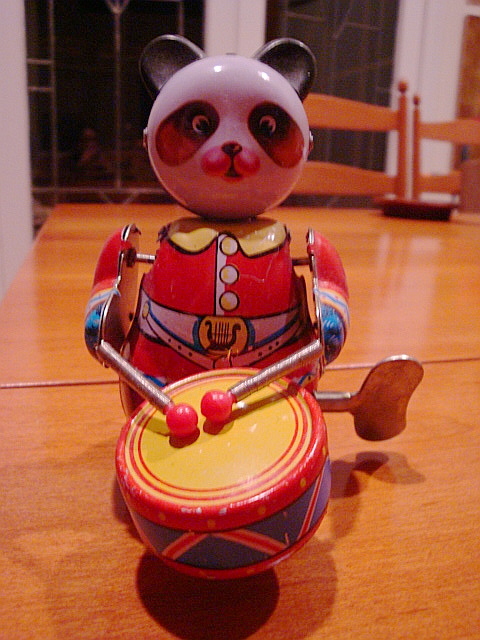
Panda drummer: who can speak?

Blindly they saw themselves and deaf they heard —

But who can speak of this?

        –Farid ud-Din Attar, The Conference of the Birds, 12th c.  A.D.

                 Persian trans. by Dick Davis and Afkham Darbandi, 1984

A stranger, someone astute and entrepreneurial, emailed me about a comment posted in a discussion about the future of journalism on the site of Harvard’s Nieman Lab. ‘I think you’re on the right track with your focus on the business-model issue,’ he said.

He was referring to an outline of a means for old media organisations to move into post-print publishing in a Networking Age in which readers want to be more than passive audiences – to do more than influence stage management and be free to perform themselves. I set out a scheme for turning readers into financial stakeholders or co-owners – experimentally, at first, on parts of newspaper sites – suggesting that this might be an ownership structure for the future.

The essence of the idea was that every subscription would also be a share or financial stake in prospective profits. It would be an inducement for each reader or viewer to help bring many more visitors to a site. It would both help the site owner to attract more advertising and – implicitly – reduce dependence on advertising, if the concept of subscription-stakes caught on and went viral.

‘I tried an experiment along the lines of the one you are proposing,’ my correspondent continued. ‘It was a tremendous success … as far as it went.’

I shall call this correspondent ‘A’, as he does not want more recognition for what he did than his fellow-experimenters. The link to wallets and handbags for their plan was so clear that it had venture capitalists salivating. The idea was to monetise a publication and online forum on building for professionals and amateurs – an offshoot of the Journal of Light Construction (JLC), a magazine now 24 years old that is also the marquee name for a popular trade show. You can tell that it is thoroughly up-to-the-minute from the table of contents, where the offerings can range from ‘Pouring Complicated Slab Foundations’ to ‘Promoting Yourself With YouTube’.

The Journal of Light Construction

The forum on the magazine’s website is divided by specialisations. Each section has its own moderator – and in an innovation I have seen nowhere else, the specialist’s name is posted prominently beside the category. When the combined on- and off-line components of JLC were on their way to becoming a publicly traded company roughly ten years ago, ‘A’ and his confederates introduced the possibility of making JLC’s contributors and employees co-owners. I do not yet know whether readers would also have been invited to become stakeholders. If ‘A’ sheds any light on that question after he reads this, I will include what he says here with any other details of the adventure and corrections of this account.

For the moment, it is enough to say that the idea of co-ownership so appalled the lead investment banker working on the public offering that the whole plan was scuppered. The points ‘A’ most wanted to impress on me were these:

Ownership can be transferred at any time. The trick is to have something worth transferring first. … There could be NGO funding possibilities from which a larger community trust with cooperative member ownership could emerge…

And that, strangely enough, is very close to the proposal for a ‘keiretsu-cooperative’.  A publishing enterprise with a thriving community of reader-commenters could easily progress to sharing ownership of the commenting sites where readers already supply most of what there is to read or watch.

It would ask that many newspapers make just one more leap forward after this change announced by the New York Times last week, but already in place for some time on other digital news sites:

We have started using an improved comment section. It will put readers’ responses on the same page as the article, provide threading of comments so readers can respond directly to one another, and allow them to share their comments and those of others, to Twitter and Facebook.

To understand why readers want more than that, I recommend an excellent paper, ‘Gutenberg and the social media revolution,’ by a new media consultant, Richard Stacy**, which puts all these developments in their historical context, then offers a clear-sighted vision of the way ahead. Serendipity led me to it last week, when it came up with some Google links to my own site. His conclusion:

It is unlikely that power and influence in the world that is now forming will lie in the control of channel.  Instead it will be vested in forms of community, which will have a tendency to exclude any forms of institutional interference, control or ownership.

He also said,

It is not that people are going to reject institutionalised trust, but the task of sustaining institutionalised trust is going to become much harder in the world of transparency brought about by social media.

I would welcome anything that reversed my own fast-diminishing trust in mainstream, 21st-century journalism’s ability to live up to the ideals of the Fourth Estate – of which the highest are impartiality and rigorous self-scrutiny. To my dismay, most of  the British media – not just the tabloids – have failed to report every important criticism of the media made in the hearings for the Leveson Inquiry, except for the sensational details of the phone hacking scandal.

Giving evidence last week, Alastair Campbell, Tony Blair’s political adviser and communications director – that is, chief ‘spin doctor’ – did draw attention to some problems of the very greatest importance:

The. principle of the freedom of the press is always worth fighting for. The quality of that freedom however is questionable when the quality of so much journalism is so low, and when so few people — just a handful of men until now seemingly unaccountable to anyone but themselves and to anything but their own commercial and political interests – have so much say over the tone and nature of public discourse, and so much responsibility for the decline in standards. It is also worth fighting therefore – politicians, journalists and public alike – to change the press we have.

What he said before that at considerable length – about the collapse in standards – was not addressed in any press report of the Inquiry I have seen.  A former editor of the Daily Telegraph, Max Hastings, said in his 2002 memoir about his career that it is the job of a political press officer ‘to act as a purveyor of half-truths to the nation’s journalists, but it is the business of the journalists to seek out the missing 50%.’

At least half of what Alastair Campbell said is true and his critique deserves intense scrutiny and wide discussion by the press – in public. It dovetailed perfectly with the testimony in the same week by Nick Davies, the freelance writer for The Guardian who broke the phone hacking story and pursued it with ferocious determination. He said unequivocally that the press can no longer be trusted to regulate itself.

Is a thorough airing of such opinions possible with today’s media ownership structure? Is it possible when the authority to disseminate the information people need in a democracy — to make decisions for the common good — is concentrated in so few hands?

Surely we need a new ‘business model’ – of which the keirestu-cooperative could be a very rough first draft – not just to accommodate readers in their wish to share the stage, but to protect our form of government?

______________________________________________________

** who has already posted a magnificent response to this piece on his own site. I shall be replying in next week’s blog entry – underlining some of his points and clarifying aspects of the keiretsu-cooperative that have been imperfectly transmitted (mea culpa). I will put that up sooner than next Tuesday if I can interrupt what I am writing off-line.