
One hundred posts, but many more kudos to Annalisa Piras and Bill Emmott for a post-print work of genius focused on Italy

giac b+w title

<i>Girlfriend in a Coma</i> encourages viewers to join its creators in knocking down and neutralising ‘Bad Italy’ – a podgy monster, in Phoebe Boswell’s conception of it

Girlfriend in a Coma urges viewers to join its creators in neutralising ‘Bad Italy’ – a podgy monster, in Phoebe Boswell’s conception

Phoebe Boswell

Phoebe Boswell
photograph by Sky Arts

[…an inadvertently belated appreciation…]

Our 100th post-Gutenberg entry amounts to a standing ovation for two old media journalists — one Italian, the other English —  who have unzipped their imaginations to create a model of transmedia fence-jumping, using digital tools to communicate subtler and more penetrating information than can be transmitted through either conventional opinion journalism or documentary film-making.

The key to realising their extraordinary ambitions for their collaborative video production, Girlfriend in a Coma, was the free hand they gave a hair-raisingly original and gifted young British artist and animator, the Kenyan-born Phoebe Boswell. Hers is a talent that had us scribbling the names of the manically brilliant English cartoonist Gerald Scarfe, his ghoulish American kindred spirits, Edward Gorey and Charles Addams, the Alice in Wonderland illustrator Tenniel, and Salvador Dali, as we ruminated about influences.

Girlfriend is based loosely on Good Italy, Bad Italy (2012), a contemporary portrait in a book by Bill Emmott, The Economist’s editor from 1993 to 2006. He is listed in the video’s credits as co-writer and co-director with Annalisa Piras, credited as director, and the prime mover behind the project. She is about ten years younger than Bill, who happens to be a former colleague of p-G’s remembered for true and exemplary collegiality. This makes it not in the least surprising that – as well as he plays his part as the video’s unassuming narrator, and as much as the narrative is technically filtered through his memories of Italy, his thoughts, and his feelings about Europe’s high-heeled boot — the production is saturated with a wildness and emotional intensity so unlike him that they could only have been conjured by his collaborators. Bill is clearly a first-rate encourager.

Annalisa (as referring to Bill as Emmott feels awkward, we’ll dispense with surnames) has explained how she sketched Girlfriend’s essential requirements for Phoebe and Jenny Lewis, Phoebe’s partner in animating her drawings and imaginings: ‘the Italian characters — the Good Italy, based on the female image since Roman times, the Bad Italy, a thug wearing a “Pulcinella” mask from the Commedia dell’Arte — and the ideas I wanted to convey, and they ran with it.’

Actually, they flew. Annalisa stayed closely involved: frame by frame, they flew together. (See updated Q & A about ‘the making of …’ here.) The result made p-G, a jaded lifelong observer of Italy, sit up and marvel, as if for the first time, about the paradox of a country easily seen as a screaming basket case — as far as economics and politics go — somehow managing to hold its place, for decades, among the world’s leading economies. If this trans-documentary has a single flaw, it is that it fails to offer an adequate explanation for the Italy that, against long odds, has not merely survived but often prospered mightily in modern times. But this is beside the point for Girlfriend — mistakenly slated by some critics for a lack of balance. It is a call to arms. It is a manifesto for the reform of a deeply marvellous but also staggeringly corrupt, inefficient, uncaring and misogynistic society.

Not that anything as dreary as ‘consciousness-raising’ remotely describes its tone. This is set by Phoebe’s surreal, dreamlike imagery, briskly intercut with footage frequently shot from clever camera angles that recalls the films of Michelangelo Antonioni, especially Blowup, and micro-clips from interviews – the interviewees as diverse as high-ranking politicians, Mafia prosecutors, all-too-understandably outraged feminists, top industrialists, historians, political theorists, the irresistible novelist-philosopher Umberto Eco, workers and inmates in a home for the disabled – that justify the video’s charming frame.

And what is that?

Italy is presented to us as a girl with whom Bill fell helplessly in love as a tourist in his student days. Not any old girl but an ethereal and languorous jeune fille who happens to be a touch eccentric, neurotic to the core, and assailed by homicidal inner demons – encapsulated in the figure of the mega-ogre with the Pulcinella mask. She has, for him, come to fit the skin-crawling title of a pop song by the Smiths; a girl so severely afflicted as to end up, virtually, on artificial life support.

No wonder Girlfriend was financed as an indie project – by Annalisa’s own company, Springshot Productions. Though her potted biography mentions her education in Rome in history, politics and cinematography, and two decades of shooting documentaries while she also served as the London correspondent of L’Espresso, we cannot imagine any part of the old media establishment backing such a commendably outlandish project.

That does say something disappointing in the extreme about the reluctance of our dominant communicators to get to grips with the future. Fear of the unfamiliar in other quarters – among arts reviewers – could also explain why p-G is writing about Girlfriend nearly a year after its release in Europe.

We learnt of its existence by accident, last month – having been mostly cut off from news about arts-and-letters at the time of its launch last November. Online searches show that though it did indeed cause the intended stir in Italy, at the loftiest levels, and was shown in art cinemas and nominated for awards in European cities, it has so far failed to be noticed for the right reasons. Though it has had some laudatory reviews in the Anglosphere, including a rave here and there, these have mostly been short (a single glowing paragraph in The Financial Times, for instance). Where, we have been wondering, are the lavish allocations of column-inches that this trans-documentary deserves? The colour photo-spreads? The probing investigations on the front pages of arts sections of how Annalisa, Bill and Phoebe came to be the pioneer-collaborators they are? The questions about their insights into the evolution of post-print media?

Funny, to say the least, that no one apparently saw plenty to write home about in watching the calm, gently reasonable ex-editor of a well-known magazine drifting in silhouette through shadowy stone arches, up and down dark stairways that evoke dungeons — sequences near the start of his narration that evoke both the vicious underside of Italy that includes the Mafia, and our narrator’s own unconscious mind.

Are we being invited, in this segment, to believe that Italy is where Bill’s muse or — from one perspective in psychological theory — anima, in the form of this Girlfriend, resides? Later in the video, one of the readings from Dante Alighieri that interrupt the narrative periodically goes, ‘O lady, you in whom my hope gains strength.’  This is stimulating allusiveness. In the hands of Girlfriend’s creative quartet, it hugely enhances all the information it packs in – is sophisticated, successful sugar-coating for the flow of statistics, miniature history lessons and political science lectures that barely register as anything so dull.

Some highlights (not necessarily in the right sequence):

• Blisteringly incisive insight and commentary in clips from interviews with Roberto Saviano, a (now) 34 year-old investigative journalist and novelist obliged to live in hiding, under police protection, from Mafiosi infuriated by his revelations. His handsome shaved head, winglike black eyebrows and dark eyes shot in stygian gloom are in perfect harmony with the sinister animation sequences.

• Bill talks to the intellectual and left-leaning Canadian-Italian industrialist, Sergio Marchionne, who made his name by restoring the fortunes of Fiat; who hopes that we will see the evolution of a healthier form of capitalism, and says that ‘People who engineer the free market have a responsibility to keep it clean.’ His point is underlined by the words of Dante – reaching us by way of the disembodied voice of the actor Benedict Cumberbatch – to which we listen looking at a panorama of industrial sprawl, probably Turin: ‘[Y]our avarice afflicts the world:/ it tramples on the good, lifts up the wicked.’

• Maurizio Viroli, a slender, elfin professor of political theory at Princeton sits at a dining table talking to us over the remains of what appears to have been a simple, vinous meal all the more delicious for its informality. He points out that the three main leaders of the 19th-century Risorgimento or ‘resurgence’ that created modern Italy – Cavour, Mazzini, and Garibaldi — ‘had a deep religiosity inspired by currents of Protestanism – Jansenism.’ He adds that ‘all three were critical of the Catholic attitude of making deals with those who are powerful,’ and he mainly blames the Catholic Church for the besetting national flaws, ‘sloth and moral weakness’.

• Sad, wraithlike, girlish figures sketched by Phoebe rise from Lake Pellicone, a dramatic expanse of blue set in a rock-walled canyon. Dante’s lines, here: ‘This miserable way / is taken by the sorry souls of those / who lived without disgrace and without praise. / They now commingle with the coward angels, / the company of those who were not rebels / nor faithful to their God, but stood apart. /’ In the rocks above the water, in another superimposed animation, the demonic ogre bashes Bill’s girlfriend.

• Bill cycles around a deserted, sparkling Ferrero chocolate factory, dressed in one of a succession of dapper outfits, many in brilliant colours that recall swinging ‘60s London. The ghastly, thankfully deposed Silvio Berlusconi, three times Italy’s prime minister – who did not keep his promise to appear in the film — was apparently thinking of Bill’s appearance as well as his politics in nicknaming him ‘Lenin,’ yet the cumulative impression he makes is a hybrid of Agatha Christie’s brainy Hercule Poirot, Charlie Chaplin in Modern Times, and Amélie’s beloved globe-trotting garden ornament in the film by that name.

Not many experimenters with post-Gutenberg communication will have either the funds or connections to match the excellence of the musical sound track, or engage the likes of Cumberbatch for poetry recitations. What any of us can still learn from Girlfriend is the importance of re-conceiving from scratch our presentation of what we want to say; of not merely pouring well-worn forms and conventions for shaping information into new-media bottles, but grabbing the chance to communicate what was virtually impossible to communicate before about non-fictional places, events and people.

As far as we can tell, Girlfriend is as scrupulously factual as the finest old-fashioned print journalism. But it exploits special capacities of moving pictures to show us how the facts about its subject impress and affect its chief observer and fact-gatherer, Bill, drawing us beneath the surface of hard reality into psyche – with the animation sequences drawn and directed by Phoebe ensuring a clear demarcation of the boundary between the actual and the strictly impressionistic. One parallel for such innovativeness that we mentioned in a recent post is Carl Djerassi’s revisiting, re-sifting, and powerful re-enlivening of the mental preoccupations and lives of pre-war intellectuals in his Four Jews on Parnassus – by recasting them as dialogue; as a spikily argumentative conversation.

This appreciation of Girlfriend will end with a whiff of the uncanny. A day or so after we first watched it, we kept thinking of Blowup, and wondering why. After we had tapped a tentative explanation into a keyboard, we went to the Wikipedia looking for the year of the film’s release – 1966, and there was a New York Times arts correspondent attributing part of critics’ reaction to this ‘stunning picture’ to the way it is ‘beautifully built up with glowing images and color compositions that get us into the feelings of our man,’ its photographer-protagonist. No, there was nothing uncanny about that discovery. The spine-prickling came from being told something we never knew, in the same Wiki entry. Antonioni had used as the backdrop for Blowup’s carnivalesque opening scene (below) the plaza of a London office building — part of a streaky-concrete-and-glass specimen of Brutalist architecture — where we had once toiled long past sunset, years after we had forgotten details of the film. … And that was the office where, bizarrely, we once worked with Bill.

Did Girlfriend’s collaborators have Blowup in mind when they were mulling over the look and feel they wanted for their project? We must remember to ask.

Screen Shot 2013-09-21 at 00.23.13

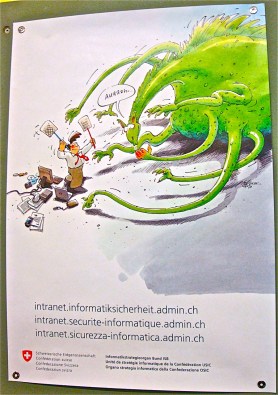
The message from ‘High tech’s missionaries of sloppiness’ about blogging’s future status is encouraging. As for its transformation of computer (in)security – bah!

One lovely child of flawed software: poster in an office of the Swiss Federal Department of Foreign Affairs, Bern, postgutenberg@gmail.com

One lovely child of flawed software:
poster in an office of the Swiss Federal Department of Foreign Affairs, Bern, postgutenberg@gmail.com

Seven years ago, Elinor Ostrom — a winner of the 2009 Nobel prize for economics — cited an article on computer unreliability in a paper on knowledge-sharing that she wrote with Charlotte Hess. The angry essay they mentioned ran in late 2000 in an e-zine, the online magazine Salon. Their thirty-nine citations included only one other in a general-interest publication, a decades-old New Yorker piece by E. B. White.

More on that in a moment …

Long before print journalists shrank from crediting or citing blogs as sources of good ideas and information, they refused to acknowledge debts to e-zines and other online-only publications. If they gave them any credit at all, it was for being brave enough to dip their toes in the digital future – in which, from print’s Olympian perch, it seemed as if these pioneers were bound to fail. Their cold-shouldering will soon have to end, thanks to the example set by unprejudiced, fair-minded thinkers.

In post-Gutenberg’s experience, intellectual greatness is in direct proportion to the trouble a powerful brain worker takes over acknowledging useful information or inspiration found absolutely anywhere – whether or not the source meets old-fashioned, conventional criteria for respectability. Only shallow snobs care about labels.

With a quotation of just three words about a growing ‘culture of carelessness,’ Ostrom and Hess directed readers of their paper about obstacles to sharing research findings to the Salon article — ‘High tech’s missionaries of sloppiness’ (‘HTMOS’) — whose subject has been making front-page headlines, lately.

For instance, yesterday’s ‘Chinese Hackers Resume Attacks on U.S. Targets’ followed by only a few weeks a long profile in the same newspaper about the über-Cassandra on this topic, an octogenarian computer scientist called Peter Neumann who is leading a team of researchers trying to make computers less vulnerable to security breaches. His interviewer noted that

… the increasing complexity of modern hardware and software has made it virtually impossible to identify the flaws and vulnerabilities in computer systems and ensure that they are secure and trustworthy. The consequence has come to pass in the form of an epidemic of computer malware and rising concerns about cyberwarfare as a threat to global security …

We would name the newspaper we have quoted in linking to it, as we usually do, except that we are trying to make a point about the churlishness of print journalists’ tendency to – shall we say, forget to credit e-zines and blogs as sources. In April, the same daily ran an opinion piece by a hacker-turned-security-consultant, Marc Maiffret, who made our eyes pop in one paragraph (our italics):

The unspoken truth is that for the most part, large software companies are not motivated to make software secure. It’s a question of investment priorities: they care more about … developing the latest features and functions that consumers and businesses are looking to buy.

Unspoken, eh?

‘High tech’s missionaries of sloppiness’ certainly spoke, twelve years ago:

A culture of carelessness seems to have taken over in high-tech America. The personal computer is a shining model of unreliability because the high-tech industry today actually exalts sloppiness as a modus operandi.

[…]

American companies accept “good enough” quality for the sake of speed. Being first to market with new products is exalted as the highest goal here, and companies fall back on huge technical support and customer service staffs to cope with their many errors of commission and omission.

“Don’t worry, be crappy,” was how Silicon Valley veteran and pundit Guy Kawasaki expressed the same idea two years ago, in a speech that won him a standing ovation.

Programmers, hackers, and technologists of every stripe were incensed by the Salon essay. After a link to it was posted in the week of its publication on Slashdot.org — then the most popular computerists’ chat-forum – they swarmed aboard, so furious that at least a third of the posts denounced the author of ‘HTMOS’ as ‘he,’ in spite of her unambiguously female name. The explosion was partly owed to the genius of Andrew Leonard, the Salon editor on the job, who barely scratched the piece’s text but wrote its headline and dreamt up a standfirst borrowing none of its actual words, which read,

Computer companies specialize in giving consumers lousy products — it’s the American way of techno-capitalism.

Maiffret and his editors might simply have failed to check the antecedents for his condemnation of Silicon Valley’s lack of interest in safe computing. A lone editor from the print world, Simon Caulkin – renowned in British journalism not just for his talent but peerless integrity (and a former colleaugue of the Salon contributor) – did cite ‘HTMOS’ in one of his Observer columns on management, titled, ‘Software must stop bugging us’.

For the most part, it is in books and university curricula that the essay has been marked for attention. Even if the world is still a long way from curing computers of their flaws, the citations that come up on the first page of Google results for the essay’s title are in, for instance:

Adapting Buildings and Cities for Climate Change, Sue Roaf, David Crichton and Fergus Nicol, Routledge, 2012

Why Programs Fail – A Guide to Systematic Debugging, Andreas Zeller, Elsevier, 2009 [also a Google e-book]

Geekonomics: The Real Cost of Insecure Software, David Rice, Pearson Education, 2007

Quality software project management, Robert T. Futrell, Donald F. Shafer and Linda Isabell Shafer, Prentice Hall Professional, 2002

‘HTMOS’ also continues to find its way into arguments between technophiles, as in 2007, on the site of the ‘Central West End Linux Users Group’ – where it was used to slap down a debater who declared airily, ‘Every OS [operating system] has its faults. Pick your poison.’

That Ostrom-Hess paper with which this post began was, as it happens, about tribalism getting in the way of sharing information critical to human life – in microbiology research. The authors noted, in their abstract, that ‘there are many, diverse participants in producing and consuming information who often have conflicting interests …’.

Conflicting interests indeed. It is obvious from the rarity with which print journalism acknowledges good work published online in e-zines and blogs that its workers are afraid of their new competitors. And then, of course, programmers are not particularly fond of that article. We at post-Gutenberg are not much interested in conspiracy theories, but could not help smiling when we noticed that someone at both The Observer and Salon appeared to have gone to pains to make it harder to find ‘HTMOS’ and the Caulkin column on flawed software. The London newspaper misclassifies his eloquent jeremiad with the work of a political writer, Madeleine Bunting. And for years, the Salon essay has been indexed not with its collections of pieces on computers, software or Silicon Valley but under ‘AUTO INDUSTRY, ENTERTAINMENT NEWS’.

Of course we imply no conspiracy… the culprit could only be a dear little sloppiness gremlin piling up overtime hours.

Bloggers’ rights, and blogging vs. traditional journalism: let a hundred flowers bloom and a hundred schools of thought contend

'Let a hundred schools of thought contend' postgutenberg@gmail.com

‘Let a hundred schools of thought contend’
postgutenberg@gmail.com

'Let a hundred bloggers bloom' postgutenberg@gmail.com

‘Let a hundred bloggers bloom’
postgutenberg@gmail.com

Blogging as one of our rights to free expression was the subject of an important and excellent ARTICLE 19 paper published earlier this month. ARTICLE 19 ‘is an international human rights organisation, founded in 1986, which defends and promotes freedom of expression and freedom of information worldwide.’

Highlights — to some of which we have added extra emphasis, in italics:

Who is a blogger?

In the most basic sense, a blogger is any person who writes entries for, adds materials to, or maintains a ‘blog’ – a web log published on the Internet. Blogs allow anyone to self-publish online without prior editing or commissioning by an intermediary (e.g. someone like a newspaper editor). They can be immediate and also anonymous if the blogger so desires.

What matters most about the right to blog?

Blogging plays an invaluable role in the free flow of information worldwide. It enables a true exchange of information in ways that traditional media did not in the past. It also allows an immediate sharing of information with its audience and immediate feedback. It represents a valuable form of alternative journalism and is an example of the Internet’s ‘democratisation of publishing.’

In the 21st century, many bloggers will take their place as watchdogs, alongside traditional media. The international community and individual states must develop protection for bloggers, just as they have developed protection for traditional media, despite the many constraints. Throughout history, the traditional media have obtained protection as a group although, at the individual level, many members of the media are not concerned with advancing public interest. Similar protection must be provided to bloggers.

How are bloggers different from journalists?

ARTICLE 19 has long argued that ‘journalism’ and ‘journalists’ should not be defined by reference to some recognised body of training, or by affiliation with a media entity or professional body.5 We have argued that journalism is an activity that can be exercised by anyone, and that it is important that any legal standards and principles applicable to the activity should reflect this.

In particular, the definition of the term ‘journalist’ should be broad to include any natural or legal person who is regularly or professionally engaged in the collection and dissemination of information to the public via any means of mass communication.

At the same time, any person who seeks to publish information on matters of public interest should benefit from the same protection and privileges given to professional journalists under existing case law, including prohibiting any requirement for journalists to be registered, requiring the authorities to investigate attacks on them, and protecting their sources.

Key recommendations

– Relevant legal standards should reflect the fact that ‘journalism’ consists

of disseminating information and ideas to the public by any means of communication. As such, it is an activity which can be exercised by anyone.

– Any definition of the term ‘journalist’ should be broad, to include any natural or legal person who is regularly or professionally engaged in the collection and dissemination of information to the public via any means of mass communication.

– Bloggers should never be required to obtain a licence to blog.

– Bloggers should never be required to register with the government or other

official bodies.

– Accreditation schemes must meet international freedom of expression standards and should ensure that:

– all applicants, including bloggers, who meet the minimum requirements defined in the law should be automatically issued with a ‘press’ facilitation card;

– press cards should only be required to get access to events or premises where there is a clear need to limit attendance based on limited space or the potential for disruption;

– the conditions for obtaining a press card should be based on the overall public interest and not on considerations such as affiliation with a professional association or degree in journalism.

– Legal commentators, including bloggers, should be allowed to use social media from court rooms if the hearings are open to the public.

– To the extent that they are engaged in journalistic activity, bloggers should be able to rely on the right to protect their sources.

– Any request to disclose sources should be strictly limited to the most serious cases. It should be approved only by an independent judge in a fair and public hearing with a possibility of an appeal.

– State authorities must guarantee the safety of bloggers using a variety of measures, including the prohibition of crimes against freedom of expression in their domestic laws.

– States must take reasonable steps to protect bloggers and other individuals actively engaged in online communities when they know or ought to know of the existence of a real and immediate risk to the life of an identified blogger as a result of the criminal acts of a third party;

– State authorities must carry out independent, speedy and effective investigations into threats or violent attacks against bloggers or other individuals engaged in journalistic activity online.

– The laws governing the liability of bloggers, including defamation law, incitement and other speech-related offences, must comply with international freedom of expression standards.

– As a general rule, bloggers should not be held liable for comments made by third parties on their blogs in circumstances where they have not intervened or modified those comments.

– For certain types of content, for example content that is defamatory or infringes copyright, consideration should be given to adopting ‘notice-and-notice’ approaches whereby bloggers would be required to pass the complaint to the original maker of the statement at issue, without removing the material upon notice.

– The term ‘duties and responsibilities’ in Article 19 of the ICCPR and Article 10 of the European Convention must be interpreted flexibly to take into account the particular situation of the blogger in question.

– Bloggers should not be forced to abide by the ethical codes or codes of conduct developed by traditional media and should not be coerced or given an incentive to join self-regulatory bodies for traditional media.

– Bloggers may decide to follow the ethical standards of traditional media of their own accord. They can also develop their own code of practice either for their own blogs or for associations they voluntarily join. Alternative dispute resolution systems should also be encouraged.

– When bloggers produce a piece for a traditional newspaper, they should be subject to the newspaper’s editorial control, and abide by the ethical standards of journalists.

Could a pope getting respect on atheist blogs make co-operatives his weapon for fighting poverty?

Might co-ops help to correct Rupert Murdoch’s delusional prediction and become Pope Francis’s silver bullet?

Might co-ops end the reign of press barons like Rupert Murdoch and become Pope Francis’s silver bullet?

It began as a lament about the disposal of a mountain of spring weeds, the conversation that got us thinking about the new Vatican leader’s inaugural promise to ‘embrace with tender affection the whole of humanity, especially the poorest,’ and his wish expressed elsewhere to see ‘a church that is poor and for the poor.’ He sounds remarkably like someone on an Occupy soapbox. But unlike members of that well-meaning but chaotic movement, he has a massive organisation behind him to help point followers in the right direction.

We have been astounded by the evidence search engines supply of wide interest in a Christian spiritual figure among so many typically secular intellectual institutions – The New Yorker, for instance — and stretching as far as blogs like one called Non-Prophet Status declaring, ‘Why this atheist is (tentatively) optimistic about Pope Francis’. Soon, he could win a popularity contest with the Dalai Lama, among non-believers.

There was even a surprise for us close to home. Though there have been no Catholics among our blood relations for three generations, one scrupulously apolitical member of our family about the same age as the pontiff, and paying close attention, insisted last week that the papal mission was doomed. ‘Because,’ he explained, ‘most of the world is poor and always will be. As he won’t be able to make any difference to the impoverished far outnumbering everyone else, why choose certain failure?’

While we considered that opinion, a question occurred to us: what single lever could Pope Francis choose to concentrate on, to prove the pessimists wrong? What might be his equivalent of the Lone Ranger’s silver bullet?

Unexpectedly, an answer suggested itself not long after we heard from a grizzled, kindly Greenlander living on the edge of San Francisco about his reason for being incensed by an argument with his local garbage collector. This rubbish-disposal engineer, on his weekly round, had haughtily spurned, then left behind, several giant plastic bags into which the Greenlander’s neighbours had taken pains to squeeze a towering weed-pile. No bags, he said. Nothing but greenery.

When the Greenlander appealed for mercy — an exception made for neighbours who were still newcomers, the haul-away man said it was time that they learnt the rules.  No, the Greenlander said later, shaking his head, the smelliness of the work did not excuse the man’s unfeeling intransigence. ‘Don’t you know how much money these garbage guys make? A fortune!’

The next person to enter the conversation filled in some fascinating details. He said that the average income of a rubbish collector working for Recology, the dominant garbage company in the region, is $80,000 – or roughly twice the salary of the average American schoolteacher or policeman. Though we have not, so far, been able to check the precise accuracy of that number, we suspect that it is correct, or nearly so, because it was part of a case handled by our informant, a lawyer with a good memory.

We thought this salary fair, and said as much. Imagine the stench for mile after mile, working on a trash-collecting truck in summer heat! But then came a bigger – and even more welcome – shock. Recology is entirely employee-owned. Historically, its workers had ancestry in common with Pope Francis. This cooperative’s website says :

Our company’s roots have always been in recycling and employee ownership.

[…]

The original Bay Area garbage men, or “scavengers”, came to San Francisco from Italy in the late 19th century. At that time, scavenging in San Francisco was a disorderly and inefficient business. Hundreds of independent collectors competed for business. The 1906 earthquake and fire temporarily improved business, but did little to bring order to the chaos of garbage collection.

The website boasts that Recology has an outstanding record for innovation, and one item on the list it offers as proof suggests a startling interest in the radical 1960s Arte Povera (art from poverty) movement in Italy:

The world-renowned Artist in Residence Program in 1990 allowing local artists to find materials in our processing facilities to create art.

… Anyway, we were, as we said, reminded by this chat of Pope Francis committing himself to helping not merely the indigent but ‘the weakest, the least important, …’. Could there be a better salve for the lowly status of garbage-collecting than a bank balance honestly earned through joint ownership?

Post-Gutenberg began as a spinoff of a paper setting out a detailed proposal for saving journalism from the machinations of press barons like Rupert Murdoch through a ‘keiretsu-cooperative’ – owned by workers and customers.

Pope Francis, being a Jesuit, a member of the religious order famous, for centuries, for being frighteningly intelligent, would know about the remarkable success of huge cooperatives in, for instance, Switzerland. He would certainly stand a far better chance of pushing a new cooperative movement than any blink-and-you-miss-it blog like ours, or any of the pundits making the case for employee ownership on newspaper sites often, but to little avail – so far.