Zounds! At last print, led by The New York Review of Books, picks up the real surveillance story: the NSA and GCHQ spooks are followers, not leaders

24/7 surveillance: eyes, cameras, mirrors … cameras in and behind mirrors? - postgutenberg[at]gmail.com

24/7 surveillance: eyes, cameras, mirrors, clear and fuzzy views … cameras in and behind mirrors?
– postgutenberg[at]gmail.com

Not for ages has there been a pudding quite as over-egged as the one presented as the news story of 2013 – the Orwellian mass surveillance exposé which, as it unravels, shows the UK and US governments hardly initiating nonstop monitoring but, rather, striving to keep up with companies like Facebook, Apple, Microsoft and Google in gathering intimate information about us and watching what we do.

Why are you learning about this on a blog, not on the front page of any well-known newspaper? Because any dissenting voices in the new ‘participatory media’ – the blogosphere, online-only journals, social networking sites and other evolving sources of facts – are still drowned out by the megaphones of the brand names at the top of the old media pyramid, names we were brought up to revere. Until those amplifiers are shared through a formal restructuring of media ownership and operation – which could be a long wait — correcting misguided and misleading information will tend to be maddeningly slow, no matter how big the story.

Two of the finest of the old guard, The Guardian and The New York Times, have yet to give any sign of noticing the shifting narrative about surveillance. This is unsurprising. They love the attention they have won from pinning Big-Brother-run-amok behaviour exclusively on the UK and US governments, and the hailstorms of congratulations from commenters and colleagues in other parts of the media that they unwittingly led astray. Both newspapers chose – apparently without much critical thinking – to gratify Edward Snowden’s wish to be fêted as a hero for torrential leaking of extremely sensitive information related to national security. 

The clearest de-bunking of the myth constructed from the Snowden leaks has come from The New York Review of Books – it so happens, after someone at post-Gutenberg wrote late last November to two editors on that publication, the editor-in-chief, Robert Silvers, and the one in charge of covering technology. The email was not about mass surveillance. But it did include a link to this blog when our home page displayed more than one post deconstructing the souped-up hullabaloo with our usual careful citations, and pointing to corporate technology giants as the round-the-clock watchers we should really be worrying about – even if the NSA appears to have outdone them in spying techniques (see yesterday’s ‘N.S.A. Devises Radio Pathway Into Computers’ in the NY Times).

In the week in which we communicated with that rightly esteemed publication, the NYRB’s contribution to the discussion was ‘The NSA’s Threat to Global Free Speech,’  to be followed shortly by ‘The Snowden Leaks and the Public,’ and ‘The NSA on Trial’. In fact, searching on ‘NSA and NYRB’ brings up a first page of Google links to articles in that publication last year all singing the same tune as The Guardian and The New York Times.

Then came an abrupt switch in direction. … Was it a mere coincidence that last week, about six weeks after the NYRB received a web address for post-Gutenberg — and roughly as long as it takes a publication as methodical as that Review to put together a report — its site featured a piece titled, ‘How Your Data Are Being Deeply Mined’, beginning,

The recent revelations regarding the NSA’s collection of the personal information and the digital activities of millions of people across the world have attracted immense attention and public concern. But there are equally troubling and equally opaque systems run by advertising, marketing, and data-mining firms that are far less known. Using techniques ranging from supermarket loyalty cards to targeted advertising on Facebook, private companies systematically collect very personal information, from who you are, to what you do, to what you buy. Data about your online and offline behavior are combined, analyzed, and sold to marketers, corporations, governments, and even criminals. The scope of this collection, aggregation, and brokering of information is similar to, if not larger than, that of the NSA, yet it is almost entirely unregulated and many of the activities of data-mining and digital marketing firms are not publicly known at all.

Compare that with part of our own offering on the subject, in the week we wrote to the NYRB,  titled, ‘In the shift “from God to Google” do we want our spooks stuck in the age of typewriters …?’:

The Guardian – railing ad nauseam about spooks — is oddly tongue-tied about corporate surveillance. The explanation for this is surely the potential embarrassment of having to admit the true extent of the newspaper’s own monitoring of its readers’ behaviour.

[…]

Onora O’Neill, a down-to-earth philosopher — specialising in justice, public trust and accountability – who is also a member of the House of Lords (Baroness O’Neill of Bengarve) commendably unaffiliated to any political party, is one of the few sounding this particular alarm. ‘Insofar as [government spies at the NSA and GCHQ] collect content, I might be … worried,’ she said recently, ‘but by the same token I would worry equally about Facebook, who collect content, and in particular a lot of personal content.’

The NYRB added, in the same report on data mining:

[W]e may be more concerned with government surveillance than with marketers or data brokers collecting personal information, but this ignores the fact that the government regularly purchases data from these companies. ChoicePoint, now owned by Elsevier, was an enormous data aggregator that combined personal data extracted from public and private databases, including Social Security numbers, credit reports, and criminal records. It maintained 17 billion records on businesses and individuals, which it sold to approximately 100,000 clients, including thirty-five government agencies and seven thousand federal, state, and local law enforcement agencies.

Again, compare that with a point made here earlier. Last September, this blog warned that the blinkers needed to come off too many commentators on the NSA and Britain’s GCHQ – to let them appreciate that we should be protesting not just about spooks but anyone amassing personal data about us. In an entry about reader-commenters on newspaper sites correcting the unbalanced coverage of mass surveillance, we said:

Stores of information, once they are gathered, can acquire new owners. 

By the end of 2013, when the Guardian and New York Times were running editorials campaigning for the virtual canonisation of Snowden, the Guardian’s commendably independent-minded sister publication, The Observer, was changing tack in the same direction as the NYRB. The standfirst for an editorial there read: ‘Digital behemoths have perfected surveillance as a business model.’

Did the ‘digital behemoths’ scream in protest about that attack on nonstop surveillance as their ‘business model’? On 30 December, The Guardian, perhaps in sympathy with their plea – and conceivably worried about losing its own right to spy on readers, justified as market research — actually ran a blog post by an American academic, titled ‘The primary NSA issue isn’t privacy, it’s authority’:

[O]nce we say some amount of data is too much to have, then we will end up debating the line around too much knowledge and that is a line I never want to see drawn. If we start to say that bad things can happen merely if knowledge exists, then too soon we fall into the trap of controlling the extent of knowledge – who may know what and how much they may know and thus who may say what to whom.

Imagine how the spooks at the NSA and GCHQ must have smiled about reading that.

N.B.: As we post, The Guardian site has a lamentation by Senator John McCain about ‘overreach’ by the NSA. In a menu of other offerings in the right-hand column on the same page, there is this bit of clickbait: ‘US will not enter bilateral no-spy agreement with Germany … Despite assurance from Barack Obama, United States has not ruled out bugging political leaders’ calls, claims German paper.’

We somehow doubt that much of what the NSA or GCHQ do will change, after a crowd-calming interlude of more or less cosmetic modifications of their practices. Spies can no more stop spying with every available advance on James Bond’s arsenal of gadgetry than journalists can stop wheedling secrets out of sources with charm, or casinos discourage impulsive and compulsive gambling, or prostitutes start dressing like nuns …
‘Mass surveillance’: a top spook is allowed an intelligent and revealing say, at last

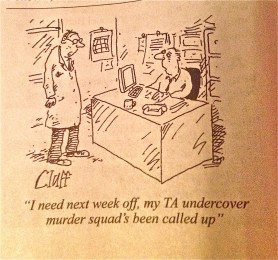
With the apparent arrival of see-through spying, can transparent black ops be far behind? - 'Cluff' for Private Eye

With the apparent arrival of see-through spying, can transparent black ops be far behind?
– ‘Cluff’ for Private Eye

As this is not really a personal blog, let us say simply that, for the second December in a row, we find ourselves grieving. Two losses. Two who could not be closer to us: she, just after Christmas, last year; he, last week.

He could be morose and rage like thunder, yes. But laughter was what came to him most naturally. He would have loved this enlargement of a drawing at the bottom of an inside page of a recent Private Eye that there was no time to send him. For weeks, we’d been discussing — in wondering tones — exactly how the spies of Britain’s GCHQ and America’s NSA were going to do their jobs ‘transparently’ with members of the judiciary and politicians breathing hotly down their backs.

He, with an insider’s knowledge of these things – in another part of the world – would have warmly endorsed points made by a former top spy in the aftermath of the Snowden leaks. David Omand is the one truly thoughtful debater who, as far as we have noticed, has been given a chance to make the case for the other side of government data-gathering about ordinary citizens to a politically liberal audience. We have not seen his reflections given any space in the newspapers**, but paid close attention to what he said at a forum organised by the Labour Campaign for Human Rights – ‘GCHQ and the fight against terrorism: did UK surveillance go too far?’ — where the speakers included the Wikipedia founder Jimmy Wales. Here was an event that made us think — at long last, balance.

Not as an endorsement, just good food for thought, an extract from live reporting of the event by a Guardian reporter — part of David Omand’s contribution to the conversation at the Houses of Parliament on 17 December:

7.14pm GMT Sir David Omand, the former head of GCHQ, speaks next.

He is speaking on his own behalf, he says.

He says these revelations would not have come as a shock if the Guardian had done more homework – “there are books written about all this stuff”. There is a lot of “synthetic shock horror”, he says.

7.17pm GMT There is increasing demand for more data about criminals from law enforcement, Omand says.

Supplying those demands is driven by the ever-improving electronic communications devices.

The ethical constraints are the third key force here, he says. It is our legitimate concern for privacy that constrains how such data is used.

We should be looking for a point of stable equilibrium between these three forces, he says.

Much of what has been reported about what Snowden stole has been misleading, he says.

A “major category error” runs through the Guardian’s reporting, he says. It is journalistic sleight of hand to confuse access to fibre-optic cables with mass surveillance. “We are not actually subject to mass surveillance in this country”, but we are “blessed” with an intelligence community that has “bulk access” – but that is different, he says.

7.23pm GMT

He has seven points to make.

He believes in human rights and the privacy of family life.

But also of protecting the weak from those who would harm them.

For a long time we have sanctioned intrusion by law, he says. The European convention on human rights states that states have the right to protect their citizens, but there has to be oversight and investigation of abuse, and redress if abuse is found.

The scale of change needed to deal with the internet by law enforcement today needs to be recognised, he says. It is the medium of choice for enemies of society because it offers multiple means of hiding your identity, Omand says. Complete anonymity is not desirable and should not be a policy goal, he says.

The security services should be able to find and access the communications of those who mean to do us harm, he says. You need powerful tools for that, and that’s where bulk access comes in, and if you don’t allow the services those tools, you won’t be able to stop the terrorists.

You should be proud that in this country we have people of the skills and dedication to be able to do this, he says.

Oversight and regulation and judicial determination that the actions are lawful are also necessary.

In this security space it would be absurdly self-defeating to inform suspects they were under surveillance or tell them how they were. So the authorities cannot be transparent – “they can however be much more open about the purposes of this activity and the nature of the work that is being done”, he says.

You don’t need to read the Guardian to find out about this – it was already out there. For some reasons government was reticent about giving a full account, he says.

So the ISC [ the Intelligence and Security Committee of Parliament ] will have to continue to have private sessions, he says.

7.26pm GMT

[…]

If you follow those seven steps you end up with a sensible agenda for change, Omand says.

[…]

Speaking personally, he says he didn’t devote most of his working life to fighting the cold war in order to introduce new totalitarianism, all-knowing mass surveillance.

** A quick post-posting check shows that he was permitted to contribute an opinion piece about the Snowden leaks on the Guardian site in September — but with low reader interest guaranteed by its placing in the Comment-is-Free section with commenting turned off. Erm — well, yes.

Kudos to The Register for dusting off its 2004 prediction that the spooks would soon take to watching us with Google’s panoptic lens

It should be general knowledge that newspapers spy on readers: Guardians that live in King’s Cross glass houses should not throw … - photograph by MIL22

It should be general knowledge that newspapers spy on readers: Guardians that live in glass houses should not throw … (ahem)
– photograph by MIL22

Guardian HQ, King's Cross -- photograph: vice.com

The Guardian, King’s Cross, London
photograph: vice.com

Why does this blog, post-Gutenberg, care about the mass surveillance kerfuffle? Mainly for the fun of noting the post-print 5th Estate — bloggers, reader-commenters, chatters on geeky online forums and other small voices — exposing the misinformation delivered in confident, booming tones from sections of the old media establishment, the 4th Estate.

A usually intelligent American friend uncharacteristically obtuse about government surveillance – we’ll call him Playah, in this post – believes the misinformation, distortions and mis-cueing. He takes as virtual gospel all the pompous finger-pointing at US and UK spooks for supposedly inventing Orwellian-grade spying on us. He really does believe that the secrets leaked by Edward Snowden matter because they are news – not, as we do, because of their vast destructive scale and specificity, apparently designed to maximise their usefulness to enemies of the Anglosphere and its allies.

In his misplaced trust, Playah has millions of others for company – people, some of them rather important, who ordinarily pay so little attention to conversation in the techie world as to be willingly taken in by Al Gore’s claim to have invented the internet, or the canard that gives Steve Jobs credit for the computer revolution (discussed in an earlier entry here).

We include obscure techie publications like The Register in the 5th Estate. No one – certainly at The Guardian – has given any sign of having seen a piece dated 7 November, titled, ‘How Google paved the way for NSA’s intercepts – just as The Register predicted 9 YEARS AGO’.

We only stumbled on it serendipitously, in checking search engines for our own remarkably similar (non-prescient) post on the subject last week.

Much hilarity has greeted [Google chairman] Eric Schmidt’s deeply sincere “outrage” at his “discovery” that the NSA was spying on Google. For example, Vanity Fair pointed Mr Schmidt to some helpful Google searches.

But the NSA is merely treading in some well-worn footsteps – some of which were made by Google itself. Let us refresh your memory of one of the most prescient and chilling pieces of prediction in the last decade. For all this was forecast here at The Register in early 2004 – nine years ago.

In early 2004, Google launched Gmail. Gmail performed an automated interception of your email, and – having scanned the contents and guessed at its meaning – ran contextual advertising alongside it.

Former security advisor Mark Rasch, an attorney who had worked in the Department of Justice’s cyberfraud department during the Clinton administration, and was writing for Security Focus, raised a very interesting problem. If Google could search through and read your email without explicit legal authorisation, then surely the security agencies could do the same.

Rasch argued that Google had redefined the words “read” (“learn the meaning”) and “search”, which protect citizens, when it unveiled its new contextual ads service. It had removed explicit human agency from the picture. An automated search wasn’t really a search, and its computers weren’t really “reading”.

“This is a dangerous legal precedent which both law enforcement and intelligence agencies will undoubtedly seize upon and extend, to the detriment of our privacy,” forecast Rasch, here, in June 2004.

“Google will likely argue that its computers are not ‘people’ and therefore the company does not ‘learn the meaning’ of the communication. That’s where we need to be careful. We should nip this nonsensical argument in the bud before it’s taken too far, and the federal government follows.”

Remarkably, Rasch even suggested where the security services might most effectively put this into practice.

“Imagine if the government were to put an Echelon-style content filter on routers and ISPs, where it examines billions of communications and ‘flags’ only a small fraction (based upon, say, indicia of terrorist activity). Even if the filters are perfect and point the finger only completely guilty people, this activity still invades the privacy rights of the billions of innocent individuals whose communications pass the filter,” he wrote. “Simply put, if a computer programmed by people learns the contents of a communication, and takes action based on what it learns, it invades privacy.”

Well, fancy that.

… What else isn’t news in the great surveillance exposé of 2013? Well, surely it’s about time The Guardian told us all about its surveillance of its own readers, mentioned here (again), one entry ago? And isn’t the bigger story that everyone is going to be spying on everyone else, very soon? Here is another overlooked techie, Jamais Cascio – trying to draw attention to our perfectly horrible privacy-free future in a lecture on 4 May 2005 titled ‘The Rise of the Participatory Panopticon’:

Soon — probably within the next decade, certainly within the next two — we’ll be living in a world where what we see, what we hear, what we experience will be recorded wherever we go. There will be few statements or scenes that will go unnoticed, or unremembered. Our day to day lives will be archived and saved. What’s more, these archives will be available over the net for recollection, analysis, even sharing.

And we will be doing it to ourselves.

This won’t simply be a world of a single, governmental Big Brother watching over your shoulder, nor will it be a world of a handful of corporate siblings training their ever-vigilant security cameras and tags on you. Such monitoring may well exist, probably will, in fact, but it will be overwhelmed by the millions of cameras and recorders in the hands of millions of Little Brothers and Little Sisters. We will carry with us the tools of our own transparency, and many, perhaps most, will do so willingly, even happily.

I call this world the Participatory Panopticon.

The Panopticon was Jeremy Bentham’s 18th century model for a prison in which all inmates could be watched at all times. The term has in more recent years come to have a broader meaning, that of a world in which all of us are under constant surveillance.

continues … ]

… Perhaps the blogosphere is beginning to make progress with essential de-bunking. Headlines demanding ‘transparent’ spying by spies, and close monitoring, by us, of decision-making by the loftiest administrators of espionage, have been getting less common, lately. The headline-writers have presumably begun to realise that even less attentive members of the public – such as our friend Playah — have begun to see these for what they are: quite simply, daft.

In the shift ‘from God to Google’ our security spooks – and the ‘business models’ of newspapers – can hardly risk becoming technology dinosaurs

Cartoon displayed with the kind permission of Peter Schrank, whose gorgeous, incisively impish web site banishes all woe

— screen shot, with the kind permission of Peter Schrank, whose gorgeous, incisive, impish web site banishes all woes

‘[P]eople who attack the security services for gathering information will be the first to ask “why didn’t they know?” when someone gets through the cracks and blows up a bus. What Greenwald, the Guardian, the NYT and others have been close to saying is that journalists are as, if not more, able to decide on public interest and safety [as] the state and its security. That is a vast claim which cannot be made with confidence.’

– Alastair Campbell, former journalist and director of communications for the British prime minister: from a lecture to be delivered by him at Cambridge University on 20 November 2013

If newspapers like The Guardian were working on the evolutionary successor of the ‘business model’ they run on today – we mean, showing the way to becoming net-based media jointly owned with reader-subscribers – they would have no need to fan public hysteria with one-sided reporting on the Edward Snowden leaks about spooks and surveillance. This entry on post-Gutenberg points to some of the information they might be giving their readers if, unlike The Guardian editor Alan Rusbridger, they were dedicated to journalism uncorrupted by partisan politics.

But hysteria-fanning and hyping create ‘clickbait’, today. Technically, that means writing sensationalist tabloid-like headlines to lure internet surfers into spending time on newspaper web sites. Sadly, clickbaiting is also shaping the coverage beneath headlines – skewing decisions about the stories chosen and the way they are tackled so extremely that, last week, a reader-commenter referring to The Guardian as ‘the left-wing Daily Mail’ actually seemed on to something.

‘Intelligence agencies exist to steal secrets,’ as The Economist noted in September. ‘Much of the brouhaha around the disclosures by Edward Snowden… misses that fact.’

256px-Manneken_Pis_(crop)

History will either judge Snowden and his helpers in the media as incontinent, supercharged versions of the Mannekin Pis or as heroes saving the world. The question no one seems to be asking is this: would we want our spooks to be stuck in the age of typewriters and land lines tied to walls – or keep up with every sort of capability that digital tools are putting in our hands? For instance, the various kinds of software that let blessed, indispensable – if not exactly saintly — Google, as well as the social media giants like Facebook and countless other corporations, monitor what we do round the clock, if they so choose.

Other subjects badly in need of attention:

@ Hypocrisy about the right to keep secrets – anti-transparency — in the extraordinarily influential culture of Silicon Valley. Its technology crusaders are rightly credited – or blamed – for popularising the ‘information wants to be free’ movement wrecking every form of artistic copyright and demanding transparency of governments and other authorities.

It would make no sense for the British government to prosecute Alan Rusbridger and his Guardian for publishing the Snowden leaks – as The New York Times is worriedly imagining — because Silicon Valley ‘libertarianism’ is so close to becoming conventional wisdom. Yet how many of us outside the technologists’ mecca know about ‘the Silicon Valley handshake’? This is the routine requirement that their visitors, suppliers, collaborators and other outsiders sign contracts protecting secrets – so-called ‘non-disclosure agreements’. Often, according to Eric Goldman — a professor of cyberspace law — companies demand signatures for ‘one-way NDAs that protect only information they disclose (not information they receive).’

@ Deciding whether we want companies – including newspapers – to spy on us, and how we can make it easy to deny them permission to gather information, at no risk. As recorded last week, The Guardian – railing ad nauseam about spooks — is oddly tongue-tied about corporate surveillance. The explanation for this is surely the potential embarrassment of having to admit the true extent of the newspaper’s own monitoring of its readers’ behaviour. Some readers are collecting clues. As one of them, @ElDanielfire, reported in a comment last week,

When I sign into the Guardian I get the following message:
This application will be able to:
•Read Tweets from your timeline.
•See who you follow.
[…] It’s not much different to the NSA …

Onora O’Neill, a down-to-earth philosopher — specialising in justice, public trust and accountability – who is also a member of the House of Lords (Baroness O’Neill of Bengarve) commendably unaffiliated to any political party, is one of the few sounding this particular alarm. ‘Insofar as [government spies at the NSA and GCHQ] collect content, I might be … worried,’ she said recently, ‘but by the same token I would worry equally about Facebook, who collect content, and in particular a lot of personal content.’

@ The staggering drop in crime in many parts of the world, ‘from Japan to Estonia,’ in which there could be a hopeful parallel for anti-terrorist surveillance. In a riveting collection of articles on the subject in July, The Economist speculated about the reasons why ‘the crime wave that began in the 1950s is in broad retreat’. Among its statistical revelations is the 64 per cent drop in the number of violent crimes in the largest American cities since 1990. The car-theft count in New York fell from 147,000 in 1990 to 10,00 last year.  One article suggested that ‘the biggest factor may be simply that security measures have improved,’ and mentioned that

The advent of DNA testing, mobile-phone location and surveillance cameras—which have spread rapidly, especially in Britain—have all increased the risk of getting caught.

Secret services do not and probably could not publish — verifiable — statistics about the effectiveness of their work. But if monitoring stops terrorists and other baddies the way ‘neighbourhood watch’ programmes do suburban crime, and nosy gossips have done for centuries in small towns and villages, you might imagine that both the good and evil in government surveillance could be discussed without distortion by clickbait-driven headlines and text.