Christo preceded Banksy in wresting material security or ‘business models’ from ephemeral, unshackled art — offered to all with no admission fee

Christo married nature to the built world with a modernist eye for straightforward surrealism — going beyond the real — in art that often abstracted bits of pattern or contour from a landscape, then displayed his ideas there temporarily by covering up great hunks of it in fabric, or by fastening objects onto it ( See: samples )

Banksy’s stencilled goat (L) compared to an American Indian cave painter’s freehand rendering of a nanny goat kidding with human aid, a pictograph that could be six thousand years old

Christo could have no equal in his extravagantly inventive reinvention of payment for art. Applying artistic license to finance, he exercised it to the limit. Heaven only knows how he worked out his methods of getting paid not for his barely-there/short-stay/vanishing/ephemeral works of ‘land art’, seemingly dreamt up at their gargantuan scale by giants — in fact, by a bespectacled figure as slight as an idea still being translated into flesh — but mainly for his creations’ equivalents of amniotic sacs, their eggshell-fragments, their tadpole tails. 

Getting paid, that is, without government arts-and-culture grants or fat cat patrons or by lending his face or images of his creations to purveyors of luxury goods, to flatter their status-seeking buyers by association. If there were artists before him who showed him how to thrive by unconventional means, they go unmentioned in encyclopaedia entries, journalists’ potted biographies, and on Christo fan sites. 

Christo as the signature not noticeable on projects such as Wrapped Coast in 1969 — in which an entire small bay and its cliffs in Australia were draped in grey erosion-control fabric for ten weeks — eventually referred to both the primary mover and his collaborator and wife, two artists born in different countries on the same June day in 1935. 

They were married in the late 1950s in Paris, where he had arrived by way of Vienna and Geneva, having fled Bulgaria, where he was born, as a penniless 21 year-old stowaway on a railway car — to escape military conscription and being forced by the Communist government to paint propagandist imagery. She was a Moroccan-born socialite living there, the stepdaughter of a distinguished French general, when he was commissioned to paint a portrait of her strikingly beautiful mother.

Her family’s wealth was probably the psychological safety net for the Christo partnership’s confident, early rejection of the usual ways of earning money for art to seek alternatives. His contribution was psychological drive — motivation that children of the well-off typically do not find on their own. It originated in dire family travails and his own struggle for free expression in Bulgaria, where his father had been imprisoned ‘for being part of the intelligentsia,’ leaving a household that had been prosperous impoverished and subjected to oppressive state surveillance.

Combining actual names for credits would have hinted at these complex antecedents but made an indigestible nomenclature soup: Christo Vladimirov Javacheff and Jeanne-Claude Denat de Guillebon. 

Part of their earnings came from the sale of original lithographs related to their creations; the rest from purchasers of the sketches and collages, preparatory drafts, plans, and scale models of their spectacular finished works — for whose execution they hired other hands, or accepted help from volunteers. They insisted that their contributions to art should be seen as encompassing their exhausting extended battles to overcome public and governmental opposition to realising their imaginings — most famously, a fight for nearly a quarter-century ’across six Bundestag presidents,’ for permission to wrap old imperial Germany’s Reichstag, its supreme government building, still serving in that role today.

Some of us spent the end of summer waiting for any plausible cultural commentator to invoke Christo as the crucial predecessor — part-inspiration, surely? — of Banksy, the pseudonymous and elusive street artist-cum-prankster from Bristol who cheered everyone up after the mass rioting following Britain’s change of government in July.

The goat mural that attracted worldwide attention in early August was obviously in the stencilling tradition he is so proud of — because it lets him put up murals he has worked on in his studio at top speed. Not so as to shine as a time-and-motion virtuoso, but to avoid getting arrested. He could still work fast and stealthily in a freehand line but, no, he prefers the mechanical look of stencils with none of the élan or genius of the cut-outs Matisse turned out like hotcakes in his old age. These Banksy templates actually look as if they were never drawn at all but traced from documentary photographs, reminding the viewer of his reputation as a copycat’s copycat — since stencilled graffiti have been associated since the early 1980s  with a Parisian artist, Blek le Rat, who has complained mildly about the imitation.

None of this is to deny the charm or wit in Banksy’s antic political protests, from his very first graffito in 1997, a mural with a cartoon teddy bear hurling a Molotov cocktail at hapless riot policemen.

Like Christo, Banksy also earns his money — millions of pounds a year, it is said in unsubstantiated reports — by thumbing his nose at traditional sources of income for art. (He could be an invisible man with no visible means of support except for the unavoidable conclusion from visits to art world sites, that he and mainstream media have an unofficial pact to keep the wheeze about his indeterminable identity going for as long as possible, to give us something to smile about.)  As a street artist determined to avoid being dictated to, exploited or edited by gallery owners, he sells representations or versions of his murals — ‘stencil works, silkscreens, and lithographs rendered in the same style as his wall pieces, and in many cases [using] the same imagery’ — according to a long, absorbing and apparently well-informed account of his ‘business model’ on Art Space’s website

He seems never to have sought to stop ‘art dealers and property owners … tearing apart walls to remove and sell Banksy works.’ For a span of years ending in 2018, he collaborated with other graffiti specialists to sell modestly-priced prints of their images through a printshop and website. That collective, Pictures on Walls, was shut down six years ago with this impressive statement:

Inevitably disaster struck—and many of our artists became successful. Street Art was welcomed into mainstream culture with a benign shrug and the art we produced became another tradeable commodity. Despite attempts at price fixing regrettably some POW prints have become worth tens of thousands of pounds. 

Either unable or unwilling to become part of the art market we once so self-righteously denounced — we called it quits.

Banksy apparently continues to circumvent the art world’s mercantile establishment by selling his work exclusively through private arrangements with buyers — again, according to Art Space’s worshipful exegesis.

Search engines produce few or no results for simple queries combining Christo’s and Banksy’s names — yield no evidence of anyone noticing their similarities. A list of rough jottings:

— art displayed for no charge in public spaces — playfulness/ a spirit of fun even when protesting about collective obtuseness/social injustice

— earn money (lots) from tangentials, incidentals and representations of — not the works themselves 

— art that is not made with permanence as the objective 

— BUT is also part of a personal fight against authority of some kind — for C, with governments or collective administrators; for B, against gallery owners and other ruling powers in art merchandising establishment

—  art that offends some — B’s sometimes referred to as defacements or vandalism; C’s infuriated eg., Parisians who objected to the wrapping of the Arc de Triomphe, and it took decades to overcome objections to several public projects, even when he and Jeanne-Claude won

Christo and Banksy matter naturally to this p-G website because financial innovation for a different category of arts worker is the point of the proposal for a keiretsu-cooperative — a constructively social, egalitarian scheme for using the internet to nudge publishing into its post-Gutenberg future.

Alas, no writers appear to have accomplished what these artists have in setting their enviable terms for making art pay, and handsomely. 

This is less true of Christo — who survived Jeanne-Claude by eleven years and died in 2020 — than of Banksy, who does not lend his image or scraps of autobiography to hawking his pictures. What contemporary, real-life equivalent is there of the wholly fictional M. N. Opie, a gifted, principled storyteller in a new novel by Neel Mukherjee, who ‘refuses to jump through the hoops of book promotion, will discuss editorial matters over email but avoids social media and will volunteer no personal information, not even a gender’? The LRB reviewer, Adam Mars-Jones, believes like most professional novelists that they are powerless to oppose being required to appear before the public like plucked chickens: ‘These days self-promotion, the business of presenting to the world your trauma or cheekbones (ideally both) is not optional …’. Brilliant M. N. Opie’s story collection does not find enough readers to save it from imploding into utter obscurity.

We must reach once again to the past and a certain Elizabethan playwright for an example of a scribbler soaring above the constraints and humiliations bedevilling writers to succeed in a bold new way of earning a living — the subject of a p-G post in March. Jonathan Bate — the Shakespeare expert whose deductions about the Bard’s financial acumen from decades of research featured there, effectively makes a case for Shakey being a sort of Banksy avant la lettre, for his own reasons. 

The dearth of verifiable flesh-and-blood facts about the man from Stratford-on-Avon, Bate suggests, is not in the least accidental. It is what he intended for posterity. Philosophy in Shakespeare’s day was conditioned by the Greeks and Romans. They warned about the double-sidedness of fame; that with glory comes Rumour, ‘the evil of the highest velocity,’ envisaged as a shameless surveillance she-monster whose body is pocked all over with ‘vigilant eyes’. Bate singles out Epicurus as the crucial influence — homing in on ‘the Epicurean precept that would have been the perfect motto for Shakespeare: “HIDE THY LIFE.”’ [ JB’s emphasis ]

That could hardly be an injunction for the rest of us, now. What defence has the resourceful Banksy himself against the ever-intruding snouts of the data collection apps in our devices, the treacherous software in the internet of things; against our collectively spineless, toothless — or uncomprehending — submission to an AI-ruled future? Or does Banksy rely on human couriers networking with carrier pigeons to communicate, and post on Instagram through intermediaries? Questions for a future p-G installment.

Private Eye’s almost unbearably brilliant Libor for Dummies business model for the future of book publishing

Cover of the autumn 2015 Bulletin of the American Authors Guild: ‘Should Writers Be Performers?’ -- Cover artist: Kevin Sanchez Walsh, kswradiographic@gmail.com

Cover of the autumn 2015 Bulletin of the American Authors Guild: ‘Should Writers Be Performers?’
— Cover artist: Kevin Sanchez Walsh, kswradiographic [at] gmail.com

For months — as much as a year, perhaps — we have seen no new ideas for economic structures for post-Gutenberg publishing, the turn-of-the-decade preoccupation of many an anxious scribe, and the topic that launched this blog. Then we read the dire news of a ‘business model’ that a well-known large publisher has begun to offer authors. Fittingly, this was in a masterpiece of sardonic rage in the Books and Bookmen column of a satirical magazine, Private Eye (No: 1412; 19, February 2016). We will spare our readers the chore of looking up the Latin derivations of ‘libor’ – from libare or ‘sacrifice,’ or liborius, ‘free’, according to the Wikipedia. (But do scroll down this blog entry** to note the most interesting overlap with one Latin word for book — not codex, of course.)

BOOKS and BOOKMEN

With the vast majority of published authors earning below the minimum wage, one major publisher has found a way to give them even less — and indeed land them with a five-figure bill, in a scheme that owes more to vanity publishing than to the normal commercial author/publisher relationship.

Publisher John Wiley, which issues the popular ‘… For Dummies’ series, is telling writers its ‘business model has changed over recent months’. Out goes the advance on royalties. In comes an author commitment, ‘at the outset’, to buy ‘a minimum quantity of approximately 1,500-2,000 copies over the course of a three-year period’. For 2,000 books, even with an author discount, this adds up to nearly £13,600.

And out goes the writer looking to the publisher to help promote the title. In comes ‘author commitment in terms of promotion of the book at speaking engagements and training events’. This means the writers selling their own books, or as Wiley puts it, ‘purchasing discounted copies for events/business use/training courses to make our products viable’. An author selling 2,000 copies would make £19,200 — less costs involved in the ‘events’.

No mention of the cost of researching and writing the book, or the fact that some authors aren’t physically able to be travelling sales reps. These requirements will mean that most authors can only afford to write if an employer sponsors them with time, event organisation and the cost of buying their own books.

Take the (imaginary) Libor for Dummies. It would be hard to find an independent author with the ability or money to follow Wiley’s new business model. But there are plenty of bankers who could write this title from their employer’s point of view, and promote it with the bank picking up all the tabs. Which would make the book financially viable — and simultaneously worthless.

At last someone with a powerful megaphone has spoken out about the absurdity of trying to turn all scribblers into salespeople, on social media or anywhere else. Roxana Robinson, the president of the Authors Guild in New York — and author of a sensitive and perceptive biography of the painter Georgia O’Keeffe, for which we were long ago proud to make room on our shelves — is pointing out what we did in an early entry in this blog, when practically no one was publicly challenging the near-universal conviction that writers have no alternative to morphing into performing fleas. It has been one of our most popular posts — without having any discernible effect, so far:

How would introverts like Beckett — and Wittgenstein, Kafka and P.G. Wodehouse — have survived social media?

This is part of what the Authors Guild leader said on virtually the identical subject a few months ago:

Promotion is the opposite of writing. It’s depleting. And this kind of ‘creative’ promotion, is an act of desperation.

You can’t be a writer while you are onstage, answering questions. The only place where you can be a writer is alone with your mind, answering the questions that come from yourself, the ones you can reconsider, shift and re-phrase, until you find yourself heading out alone into the ranges you want to explore. Most writers are not performance artists. When we’re in public, we’re not writing. When we’re writing, we’re not in public.

Moreover, if you’re not well-known, none of these strategies of self-promotion is useful. No one will pay money to see an unknown writer.

… It might be better if the publishing houses let writers do what they’re good at, which is writing, and if they did what they’re good at, which is editing and producing and promoting, the books they have bought, believe in and support.

That’s called division of labor, and in the world of economics, it’s quite highly thought of.

If only writers could go on strike …

** From a lively discussion on Reddit:

Liber with a short i (pronounced like: li – ber) means “a book” and declines liber, libri, libro, librum, libro. Liber with a long i (pronounced like: lee – ber) as a noun means “a free person; children of a family” and declines liber, liberi, libero, liberum, libero.

Milan says a tender goodbye to Umberto Eco in high style: let’s hope that someone put his confession about The Da Vinci Code into a eulogy

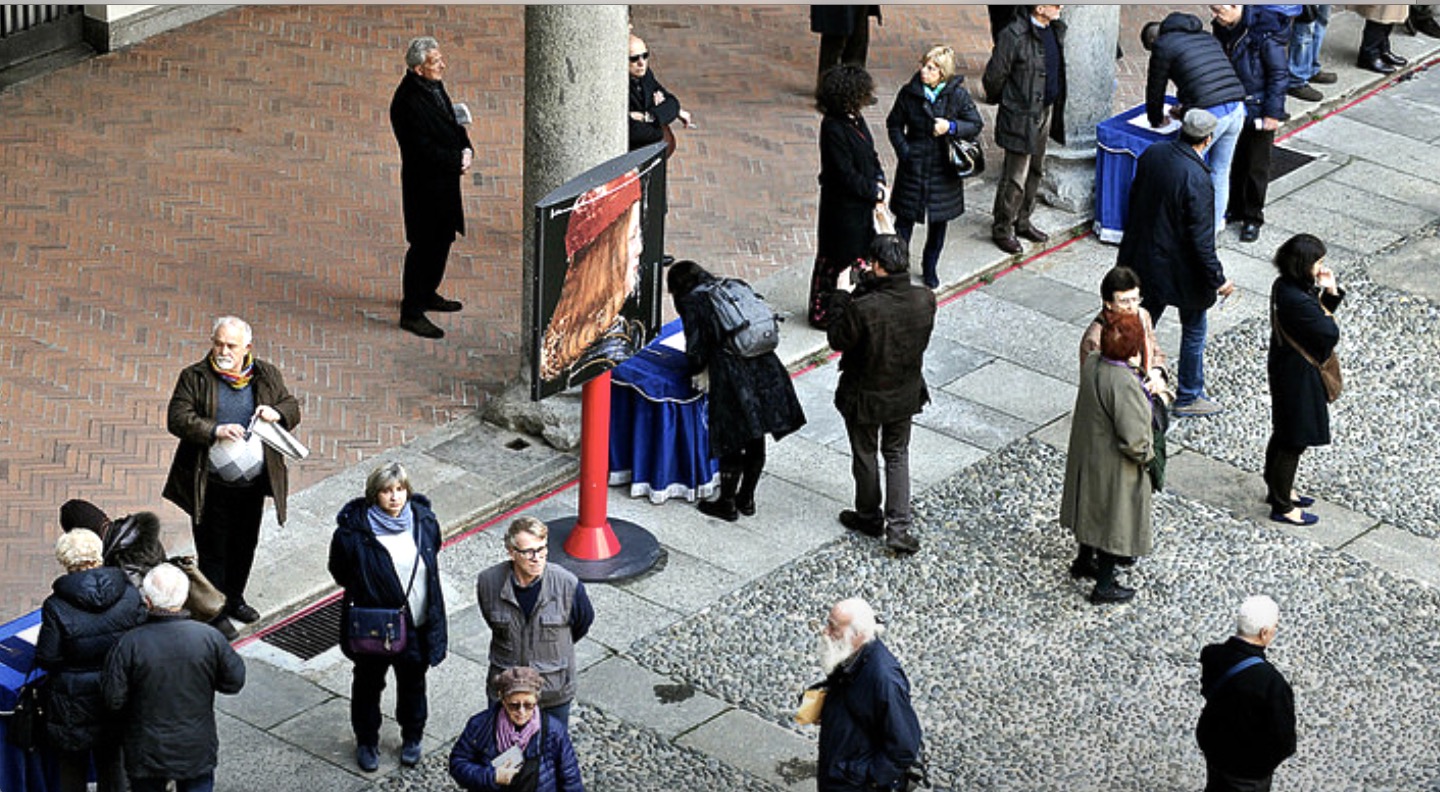
Umberto Eco funeral, Sforza Castle inner courtyard

Photographs of mourners at Castello Sforzesco (Sforza Castle): Comune di Milano, with thanks to our peerless detective MIL22

Photographs of mourners at Castello Sforzesco (Sforza Castle): our thanks to Comune di Milano and our peerless detective MIL22

[ an earlier post on the same subject: here ]

Have we ever seen a novelist or scholar given anything resembling a state funeral before? Probably not, and if Umberto Eco was a typical humbug-hating scribbler — as we suspect, not just from his work but the many descriptions of his large form shuffling along the corridors of his house in ancient slippers and baggy, comfortable clothes — we would expect him to have been vastly amused as well as touched by the sendoff he was given in Italy’s capital of book publishing. He would probably also agree with Flannery O’Connor’s belief that …

[The writer’s] concern with poverty is with a poverty fundamental to man. I believe that the basic experience of everyone is the experience of human limitation….[I]n the sight of the novelist we are all poor, and the actual poor only symbolize for him the state of all men.

Even though Dottore Eco died immensely rich, and even if he took a certain pride in that, no remorseless realist like him would disagree with O’Connor’s take on the philosophical core of all good writers — which rings deeply true.

On a lighter note, … we went looking for fresh experiences of what he offered us — which was a long-running ‘feast of intelligence and intellectual sparkle,’ far more so than technically perfect novels. And never mind if the quotation is a clip from the Libération review on the back cover of The Name of the Rose.

How did Eco explain the sales of Foucault’s Pendulum? Our last post admired Alexander Stille’s review of it in Harper’s, which contains this revelation:

One Italian magazine reported that only 20 percent of the people who bought the book have bothered to read it. Finding even that figure suspiciously high, the magazine quizzed people who claimed to have read the book and found that most could not recall key incidents in the novel.

Now, here are two delectable excerpts from a Paris Review interview with the author. The first seems a flawless encapsulation of the reasons why he was so successful. As for the second, what would-be reader of Foucault and the American blockbuster Eco was asked about — that we must admit we have not read but only listened to, in helpless convulsions, on a long car journey — could possibly disagree with him?

INTERVIEWER

In Foucault’s Pendulum you write, “The more elusive and ambiguous a symbol is, the more it gains significance and power.”

ECO

A secret is powerful when it is empty. People often mention the “Masonic secret.” What on earth is the Masonic secret? No one can tell. As long as it remains empty it can be filled up with every possible notion, and it has power.

INTERVIEWER

Have you read The Da Vinci Code?

ECO

Yes, I am guilty of that too.

INTERVIEWER

That novel seems like a bizarre little offshoot of Foucault’s Pendulum.

ECO

The author, Dan Brown, is a character from Foucault’s Pendulum! I invented him. He shares my characters’ fascinations—the world conspiracy of Rosicrucians, Masons, and Jesuits. The role of the Knights Templar. The hermetic secret. The principle that everything is connected. I suspect Dan Brown might not even exist.

Farewell, phenomenal Umberto Eco

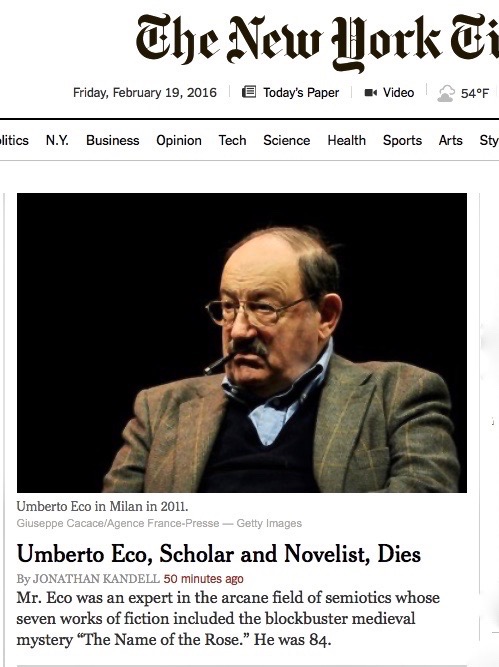
Umberto Eco top of NYT home page (1)

[ late addition below ]

A yellowing copy of ‘The Novel as Status Symbol,’ a 1989 book review by Alexander Stille not available on the net, happened to be lying on this desk when the divine imp Umberto Eco died on Friday. For several weeks, we had smiled every time we came across it, hunting for other pieces of paper. It made finding him honoured with an obituary portrait at the top of the home page of The New York Times a sad pleasure: he deserved no less.

What Stille recounted of the great semiotician-novelist’s fiction writing philosophy was quite wicked enough a quarter-century ago, when marketing chieftains in publishing companies were well on their way to wresting supreme veto power from editor-tsars. In our new age of scribes, book-promoters and whole literary communities bowing low to likey/no-likey social media, it is not impossible to envisage someone like Eco being burned at the stake for heresy, some day.

Some extracts from the most enthralling sketch we have ever read of the author of The Name of the Rose and Foucault’s Pendulum:

Last June, Eco — a medieval scholar and a professor of semiotics at Italy’s University of Bologna — stood on the dais of the cavernous ballroom in the Washington Hilton before a crowd of more than a thousand American booksellers.

In open defiance of the usual laws of marketing, Eco told the booksellers, he had written his first novel for about a thousand readers and decided to write the second for five hundred. ‘With my first book I was criticized for putting in too many quotations in Latin, so I started my new book with a long quotation in Hebrew. That’s my challenge.’ But Eco is not a naïve professor who was catapulted to stardom by an unlikely turn of fate. As a professor of semiotics (the theory of signs), a former publishing executive, a journalist, and the author of some twenty books, Eco is an expert on mass media and the machinery of popular fiction. ‘The world of media is full of free gifts, wash-and-wear philosophy, and instant ecstasy,’ he explained to the booksellers. ‘Readers want a little more; they want to be discouraged in order to be respected.’

… Since its publication in Italy last fall Foucault’s Pendulum has provided several new twists to what has come to be known as the Eco phenomenon. The novel has sold more quickly than any book in Italian publishing history, while becoming the center of a fierce national controversy.

Rumors than Eco was working on the book were eagerly picked up by the Italian press as early as two years before the book appeared … Anticipation built up to such an extent that when the book finally appeared, 500,000 copies were sold before the first buyers had a chance to grapple with it and tell their friends what they thought.

But within several weeks the Eco phenomenon boomeranged. Readers who had bought the book for faddish reasons gave up when confronted with the labyrinthine complexities of a novel that explores the mysteries of the Jewish cabala, hermetic philosophy, and a thousand years of esoteric thought. Eco was accused of having shrewdly manipulated the press in a plot to push sales. ‘Eco is a genius of our culture,’ one critic wrote, ‘a genius of self-promotion.’ To his dismay, Eco has become a kind of literary Midas: everything he does makes news and sells copies. Even his decision not to appear on television was perceived as another clever maneuver to attract attention. But the attacks, predictably, only had the effect of selling more copies …

Harper’s, November 1989

But, as we discovered not long after we posted those Stille quotations, Eco hardly spared the editor-tsars. We had long wondered how any editor, no matter how skilled and revered, could have had any idea of how to edit his novels — known whether to add or substract as much as a comma — which could define idiosyncratic. What did Eco think of their role? On the site of The New York Review of Books, there was his concise answer to that question, in 1994: ‘Case for Textual Harrassment’. Skim-read it at your peril: after we stopped to re-read it with closer attention, we were shaking so excessively that we had to lie down for a minute-and-a-half. Unless you know Philip Larkin’s and T.S. Eliot’s most famous poems, you will not understand. (The ‘rites of vegetation,’ William Weaver’s translation of whatever Eco wrote in the Italian original, is a master-stroke. Oh, you poor lilacs …)

The miniature essay begins:

These days, especially in the United States, implacable copy editors demand of authors not only stylistic revisions but even changes in plot, new endings, whatever commercial necessity dictates. But … can we honestly say that they ordered things so differently in the past?

Take the usually overlooked fact that the first version of a well-known poem by Philip Larkin originally went: “They do you harm, your father and mother.” It was only the insistence of Larkin’s editor that inspired the now famous variant. And the first draft of Eliot’s Waste Land opened: “April is the cruelest month. And March isn’t all that great, either.” Weakened in its impact by this peevish insistence on climactic details, the earlier text denied April any implied link with the rites of vegetation. As everyone knows, Ariosto at first submitted to his publisher a very brief poem that went: “Of women and knights, arms, loves, courtly rituals, and bold ventures I have nothing to say.” And that was that. “How about developing it a bit?” the editor suggested. And Master Ludovico, who was having enough trouble as civil governor of a remote Tuscan province, said, “What’s the use? There are dozens of epics of chivalry already. Leave it. I want to urge poets to try new genres.” And the editor replied, “Yes, of course, I understand, and, personally, I agree with you. But why not try approaching the form from another angle? With irony, for instance. Anyway, we can’t sell a onepage book, particularly one with only two verses on the page. It looks like imitation Mallarmé. It would have to be a limited, numbered edition. So unless we can get Philip Morris to sponsor it, we’re screwed.” …