As great scientists frankly admit what they owe artists, should the income gap between gifted arts and science workers be quite so wide?

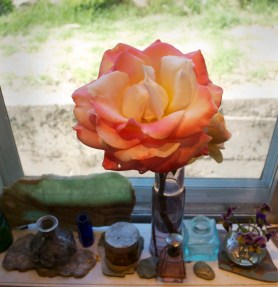
Lucinda's rose LARGER June 2015 IMG_7530

— photograph by Lucinda


A virtuoso painter and craftswoman friend — prolific, courageous, stoical in degrees that sometimes defy belief — grew up among Californian country folk, on the margins of the Pacific, in high trees and curling mists a few miles south of a refuge for artists established by an autobiographer who wrote these lines:

… [W]hy did I collect art? Or even more pertinently, what is art? I answered this question in my play Phallacy …:

REGINA If the beauty of this sculpture is not important, what about art?

REX Define Art.

REGINA An image from the mirror of life.

REX (derisive) Good God!

REGINA: All right then. How about Art being everything other than what you see in the mirror?

REX Better! But how necessary is that?

REGINA Art is never necessary. It just happens to be indispensable.

For me, not as a collector but as a human being, art happens to be indispensable. Isn’t art what distinguishes us from all other species?

Those are words of the late Carl Djerassi, and the retreat, his well known Djerassi Resident Artists Program. Before he jumped tracks to write novels and plays in late middle age, he made his name — young — as a scientist of the same rank as the superstars in our last two entries on this blog (part 1  and part 2).

Lately, the reminders of him have been so frequent — and cheering — that some of the mystically inclined would offer them as certain proof of haunting.

Another reason why he swims into view, in an inner eye, is indirect. We often think of him when we hear from our artist friend, who would have been a sort of neighbour of his, had she not flitted away to an art academy and the next act in her life in virtually the year he bought himself an outsized eyrie in the Santa Cruz range. Like him, she shone in school — especially as a science student. Then one day, she met and was magnetised by a whole family of artists living nearby. Watching them draw and paint — with radiant abandon — made trying her own hand irresistible. In no time, she was an addicted arts-worker-for-life.

The rest of this story told only in its leanest outline — to protect someone shy — is, on the economic plane, all too predictable. Though her work has found devoted fans to whom she ships orders at addresses all over the world, and she lives simply, with few luxuries, financial security has always been a dream never quite within grasp.

Dr. Djerassi, by contrast — even if he had been merely a successful scientist, not one referred to as ‘the father of the birth control pill,’ was virtually guaranteed a life free of money worries by turning the exceptional aptitude recognised at university into a career.

Here is the question that led to this post: is it necessarily quixotic (or mad or pointless) to wonder whether this cliché of contrasts — comfortable scientists and struggling artists — should be accepted as inevitable and unalterable, forever?

Accepted even though a Carl Djerassi was as unembarrassed as a Lawrence Steinman or a Josef Penninger in wearing his love of, and need for, art on his sleeve — long before he took off his lab coat to write poetry and fiction? Even if large numbers of practical materialists will scoff, ‘But that’s absurd! How could artists deserve to be compensated as well as scientists, who save lives, and whip up whizzy innovations entrepreneurs use to build technology giants, and send people to Mars?’

Ah, but if artists feed the souls of those scientists?

Better than setting up arts foundations and handing out grants, what if scientists were to make a sacred mission of looking for new ways to buy more work from artists of all descriptions? Employ more gifted and even daring architects to design their research centres and laboratories, … designers to add eye appeal to the utilitarian interiors in which they usually toil, … spend real money on aesthetically pleasing web sites … on art for scientific book and journal covers, and between them … and employ more editors capable of honing and adding lustre, if not poetry, to their words … ?

Brink-of-summer break

'Umbrella: 7 March 2015' -- postgutenberg@gmail.com

‘Umbrella: 7 March 2015’
— postgutenberg@gmail.com


Afflicted with an acute case of screaming eyeballs syndrome at post-Gutenberg — concentrated, migraine-like pain in eyes recovering from screen-gazing and months of disrupted sleep cycles — we must take a brink-of-summer break.

We can certainly revel in summer, on the right day. With the stretching out of light-filled hours, a silent enchantment begins, and continues until the Solstice. But summer has never been our favourite season. We have always preferred winter and the transitions from and to it, spring and autumn, for reasons never explained as well as by Francine du Plessix Gray, a biographer with an elegant mind:

I have a theory about poets’ distrust of summer. It is in this most rapacious of seasons that the ambivalence facing all writers becomes most poignant: our desire to drench in the world for inspiration, our simultaneous fear that this contact will drown our powers; our contradictory need for participation and withdrawal, for summer’s frenzied elation and winter’s quietude; a choice in which most writers would choose winter, what Thoreau called ‘life near the bone where it is sweetest.’

The dilemma transcends poetry, reaches every one of us: vernal, orgiastic need to be engulfed in the Cosmic Whole (or the Lover); simultaneous desire to preserve, undiminished, the wintry fortress of Self.

— Francine du Plessix Gray in Summer (a collection edited by Alice Gordon and Vincent Virga), 1990

Happy Bank Holiday Monday Memorial Day Weekend


Carl Djerassi, exemplary forerunner of Post-Gutenberg Man

Carl Djerassi in the late summer of 2013 - postgutenberg [at]gmail.com

Carl Djerassi at home in Green Street in San Francisco in the late summer of 2013
– photograph: postgutenberg [at] gmail.com

Recorded with sadness:

Carl Djerassi,

29 October 1923 – 30 January 2015

In an unprecedented commemoration, in our experience, yesterday’s Guardian ran — in addition to a short obituary for the general reader — a long and detailed encapsulation of Carl Djerassi’s extraordinary life in its science pages, and in its arts section, a critique of his dramatic oeuvre by a veteran theatre critic.

The photograph was taken in a poignant, unforgettable afternoon spent with Dr. Djerassi in September, 2013 – in which he revealed that he was recovering from a surgical operation for an illness he hoped to defeat for a second time. One recurring conversational theme was a comparison of recent experiences of grief and bereavement: it was clear that he found the loss of his third wife, the literary scholar Diane Middlebrook, virtually unendurable. We were both unquestionably happier discussing e-publishing and the post-print future — the reason for his invitation after writing, improbably, to express his pleasure and surprise in discovering this ‘sophisticated and literary’ blog.

His mention of having personally designed the gorgeous cover of the book he is holding, in his portrait — Newton’s Darkness: Two Dramatic Views — made it impossible not to ask him to pose with it. This he graciously agreed to do without any fuss, issuing no instructions and imposing no conditions. He could not have been a more relaxed subject.

The cover image he chose for the joint publication in a single volume of his play, Calculus, and Newton’s Hooke, by the English dramatist (and father of a physicist) David Pinner — about curious incidents and relationships in the life of Isaac Newton — is a photograph of a sculpture by Salvador Dali, a perfect choice for the surreal life of the greatest scientist before Einstein.

The news that Dr. Djerassi had designed some of his own book jackets could not have been less surprising after the three entries on this blog nominating him as a leader in the transition to unbounded, unboxed, post-Gutenberg creative expression: ‘Carl Djerassi’s sumptuous foretaste of publishing’s mixed-media future’, parts 1, 2 and 3.

We did not expect to find any mention of his accomplishments as an early prototype of Post-Gutenberg Man in any obituary, and indeed there has been none in the dozen-odd specimens we have read so far. But on this blog and elsewhere, there will be a lot more to say on that subject.

In the meanwhile, because his interest in finding new readers of his work could not have been fiercer, all the way to his final weeks, here is an extract from Dr. Djerassi’s programme notes for Calculus – which should be of particular interest to readers of the most popular item in this site’s archives, ‘The Riddle of Ramanujan,’ an essay and review of a novelisation by David Leavitt of the life of India’s legendary mathematician, Srinivasa Ramanujan.

Any mention of dabbling in mysticism by a venerated scientific figure is apt to make the typical working scientist bristle, snap, or break out in some other conversational equivalent of hives. Positively the last thing she or he wants to hear is about the brain of Newton not merely leaning heavily in that direction, but every bit as preoccupied by the extra-rational and occult as an ‘exotic’ subcontinental would be three centuries later.

Putting physics on a firm experimental and mathematical foundation – an approach coined Newtonism – earned Newton the ultimate accolade as father of modern scientific thought. However, a revisionist historical analysis, based in part on the discovery by the economist John Maynard Keynes of a huge trove of unpublished papers and documents, has led some scholars to consider Newton the last great mystic rather than first modern scientist.

[…]

… Newton spent much more time on alchemy and mystical theology than on “science”-composing over 1 million words on each of these two endeavors, much more than all his writings on physics combined! His alchemical library was huge and his alchemical experiments, though kept secret from all but a few intimates and servants, consumed much of his waking hours for decades. Even his religious convictions had to be kept secret, because his faith in Arianism (holding that Christ and God are not of one substance) was considered heretical within the Anglican Church.

Born on Christmas day in the year of Galileo’s death, Newton was so convinced of his supernatural powers that he once constructed a virtual anagram of his name (Isaacus Neutonus) in terms of “God’s holy one” (Jeova sanctus unus). His position as a fellow of Trinity College and Lucasian Professor of Mathematics at Cambridge (a chair now held by Stephen Hawking), his subsequent elevation to the important government rank of Master of the Mint, and conferment of a knighthood by Queen Anne …

[ and here, because the playwright would prefer you to read his words in their context – and purchase and arrange for performances of his play — please continue to … http://www.djerassi.com/calculus/calculusfull.pdf ]

Thoughts on Charlie Hebdo, Molière, and Carl Jung: where does a fearless – heedless – sense of vocation originate?

-- postgutenberg@gmail.com

— postgutenberg@gmail.com

Still finding it hard to put the Charlie Hebdo victims out of mind, to get work done – because so many of them look like writer, journalist and artist friends of post-Gutenberg’s, over the years – we have a question. Where does a sense of vocation come from?

There is no doubt that it is an irresistible, mysterious-bordering-on-mystical compulsion. It was described penetratingly in the last century by Carl Jung, though without an explanation grasped as easily as, say, a definition of a table – or, for that matter, a layman’s guide to particle physics. He saw a vocation as a sort of daimon. In an essay on the subject, an unidentified Jungian blogger has attempted a down-to-earth summary of the psychology pioneer’s conception of it:

The word “daimon” is Greek, deriving from daiw, “to divide or distribute destinies.” [… “D]aimon” is not the negative thing we associate with “demons.”

Being well versed in the classics, Jung brought many ancient concepts into modern usage in psychology … The “daimon” became a central part of his thinking about vocation, motivation, creativity and the individual’s potential for achieving fulfillment in life.

[… ]

As “… autonomous psychic content,” the daimon is a “force as real as hunger and the fear of death.” Because it is autonomous, it behaves within us like a god, making demands of us and acting with authority. The poet and potter M.C. Richards describes the experience of the daimon well when she says, “There lives a creative being inside all of us and we must get out of its way for it will give us no peace unless we do.” Beside Jung, multiple figures in history have acknowledged being in the grip of a daimon, e.g. the Greek philosopher Socrates, the German poet Goethe, and the French ruler Napoleon.

Inclusive, democratic media of this post-Gutenberg age are making it easier than ever before for the ‘creative being inside all of us’ to get out and do something. What effect is that going to have on this world?

We suspect that no matter how many millions are freed by digital tools and the net to let their daimon out for a run, the class of people who have anything critically important to tell us — who are gifted enough to excel in exercising their talent for communicating, and in exploring new avenues — will always be small. Those who put themselves at risk will be an even tinier, vanishingly small minority.

Last week we quoted one slain Charlie Hebdo artist and caricaturist, Jean Cabut – who signed his work ‘Cabu’ – saying that art should never be constrained. Artists who honour their vocation resist re-routing into less imaginative and risky occupations, and attempts to constrain what they express.

Writing on the New York Review of Books blog two days after the bloodbath at the French magazine’s offices, Robert Darnton, a historian of French satire, said that Charlie Hebdo is carrying on a tradition of fearlessly lampooning ‘power and bigotry’ that, in France, goes back at least as far as the reign of Louis XIV in the 1600s. He mentions Rabelais, Bussy-Rabutin, Beaumarchais, Chamfort ‘…and above all, Voltaire’ as practitioners of this art.

Somehow, he (or perhaps his editor) omits Molière, who died in 1673 at the age of fifty-one as one of the greatest satirical playwrights and actors of all time – and whose short lifespan was arguably part of the price he paid for giving up life at the heart of secure, bourgeois Paris to wander in search of audiences and patrons with a band of fellow thespians.

We are guessing that the NYRB was needlessly bowing to the frenzied pace of internet news analysis when it posted the Darnton contribution – because with his expertise, given a little more time, he could have shown us how some of those 17th-century French satirists were punished almost as severely as members of the Charlie Hebdo crew.

In a sparkling, dancing, marvellously imagined biography of Molière presented as part-fact, part-fiction, Mikhail Bulgakov – the Russian novelist and satirist – tells us how he died. The Wikipedia supports his version as mostly true; not too far removed from the actual events.

The medical profession and the priesthood were two of Molière’s favourite targets. He eviscerated arrogant, all-knowing doctors and their habit, in that era, of killing off patients with bleeding by leeches — because they had neither the tools nor understanding to effect a cure. He did this in one play after another with titles translated as The Flying Doctor; The Doctor in Love; Love, the Doctor; and The Doctor in Spite of Himself (in which the writer of this post actually had a leading, non-speaking part as a mute, at the age of fourteen).

In Mira Ginsburg’s quick-stepping, compulsively readable translation of the Bulgakov biography, there is this passage:

As regards the purely external characteristics which distinguished doctors at the time, we may safely say that these men, riding through Paris on mules, wearing long, gloomy mantles and beards, and speaking a mysterious jargon, simply begged to be set on the stage in a comedy. And in his Love, the Doctor Molière brought four of them on stage upon the stage. … The first doctor was called Des Fonandrès, which means ‘murderer of people’; the second, Bahys, ‘one who barks’; the third, Macroton, ‘slow of speech’; and, finally, the fourth, Tomès, or ‘bloodletter’.

What followed was a major scandal, for the audience easily recognized in the four quacks four of the Court physicians, Sieur de Forgerais, Jean Esprit, Guénaut, and Vallot, the latter being not merely a Court doctor, but the King’s chief physician. … [I]t is small wonder that hatred of Molière among the physicians reached unprecedented proportions.

After he collapsed on stage, acting a part in his latest play, The Imaginary Invalid –— then died coughing and spitting up blood a few hours afterwards — old friends and family were obliged to cope, without his help, with the consequences of his years spent savaging mediators between the realms of matter and spirit:

[E]arth refused to receive Monsieur Molière’s body.

Jean Aubry had vainly pleaded with the priests of the Saint Eustache parish to visit the dying man. Both of them flatly refused to come. A third, taking pity on the desperate Aubry, came to the comedian’s home, but it was too late. Molière was dead, and the priest hastened away. Burying Molière without proper Church rites was out of the question. The sinful comedian died without a last confession and without repudiating his profession [acting], which was condemned by the Church. Nor had he made a written promise never again to play on the stage again in the event that the Lord, in his infinite mercy, restored him to health.

This formula had not been signed, and no priest in Paris would undertake to escort Monsieur de Molière to the cemetery. Besides, no cemetery would accept him. …

Back to the Jung blog post quoted above:

[ The daimon ] … pulls us out of conventions and social norms. Because it is archetypal, the daimon exists outside of time and cultural contexts. It doesn’t follow fads or fashions, or feel any need to measure up to social niceties and expectations.

Fair enough — and well said. But what explains the existence of daimons, and what or whose purpose do they serve? We have never read a completely satisfactory answer.