Should Babette’s creator have been expected to ask for permission to be a writer?

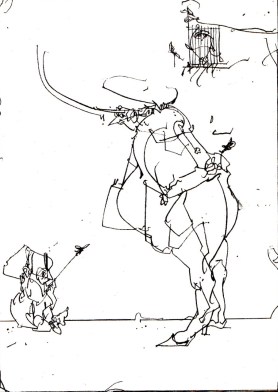
Drawing by Sascha Juritz

Drawing by Sascha Juritz

Dear Reader, our wish for a Happy New Year comes in the spirit of the lovebird mentioned here, in this set of advance instructions:

When a baby budgerigar died in a cage adjacent to the lovebird’s the latter grieved horribly for three days. She sat on her perch with her eyes squeezed tightly shut and ignored all attempts to communicate with her. She ate meagrely — but after three days, she put the matter firmly behind her and would entertain no reminders. She had returned to her usual vivacious self. So there you are, the animals are ahead of us. Humans are always uncertain about the policy in any situation, but animals …possess an answer to all problems.

The witty, magisterial line of Sascha Juritz, about whom we posted earlier this year, accompanies those thoughts of ACB’s, an ardent admirer of feathered creatures, whose flashing communication about an iris we recently recorded in this spot.

What came to mind when we revisited Sascha’s sketch yesterday was the title of a short story, ‘The Old Chevalier,’ from the Seven Gothic Tales of Isak Dinesen, to whose incomparable oeuvre post-Gutenberg was introduced by that same ACB — one of the two most significant forces in our existence — to whom we had no choice but to say a final good-bye last week.

Reflecting on her life, we find ourselves thinking often about Dinesen’s ideas about redemption through literature and art for all those who feel more thwarted than not; who can justify seeing themselves as victims of implacable, virtually lifelong, opposition to their hopes, dreams and plans.

Our woolgathering inevitably led us to Google, where we found, first, an appreciation by Susan Hardy Aiken of the most famous Dinesen story, ‘Babette’s Feast,’ whose theme the critic considers a reprise of another tale by the same genius, ‘The Supper at Elsinore’ — ‘a story of failed flight, of “all the betrayed and broken hearts of the world, all the sufferings of weak and dumb creatures, all injustice and despair on earth” …’ …

Of the later story, Aiken tells us:

… [T]he haunting presence … is … a revolutionary woman. At once ‘beggar’ and ‘conqueror’, benignly maternal and bewitchingly seductive, a festive, unclessifiable figure who makes ‘righteousness and bliss kiss one another’, Babette is also … a ‘great artist’ with ‘the gift of tongues’ whose concoctions can transcend and transform the confinements of culture and the misdirections of history. … Writing ‘Babette’s Feast’ in her old age, at a time when her own body was consumed by incurable illness, Dinesen would enact her artistic transcendence of that carnal confinement, offering her readers a ‘celestial’ feast of words, a ‘blissful’ feminine Eucharist able to redeem those who are failed or thwarted …

Then we found, in Susan Brantly’s book about Dinesen, a reminder of the reason why this author was first published outside her Danish homeland:

Dinesen’s reception in the United States was enthusiastic beyond all expectation [ … but her… ] misgivings about how the Danish audience would receive her book proved to be well founded … [Her] imaginative tales set in the previous century were quite different from what most Danes were reading. Svend Borberg described Dinesen as a flamingo-red orchid in a cabbage patch … The most notorious of the Danish reviews accused Dinesen of ‘snobbism, the fantastic, and perversity.’ The negative Danish reviews upset Dinesen. Svend Borberg, with a good dose of irony, suggested one reason for Dinesen’s being subjected to such a beating by the Danish critics: ‘It was naturally very cheeky, not to say brash, of Isak Dinesen — alias Baroness Karen Blixen — to conquer the world first with her book Seven Gothic Tales and then come to Denmark with it. As a Danish author she should have felt obligated to ask here at home first if she was worth anything.’

Ah, gatekeepers … We have posted about these beings before, when we considered Samuel Beckett’s opinions of them in a post here last winter. No doubt we will revisit the subject in 2013, if we can keep this blog going.
Structural priming — or why you can’t put an arts career on hold to get rich, then become Van Gogh or Nabokov

Conversational sketch, at lightning speed, by ACB
Photograph by Louise Dumitriu and Drew Collins

Photograph by postgutenberg@gmail.com

A lawyer and the doctor practice their callings. The plumber and the carpenter know what they will be called upon to do. They do not have to spin their work out of themselves, discover its laws, and then present themselves turned inside out, to the public gaze.

Daybook, Anne Truitt

‘Artistic people aren’t respected.’

Such was the sorrowful reason given to a mother by a mid-twenties daughter for abandoning the drawing and painting garlanded with praise by teachers at her school. Post-Gutenberg hopes that this daughter, a newly-discovered second cousin, was only having a temporary fit of the glooms and has yet to donate her 2B pencils to the Salvation Army.

We are reluctant interventionists. We are unlikely to collar this cousin and warn her about one common, possibly universal, form of pressure indiscriminately applied to young people with artistic talent.

It comes in the form of this advice: just build a secure nest egg, first, by chopping off the mental equivalent of arms and legs in the service of a Procrustean accommodation to conventional expectations – by working in (say) plumbing, podiatry, linear programming, or as a technology entrepreneur. Get a mortgage. Pay off most of it. Then, and only then, allow yourself to yield to your daemon – or whatever wonderful madness compels people to sculpt, write musical scores, etch, scribble, and so on – ‘and become successful and world-famous.’ That last part is often laced with irony the advisers like to imagine they have successfully concealed.

Ignore this well-meaning counsel, we would tell anyone with a true vocation. Toss it into the nearest circular file, because it amounts to dispatching someone on an impossible mission. Where are the ex-financiers and former Silicon Valley stars rocking and reshaping the arts world with their surpassing contributions, in second careers? (as even post-Gutenberg fondly imagined, long ago: see ‘Literary Capitalism’.)

That’s right. There is virtually no life that fits that arc.

Why not?

Once, we could only have offered a hunch based on years of watching lives unfold. Now, we can point to possible support for our intuition in speculating about the wider application of findings in psycholinguistics – of which the gist is that what we do strengthens and biases our neurocircuitry towards doing more of the same; also, that this can become a sort of mental rut not easily escaped.

For example, someone churning out executive memos day after day is unlikely to be capable of writing with the freedom and literary finesse of, say, a Sean McNulty (Murray) – recently featured on this blog – on nights after work, or years down the road, in retirement. Sean, judging by what he has told us over the years, chooses jobs for the time and brainpower they allow for writing – that free as much mental circuitry as possible for polishing risky, high-wire prose like his new novel, Twentieth Century Transmissions.

Post-Gutenberg would recommend Sean’s solution, working in the time-honoured tradition of ‘day jobs’, to anyone else young, talented and patron-less —  as far preferable to the ‘art as second career’ option that is really not realistic at all. Some means of keeping a talent alive by practicing it every day must be found, if only in the chinks and crannies of a life.

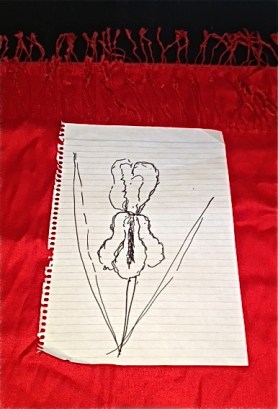
ACB, for example – someone as militantly anonymous as MIL22, whose photography frequently graces this site – has never stopped drawing, sneaking it in much like Jane Austen shoving her manuscripts under a blotter every time a family member entered the drawing room. When she mentioned bearded irises to us last week, in just the minute and a half it took post-Gutenberg to hunt for our photograph of one specimen, she had sketched – from memory — the flower she was referring to in the notebook she keeps at her side. ACB, we might add, is 81 and a half years old, and still, despite the acute arthritis in her hands, the multi-tasker she learnt to be long before whizzy digital technology filtered down to the public.

We had never seen so clear a pointer to the advantages of keeping your hand in, to preserve a talent, as the one we found in the implications of this explanation of ‘structural priming’ – in the way we all use language – in a recent column in The New York Times:

[Y]our brain’s activity in one part of the day shapes it in another, especially when it comes to creating sentences. This is a real phenomenon, described by psycholinguists, who call it “structural priming” or “syntactic persistence.” Basically, earlier patterns in what you say or read or write “prime” you to repeat them when you’re acting automatically. Our tendency to say the same sorts of sentences as those around us was first studied by someone looking at, of all things, walkie-talkie conversations between burglars. Our words and sentence patterns are also primed in the same way, such that the words we chose are the words we will choose later.

If I write Kevin gave Sally a pen, I’m more likely later to write John sent Tim the files than I am to write John sent the files to Tim.

[…]

Each time you sit down to write, you should cleanse your linguistic palate by reading some things that are vastly unlike what you’ve been writing.

[…]

Also, it’s imperative that you shut off the Web and don’t look at e-mail while you’re writing. Each time you look at Facebook or Twitter, you get primed with another kind of language, whether it’s your friends’ or your own. But maybe you want to write like you tweet. In that case, prime away.

We make no claim to being neuroscientists, at post-Gutenberg. We have no official license to speculate as we have about the critical importance of priming not just as a sort of mental conditioning for scribblers, but a guide to managing a life in the arts. Even so, we suspect that many readers here will find all this cod obvious.

A boatload of words, part 2: new media experiments suggest how lost languages might be saved

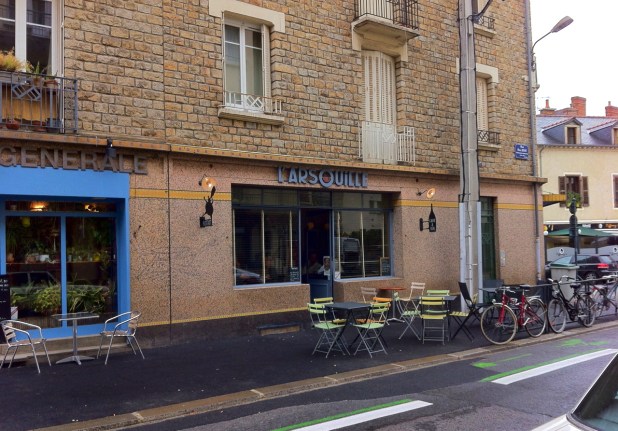
‘L’Arsouille’, Rennes, Brittany
Photographs by Mark Barron

Owing to chronic disruptions beyond our control, our usual timetable for new posts – roughly every six to seven days – must regrettably be abandoned for a while. ]

[ part 1 of ‘A boatload of words …’ is here ]

We are experimenting again — this time, with 21st-century ways of long-distance literary exploration. We are doing this in a multi-media collage — additions to some lines of poetry that we featured here last month.

Suppose that you discovered a beguiling poem that was a call to arms on behalf of an endangered language — lines saturated with the emphatically anti-glamorising spirit of a place, and adding up to a sort of love letter to its culture? Suppose that this place was Brittany, and that before you found the poem, you had only ever read the same clichés about its resilient, courageous, resourceful and fiercely independent people and been served, ad nauseam, the same images of its rugged coastline, its boats, its mizzling North Atlantic skies — without ever having heard a Breton speak?

Language arguably is culture.

Its sounds contain revelations inaccessible except by listening — a thought that came to mind playing back a recording of Roy Eales’s exemplary, playful-yet-serious reading of his own poem in its English original, then hearing his friend Fañch Peru recite his translation of it into his native Breton in ringing tones that are somehow both gritty and embracing. You can almost feel the inhospitable roughness of rock on your skin and taste acrid brine, halfway through the Breton version.

Beneath audio clips that any visitor to this blog can compare is the Breton text of Peru himself, a scholarly authority on the language – offered for listeners curious enough to read along. (Scroll down to the bottom of this post.)

( … The audio files that follow work on some machines; not on others. … We are still digging to get to the bottom of the mystery. )

Roy Eales reads ‘A boatload of words:

Fañch Peru reading his translation of the poem into Breton:

Near relations of ours were in Brittany earlier this summer, and to one of them we are indebted for the photographs at the start of this post. They were taken in Rennes, where the native people speak not Breton but Gallo, the other regional language of Brittany, but whose look and mien — in the images we were lucky enough to receive — do fit Roy Eales’s descriptions of the preference for substance over style in the culture of this province.

The correspondences between sound and meaning in Breton are so unexpected, to these post-Gutenberg ears, so captivating, that we consider ourselves enlisted in the cause of saving a language we have never heard in its own home – ‘virtual’ allies. In our last post about Breton and ‘A boatload, …’, we proudly displayed a drawing by the artist Sascha Juritz, another foreign campaigner, but one who considered Brittany a home for years before he died in 2003. It has taken a while for the photograph of him that we requested to reach us, but here it is – an image well worth waiting for:

Portrait of Sascha Juritz by Ursula Leipold

The Wikipedia entry for this region – Europe’s northwestern corner — says, in part:

In 1956, Brittany was legally reconstituted as the Region of Brittany, although the region excluded the ducal capital of Nantes and the surrounding area. Over this period the Breton language declined precipitously. Children were not allowed to speak Breton at school, and were punished by teachers if they did. Famously, signs in schools read: “It is forbidden to speak Breton and to spit on the floor” (“Il est interdit de parler breton et de cracher par terre”). As a result, a generation of native Breton speakers were made to feel ashamed of their language and avoided speaking it or teaching it to their children.

Victor Hugo (Les Misérables), who had a Breton mother he adored, unfortunately identified with the French capital’s prejudice against the place. As one of his biographers, Graham Robb, has explained:

According to Hugo, … his mother was a half-wild royalist Amazon, chased through the Breton undergrowth by republican soldiers, risking her life to rescue persecuted priests. Brittany itself, in Hugo’s Parisian view of the country, was an antediluvian land inhabited by hairy, tattooed peasants, squatting in their cottages or holes in the ground, surviving on milk and chestnuts, fanatically loyal to King and Church, their worldview bounded by the horizons of the ancient forests in which they hid, bristling with Druidic superstition and mindless animosity — a contrast, in Hugo’s personal mythology, to the mountain-born genius. Only the `wash-basin’ of the Atlantic Ocean was equal to the filth of Brittany, he wrote on a visit in 1836.

Oh, the obtuse pointlessness of prejudice … Here, two centuries after Hugo was born, is an extract from a Breton poem – Fañch Peru’s rendering into English of his eulogy for Sascha Juritz:

The black knight of summer

Every summer

The black knight

Came galloping to our country.

In clothes of velvet corduroy

And leather boots

He rode his white horse

Along green paths,

[…]

To meet friends

And talk together

With fervour and passion

Of art,

Of poetry,

Of the force of words,

Of Brittany, its language,

Of black and of white,

His chosen colours,

Of the wide world

Which turns the wrong way.

.

And we were happy.

[… continues in What matters most is what you make ]

En ur porzh-mor kozh e Breizh un den, ur gasketenn martolod gantañ war e benn harpet war e c’har zehou a selle pizh ouzh un dra bennak a bouez bras.

Treiñ a reas e benn hag ober a reas un hanter tro war e c’har gleiz evit cheñch plas hag e chomas aze war e c’har zehou adarre.

Tanañ a reas e gorn ha kontañ a reas ur marvailh. Setu petra ’ oa c’hoarvezet.

Ur beurevezh yen er goañv en hevelep porzh-mor e kludas un evn mor du war e skoaz hag e kontas dezhañ e brezhoneg penaos ul lestr bras tre ruilhet ha diruilhet e-maez da Vreizh war ur Mor Atlantel rust a reas peñse abalamour d’un taoldispac’h -eus e lestrad – ur sammad gerioù, e gwirionez, holl c’heriaoueg yezh ar ro.

Richanañ a rae an evn du en ur ziskleriañ penaos ar gerioù a oa da vezañ diskarget er mor, ul lev vat er-maez e seier du krouget start merket warne e ruz: DIEZHOMM dre urzh Ministrerezh ar C’hontrollerezh Diharz.

Evel-just ne voe ket laouen ar gerioù gant se. Bet e oant trec’het kent met biskoazh ken gwazh kinnig marv n’o doa bet.

En ur brezegenn nerzhus, Gwendal, e-penn al lestrad gerioù a c’houlennas digante sevel da stourm. Ijinañ a reas ur mod d’en em zifenn. Dieubiñ an holl a rafe an ampartañ gerioù, kas al lestr d’ar strad a rafe ar re bounnerañ. Goude e tistrofe an holl c’herioù war-varin d’o bro c’henidik.

Evned mor o nijal a – us d’al lestr a glevas dre guzh komz eus difennerezh ar gerioù. Goulenn a reas ar re-mañ digante skignañ buan ha buan kemennadoù e brezhoneg e touez ar bobl.

Evel-se e voe embannet prim ar c’heleier a-dreuz ar vro ha prestik holl aodoù Breizh a virvilh, beuzet a don hag a son hag a dud o koroll hag o kanañ dirak ar mor hag al lestr o vont d’ar strad en dremmwel.

Hag o tont davete ul liñsel eonenn gwenn war ar mor, un eonenn gerioù, yezh ar vro en he fezh a voe charreet gant lorc’h betek an aod gant ar gwagennoù evel un harozez.

Adalek an deiz-se e touas ar bobl ne lezfe biken ken he yezh he-unan da rentañpenn da n’eus forzh peseurt degouezh arvarus war ar mor pe e-lec’h all.

Translation, English to Breton : Fañch Peru, Breton poet and professor of the Breton language. From the book, What matters most is what you make …