Dogs, wolves, and stress relief: a coincidence of the digital age and a special ceremony in Milan

- photograph by MIL22

– photograph by MIL22

- photograph by MIL22

– photograph by MIL22

- photograph by MIL22

– photograph by MIL22

Do dogs in the presence of wolves sense their long-ago kinship, high in their family tree? And why do wolves appear to occupy a special place in people’s imaginations?

We were gratefully distracted in a week spent sweating over software incompatibility — unrelated to blogging on this WordPress site — by a Salvador-Dali-meets-Jabberwocky wolf poem that found us on Twitter in an entertaining coincidence.

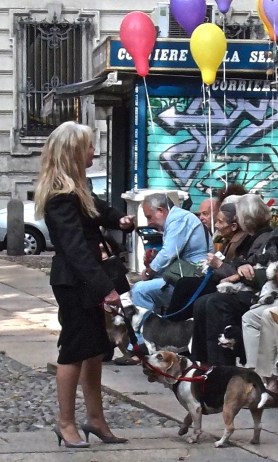
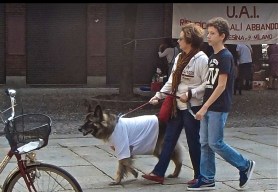
Would the particular wolf into whose soul the poet dreamt himself recognise as distant relations the beloved Milanese canines in these pictures — more irresistible work by our MIL22? Would it see through the trouble their owners have taken to play down their wolfishness? For instance, the Alsatian – of the breed in which the family resemblance is most pronounced — dressed to look like an American adolescent in a freshly laundered white T-shirt?

What about the intriguing hybrid guarding the owner with a lush platinum mane, the dog with the plump pug’s rump and a disproportionately small beagle head and ears? (Pugle or Beagug – after ‘Labradoodle’? … But then there’s that tail to account for. Just a beagle, perhaps, on a regular diet of kill-me-with-cholesterol-pasta dressed in Alfredo sauce.)

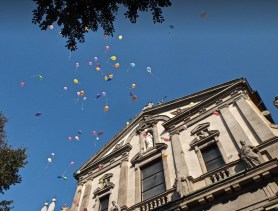
The loup in ‘Lupine’, below, would almost certainly see whatever the Italian equivalent of a sublime smorgasbord is, in the annual, only-in-Italy Benedizione degli Animali – blessing of the animals ceremony – complete with be-robed cleric, balloons, and brass band. We suspect that his most carefully considered comment would be rather brief: yum.

We met this beast by way of Twitter, in a collection titled Rejectamenta — the response to literary rejection of a group of clever and talented Kiwis. Some of the contributions appear to be actual ‘Sorry, not quite right for us at this time’ communications, both form letters and individual replies; others, impish inventions. If they are all real, we are impressed by the time some editors of little literary magazines are taking over saying No.

The link to Rejectamenta was tweeted by (the Man Booker Prize winner) Eleanor Catton’s original publisher, in New Zealand, three minutes after our tweet about last week’s post on what indie publishing could mean for long-established professional scribes – especially those that conventional publishers have declined or been reluctant to publish for unpersuasive reasons. Naturally, we were astonished to follow his tweet and find the assemblage we did. And then, there was this … by a poet whose first full-length collection of poems, How to be Dead in a Year of Snakes, was published by the University of Auckland Press in September.

LUPINE


When I was a young wolf undergoing transformation

that trickster moon, so rich with gravitational pull,

drew the buried beast out of me. Stalking the streets

with my sharpened howls seeking out the night

I set my sights on warm hearts whose keepers did not

believe in my kind or in fear. Something in their delusion

dragged at my thirst, which had no trouble finding

its way into their homes and shelters. I showed them fear.

Such were my nights for years as a fallow soul; I shed my

goatskin and terrorised. I licked their wounds with glee

until one chanced night the moon refused my skin.

The beast did not come. Confused and rejected, I ran until

I dipped headfirst into a solemn silver lake not knowing

if I was unraveling in a spent dream or simply drowning.

Chris Tse, 2014

- photograph by MIL22

– photograph by MIL22

- photograph by MIL22

A Richard Dawkins dog who does not want to be here at all – photograph by MIL22

Three writers who show us why we need indie publishing — not least, from old-fashioned professional scribblers — to save civilisation

Santas for sale in March? Why not, if she is sure that they will find buyers? Shouldn't writers be as brave, setting out their own stalls? - photograph by MIL22

Santas for sale in March? Why not, if she is sure that they will find buyers? Shouldn’t writers be as brave, setting out their own stalls?

– photograph by MIL22

Insisting that the rise of indie authors and self-publishing spells the death of high culture — or raging at Amazon as their supreme enabler and champion — the anti-indies only ever invoke the spectre of talentless amateurs driving literature down the sewer.

Why do they almost never mention what excellent, necessary — even essential — books by fully qualified professionals could be be spared a waiting-for-Godot struggle to be admitted to the publishing pipeline?

In this post, we offer three examples that should shock honest and open-minded denouncers of the publishing revolution — if they exist — into reconsidering their position.

… But first, for Amazon-bashers, a quick announcement of a constructive reaction to publishers’ understandable fear of the Seattle retailer’s growing power. Anglo-German Haus Publishing in elegant Mayfair, at the heart of London, has launched a web site with an irresistible offer: ‘We guarantee to match amazon.co.uk prices when you order online or we’ll refund the difference. We’ll post your purchase free to anywhere in the UK or you can pick it up from us … enjoy a cup of coffee on us, a chat and browse of the shelves.’ Amazon unquestionably needs competition, a point underlined in an earlier entry on this blog. Instead of complaining about its terms for doing business with them, other publishers can follow Haus’s example – and, while they’re at it, start supporting indie authors, which brings us back to our topic …

… professional writers for whom serious indie publishing is not being born a moment too soon:

• a trans-cultural and trans-disciplinary genius baring his soul in his tenth decade;

• an intrepid explorer in the unfriendly Middle East brutally punished for his curiosity; and …

• an editor near the summit of The Economist.

carl djerassi IN RETRO COVER

Carl Djerassi, aged 91, is in the first stage of publishing In Retrospect, his third autobiography. Yes, you read that right, and there are not many examples of living historical figures — let alone anyone else — publishing more than one. Sceptics about the greatness of this scientist usually referred to as ‘the father of the birth control pill’ should do a quick search under his name on an Amazon site and have smelling salts on hand, as they inspect the staggering list of novels and plays credited to him. His imaginative literary works have won prizes. His plays are being performed in theatres across the world, in several languages. His scientific accomplishments listed in his Wikipedia entry, though incomprehensible for a non-chemist, look like the work of several gifted scientists (and yes, he has an ego — and charm — to match).

Presumptions of the smallest loss of mental acuity because of his age — by anyone who has not received tightly argued email replies from him at speeds rivalling a texting teenager’s — are instantly dispelled by reading two of his contributions to the 25 September edition of The New York Review of Books: an essay about the divorce of sexual reproduction from coitus, and a deeply erudite, acerbic letter to the editor scolding two biographers and their reviewer for not knowing that an interpretation by a celebrated cultural critic, Walter Benjamin, that links a Paul Klee painting to Hitler is the reason why this work — Angelus Novus — is famous (and partly a subject of an earlier post on this blog.)

Now for the show-stopping news: his new book about his life is not being published by any of the famous names in trade (general-interest) publishing but by Imperial College in London. A small gathering for a discussion in its honour was arranged at Cambridge University earlier this month.

Such a narrowly academic launch makes no sense at all for a true story oozing high emotional drama; whose historical backdrops include Kristallnacht and the Anschluss in Vienna; a tale that could easily supply enough material for two films — biopics or fictionalised versions of the truth — with lots to spare. With unflinching directness, he tells about being the only child of parents who divorce; enforced expatriation, as a Jew fleeing the Nazis; adjusting to life in the American Midwest; adultery; more than one suicide; being chronically threatened with suicide by an emotionally suffocating parent; and dealing with every form of rejection and vicious competition in parts of five outrageously successful careers: research scientist; university professor; manufacturing entrepreneur; literary artist in several genres; large-scale philanthropist specialising in the arts.

Why did conventional publishers decline to make an offer for a reconsideration of this particular personal history? Because – as he told us at post-Gutenberg, they thought that book buyers would be confused by being given this third version with its predecessors still in print, whose sales would be cannibalised by a new volume. He had to field these ridiculous objections by himself. The literary agents you might expect to be delighted to offer representation were apparently put off by his vast age. They were afraid, he said, that he would die on them.

But … were he publishing himself — if his autobiography were an e-book offered on, say, Amazon.com, he would be free to revise it ad infinitum. For each round of major alterations, he could use his blog to tip off readers with a special interest in his work – and their original purchase price would pay for all the updates.

We will be returning to this book and its author, and the parts of it we found especially rewarding to read – on another site. For the moment, we offer just one clip from In Retrospect justifying its publication. It would deserve wide attention merely for being intensely self-critical and raw in ways that scientists almost never permit themselves, and for its accessible conversational style:

… [O]nly if one has already published some self-reflections or autobiographical accounts two decades earlier, is it worthwhile to revisit them and reinterpret some of their deeper meanings as the end of the author’s life is rapidly approaching and with it a recognition of how big a role discontent has played in it. This is hardly original, considering what Flaubert once said: “An autobiography?…Wait 20 years to write about a painful experience.” What I shall be saying in this book about the topic of discontent—a painful synonym for the darker shadows in life ̶ is likely to be the last word, given that I am now approaching the age of 90. Furthermore, a lot has happened in my last two decades—in many respects a totally new life as an author and playwright rather than as a scientist. The reasons for such a transformation are worth describing, partly as useful examples to others in a progressively more geriatric world to demonstrate that it is never too late to transform oneself and even grow, but also as warnings, because there are many things I would not do now if I had the chance to start all over again.

nyt THEO PADNOS cover … 02cover_type-blog480Theo Padnos. Though his keen powers of observation, gift for metaphorical thinking and emotional honesty should have made his passage to publication an easy one, this writer found himself on the cover of The New York Times magazine last month for the worst of reasons. The standfirst for his contribution read:

In 2012, an American journalist went into Syria to cover the civil war. He was kidnapped and held for the next two years by an affiliate of Al Qaeda. After months of beatings and torture, he was certain he’d be executed. Instead, he lived to tell this tale.

Those of us who were adults in 2003 remember the debate about whether the world was being misled by a British prime minister, Tony Blair, and an American president, George Bush, insisting that declaring war on Iraq was unavoidable because of vast stores of ‘weapons of mass destruction’ being concealed and prepared for deployment by the country’s ruling dictator, Saddam Hussein. The memory is painful because the West had practically no reliable information about what was happening in Iraq — and certainly no proof of whether the WMD stockpile was real or a myth dreamt up by propagandist leaders of the Anglosphere. Article after article by learned military experts and scholars drew our attention to the lack not merely of competent observers on our behalf in the entire Middle East, except in Israel, but of spies, military observers or even mere civilians with connections to and experience of everyday life in the region. Worst of all, there was an alarming shortage of skilled interpreters and translators of languages spoken there.

A decade after we learnt all that, you might imagine that a good writer willing to sign on for the hard labour of filling in some of those gaps might have publishers falling at his feet, competing to serve as midwives for his discoveries. Think again. Here is what his article said in part:

In 2004, when the United States was mired in the war in Iraq, I decided to embark on a private experiment. I moved from Vermont to Sana, the Yemeni capital, to study Arabic and Islam. I was good with languages — I had a Ph.D. in comparative literature — and I was eager to understand a world where the West often seemed to lose its way.

[…]

At the beginning of the Syrian civil war, I wrote a few articles from Damascus, then returned to Vermont in the summer of 2012. Just as the Islamists were beginning to assert their authority in Syria, I began pitching articles to editors in London and New York about the religious issues underlying the conflict. By now, I could recite many important Quranic verses from memory, and I was fluent enough in Arabic to pass for a native. But these qualifications mattered little. The editors didn’t know me; few bothered to reply. Perhaps, I thought, if I wrote from Syria itself, or from a Turkish town on the border, I’d have better luck. On Oct. 2, 2012, I arrived in Antakya, Turkey, where I rented a modest room that I shared with a young Tunisian. I tried pitching the editors again. Still nothing. I began to despair of publishing anything and cast about for something else to do. Should I try teaching French? I wondered. Coaching tennis?

Of course, indie publishing was a path he could have taken, in 2012. But many otherwise brave writers were — are — cringing inwardly about the stigma of self-publishing, even if it is fading rapidly and will soon be as incredible as the snobbery about books published in paperback, in the first half of the last century.

Too many wars and destructive conflicts of every sort are caused and escalated by ignorance and misunderstanding. Middle East tension has been at or near the top of many people’s anxieties about the planet going up in flames, for most of our lives. Who would disagree that impediments to sharing the information Theo Padnos gathered threaten our safety, peace and civilisation?

When those obstacles are decision-makers in a print publishing industry guided almost exclusively by profit-or-loss considerations, doorkeepers whose knowledge and expertise is inevitably limited – just like everyone else’s – we need another way for writers to reach readers. Fortunately, it already exists, and some occupants of lofty rungs on old print publishing ladders are eagerly seizing the freedom in e-publishing to make their own decisions about what facts and opinions should be be getting out there. For example, …

ed lucas snowden cover

Edward Lucas. Serving as international editor of The Economist when the news of the Snowden leaks broke, he quickly found himself isolated in his opinions about them. As he recounted in an article for The American Interest in February,

It’s now exactly eight months since the Snowden Affair broke, and I daresay that last June few would have been able to predict the ample fallout. One development, in particular, though not perhaps the most important, has been particularly surprising: Snowden’s elevation, in the eyes of many of my friends, colleagues and counterparts around the world, into a secular saint.

Refusing to accept the majority opinion as correct — and rightly so, given his privileged understanding of Russia, acquired as The Economist’s Moscow bureau chief from 1998-2002 — he published his own short book about the leaker, The Snowden Operation: Inside the West’s Greatest Intelligence Disaster, at the start of this year. In an earlier version of this post, we mistakenly interpreted his change of responsibilities at the magazine — from ‘foreign editor’ to staff specialist in energy coverage and a raft of other subjects, including cyber-security — as the price he accepted for refusing to pretend that he did not see grave flaws in the media reporting and analysis of what Snowden did. He says that, in fact, The Economist gave him time off from his work as ‘international section editor’ to write his e-book and ‘threw a huge party on publication.’ … That certainly speaks well for the magazine that prefers to call itself a newspaper, but makes him no less courageous.

We are guessing that it has not escaped his notice that opposing the majority opinion of the most sensational political story of 2013 in the media establishment on both sides of the Atlantic and taking the indie author route; presenting your reasoning and facts to readers independently; virtually guarantees shunning by the professional book-reviewing community.

That has indeed been the fate, so far, of The Snowden Operation – even though a third edition of Lucas’s brilliantly timed The New Cold War: Putin’s Threat to Russia and the West was launched almost simultaneously by its respected conventional imprint, Bloomsbury (best-known as the home of the Harry Potter books on publishers’ row).

You, reader, must decide whether indie publishing does not represent a critical marker of cultural progress when it gives an expert writer a chance to set out arguments like the following excerpts from the Lucas justifications, arguments mostly suppressed by the oldest and most famous names in old-fashioned journalism. You do not have to agree with or approve of them to concede that they should have been balancing the endless column-inches of Snowden canonisation in those newspapers.

Snowden’s published revelations include material that has nothing to do with his purported worries about personal privacy. They reveal how countries like Norway and Sweden spy on Russia. Why is it in the public interest to reveal how democracies spy on dictatorships? The Snowdenistas’ outrage is based on the fact that this spying takes place in cooperation with the NSA, the Great Satan of the intelligence world.

[…]

It is fatuous for Snowden’s allies to say that they are keeping the stolen material safe: they lack the knowledge and skills to do so. With equal fatuity, they assert that redact the published material in order not to breach security. How can they possibly know what will be damaging and what may be harmless? Seemingly anodyne pieces of information can be gravely damaging when combined. Whether the documents stolen by Snowden number in tens of thousands, or 1.7m (sources differ) the combinations—and the damage—are almost beyond measure.

As I argue in the book, the damage done by Snowden’s revelations neatly and suspiciously fits the interests of one country: Russia. The sensationalist and misleading interpretation of the stolen documents has weakened America’s relations with Europe and other allies; it has harmed security relationships between those allies, particularly in Europe; it has corroded public trust in Western security and intelligence services; it has undermined the West’s standing in the eyes of the rest of the world; and it has paralysed our intelligence agencies.
The unbearable unreliability of online being, and a warning deducible from the lovely speculations of Bernard Mayes about the foolishness of all such complaints

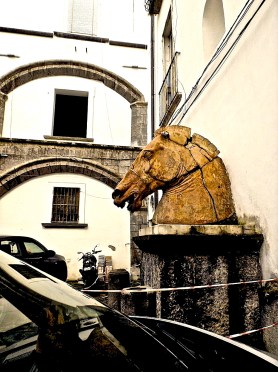
All things material must pass or be set aside – not unlike this head of a grand old equestrian statue mouldering in a seedy car park. The construction of our online lives in software — ‘pure thought stuff’ — is even more ephemeral  - photograph by MIL22

All things material must pass or be set aside – not unlike this head of a grand old equestrian statue mouldering in a seedy car park. The construction of our online lives in software — ‘pure thought stuff’ — is even more ephemeral

– photograph by MIL22

Screen Shot 2014-11-06 at 02.40.29

The original version of our masthead, using fonts offered by Wordpress.com through an arrangement with Typekit.com – then arbitrarily ‘retired’ by the blogging platform

Post-Gutenberg has been looking for a new home on the internet after an unwelcome lesson about the flimsiness of all commitments between suppliers of internet services – such as blog-hosting platforms like WordPress.com – and their too-trusting users. Any faithful reader of this blog since its first entry three years ago knows that the one element that stayed constant through experiments with layout and colours was the lettering in its masthead, a style referred to over the centuries as Fraktur, Blackletter, Gothic and – most recently — Brokenscript.

Choosing it for this site was a very small visual joke, a reminder that one of the oldest versions of the typeface was actually carved by Johannes Gutenberg himself in the 1450s, to print his mechanically lettered version of the Bible which – in the Wikipedia’s salute to it,

… was the first major book printed in the West using movable type. It marked the start of the ‘Gutenberg revolution’ and the age of the printed book in the West.

A blog becomes a sort of home on the net for its minders and contributors, over time. Watching the pixels of its masthead swim into view can be as consoling as knowing that there will soon be a mug of fragrant hot cocoa on the other side of your front door on a soggy night on which you approach it with freezing rain snaking down the back of your neck. But suddenly, last summer, that comfort was lost. Post-Gutenberg appeared at the top of each page in the timid, undersized, spidery default font for this layout (or ‘theme’). After a temporary switch to another layout to compensate for the mysterious reversion to what we never chose, it proved impossible to restore the original look of this site – not just the masthead, but the sizes of other fonts we selected with care.

As the use of these custom typefaces is not free, but requires a subscription, the usual excuse for having some part of one’s cyber life turned upside-down — ‘You get what you pay for’ – is hollow. We say this sadly, as WordPress.com – literally wonderful, in innumerable ways — has been a cross between kindergarten and training wheels in our education in unmediated publishing.

One group of WordPress users in England, at thelondonwakecompany, reacted as disgustedly as we did to the blog host’s refusal to offer any explanation for the change:

Hi, our website seems to have lost the original font we used and we can’t seem to get it back, its not in the list of fonts we can use either and it’s changed the whole look, […]There is no other font that even comes close and I’m supremely annoyed. All our marketing material matches our website especially the font and looks completely out of sync now, as there isn’t even a similar font that we can get away with. Why were we not warned of the changes that were being planned? Such a small change for you guys is a headache for us. I would like something to be done, as when I bought our site/signed up with WordPress I was not aware that they can change what they want when they want without any notification or consideration.

It was while fuming over this saga that we came across a record of a surpassing life, the obituary in The New York Times of one of England’s finest exports to the U.S.. Here was a man who somehow helped to found and run America’s only reliably intelligent and advertisement-free TV and radio channel — the Public Broadcasting Service – and personally ran its first suicide-prevention hotline, while living at a vast remove from the public eye and any popular acclaim. He was also an ex-Anglican clergyman and gay rights activist. Not until Bernard Mayes died on 23 October at eighty-five were his achievements ever celebrated in the media – an impression that the Wikipedia’s lack of any media citations before then seems to confirm.

This was the most captivating section of the NYT’s account of his passage for someone maddened by insubstantial software’s ephemerality – a reminder that even what we perceive as reliable matter is, in its essence, far from solid:

As he grew older, Mr. Mayes abandoned his Christian faith and promoted a philosophy that he said was rooted in “scientific materialism.” He called it Soupism.

“There are no gods, no magic, no final judgment and no grand plan,” he wrote on his website devoted to Soupism. “Everything from planets to humans is composed of tiny particles, energy, and nothing else. All the particles are always moving and endlessly interacting with each other as in a soup.”

He discussed the philosophy in his autobiography as well, finding a kind of transcendence in the material world.

“We are,” he wrote, “already close to, surrounded by, enveloped, as it were, in immortality: sheets formed from the cotton of the fields or the wool of the sheep; plastics boiled from minerals dug from the earth or the oil of ancient vegetation; concrete and metal poured from the rocks of the planet; all moving within the endless interchange from which our bodies are derived and from which others are already being born. Never does the process cease; never does it fail us.”

- photograph by MIL22

– photograph by MIL22

With all our e-devices, why don’t we hear from more voices like Yan Lianke’s in China and Russia? + can The Guardian’s ‘membership’ scheme set an example?

Commenters on Yan Lianke’s poetic essay from China in Thursday’s New York Times — about the task of writers — spoke for many and maybe most of his readers in expressing fears for his safety. Why, in this age of magically flexible and ubiquitous post-Gutenberg communication tools — of which China is the leading manufacturer — do we hear so seldom from voices like his in China and Russia, supporting writers like him, and giving us essential information?

A small child who has only paddled in a bathtub can have no idea of what swimming in an ocean is like. Still, the experience of being immersed in water does supply an atom or two of useful comprehension. In this way, anyone in the liberal West whose thoughts typed into comment boxes on media sites have been stifled — persistently — by ‘community moderators,’ solely because they do not suit the politics and editorial policies of a powerful newspaper, has had a taste of actual censorship, and of refusing to let the fear of humiliation, punishment and banishment (deleting a commenter’s account) shut down the flow of words.

No one expects to have to be a heroic Yan Lianke in any proud Western democracy. Yet even in these, the suppression of inconvenient views in the most scrupulously polite debate gets hardly any attention. This week, The Guardian has again been promoting the paid, tiered ‘membership’ scheme it is offering readers. No one yet knows exactly what this club is going to do for free expression, and for reining in this paper’s notoriously trigger-happy moderators (of whom we at post-Gutenberg must admit that we have no recent first-hand experience, having decided to stop going there and say what we want to about The Guardian on this site, instead.) In a post here a few weeks ago — ‘Alan Rusbridger must please not let ‘Guardian membership’ mean bread-and-circuses, and prove that he is sincere about ‘mutualised’ journalism’ — we expressed our hope that there is substance behind the alluring advertisement.

No ‘membership’ scheme will be worth the attention of thinking people unless ‘members’ are allowed to help The Guardian’s policy-makers ensure that its ‘Comment is Free’ section lives up to its name. Yan Lianke’s New York Times contribution shows just how much thinkers like him count on the West for inspiration and support. Never mind China’s grand, ancient philosophical tradition. Confucianism was never about individual freedom.

With marvellous economy and a soulfulness rarely found in Western editorialising, he has reminded us of what we forget at our peril – the importance of unencumbered truth-telling. Please pass on the link to his piece after you have read the extracts below, and a sample of readers’ comments on them – including one from someone not fluent in English, who is owed our thanks for pointing out why some of his criticisms of China could be mistaken. We wish it was within our power to invite Yan Lianke to respond in this space.

BEIJING — China’s efforts to promote socialism in the late 1950s and early 1960s resulted in what is euphemistically known as the three years of natural disasters, during which more than 30 million people starved to death. One evening when I was a young boy, not long after the catastrophe, I followed my mother as she went to dump garbage outside the wall that surrounded our village, a poor and isolated town in central China.

Holding my hand, my mother pointed to the white clay and yellow earth of the wall, and said, “Son, you must always remember, when people are starving to death they may eat this white clay and elm tree bark, but if they try to eat that yellow earth or the bark of any other kind of tree they will die even faster.”

Mother went back inside our house to cook and left behind a long shadow. I stood in front of the edible clay gazing out at the sunset, the village and the fields, and an enormous sheet of darkness gradually approached.

[…]

China may boast of having several thousand years of civilization, but when an old man collapses in the street, everyone refrains from helping him out for fear of being implicated, even as the old man bleeds warm, red blood. What kind of society do we live in when a pregnant woman dies on the delivery table and all of the medical technicians flee in order to avoid responsibility, leaving behind a tiny soul uttering a feeble cry?

It is a writer’s job to find life within this darkness.

I am reminded of Job, in the Old Testament, who after experiencing countless misfortunes said to his wife as she was urging him to curse God, “Shall we indeed accept good from God, and shall we not accept adversity?” This simple response demonstrates that Job understood that his suffering was merely God’s way of testing him, and was evidence that darkness and light must exist together.

I don’t pretend that I have been uniquely selected by God, as Job was, to endure suffering, but I do know that I am somehow fated to perceive darkness. From these shadows I lift my pen to write. I search for love, goodness and a perpetually beating heart.

At a symposium last week, President Xi Jinping met with a group of artists, including the Nobel Laureate Mo Yan, and talked about the value of art in China. According to the official China Youth Online, he said, “For art workers to be successful, they must breathe together with the people, share their fate and feel their feelings, rejoice at their joy, grieve at their grief, and serve the people like a willing ox.”

But only the pursuit of true art, unencumbered by anyone, can help us find the delicate light, beauty, warmth and love that are hidden in the darkness.

Some comments by his readers (not in their original order):

William Hathaway

… Despite the unfashionable earnestness in this essay, I applaud its plea for cosmopolitan artistic freedom in the tradition of Romain Rolland. I’m sure that Yan Lianke will pay a real price for it.

ronnyc

I was hoping to read that his name was a pseudonym, but I didn’t. It is a beautiful and incredibly brave piece of writing. I just hope it doesn’t cost him his freedom, or worse.

Andre

Absolutely correct…. Confuciusm can’t mesh with the mordern global system… Neither can traditional Judaism/Christianity/Islam. Te only thing that meshes is money. It’s the new world order…

Tim McCoy

“…now that money and power have replaced socialism and capitalism…

Though Yan Lianke seems like writer of some brilliance, I think the above statement is fundamentally flawed. Capitalism is nothing if it is not about money and power.

Stranger [ someone apparently posting from California ]

The author only pointed out one side of the problem.

Why the old man fell on the street and nobody dared to help him? Because there was a famous lawsuit in Nanjing in which an old lady framed a young guy who actually helped her get up and the judge condemned him to pay about 12,000USD to that old lady.

And why the medical technicians flee when the pregnant woman died? She died from amniotic embolism which is difficult to diagnose and extremely dangerous. A hysterectomy surgery might have saved her life but unfortunately her husband refused this option because he was worrying about if his wife was going to be able to have the second baby. After the pregnant woman died, the family sent dozens of relatives trashed the hospital, that was why the doctors and nurses had to flee. IN china, every year several doctors died of medical disputes, most of them are stabbed by angry/crazy patients or their family members.

well, the other side of story only makes China even a worse country. That’s the reality of China. Democracy is not the medicine for its illness right now, seriously. With such a low level civil consciousness, democracy will just be abused. china has a long way to go. let’s take it slowly.

A Sincere but Puzzled Han Chinese Girl [ Guangzhou, China ]

Stranger, you speak out what i’d like to clarify here. Many thanks

Richard Luettge 

The author may be fated to perceive darkness, but if so, he would perceive darkness wherever men walk in numbers, and not merely in China. The challenges he writes of aren’t uniquely Chinese challenges but human ones and timeless ones. We study these challenges in every society, in part through art, in part through philosophy, and the purpose of such study is to find the “delicate light, beauty, warmth and love that are hidden in the darkness”. More, it’s to find purpose in the darkness.

Others labor elsewhere, but his challenge is to find these qualities in China.