
Civic Centre, San Francisco — a city of steeply rising economic inequality
— photograph: postgutenberg@gmail.com
…
Man has places in his heart which do not yet exist, and into them enters suffering in order that they may have existence.
— Léon Bloy (1846-1917)
…
Better than suppressing criticism of Google’s new chief executive, Sundar Pichai — as Google seems to have been doing in some recent search rankings — would be answering the critics in a public debate. That would give Pichai-backers a chance for a friendly counteroffensive, listing all the reasons why his appointment is so hopeful for all unreconstructed idealists.
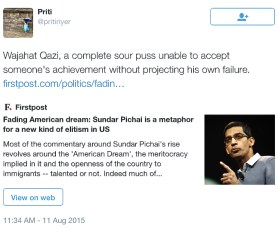
Though we have yet to come across any personal attacks on him, there has been angry murmuring in certain quarters about Indian leaders of Silicon Valley companies, lumping them together as selfish elitists. For two or three days after the announcement earlier this month about the Tamil Nadu-ite who had landed at Google’s pinnacle, a post by one Wajahat Qazi — described in his Twitter bio as ‘a former senior policy analyst’ in the part of Kashmir governed by India — persistently appeared in search engine results at or near the top of links offered for inquiries under the new tech star’s name. Then, it all but vanished: his Pichai-focused screed on FirstPost.com — ‘Fading American dream: Sundar Pichai is a metaphor for a new kind of elitism in US’ — did not appear on the first page of Google offerings for queries using Qazi’s name. Even if it sank partly because the words of writers and bloggers with larger followings were rising, it does not seem likely that its displacement was unassisted by colleagues and friends of Pichai’s, like the tweeter in the screen shot below.
What is Qazi’s objection to Pichai and other successful Indian techies? That’s hard to say, exactly, because his post is somewhat incoherent, as if written in a furious rush, and strikingly self-contradictory. He praises Pichai lavishly, then condemns him for belonging to ‘a new class of people: the nouveau elite who are the children of the marriage between technology and liberalism [… that … ] owes no real allegiance to any state, nation or culture …’. He is apparently protesting on behalf of ‘the “average” white young man from the South’ who ‘would perhaps naturally vent out his frustration at the brown, Indian ‘geek’ or techie for the loss of status and employment opportunities.’
Actually, white- and blue-collar workers shut out of the great Silicon Valley casino are envious and resentful across the entire U.S. and probably most of the globe, as Qazi does point out. The local resentment, especially in San Francisco, now at the northern limit of Silicon Valley, makes the most sense — for the reasons set out in ever more frequent reports about consequences of missing public services or public services strapped for cash, beneath headlines like the one for Debra Saunders’ 9 August piece in The San Francisco Chronicle: ‘San Francisco’s summer of urine and drug-addicted homeless’. ‘How bad is the urine situation in San Francisco?,’ the piece began. ‘Monday night, a light pole corroded by urine collapsed and crashed onto a car, narrowly missing the driver. … Prosperity has produced a building boom — so there are fewer vacant spaces where the homeless can burrow.’
Facts and events like these are shocking enough in themselves. And there are few other places with so many physical, sensory reminders that economic inequality in America is greater than in any other rich country. Silicon Valley, as a whole — with all its native-born Americans, immigrants and highly skilled temporary workers with H-1B visas — could be accused of a callous detachment from economic hardship on its doorstep and everywhere else.
But it’s clear from detailed reports about encounters with Pichai — especially from an excellent interview by Dieter Bohn of TheVerge.com last May — that Qazi could not have made a poorer choice of target — or ‘metaphor for this new elitism’:
Bohn: Is there anything personally important to you that you wish Google as a whole were doing more of?
Pichai: The thing that attracted me to Google and to [the] internet in general is that it’s a great equalizer. I’ve always been struck by the fact that Google search worked the same as long as you had access to a computer with connectivity, [whether] you were a rural kid anywhere or a professor at Stanford or Harvard.
I want Google to strive to do that — not just build technology for certain segments. For me, it matters that we drive technology as an equalizing force, as an enabler for everyone around the world.
Incidental descriptions of Bohn’s like this make that commitment credible:
Pichai is thoughtful and friendly in person, nodding carefully as he listens and then responding with real empathy. After the first day of I/O, I watched as Pichai walked into the hungry press gaggle, giving everybody who approached him equal attention. Amidst the tumult, he even sought me out to finish a conversation we’d had the previous week.
Last year, techie sites like 9to5mac.com gleefully quoted the gentle and restrained answer Pichai gave Bloomberg.com, when asked about the Apple leader Tim Cook’s description of the security designed into Google’s Android technology for mobile devices as a ‘toxic hell stew’ – obviously, by comparison with his own company’s comparatively flawless iPhone and its siblings. Apple, Pichai said, set its products’ price tags so high that it could afford to commission custom components (chip-sets) for elegant solutions to technical dilemmas — whereas Google had to make do with off-the-shelf parts to keep prices low for its volks phones:
“It must be liberating [for Apple] to wake up and think about your device, your software, and hey, ‘I can even call the chipset guys and say what the chip should be,’” he says. “I have to think about building a platform and bringing as many people along on this journey and getting it right. I believe that ultimately it’s a more powerful approach, but it’s a lot more stressful as well.”
You have to be careful when you make a $100,000 Mercedes car not to look at rest of automotive industry and make comments on it… We serve the entire breadth of the market, globally across all form factors, et cetera. Android from the ground up is designed to be very, very secure… History shows typically that malware is also targeted at the more popular operating system. So you know there is that.
In January, when only Silicon Valley insiders knew that Pichai was being groomed for his promotion to the top, the New York Times columnist Nicholas Kristof posed an unusually interesting question: can people be made more empathetic?
One of his observations was that ‘affluence insulates us from need … Wealthy people who live in economically diverse areas are more generous than those who live in exclusively wealthy areas.’
Pichai does not seem to be one of those who forget all about growing up relatively poor — as virtually every recent story about him has emphasized — or about the infinitely greater poverty than his family’s, in India’s underclasses. Nor would he need the reminder in the last sentence of the Kristof meditation on empathy: ‘Above all, let’s remember that compassion and rationality are not effete markers of weakness, but signs of civilization.’
It is not inconceivable that someone exactly like him could become the influential conscience Silicon Valley needs.
In the meanwhile, it’s important to let the Wajahat Qazis have their say — rant, if they must.
 post-Gutenberg