Sundar Pichai, Silicon Valley’s new technology star: wondrously un-grok-able by Westerners looking at him in rear-view mirrors angled on roots

Sundar Pichai 3 YouTube discussion Screen Shot postgutenberg@gmail.com

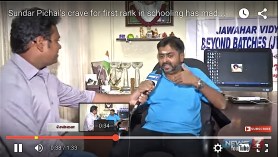
Where, if not in India, would an authority on the childhood of a technology superstar be interviewed with a garlanded guru and personal shrine at his back? Tamil TV screenshot, postgutenberg[at]gmail.com

Screen Shot 2015-08-13 at 17.09.22

Grok means to understand so thoroughly that the observer becomes a part of the observed—to merge, blend, intermarry, lose identity in group experience. It means almost everything that we mean by religion, philosophy, and science—and it means as little to us (because of our Earthling assumptions) as color means to a blind man.

Stranger in a Strange Land, Robert A Heinlein, 1961


A pity that someone from Madras — known as Tamil Nadu, now — is stripped of the special qualities that tie him to one of the most extraordinary parts of India, a country hundreds of times more colourful and gloriously bizarre than any other. This is what media coverage – in India’s English-language press as much as anywhere else – has done to Google’s new chief executive, Sundar Pichai, born and brought up in the southeastern state of Tamil-speakers.

Diligent reporting for biographical sketches in, for instance, The Times of India, has supplied the impressive details of his rise from the middle-classes — a long way from the poverty of the Indian masses, yet far enough from a life of Western privilege and ease to be deemed a ‘moonshot,’ Google’s term for ambitious, risky, work-in-progress expected to take more than ten years to bear results.

But in what kind of cultural soil were his roots – being widely characterized as ‘humble’ – fed and watered? Nothing in what we have read so far in news analysis offers the tiniest glimpse of what is most fascinating about Pichai’s home state. Its culture has been ignored or edited out, as if in the Indian call-centre tradition in which a sparkling customer service representative assisting a faraway English-speaker says, ‘Hi, this is Brad, how can I help you?’ — when his real name is P. K. Gopinath, and his consonants are so deliciously guttural in the classic Tamil way that you imagine him speaking to you with the shimmering Bay of Bengal for a backdrop.

What is unusual about Tamil Nadu? Jottings:

From a New York Times profile last month of Jayalalithaa Jayaram, the state’s best-loved politician — a former chief minister and actress, now general secretary of the ruling political party, the A.I.A.D.M.K. — and revered by many Tamils as a personal deity (Rollo Romig, 1 July 2015):

When Jayalalithaa set up a tent on Marina Beach and fasted publicly for 80 hours in protest of interstate water policy, thousands joined her. At every letdown, it seemed, A.I.A.D.M.K. supporters tried to set themselves on fire. Several Jayalalithaa skeptics told me that they doubt her party members care for her at all. They just know that mad acts of political theater are how things get done in Tamil Nadu.

… So is Tamil Nadu chaotic, an economic basket-case … ? Think again:

You would think that given all this emotional mayhem, Tamil Nadu would be a mess, but in fact it’s one of the best-run states in India. Jean Drèze and Amartya Sen, in their book ‘‘An Uncertain Glory,’’ an analysis of economic development in India, single out Tamil Nadu as a paragon of administrative innovation among Indian states, ranking it best in the country for the quality of its public services. Under Jayalalithaa and Karunanidhi’s governance, Chennai has gained a reputation as the Detroit of India (in the car-manufacturing-hub sense, not in the bankrupt-and-abandoned sense).

None of that is any more unlikely than the life of the state’s most famous mathematician, Srinivasa Ramanujan — the subject of a book reviewed on this blog. As noted there, Ramanjuan’s mathematical discoveries in the early 20th century have been used in polymer chemistry, crystallography, string theory, computer science and cancer research. Even so,

 … a former accountant-general of Madras … remembered Ramanujan telling him that in dreams in which he saw the male consort of [the goddess] Namagiri, ‘scrolls containing the most complicated mathematics used to unfold before his eyes.’ He shows how dream interpretation, palmistry and astrology influenced crucial decisions with which Ramanujan wrestled. (Quotation from The Man Who Knew Infinity, Robert Kanigel, 1991)

What would the Indian poet Rabindranath Tagore make of Sundar Pichai and 21st-century India? In 1944, a young writer, Santha Rama Rau — another Tamil Nadu native — recounted meeting Tagore as an old man and proud Nobel laureate:

… Tagore continued fiercely and with what seemed like rising irritation, ‘Our youth, too much of our youth goes to learn from the West. Were we not their tutors originally? What will you learn from them? Technology!’ he growled scornfully. ‘Look in your villages, child. What use has an Indian farmer for technology until he has learned to defend himself against exploitation?’ …

Ah, … but there was this snippet in International Business Times last Friday:

… Prime Minister Narendra Modi, who himself congratulated Pichai via Twitter, has asked why the country lags many other economies when it comes to major science and technology breakthroughs and innovation. “Why is it that a company like Google isn’t born in India?” Modi asked recently, speaking in Hindi, at the inauguration of Digital India, a multibillion-dollar program to bring Internet to the country’s villages …

Wonderful. Wonderful. Wonderful. … Post-Gutenberg can never read enough proof of this world being infinitely stranger and more unaccountable than any of us can imagine.

A New York Times reporter uses the dreaded ‘c’ (for cooperative)-word and finds his enthusiasm premature, just like post-Gutenberg’s … in 2010-11

Screen Shot 2015-08-06 at 00.15.37

[ a curious WordPress software bug appears to be interfering with linking to some earlier post-Gutenberg entries. Follow the asterisks to the bottom of this post for those missing links ]

Well done, New York Times, at last … for letting one of your sharpest technology reporters advocate turning Reddit into a ‘user’-owned cooperative to end the fight about the news-aggregator site’s comment moderation policies. We had yet to come across Farhad Manjoo’s missionary zeal for this possibility when we made the same suggestion two posts ago: ‘The media ownership structure that dare not speak its name? Or is it the writing on the wall that new media, too, are deciphering too slowly?’. We could scarcely believe our eyes when we did.

Think of our last post in 2011, ‘Will 2012 be the year of a great leap forward into media’s future — even at The New York Times?’*. It contained this passage:

My personal high-water mark for the media establishment’s resistance to the new dates from the spring of 2010, when I emailed a question to an editor near the top of The New York Times.

The press has been critical to the success of democracy as a form of government; how is it responding to its own democratisation, and how far would it be prepared to go on that road — voluntarily? If you could recommend the right person at the paper for these questions, I’d be immensely grateful.

Zzzzzzzzzing! … the editor’s reply came fast enough to set heads spinning:

I don’t know that anyone would have a specific opinion on this, at least not one that represented the Times in general. You might look to see if an editorial has ever been written about it. If not, I suspect your question doesn’t have an answer. [my ital.]

No search engine brings up any such NYT editorial. What that response was surely supposed to impress on me was that ‘our’ never having addressed the question meant that it was inherently unanswerable.

Which is patently untrue …

Still, that was a gracious and munificent response, certainly by comparison with The Guardian’s — which had banned a suggestion along the same lines, a few weeks earlier. We reprinted the censored comment in a 7 November 2011 post, ‘Why is The Guardian censoring debate about press reform and ignoring the Lord Chief Justice’s endorsement of citizen journalism?’** Here is what the axed comment said, in part (see that archived blog entry for the complete version ):

‘postgutenberg‘s comment 29 September 2011 9:34PM

This comment has been removed by a moderator.’

What the censored comment said:

postgutenberg

29 September 2011 9:34PM

[…]

Addressing Whealie‘s point, what if the Guardian were to try out an experiment in which commenters become part-owners of a section of the online newspaper and helped to decide on policies, including moderation?

More details here: Wanted: a brave newspaper, for an experiment in which readers become stakeholders.***

The lapse of four years has not made much of a difference. The cringing reaction to the idea of co-ownership today, of many ordinary people — not just of famous newspapers like the NYT and Guardian – was in the tweets replying to @fmanjoo’s advertisement of his piece on Twitter. A sample, not necessarily in the right chronological order – from tweeters who sound pessimistic even when they believe in the dream of democratised management and shareholding:

Jul 14

Michael Moeschler ‏@moesch

@fmanjoo baguettaboutit

Jul 14

Arlo Gilbert ‏@arlogilbert

@fmanjoo @nytimes the phrase “herding cats” comes to mind.

Jul 14

LornaGarey ‏@LornaGarey

@fmanjoo @nytimes Commie.

Jul 14

Jonathan Harrop ‏@harropj @fmanjoo Most redditors ALREADY think the site should bend to their whims and turn on a dime. This would be a terrible shit show.

Jul 15

Mark Devlin ‏@sparkzilla

@fmanjoo @nytimes But no mention of ethical issue of companies making millions/billions from the free work of contributors.

Jul 15

Mark Devlin ‏@sparkzilla

@fmanjoo @nytimes In the same vein: http://newslines.org/blog/reddit-and-wikipedia-share-the-same-disease/

All that will have been déja-vu for readers with excellent memories. The first post-Gutenberg.com entry, on 5 September 2011 — ‘Wanted: a brave newspaper, for an experiment in which readers become stakeholders’*** — offered this anatomisation of objections to publishing enterprises co-owned with ‘reader-commenters’ (‘users’, for @fmanjoo).

In January of last year, I outlined a scheme that a newspaper could run as an experiment in sharing ownership of a part of its site with reader-commenters. […] There were, broadly, five reasons for their reluctance to try it out:

  • ‘Too new’ – the scheme diverges too far from their ideas about the future evolution of media.
  • Protectionism. The mistaken belief that the scheme would entail paying commenters at the same rates as professional writers and journalists. That is not what the proposal says at all. The idea is that the arrangement would work very broadly in the way insurance does: people contributing more or less equal sums into a pool of money from which disbursements would be made in accordance with merit and need.
  • Semantics. Interpreting the scheme as ‘socialism’. There is no precise counterpart for the proposed arrangement – certainly not in publishing, as far as I know. But to convey the idea of shared ownership I used the word ‘cooperative’—which unfortunately spells ‘hippie’ utopianism or bankrupt socialist idealism to many people. It says something else entirely to me. For nearly 20 years, I have been a member of a rural electricity cooperative founded 75 years ago by a group of farmers – after the local power company refused to put them on its network. This organisation runs so beautifully that my electricity bills have always been a small fraction of sums I have paid for the identical usage patterns in other places.
  • Fear of losing power. Most publishers of the print era cannot give up the idea of journalists and editors performing on a stage for readers – the audience down in the pit, which is where they would like them to stay. They cannot accept that technology has made it realistic for readers to want – indeed, expect – to share the stage with them, even if only in walk-on parts, in most cases, at the start.
  • Pessimism. Publishers cannot conceive of making a bigger pie – that is, expanding revenue, and even earning profits, with luck – through sharing ownership with reader-commenters. They can only imagine being forced to accept smaller slices of an unchanged or shrunken pie.

Ah, well … none of that would be in the least surprising to anyone who lived through the 15th-century transition from scrolls and illuminated hand-made manuscripts to the printed book. The scholar Andrew Pettegree’s The Book in the Renaissance is a richly detailed, gripping account of that revolution. Many fell by the wayside in the quest for a workable economic structure (‘business model’) by entrepreneurs keen to use Gutenberg’s press to replicate manuscripts by the hundred — for citizens just as eager to become readers and acquire libraries of their own:

The investment that a printer made in type, paper and wages was all directed towards a clear goal: the production of a finished artefact. But unless the edition was supported by a wealthy sponsor or patron, the costs could only be recouped once the books had been sold. For many printers this demanded skills for which experience in a workshop offered little help, and a network of commercial contacts they did not possess. The pool of potential purchasers was large, but often widely dispersed. The desire of many printers to publish eye-catching, luxurious or innovative publications accentuated this problem, since books like this were most difficult to sell to a clientele dispersed around Europe. Printers would often have to hold stock for a long time before the edition was sold out: this again, was a problem not anticipated by those familiar with the retail manuscript trade …

https://post-gutenberg.com/2011/12/30/will-2012-be-the-year-of-a-great-leap-forward-into-medias-future-even-at-the-new-york-times/

**https://post-gutenberg.com/2011/11/07/why-is-the-guardian-censoring-discussion-of-press-restructuring-and-ignoring-the-top-judges-support-for-citizen-journalism/

***https://post-gutenberg.com/2011/09/05/wanted-a-brave-newspaper-for-an-experiment-in-which-readers-become-stakeholders/

Late July break: ‘electric messages’ flying between two variations on summer

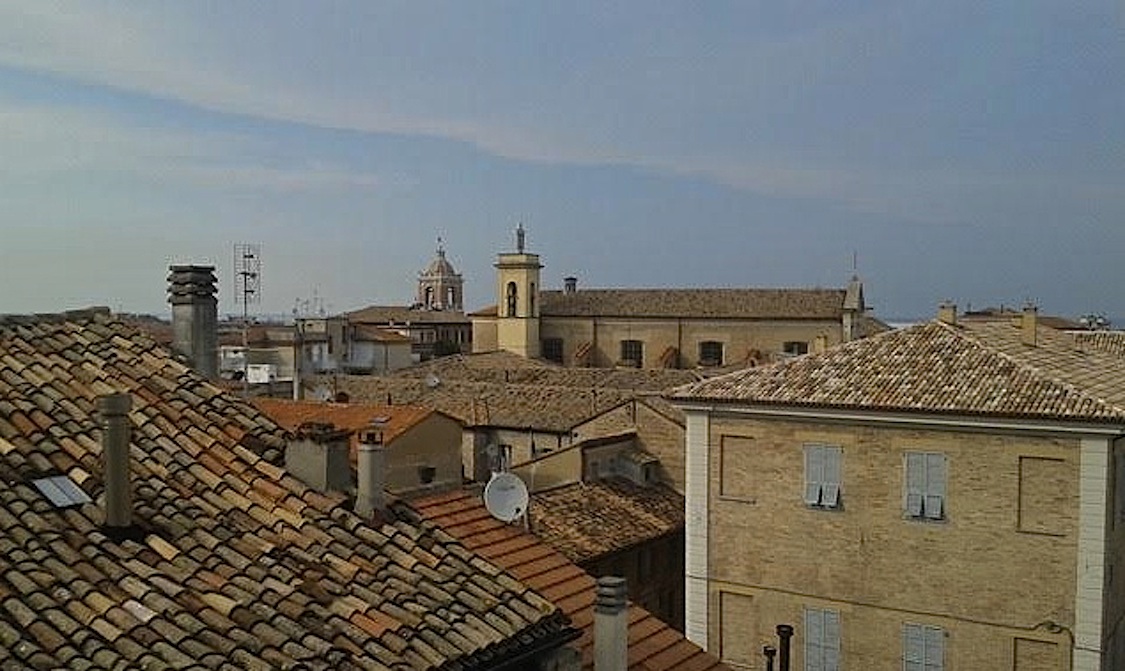
Senigallia rooftop satellite dish

cloudwatching, tall Highway 139 poatgutenberg@gmail.com

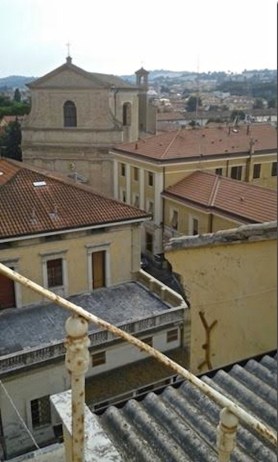
Pictures of satellite dish and medieval rooftops are by MIL22; of clouds above electric wires, by postgutenberg@gmail.com


Across the wires the electric message came

He is no better. He is much the same.

— Alfred Austin, generally reckoned to be Britain’s worst Poet Laureate of all time, on the illness of the Prince of Wales in 1871

Nothing as gossip-worthy as that is travelling between the satellite dish on a tiled roof that could easily have been built in Gutenberg’s day — and an elongated expanse of semi-wilderness an ocean and oversized continent away. We might, if we only had the time to spare, tell a shaggy bat story — a four-day saga not quite over, starring the only known species of flying mammal. Never before have we kept company with a face copied often in medieval church gargoyles — yet oddly apt for its boffin-ish style of getting about.

Read these extracts from the Wikipedia entry on echolocation, and we defy you to come away less than one hundred per cent certain that bats are the ultimate geek totem animal:

FM signal advantages

The major advantage conferred by an FM signal is extremely precise range discrimination, or localization, of the target. J.A. Simmons demonstrated this effect with a series of elegant experiments that showed how bats using FM signals could distinguish between two separate targets even when the targets were less than half a millimeter apart. This amazing ability is due to the broadband sweep of the signal, which allows for better resolution of the time delay between the call and the returning echo, thereby improving the cross correlation of the two. Additionally, if harmonic frequencies are added to the FM signal, then this localization becomes even more precise.

[…]

CF signal advantages

The structure of a CF signal is adaptive in that it allows the CF-bat to detect both the velocity of a target, and the fluttering of a target’s wings as Doppler shifted frequencies. A Doppler shift is an alteration in sound wave frequency, and is produced in two relevant situations: when the bat and its target are moving relative to each other, and when the target’s wings are oscillating back and forth. CF-bats must compensate for Doppler shifts, lowering the frequency of their call in response to echoes of elevated frequency – this ensures that the returning echo remains at the frequency to which the ears of the bat are most finely tuned. The oscillation of a target’s wings also produces amplitude shifts, which gives a CF-bat additional help in distinguishing a flying target from a stationary one.

IMG_0213

Senigalli rooftops JULY 2015 unnamed

Radically open — post-print — justice, streamed live from Britain’s Supreme Court, salutes art’s power to keep an artist alive and prevail over horror

At La Scala -- photograph by MIL22

At La Scala, the world’s most famous opera house and concert hall:  neither here nor at its least glamorous counterparts elsewhere is it possible to discern, from the audience, the awful truth about what music means to some musicians — photograph by MIL22

James Rhodes at the piano

James Rhodes at the piano

After you have recovered from your astonishment at seeing the Kindle price for this book, Instrumental: A Memoir Of Madness, Medication And Music£8.54, or $24.46 in the U.S., where you cannot buy a copy, at present, you click on ‘Look Inside’. First come the chapter headings most unusual for an autobiography, irresistible for any lover of classical music: ‘Track One: Bach, “Goldberg Variations,” Aria (Glenn Gould, Piano)’, ‘Track Two: Prokofiev, Piano Concerto No. 2, Finale (Evgeny Kissin, Piano),’ … and so on. The opening paragraphs are so raw, self-lacerating and articulate, at once, that you feel as if the top of your head has gone missing. You emerge from the text to Look Outside again, following your scrolling finger down to British reviews that add up to a standing ovation … but, wait! Are you seeing straight? Can this really be the first reviewer? Yes. Improbably, here are the words of the clip and credit beneath it:

A person who has suffered in the way that [James Rhodes] has suffered, and has struggled to cope with the consequences of his suffering in the way that he has struggled, has the right to tell the world about it. And there is a corresponding public interest in others being able to listen to his life story in all its searing detail. (THE SUPREME COURT)

Though we have yet to read more than the brief sample of the text on the Kindle site, it looks as if it is written in the incandescent Angry Young Men tradition of 1950s England — by one of the Oxford-educated members of the group, perhaps. The soaring encomiums it has won from reviewers are plainly not hyperbole extracted by cunning marketing and influence-peddling. The reader reviews on Amazon UK confirm that. Who has ever seen nothing but 5-star reviews for a work with more than a handful of testimonials, on the e-bookseller’s site? This one had 111, when we last checked.

Judged by the Court’s explanation for its decision, quoting James Rhodes at length — hair-raisingly — his book is the most stunning record of art redeeming life that most of us will ever have encountered. Almost equally arresting were the words the justices chose to spotlight the sublime importance of freedom of expression:

Freedom to report the truth is a basic right to which the law gives a very high level of protection. It is difficult to envisage any circumstances in which speech which is not deceptive, threatening or possibly abusive, could give rise to liability in tort for willful infringement of another’s right to personal safety. The right to report the truth is justification in itself.

News and analysis of this uplifting decision was posted in two entries in Inforrm’s Blog (the International Forum for Responsible Journalism) — one of them a re-blogging of an entry in the Injunctions Blog. Somehow, both posts failed to mention that the pianist and autobiographer was represented at the appeal by Hugh Tomlinson QC — anointed Lawyer of the Week by The Times for his victory — who happens to be the founder-editor of the INFORRM web site. The blog is invaluable to anyone trying to keep up with changes in media law in the disorienting transition from traditional publishing, but especially indispensable for independent journalists, bloggers and citizen journalists who — unlike their counterparts in corporate media — have no legal department watching their backs. Many, if not most, INFORRM posts are reproductions of entries in other blogs, mainly from the UK, Ireland and Australia — an exemplary exercise in aggregation.

The INFORRM editor was also the founding editor of the UK Supreme Court’s blog, inspired by its American counterpart, the SCOTUS blog. However, Britain’s court of last resort stole a jump on the Americans with the start of live video streaming of its proceedings in 2011 — a move still being resisted across the Atlantic. This proof of a commitment to using post-Gutenberg media to deliver radically open justice dovetails perfectly with the justices’ heavily underlined commitment to protecting free speech in all its forms.

A videorecording of Lord Toulson delivering a summary of the Rhodes case judgment can be watched here.

Below, we post extracts from the detailed exegesis of keenest interest to us.

Just how did Instrumental come to the attention of Britain’s highest court of appeal? From the opening paragraph of the judgment published on 20 May, it is possible to glean the conventionally-minded reasoning to which the lower court responded, in suppressing its publication:

By these proceedings, a mother seeks to prevent a father from publishing a book about his life containing certain passages which she considers risk causing psychological harm to their son who is now aged 12. Mother and son now live in the United States of America and so the family court in England and Wales has no jurisdiction to grant orders protecting the child’s welfare. Instead, these proceedings have been brought in his name, originally by his mother and now by his godfather as his litigation friend, alleging that publication would constitute a tort against him. The tort in question [dates back to 1897, and is] generally known as intentionally causing physical or psychological harm. What, then, is the proper scope of the tort in the modern law? In particular, can it ever be used to prevent a person from publishing true information about himself?

Then, later passages in the very long but riveting explanation for the decision show how profoundly impressed the higher Court was — to its everlasting credit — by the meaning of music for this particular musician:

The father is James Rhodes, the concert pianist, author and television filmmaker. The book is entitled Instrumental. The author believes that “music has, quite literally saved my life and, I believe, the lives of countless others. It has provided company where there is none, understanding where there is confusion, comfort where there is distress, and sheer, unpolluted energy where there is a hollow shell of brokenness and fatigue”. He wants to communicate some of what music can do, by providing a sound track to the story of his life. “And woven throughout is going to be my life story. Because it’s a story that provides proof that music is the answer to the unanswerable. The basis for my conviction about that is that I would not exist, let alone exist productively, solidly – and, on occasion, happily – without music.” So the book juxtaposes descriptions of particular pieces of music, why he has chosen them, what they mean to him, and the composers who wrote them, with episodes of autobiography. He wants the reader to listen to the 20 music tracks while reading the chapters to which they relate.

Thus far, there would be nothing for anyone to worry about. But the author’s life has been a shocking one. And this is because, as he explains in the first of the passages to which exception is taken, “I was used, fucked, broken, toyed with and violated from the age of six. Over and over for years and years”. In the second of those passages, he explains how he was groomed and abused by Mr Lee, the boxing coach at his first prep school, and how wrong it is to call what happened to him “abuse”:

“Abuse. What a word. Rape is better. Abuse is when you tell a traffic warden to fuck off.

[…]

He describes how he learnt to dissociate himself from what was happening, to block it out of his memory, how when he moved to other schools he had learnt to offer sexual favours to older boys and teachers in return for sweets and other treats. He gives a searing account of the physical harms he suffered as a result of the years of rape and of the psychological effects, which made it hard for him to form relationships and left him with an enduring sense of shame and self-loathing.

He recounts the ups and downs of his adult life: a year at Edinburgh University filled with drugs and alcohol, leading to his first admission to a psychiatric hospital; a year working and sobering up in Paris; three years studying psychology at University College London, leading to a highly successful career as a salesman in financial publishing; meeting and marrying the mother, whom he calls Jane, an American novelist then living in London; making a “perfect home” with her. He is kind about his wife – “The poor thing didn’t stand a chance” – and hard upon himself …

[…]

Then their child, whom he calls Jack, was born: “My son was and is a miracle. There is nothing I will experience in my life that will ever match the incandescent atomic bomb of love which exploded in me when he was born.” He wanted to be a perfect father, but “I don’t think that I will ever be able to make my peace with the fact that the ripples of my past became tidal waves when he was born”. His past had installed “an unshakeable belief that all children suffer through childhood in the most abominable ways and that nothing and no-one can protect them from it”. Eventually, he looked for professional help from a charity specialising in helping victims of child sexual abuse and was told that he must tell his wife about the abuse. So he did. Their child was then four years old. “It is, apparently, very common for the world to spin completely off its axis when your child approaches the age you were when the abuse began”.

[…]

Interwoven with this painful story is the story of his relationship with music. He discovered music, specifically, Bach’s Chaconne for solo violin in D minor, transcribed for piano by Busoni, while still at the preparatory school where he was being so brutally abused:

“… that piece became my safe place. Any time I felt anxious (any time I was awake) it was going round in my head. Its rhythms were being tapped out, its voices played again and again, altered, explored, experimented with. I dove inside it as if it were some kind of musical maze and wandered around happily lost. It set me up for life; without it I would have died years ago, I’ve no doubt. But with it, and with all the other music that it led me to discover, it acted like a force field that only the most toxic and brutal pain could penetrate.”

At his next preparatory school he largely taught himself to read music and play the piano. At Harrow, he had his first proper teacher, who was “awesome”. He discovered that “literally the only thing in the universe I realised I wanted was to travel the world, alone, playing the piano in concert halls”. Then he gave it up during the ten years of university, building a career and getting married. But after his son was born and the demons returned, “I looked for distractions. I looked for a way out that didn’t involve homicide or suicide”. He found it in music. He set about building a business partnership with the agent of “the greatest pianist in the world”, but was persuaded instead to train as a pianist himself. He worked hard. And when he had begun to resort to self-harm, he decided to organise his first public concert. He rented a hall on the South Bank, the hall was filled, and the concert went well: “I realise that all those fantasies about giving concerts that I had as a kid, that kept me alive and safe in my head, were accurate. It really is that powerful. And I knew I wanted to do it forever. No matter what”.

Then the suicidal ideas and attempts and hospitalisation took over. But a friend visiting him in hospital brought him an iPod nano loaded with music inside a giant bottle of shampoo (toiletries being the only gifts allowed). Once again music was his salvation. It persuaded him to do what he needed to do to get out. After separating from his wife, he started to get more involved in the piano again. And in a café he met the man who was to become his manager. Together they arranged for him to record his first CD, Razor Blades, Little Pills and Big Pianos. He found a sponsor to enable him to concentrate on his music. He did a documentary about Chopin for the BBC. His manager arranged concerts at the Roundhouse and the Queen Elizabeth Hall. Together they devised a new sort of concert, in which the pianist talked about the music, the composer and what it meant to him, in an informal way quite unlike the usual classical music concert. It was a success. Through his manager he met the woman who was to become his second wife.

[ continues: … https://www.supremecourt.uk/cases/docs/uksc-2014-0251-judgment.pdf ]