Christo preceded Banksy in wresting material security or ‘business models’ from ephemeral, unshackled art — offered to all with no admission fee

Christo married nature to the built world with a modernist eye for straightforward surrealism — going beyond the real — in art that often abstracted bits of pattern or contour from a landscape, then displayed his ideas there temporarily by covering up great hunks of it in fabric, or by fastening objects onto it ( See: samples )

Banksy’s stencilled goat (L) compared to an American Indian cave painter’s freehand rendering of a nanny goat kidding with human aid, a pictograph that could be six thousand years old

Christo could have no equal in his extravagantly inventive reinvention of payment for art. Applying artistic license to finance, he exercised it to the limit. Heaven only knows how he worked out his methods of getting paid not for his barely-there/short-stay/vanishing/ephemeral works of ‘land art’, seemingly dreamt up at their gargantuan scale by giants — in fact, by a bespectacled figure as slight as an idea still being translated into flesh — but mainly for his creations’ equivalents of amniotic sacs, their eggshell-fragments, their tadpole tails. 

Getting paid, that is, without government arts-and-culture grants or fat cat patrons or by lending his face or images of his creations to purveyors of luxury goods, to flatter their status-seeking buyers by association. If there were artists before him who showed him how to thrive by unconventional means, they go unmentioned in encyclopaedia entries, journalists’ potted biographies, and on Christo fan sites. 

Christo as the signature not noticeable on projects such as Wrapped Coast in 1969 — in which an entire small bay and its cliffs in Australia were draped in grey erosion-control fabric for ten weeks — eventually referred to both the primary mover and his collaborator and wife, two artists born in different countries on the same June day in 1935. 

They were married in the late 1950s in Paris, where he had arrived by way of Vienna and Geneva, having fled Bulgaria, where he was born, as a penniless 21 year-old stowaway on a railway car — to escape military conscription and being forced by the Communist government to paint propagandist imagery. She was a Moroccan-born socialite living there, the stepdaughter of a distinguished French general, when he was commissioned to paint a portrait of her strikingly beautiful mother.

Her family’s wealth was probably the psychological safety net for the Christo partnership’s confident, early rejection of the usual ways of earning money for art to seek alternatives. His contribution was psychological drive — motivation that children of the well-off typically do not find on their own. It originated in dire family travails and his own struggle for free expression in Bulgaria, where his father had been imprisoned ‘for being part of the intelligentsia,’ leaving a household that had been prosperous impoverished and subjected to oppressive state surveillance.

Combining actual names for credits would have hinted at these complex antecedents but made an indigestible nomenclature soup: Christo Vladimirov Javacheff and Jeanne-Claude Denat de Guillebon. 

Part of their earnings came from the sale of original lithographs related to their creations; the rest from purchasers of the sketches and collages, preparatory drafts, plans, and scale models of their spectacular finished works — for whose execution they hired other hands, or accepted help from volunteers. They insisted that their contributions to art should be seen as encompassing their exhausting extended battles to overcome public and governmental opposition to realising their imaginings — most famously, a fight for nearly a quarter-century ’across six Bundestag presidents,’ for permission to wrap old imperial Germany’s Reichstag, its supreme government building, still serving in that role today.

Some of us spent the end of summer waiting for any plausible cultural commentator to invoke Christo as the crucial predecessor — part-inspiration, surely? — of Banksy, the pseudonymous and elusive street artist-cum-prankster from Bristol who cheered everyone up after the mass rioting following Britain’s change of government in July.

The goat mural that attracted worldwide attention in early August was obviously in the stencilling tradition he is so proud of — because it lets him put up murals he has worked on in his studio at top speed. Not so as to shine as a time-and-motion virtuoso, but to avoid getting arrested. He could still work fast and stealthily in a freehand line but, no, he prefers the mechanical look of stencils with none of the élan or genius of the cut-outs Matisse turned out like hotcakes in his old age. These Banksy templates actually look as if they were never drawn at all but traced from documentary photographs, reminding the viewer of his reputation as a copycat’s copycat — since stencilled graffiti have been associated since the early 1980s  with a Parisian artist, Blek le Rat, who has complained mildly about the imitation.

None of this is to deny the charm or wit in Banksy’s antic political protests, from his very first graffito in 1997, a mural with a cartoon teddy bear hurling a Molotov cocktail at hapless riot policemen.

Like Christo, Banksy also earns his money — millions of pounds a year, it is said in unsubstantiated reports — by thumbing his nose at traditional sources of income for art. (He could be an invisible man with no visible means of support except for the unavoidable conclusion from visits to art world sites, that he and mainstream media have an unofficial pact to keep the wheeze about his indeterminable identity going for as long as possible, to give us something to smile about.)  As a street artist determined to avoid being dictated to, exploited or edited by gallery owners, he sells representations or versions of his murals — ‘stencil works, silkscreens, and lithographs rendered in the same style as his wall pieces, and in many cases [using] the same imagery’ — according to a long, absorbing and apparently well-informed account of his ‘business model’ on Art Space’s website

He seems never to have sought to stop ‘art dealers and property owners … tearing apart walls to remove and sell Banksy works.’ For a span of years ending in 2018, he collaborated with other graffiti specialists to sell modestly-priced prints of their images through a printshop and website. That collective, Pictures on Walls, was shut down six years ago with this impressive statement:

Inevitably disaster struck—and many of our artists became successful. Street Art was welcomed into mainstream culture with a benign shrug and the art we produced became another tradeable commodity. Despite attempts at price fixing regrettably some POW prints have become worth tens of thousands of pounds. 

Either unable or unwilling to become part of the art market we once so self-righteously denounced — we called it quits.

Banksy apparently continues to circumvent the art world’s mercantile establishment by selling his work exclusively through private arrangements with buyers — again, according to Art Space’s worshipful exegesis.

Search engines produce few or no results for simple queries combining Christo’s and Banksy’s names — yield no evidence of anyone noticing their similarities. A list of rough jottings:

— art displayed for no charge in public spaces — playfulness/ a spirit of fun even when protesting about collective obtuseness/social injustice

— earn money (lots) from tangentials, incidentals and representations of — not the works themselves 

— art that is not made with permanence as the objective 

— BUT is also part of a personal fight against authority of some kind — for C, with governments or collective administrators; for B, against gallery owners and other ruling powers in art merchandising establishment

—  art that offends some — B’s sometimes referred to as defacements or vandalism; C’s infuriated eg., Parisians who objected to the wrapping of the Arc de Triomphe, and it took decades to overcome objections to several public projects, even when he and Jeanne-Claude won

Christo and Banksy matter naturally to this p-G website because financial innovation for a different category of arts worker is the point of the proposal for a keiretsu-cooperative — a constructively social, egalitarian scheme for using the internet to nudge publishing into its post-Gutenberg future.

Alas, no writers appear to have accomplished what these artists have in setting their enviable terms for making art pay, and handsomely. 

This is less true of Christo — who survived Jeanne-Claude by eleven years and died in 2020 — than of Banksy, who does not lend his image or scraps of autobiography to hawking his pictures. What contemporary, real-life equivalent is there of the wholly fictional M. N. Opie, a gifted, principled storyteller in a new novel by Neel Mukherjee, who ‘refuses to jump through the hoops of book promotion, will discuss editorial matters over email but avoids social media and will volunteer no personal information, not even a gender’? The LRB reviewer, Adam Mars-Jones, believes like most professional novelists that they are powerless to oppose being required to appear before the public like plucked chickens: ‘These days self-promotion, the business of presenting to the world your trauma or cheekbones (ideally both) is not optional …’. Brilliant M. N. Opie’s story collection does not find enough readers to save it from imploding into utter obscurity.

We must reach once again to the past and a certain Elizabethan playwright for an example of a scribbler soaring above the constraints and humiliations bedevilling writers to succeed in a bold new way of earning a living — the subject of a p-G post in March. Jonathan Bate — the Shakespeare expert whose deductions about the Bard’s financial acumen from decades of research featured there, effectively makes a case for Shakey being a sort of Banksy avant la lettre, for his own reasons. 

The dearth of verifiable flesh-and-blood facts about the man from Stratford-on-Avon, Bate suggests, is not in the least accidental. It is what he intended for posterity. Philosophy in Shakespeare’s day was conditioned by the Greeks and Romans. They warned about the double-sidedness of fame; that with glory comes Rumour, ‘the evil of the highest velocity,’ envisaged as a shameless surveillance she-monster whose body is pocked all over with ‘vigilant eyes’. Bate singles out Epicurus as the crucial influence — homing in on ‘the Epicurean precept that would have been the perfect motto for Shakespeare: “HIDE THY LIFE.”’ [ JB’s emphasis ]

That could hardly be an injunction for the rest of us, now. What defence has the resourceful Banksy himself against the ever-intruding snouts of the data collection apps in our devices, the treacherous software in the internet of things; against our collectively spineless, toothless — or uncomprehending — submission to an AI-ruled future? Or does Banksy rely on human couriers networking with carrier pigeons to communicate, and post on Instagram through intermediaries? Questions for a future p-G installment.

Proofs of concept for a keiretsu-cooperative to succeed the data collection and ad-dependent legacy publishing model— from TikTok, the online Daily Mail … and Shakespeare

By becoming a shareholder in an acting and theatre-owning joint-stock company, Shakespeare — a ‘country boy’ outsider — ‘was the first to turn playmaking into a potentially rewarding profession’ — Soul of the Age: A Biography of the Mind of William Shakespeare, Jonathan Bate

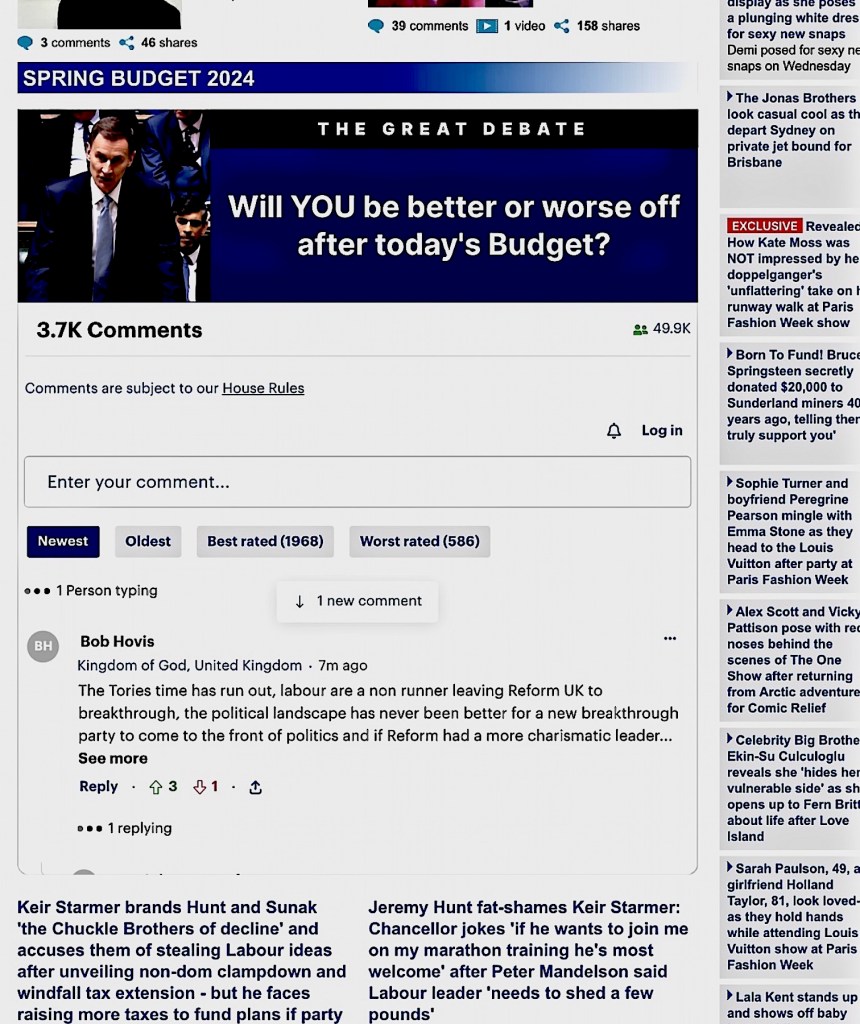
A live scroll of 3,700 readers’ comments on U.K. taxation and a comment invitation box on the 6 March home page of the online Daily Mail look like illustrations for William Dutton’s The Fifth Estate: The Power Shift of the Digital Age

Real-life counterparts of conceptions of things to come can appear in unlikely places, including some in the past. 

But, you may say — surely not the online Daily Mail coupled to the Chinese user-videos-plus-shopping platform, TikTok? Yes, and yes. But also from, of all people, the supreme William Shakespeare — or what literary experts and historians searching for the indisputable facts about his life have unearthed in recent decades. 

This improbable group answers the question of what evidence there is for the practicality of a keiretsu-cooperative to succeed the noxious advertising and personal data collection-dependent  surveillance business model for journalism and publishing. 

Though legacy media’s need for an innovative financing scheme and structure has proceeded from dire to desperate, this has somehow gone unmentioned in 2024’s mournful stream of reports about the decimation of employment in the news business. 

In noting that over five hundred jobs in U.S. print, broadcast and digital media fell to cost-cutters’ axes in January, Politico said that this followed layoffs of 3,087 in the same categories in 2023 and 2020’s high watermark of 16,060. A 5 March reminder in the Financial Times of 450 journalists losing their jobs in Britain’s dominant Reach publishing conglomerate last year — because of an advertising slump linked to a steep slide in its newspapers’ online reader numbers — was not accompanied by any discussion or speculation about ways to stop or reverse the trend. Legacy publishers exhibit no outward signs of interest in remedies except for tried and tired variations of subscription terms or experiments in taking paywalls up or down to limit what visitors to their sites can read. 

The New Year’s Day post here drew attention to the lone, faint glimmer in this doom-saturated panorama: old media managers do at last understand that reader-commenters are poised to become the core of their economic survival plans — the same people at the heart of the keiretsu-cooperative

These are the visitors — effectively, informal, indie micro-publishers — luring and engaging site traffic who in 2010 were still commonly referred to as ‘bloggers’. January’s  p-G jottings about them recorded that the business brains at some newspapers have begun to treat reader-commenters’ reactions and other ‘content’ like gold dust. As a result, some of them have begun — shamefully — to slap copyright claims with no legal justification onto those contributions from audience members, including many who are handing over cash as site subscribers.

How long is it going to take before most of them understand all the transformations underway sufficiently to see that reader-commenters are well on their way to morphing into: 

— CONVERSATION PARTNERS ON EQUAL TERMS 

or ‘interactive’ audiences who are no longer mere receivers for broadcasts by newspaper reporters and opinion writers. On 6 March, anyone popping in at the online Daily Mail would have noticed an apparent experiment — placing at the centre of its home page a blank commenting box inviting readers to have their say on the U.K. government’s spring taxation and budget announcement. 

This invitation was set in a screen within a screen with a moving scroll of other readers’ thoughts on the topic (see screenshot above, taken when the comment count had reached 3,700). 

The overall impression was of a live demo of William Dutton’s portrayals in The Fifth Estate (2023) of ‘networked individuals’ becoming powerful as ‘a new source of accountability, not only in government and politics but also in all sectors of society.’

— CO-PERFORMERS 

The online Daily Mail is the world’s fifth most-popular English language news title. It also magnetises more visitors to TikTok than any other purveyor of news on this Chinese-owned (ByteDance) social media platform where anyone can upload short videos they have made; earn cash from advertisers through product placements and promotions if they can lure enough traffic; and buy things hawked to them.

Publishing for people catching up on news where they go for relief from boredom, to play amateur auteur or entrepreneur, or to risk becoming shopaholics looks unavoidably like the future of journalism — because these people are disproportionately the youngest adults. 

In a mid-January feather-fluffing announcement, the Daily Mail Online claimed to have ‘surpassed 10 million followers’ on TikTok (estimated by backlinko.com, to have soared beyond X-Twitter, Telegram, Reddit, Pinterest and Snapchat in platform popularity measured by ‘monthly active users.’) 

The paper summed up its TikTok triumph as icing on the cake for its ‘unrivalled position as no.1 for engagement with audiences across all platforms.’ It explained that ‘[a]ccording to research by the Reuters Institute for the Study of Journalism, 20 per cent of 18-24s use TikTok to learn about current events, which was an increase of five percentage points from the previous year.’ A follow-up story in February quoted other research ‘showing that more than 40 per cent of 18-24s receive news from the Chinese-owned social media giant once or more times a day, compared with 19 per cent for the BBC, Instagram (44 per cent), Facebook (33 per cent) and Elon Musk‘s X (24 per cent), formerly known as Twitter.’

Luck being what luck is, my 2010 outline of a scheme for post-Gutenberg publishing, six years before the birth of TikTok, began:

New communication technologies have created a karaoke world. It is not just that we have the means to ensure, cheaply and easily, that—as Andy Warhol predicted— everyone could be world-famous for fifteen minutes … Practically nobody is content any more to be just a spectator, reader, passive listener or viewer. Audience participation as well as the right to talk back—which includes non-expert reviewing of works or performances by trained and seasoned professionals—have become absolutely standard expectations. 

— STAKEHOLDERS AND CO-DETERMINISTS

Few card-carrying cultural elitists inclined to shrug loftily about TikTokers earning cash from homespun, unmediated webcasting — making them de facto stakeholders in the platform’s success — will know that without the democratisation of culture in his own revolutionary epoch, we would never have heard of William Shakespeare. That man of mystery incommensurably more gifted than any other literary genius — forget TikTokers — has emerged from recent literary and historical sleuthing not as the aristocrat lurking behind a pseudonym in the centuries-old rumour, but incontestably a ‘country boy.’ 

He was ‘the grandson of a yeoman farmer and the son of a failed provincial shopkeeper,’ in his portrait by today’s pre-eminent Shakespearean scholar, Jonathan Bate, in Soul of the Age: A Biography of the Mind of William Shakespeare (2009). He got his start in playwriting by polishing the scripts of other writers while enduring mockery as ‘an upstart crow,’ a ‘rude groom,’ and a ‘peasant.’

But this book’s most unexpected revelation, for many, will be about Shakespeare’s business acumen, an asset as rare in writers then as it is now. He died a prosperous landowner at fifty-two, leaving his wife and the children he had fathered before his twenty-first birthday well provided for from his earnings as a shareholder in an acting company that operated very like a cross between an artists’ collective and a cooperative venture in our time.

Through becoming a shareholder, Shakespeare was the first to turn play-making into a potentially rewarding profession that could support a marriage and a family. His fortune was made not by a literary innovation but by a business decision. In his early career, Shakespeare would have noted the raw deal suffered by the script writers, who were paid only a few pounds per play. The serious money was made by manager Henslowe and lead actor Alleyn, who ran the Rose Theatre as an entrepreneurial partnership. Shakespeare and his close associates came up with an alternative arrangement: the Lord Chamberlain’s Men was formed in 1594 as a joint-stock company, with the profits shared among the players.

What could have been the equivalent of reader-commenter power for Shakespearean audiences? 

The 20th-century historian John Hale has shown that unlike the ‘patron-fostered painters of Italy, the Low Countries and Germany,’ the Bard ‘was reliant on popular support, as were his fellow playwrights.’ Their works and the venues for their performances were part of a democratically inclined ‘theatrical machinery that both responded to and increased the number of spectators and dramatists.’ Another impression from reading The Civilization of Europe in the Renaissance is  of how uncannily today’s social media frenzy resembles the explosion in early 17th-century mass entertainment in London:

During the boom period of new plays, 1600-10 … the places available each year in the commercial theatre, discounting Sundays and Lent, may have topped a staggering two million when the population of London was two hundred and fifty thousand. Never before in Europe had there been so heavy a vote of confidence in a single form of cultural activity.

In another prefiguring of the present, Civilization shows the joys of expanding free expression for playwrights soon proving to be too much for the authorities:

Altogether the appetite for theatrical dialogue and effects was so constant as to enable a playwright to indulge his own aspirations short of flagrantly inviting political and religious censorship; bawdiness was let slip with a shrug, a contributory reason for the Puritan criticism which led eventually, in 1642, to the order that the theatres should be closed altogether, an order honoured almost as much in the breach as in the observance.

Some of the Puritans especially disgusted by their inability to control this tide in public affairs presumably let a different one carry them away to found a new colony on the other side of the sea. But here we are now, being reminded that the most satisfying narrative arcs can turn out to be circles. 

The keiretsu-cooperative seems to rhyme naturally with what has gone before, not just with what will or should be.

The proof that newspapers’ reader-commenters are data-collection gold is in site-owners’ tightening restrictions; attempts to control the historical record; and seizing gifts to the commons for themselves

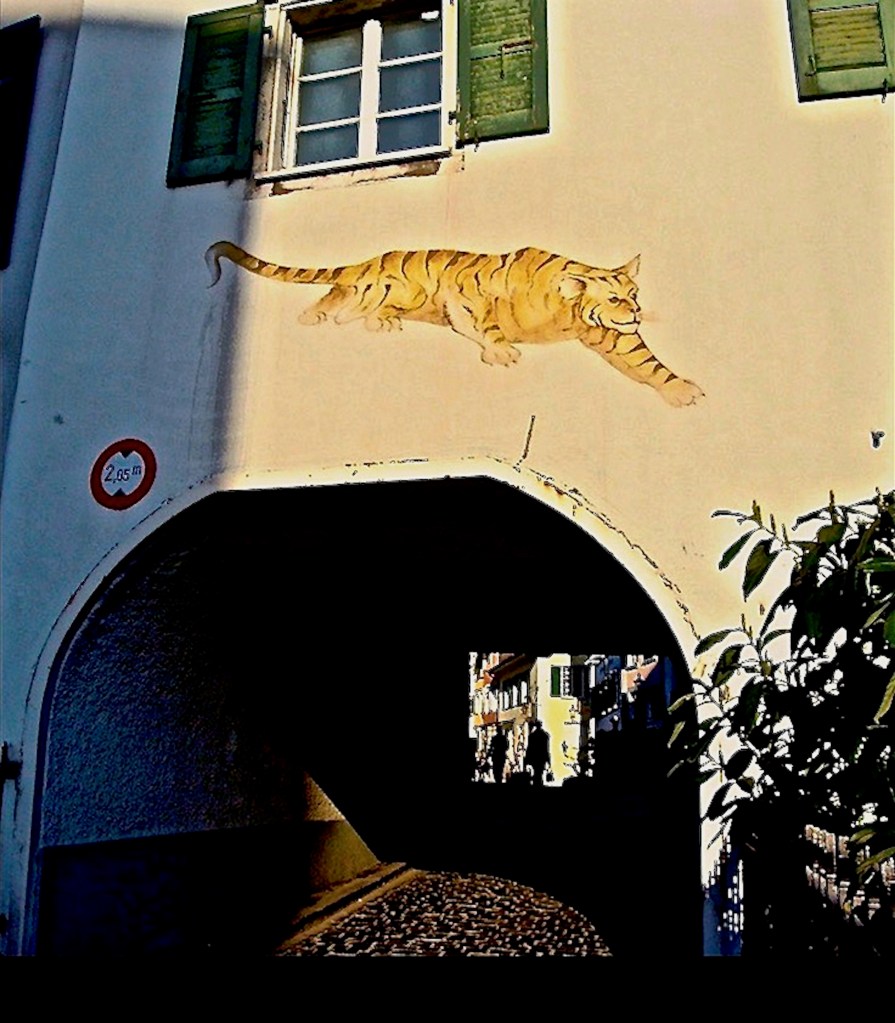
The tiger mural is a reminder that our most ordinary actions, from shopping to pumping fuel ( above and below ) are being included in data-gathering for AI everywhere. In an old Chinese philosophical text, tigers spy with ‘sharp eyes’ — the official name of China’s nationwide surveillance system

The Wikipedia uses this painting by Hieronymus Bosch to illustrate its explanation of misdirection. Frogs leaping from the mouth of the victim having his pocket picked by the conjurer’s accomplice mock his foolishness

Hello froggy.

Happy New Year!

Before I get to frog ponds — or another way to think of comments sections of newspapers and other media sites — let’s think about where we are on this road to a world run on AI. What’s being done to commenters couldn’t be more emblematic.

No I’m not addressing you as a twitchy amphibian to be rude. I’m a frog too. We all are. Frogs clueless for the most part about the heat being turned up under this pot of water we’ve been put in ever so gently, as the dial twists by infinitesimal degrees. Or not so oblivious, but lying to ourselves about what is happening because truth is frightening when we don’t know how to defend ourselves against its implications.

What truth is that? you ask. This: in digital technology’s reshaping of society, we have gone far beyond the surveillance business model (or ‘surveillance capitalism’ if you are politically-minded) to losing our human agency — which is, being deprived of our ability to act on our intentions, or do freely what we reasonably expect to be able to. Or did.

Pay attention to what the most objective leading scientists are saying. Not the elite compromised by still working in or closely connected to technology giants, investors and startups. Not anyone taking Big Tech’s coin in research funding at their universities — the subject of a recent report in the Washington Post — unless they are as honest as the Belgian physicist Bob Coecke. He taught at Oxford for over twenty years and lately, has been doing all he can for emergency public education. In an interview with a Guardian journalist published two weeks ago he said, too bluntly for delicate ears:

‘Think about AI. Think about how the world is getting fucked up now. Billion-dollar companies are in charge of a revolution that could control the world and nobody understands what they are doing.’

Note his use of the present tense, dear froggy. Treat as singing with forked tongues the chorus of alarmism about AI dangers from too many sci-tech stars. Note that their warnings are focused on the future — with no mention of damage being done by AI in the present, in which fortunes are being made by some of those alarmists as they themselves exploit the all-invading technology (last mentioned in a post here in June.)

It’s hard to shake off the impression that the persistent future-focus is being used exactly like the ancient magician’s art of theatrical misdirection. A stream of deceptive patter from the conjurer concentrates on what he wants the audience to look at while he grabs the diversion to play his tricks and pull off his stunts.   

How do you demonstrate that we are losing human agency? O froggy, o froggy, the proof that we’re frogs set for boiling is all around us in the trivia of daily life. It looks boring beside the futurist-conjurers’ high-flown speculations about AI becoming ‘conscious,’ and their arguments about what that what would mean. 

You can trace an arc of horror from a New York Times exposé five years ago to a recent leak about Google’s objective in its nonstop data collection on, and analysis of us as individuals. In 2019 Kashmir Hill, a NYT reporter, discovered that Sifted, a company specialising in data-gathering, was a top purveyor of detailed personal profiles of consumers that other companies buy to decide on discriminatory treatment. How long you are kept on hold  as you wait for customer support. Or when you have to return a defective product you have bought, make that task easy, arduous or impossible. 

This is all done automatically by software, early AI or machine intelligence, based on your very personal Sifted profiling and categorisation, which can include — as the NYT journalist discovered — ten years of comments that you posted on some website. Rating like this could account for some cases in a Guardian report on 19 December about the frantic struggles of UK telecommunications customers attempting to cancel broadband contracts. One said that he could not get anyone to help him on his telecoms company’s web chat service ‘after leaving it open all day for two consecutive days,’ — after which he spent hours on hold seeking help by telephone, during which he was disconnected four times.

Who could expect any of this to get better after considering the implications of these Daily Mail gleanings from documents presented at a recent internal conference at Google describing ‘the tech giant’s plan to create an artificial intelligence designed to become its users’ “Life Story Teller”’ — software anyone could open for the first time and discover that ‘“it already knows everything about your life.’’’

As people paying attention know by now, dear froggy, the technologists say that they are only following digital technology where it is leading us unavoidably. Before the wide public debate that this rationalisation needs — urgently, members of the public have to open their eyes wide to their frogs-in-pot predicament.

My own enlightenment came from thinking about roughly a decade of reading and commenting on the website of the Financial Times, a newspaper to which I have had fond, work-related ties going back to three weeks before I turned twenty-one, a whole geological era ago. I mention this because feeling the temperature go up in the frog water on that site, and realising that commenter-frogs are no longer in a pond but a confining pot — thanks to sweeping changes in the online FT’s management practices — is especially unnerving for those of us who knew the paper in its still recent, pre-digital past.

There was of course no glimmer, in that past, of anything like the proposal related to this post-Gutenberg site’s launch in 2011 — a description of a new economic structure or ‘business model’ for publishing I called a keiretsu-cooperative, which placed reader-commenters at its core. I saw a chance for a sort of symphysis: commenters and publishers evolving, growing and prospering together — after an experimental phase in which the idea was debugged and refined.

In spite of the annoyance of trigger-happy site moderators, the first few years of media commenting sites, from approximately the mid-noughties, were glorious fun. Very happy frog ponds. On the websites where I tried out commenting — or unmediated publishing — it was startling to see readers hopping in and out at any hour of day or night, frequently posting links to their personal blogs and websites. We started our own, separate conversations in those places. Some of us went on to exchange news about our families as a matter of course.

The Financial Times site was not one of my early commenting ponds. Perhaps because it was already behind a paywall in 2016, and because a large proportion of its readers’ subscriptions are paid for by their expense accounts, the conversations there are less relaxed — if more reliably intelligent. But it was enough like the sites where I learnt how commenting works that I have been alarmed by registering signs of readers being treated over the years less like cherished visitors and more and more like data-collection objects (or dupes): instances adding up to froggy water warming up steadily but barely noticeably.

Signs such as these:

Blocking or interfering with downloading and saving articles and comments — that is, readers’ ability to take delivery of what they have paid for.

This includes introducing barriers to commenters’ ability to save their own published comments and the rest of the commenter thread — the context in which they were made.

It used to be possible to save any article with its entire comment thread in a single sequence of clicks. That is now only a sad memory.

Rearranging the order in which comments were actually posted in thread-saves, along with severely restricting the number of comments downloadable in a single cut-and-paste exercise. This is not merely frustrating but distorts the historical record, which matters to those of us — including scholars — who study for instance, the ebb and flow of sentiment on particular topics in the threads. Declarations of support for positions that oppose the paper’s politics can simply be eliminated from comment-rations.

— Stamping with an FT.com ownership (copyright) notice any saved comment contributed to the commons by readers writing to and for each other, a valuable public resource — even though we legally own the copyright to our own sentences and paragraphs.

Discouraging commenters from getting to know each other.

In the first of the series of redesigns of FT.com witnessed by me since 2016 — including changes in the management of the site and policies affecting reader-commenters — subscribers stopped receiving detailed email notifications of replies to our comments as well as of any new comment in a thread if we had opted to be sent these. The e-notices had until then been delivered with copies of all the sentences to which a fellow-reader was responding; the whole text of any reply, as well as the screen name of the responder. 

All these added immensely to the joys of commenting, especially for anyone like me far less interested in how many replies or recommendations my comments earn than in the screen identity of the recommender. In experiences on other sites, some responses were the start of exceptionally rewarding friendships. Being able to judge how active a thread was from new post alerts helped to decide timing for adding contributions to discussions or just larking around. The alerts often cheered up my email inbox on days when it was clogged with depressing subjects.  

Since the policy shift, all we receive is a flag about a reply from a particular screen name. Nothing more. Another alteration introduced in those early years removed the ability to address a single comment to several screen names in a thread. 

Why did the site managers do this? As they do not answer questions about their motives, you have to guess for yourself. Far from encouraging friendships and symphysis, the site operators are seemingly worried about the possibility of collective action by readers in any policy disagreement with management. 

The overriding motive for switching to bare-bones email notices was obvious: to force commenters to return to the site as often as possible — to increase the click count used to attract advertisers, and to allow data collection. As almost everyone now knows, each twitch of our cursors, every placement of our clicks and even clues to our changing moods are being recorded and added to our profiles. Sparing us the need to return and log in again would mean giving up chances to fatten these data hoards.  

— Blocking site visitors who pay to attend forums and other online events from using the privacy-preserving Safari browser to participate, and insisting that they use Chrome.

This happened to me after I had bought my ticket for one event. It took a time-wasting appeal to upper management to get my money back.

Because I put commenters at front and centre stage in my discussion brief for the Oxford Internet Institute in 2010, I have not been surprised to find comments being treated like precious metals — even if I couldn’t have guessed that this would have anything to do with data gathering for detailed profiling of citizens. Grist for the LLMs that are the mills of AI.

If further confirmation of the soaring value of the pearls of wisdom or pigeon-droppings in readers’ contributions were needed, it could be in a report last month that Chinese authorities are stigmatizing as mentally ill website visitors who read comments but seldom or never write any. Not altogether a shock, if true, when you consider that the Chinese have always had their own ways of going about compelling cooperation, and their AI mills are no less avid for everyone’s thoughts and feelings. It looks as if someone ordained that the psychological profiles of refuseniks must not be permitted to have holes. 

I posted a comment on FT.com last summer about my fear that we are on our way to a hot, wet extinction by bain-marie beneath an article about AI. A reader using @Useparagraphsplease for a screen ID was delighted to remind me that in the famous experiment my metaphor came from, all the frogs were able to escape alive and unhurt. 

But froggy dear, that took awareness and determined preventative action, which is my dearest hope for our species at the start of a new year.

Love,

p-G

Note: Readers of this post who feel that any criticism in it is unfair or inaccurate are invited to leave a comment (which will not be published until after its spambot check). Or, write to me directly at postgutenberg[at]gmail.com. 

The let’s-hear-from-everyone media revolution needs Elon Musk as much as he needs Twitter. His guides would be Robert Oppenheimer, Michelangelo and King Crimson


Should Elon switch species to a different, less complacent-looking bird for Twitter?


Musk focuses on what intrigues him as intently as a foraging woodpecker. He is studying an antique Samurai sword here during a 2018 podcast interview with Joe Rogan

[ 14.10. 2022 A quotation of an article on the Intelligencer site has been corrected for errors of transcription. ** ]

There could be no one better equipped to run Twitter for the public good than Elon Musk. Not that the link between past and present evidence of this is obvious. His exploits in space transport and electric cars have virtually eclipsed his beginnings as a pioneering new media entrepreneur. Riding on the slogan ‘We Power the Press,’ his maiden venture, Zip2 — a collaboration with his brother Kimbal — sold specialised software that helped US newspapers to dip their toes in the internet in 1995. Customers included The New York Times.

At the end of last month, a quarter-century later, Musk restored uncensored internet access to Iranians being blocked from posting, for instance, video records of police brutality. Deploying satellite technology in an unexpected caped-crusader move on their behalf, he created a communication alternative for citizens fighting steadily tightening state control through surveillance and personal data collection tied to digital identity cards unavoidable in using public health services, or buying rail or plane tickets.

Musk, more than any other technologist or legacy media operator, could engineer exactly the right transformation of mass communication. This will mean letting unmediated and dissenting voices compete with legacy publishing on less unequal terms without destroying what is best in the Fourth Estate tradition — a balancing act that is a crucial preoccupation of this website.

Musk could actually reshape Twitter expressly to democratise media, as he said he hoped to in April:

Having a public platform that is maximally trusted and broadly inclusive is important to the future of civilisation. […] Twitter has become kind of the de facto town square … It’s really important that people … are able to speak freely, in the bounds of the law.

He could supercharge the evolution of the complacent, smug-looking Twitter bird into an energetic woodpecker pecking apart any anti-social old media cliques, and disrupting their instinctive, tacit collusion — rather than active conspiring, I suspect — in only informing the public about what suits their interests and those of their allies and financial supporters, which now include Big Tech.

The scheme for phasing out the advertising-centred ‘business model’ for publishing with which this  post-Gutenberg.com (pG) site began eleven years ago aimed to correct that unfortunate tendency towards centralised control and throttling freedom of expression.

Unlike some high-profile attempts at new media creation — for instance, Truth Social and WT Social, started from scratch by a former U.S. president and a Wikipedia co-founder, respectively, at opposite ends of the political spectrum — pG’s proposal of a hybrid keiretsu-cooperative structure would grow new branches and leaves on existing rootstock.

Any significant transformation — however sensitively designed to calm the loss-of-status anxieties of old media — has to be led by an extrovert able to take it from a blueprint to a practical solution for the 21st century. That is certainly not this writer. I was surprised when certain reflexively sceptical thinkers approved of the keiretsu-cooperative’s logic instantaneously, when I sketched its outlines for them in December 2009. I was dispatched to William Dutton, the founder-director of the Oxford Internet Institute, who invited me to set down my proposal for publication as a discussion brief at the start of 2010.

In 2022, the ideas it blends together turn out to be remarkably like those of Elon Musk and some of his keenest supporters — notably, Mathias Döpfner’s. He is chief executive and part-owner of Europe’s largest mass media conglomerate, Axel Springer SE. In March, he texted Musk to say —

Why don’t you buy Twitter? We run it for you. And establish a true platform of free speech.Would be a real contribution to democracy.

Here are four reasons why Elon Musk could succeed in turning Twitter into something like a keiretsu-cooperative. They might seem a little odd, at first glance:

1. What physicists know about the foundations of the material world — in particular, ‘wave-particle duality’ — supports Musk’s belief that Twitter should be the equivalent of a town square equally open to voices from the political left and right

This correspondence between basic physics and politics occurred to Robert Oppenheimer — the so-called father of the atomic bomb — in the middle of the last century. It would be surprising if Musk, who studied economics and physics at university, did not know about the parallel he drew. 

A British physicist and decoder of Oppenheimer’s thinking, Brian Cox, has testified to the mental struggle of physics undergraduates confronting the bizarre truth that a single atomic particle at the core of seemingly solid material reality sometimes resembles a tiny billiard ball or marble; at others, is most like a water wave on the surface of a pond: ‘Neither description of it is absolutely right or absolutely wrong. They are both necessary.’ 

Just as fundamental science rules out absolutism, Cox has explained, Oppenheimer believed ‘it also has no place in politics or human affairs. It is a dead end.’ The American physicist-philosopher arrived at this conclusion in grappling with the dire, incommensurable weight on his conscience of the destruction of Hiroshima and Nagasaki. Recognising that he had given politics and politicians the power to blow up the whole world, he called for rejecting You’re either for us or against us absolutism in favour of complementarity

Almost like a poet, the exceptionally well- and widely-read Oppenheimer spoke in 1953 of ‘the life of the human spirit’ far more abundant than the ‘wealth and variety’ of physics or indeed all the natural sciences; ‘enriched by complementary, not at once compatible ways, irreducible to one another,’ and even so, part of ‘a greater harmony.’ 

2. Musk understands the new media platforms thoroughly from a user’s perspective — and is clearly addicted to Twitter, to which he could owe the vastness of his fortune 

A thoughtful long article on Intelligencer asserts that cannily calculated, massively escalated tweeting has been explosively enriching for him. Though he could be short-changing the Tesla chief’s engineering instincts — possibly, genius — the profiler, Lane Brown, is at least semi-persuasive when he says,

It’s hard to fathom how somebody could make more money faster than anyone ever has by tweeting, yet that’s pretty much what happened: A carrot was dangled, and Musk, likely figuring he would never reach it on the basis of such old-fashioned metrics as quarterly earnings, yoked Tesla’s stock to his Twitter feed and went goblin mode. A little like when Neo from The Matrix realized that reality was a mirage and therefore he could do kung fu without any lessons, Musk intuited the illusory nature of the stock market and social media and ran up a new all-time-high score. If Tesla might have been a $300 billion company under a generic Silicon Valley CEO, it was a $1.2 trillion company with the guy who turned it into a product cult.

3. He could afford to be one of those great revolutionaries who succeed wildly before they fail — on their way to a possible, grand, posthumous triumph 

For example: Einstein, much-quoted for saying that most of his ‘intellectual offspring end up very young in the graveyard of disappointed hopes.’ Long after he won the 1921 Nobel physics prize, he never stopped producing them and on the day before  he died in 1955, was still on his famous thirty-year quest for a unified theory capable of combining electromagnetism and gravity. 

Another example: Michelangelo. He could have luxuriated in retirement after his David and Pietà won him his place in sculpture’s firmament. He continued to hammer out new marvels instead, decade after decade, and spent seventeen of the last twenty years before his exit in 1564, aged eighty-nine, going full-tilt at his supreme accomplishment — the dome of St. Peter’s Basilica in the Vatican. He did that keenly aware that he would never see it in limestone, in its finished state. 

It would of course be better if Musk succeeds in his lifetime, but the worst case always bears thinking about.

4. Improvisational — like quicksilver, various, and adaptive — is a quality Elon Musk shares with cerebral-danceable progressive rock (prog) bands such as King Crimson in its earliest (mid-‘70s) incarnation 

It is a characteristic indispensable to successful new media management. 

To observers, Musk’s work and private lives look overwhelmingly chaotic. He already has his (tunnel-)Boring, Neuralink, SpaceX and Tesla companies competing for his attention, with regulators and packs of lawyers — in addition to his nine children and their three mothers; and past and present girlfriends. But this existence that few of us could tolerate for a week is a lot like prog, whose fractured and broken, jazz-like surfaces sound annoying in early encounters, until that breakthrough day when the listener perceives the serene, lush underlying harmonies borrowed by its most gifted musicians from modern classical music. 

‘All barricades are down with King Crimson but mayhem does not result,’ a New York Times reviewer remarked in 1973, after noting that the group ‘gallops into the neoclassical, pulls sharply back into rock, indulges in some just plain pretty music […] changes tempo and mood and comes up with some quirky surrealism in the lyrics.’ 

No matter what turbulence is roiling his families and companies, Musk himself seems to pile up impossible achievements steadily, relentlessly and, it must be said, bafflingly. It’s as though his mind has mysterious underlying harmonies in its depths.

Perhaps this natural sympathy between him and Crimson could encourage him to learn from a legend in prog history about the virtues of staying buttoned-up, at the right time — curbing his tendency to speak and act on impulse, for which his critics lambaste him mercilessly. A tender, exquisitely poignant improvisation for a quartet — ‘Trio’ on Starless and Bible Black — was recorded with only three actual players. 

Every time the drummer, Bill Bruford, wondered whether it was time for him to join in, he sensed that he would be messing with perfection. For never once uncrossing his drumsticks from over his chest for the entire session, his band-mates rewarded him with a co-writing credit for ‘admirable restraint.’

If the reports leaked in May about Musk’s plans for Twitter are reliable, they include halving the platform’s dependence on advertising for revenue, and introducing monthly user subscriptions to replace the lost cash.

Let us hope that he can do that as a first stage in the reinvention of media. 

How far will he go? 

A far-sighted text to him earlier this year from his friend Jack Dorsey — the Twitter co-founder who became estranged from his creation — said, in part:

Yes, a new platform is needed. It can’t be a company. That is why I left. … It can’t have an advertising model. Otherwise you will have surface area that governments and advertisers will try to influence and control.

** Huge thanks to John Logan for spotting my confusion of billions and trillions, and misspelling of kung fu.