Can artists grow the heart the European Union has to have to hold and bind together?


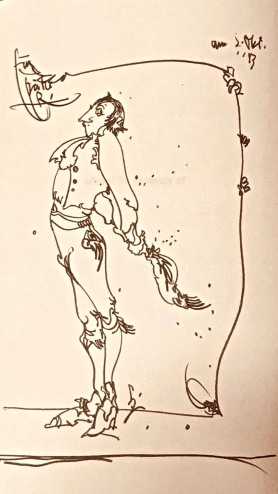
Roy Eales by Sascha Juritz, postgutenberg@gmail.com

Portrait (above, from A poem decides) and cover art (below) are by Sascha Juritz,  a lover of Breton culture who ‘saw Brittany as a twin for Lausitz, his own Slav country locked into the Czech and Polish borders’ 
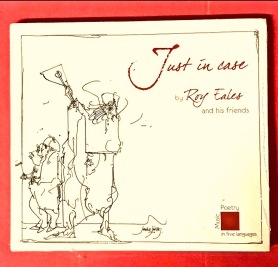
Roy Eales -- cd cover Just in Case, postgutenberg@gmail.com

Imagine the happiness of sitting on a sun-dappled terrace in the French countryside, where you have had to reassure, say, the oldest person at your café table — your dear, monolingual English father-in-law — that you suggesting that he try la tarte du village has nothing to do with the two ladies of the night before, loitering beside the picturesque stone bridge in décolletage more evident than clothes.

Forever after, this will be the most risqué story you will repeat and embellish at family gatherings, but — still in the original moment — everyone at your table goes on to order a second cup of coffee and sipping quantities of gullet-scorching marc. Why? To stretch out the pleasure of listening to the unannounced, spontaneous concert-with-poetry that has begun unobtrusively at the other end of the patio, a performance mostly in the language or dialect of this part of France that lets you crawl under the skin of the place, into the preoccupations of its people, as you could not hope to do on the usual sightseeing-and-feeding tourist rounds. Perhaps you strike up a conversation with the born-and-bred-here family at the next table, when they explain the history behind the lines of one of the songs you’ve been listening to, which reminds you of a novel by Stendhal or Colette you read and wept over as a teenager. Your satisfaction, your feeling of enrichment, becomes incalculable.

Unless and until most Europeans have sensory treasures like these to savour, personal experiences of being in other EU nations, the Unión Europea, Europäische Union, Unione Europea and so on … will never be more than a merely pragmatic head-over-heart construction. This autumn’s dismal Brexit negotiations resemble the arguments in a divorce battle at the end of a marriage notable not just for a lack of love or passion but simple affection. It is a union of countries joined in the equivalent of an arranged marriage that made unassailable good sense on paper — but in which the parties never made any effort to get to know each other at the level of scent or touch, let alone become mutually endearing; or develop shared habits; or accumulate a store of common memories.

And how can you tell what a true inter-cultural marriage — respecting and revelling in cultural differences — would be like?

There is a sort of — marvellous — answer in a set of performances captured on Just in Case, a CD first mentioned on this site six years ago that reappeared in a bookshelf-tidying exercise the other day. It sounds sung and spoken straight from the souls of Bretons about scenes and old legends of Brittany, although all its material is new, and it lets you hear Breton voices — including one that is especially gravelly and magnificent, belonging to Fañch Peru, to which you can listen on a clip uploaded here  — singing or reciting poetry, some of it protesting, conveying the depths of understandable anger about attempts by authorities in Paris to stamp out the Breton language as if it were a foul pest.

But no, not all the performers are actually natives of Brittany. Among them are Marianna Butenschön from Germany, Owen Martell and Tomos Williams from Wales, and several from other French regions.**  All the poetry and lyrics are by Roy Eales, a part-time inhabitant of Breton country whose forte is elegantly delectable whimsy with powerful undercurrents, and whose first language is English — even if, when reading English and French versions of his poems side-by-side, you might strongly suspect that several came to him first en français. The foreigners share Breton sentiments — cultural pride, outrage about subjugation — to a degree that would be implausible to anyone who had no idea of how many antifascist outsiders lost their lives fighting in the Spanish Civil War of 1936-9, including 500 from Britain and 900 Americans.***

Roy and his wife and perfect mate, the painter Susan Eales, have with a fine and cherishing ear translated into English dozens of poems by a munificently gifted Flemish friend of theirs, Willem Roggeman, published in A splendid view on words. He has reciprocated, introducing Flemish readers to Roy’s poems in his own English-to-Flemish renderings.

Like Just in Case, none of these collaborations and exchanges were subsidised by the EU or any government, as far as we know, or organised by official edict, or prompted by worthy kumbaya ambitions.**** They seem to have come about from natural attraction, or what is most essential in art.

If only they were more common, and were advertised and shared more energetically — not necessarily on the internet, where you can find uploads of the odd clip from Just in Case that, certainly at this stage of technological evolution, sound woefully anaemic and fail to do justice to its impeccable, professional production.

The collection’s tone is set by Julie Murphy, born English, but singing translations of Ealesian verse into Welsh — the language of her husband’s people — in a warm yet sublimely ethereal voice, as movingly as the young Joan Baez (and yes, that is saying a lot). It is a performance with an intimacy that cannot be faked, free of the annoyingly over-the-top emoting of too much Celtic fusion music, and of slick, big-studio tricks and manipulation. You, the audience, seem to be a privileged eavesdropper, as when listening to the riffs of jazz musicians who have been playing together for an eternity, or the improvisations of a classical Indian sitar-and-sarod ensemble — even if the pieces that make up Just in Case are not live recordings.

Saying more than this would approach literary or musical criticism. At post-Gutenberg, we prefer to let work speak for itself, on the whole — a preference that the objets d’art in this poem would certainly share:

Royal Academy of Arts

Nobody asks
how the paintings feel
when the exhibition is over.

Is it not then
that these tired oils
deserve a little rest?

They have seen enough
eyes and heard enough
words of artful observers.
Enlarged by a superior sense
who speak aloud, these masters …

… these accountants of
image, of culture,
these over-filled vessels of real meaning
(they speak of this work or
that to anyone
who listens till nobody hears).

These onlookers
must be taken down.
The paintings decide they can’t take any more.

Roy Eales, in A poem decides/ Ar barzhoneg an fini a ziviz/ C’est le poème qui decide/ Ein Gedicht entscheidet (2013)

** Reciting the names of the musicians and performers makes a feast for the ears — or aural overload. A by no means complete list would also include: Bernez Tangi, Marthe Vassallo, Emmanuelle Huteau, Nanda Troadeg, Kemo and Matilda Veillon, Jean-Michel Veillon, Yannick Jory, Jean-Luc Thomas, Pierrick Tardivel, Philippe Gloaguen, Philippe Ollivier … And then there are the translators from English: Fañch Peru (Breton); Nanda Troadeg, Marie-Noëlle Le Tallec, and André LeFèvre, in addition to Roy and Susan Eales (French); Maria Tritschler, Marianna and Wolf Buenschön (German); and Owen Martell (Welsh). For your own copy of the CD, telephone or write to Marie-Pierre Le Pennec, Le Bourg, 22140, Pluzunet, France. Tel: mobile -0033635911833. €16.50 (including p&p). Email: marie-bzh-22@orange.fr

*** In the first part of her autobiography, An Unfinished Woman (1969), the playwright Lillian Hellman — who travelled to Spain to report on this war — wrote: ‘Never before and never since in my lifetime were liberals, radicals, intellectuals and the educated middle class to come together in single, forceful alliance.’

**** A kind note from Roy on 23 September added valuable enlightenment, summarised as follows:

The artists worked together for four years without any external financial support. Once the collection of performances that became Just in Case was ready in final form, funding for production of the CD and for concerts to promote it arrived from: the cultural services section of the Conseil Générale of the Côtes-D’Armor and Itinéraires BIS des Côtes-d’Armor (the département where the Eales family and Breton and other artists have homes); Stiftung Brass, a cultural foundation in the German city of Aschaffenburg (which had in the past supported and helped to arrange exhibitions of the works of Sascha Juritz, see above); the Arts Council of Wales and Welsh Arts International; and Dao d’a r C’had and Ti ar Vro, two Breton cultural associations in Cavan and Pluzunet. After Just in Case was released, France 3 Television chose it as one of the three best CDs of 2011.


A dunce cap for T. S. Eliot, who could not tell a lilac from a lollipop — and an explainer in images

lilac buds 4 april 2018 postgutenberg@gmail.com SC

Lilacs, 1: Budding: 4 April 2018 (Does that ground look not just cold and post-wintry but ‘dead’? Scroll down for the next acts in the drama.)

In the internet tradition of putting out bird seed for each other — information for nameless, faceless strangers — this entry is mostly for those visitors revealed by our site traffic analysis to be doing their English Literature homework.

We would march in the streets to protect poetic licence, but a poet who cannot get his elementary facts about nature right cannot be trusted as a wielder of metaphors or teller of even strictly psychological truths. He is liable to be written off as a pretentious twit for ending a poem with, for instance, …

… London Bridge is falling down falling down falling down

Poi s’ascose nel foco che gli affina

Quando fiam uti chelidon—O swallow swallow

Le Prince d’Aquitaine à la tour abolie

These fragments I have shored against my ruins

Why then Ile fit you. Hieronymo’s mad againe.

Datta. Dayadhvam. Damyata.

Shantih shantih shantih

… as T.S. Eliot did The Waste Land (1922), if he had started it with these offences against accurate observation and common-sense botany:

April is the cruellest month, breeding

Lilacs out of the dead land, mixing

Memory and desire, stirring

Dull roots with spring rain.

Winter kept us warm, covering

Earth in forgetful snow, feeding

A little life with dried tubers.

What dead land would that be? Year after year, we watch as lilac bushes close by bud, sprout, come into leaf, then give us a live demonstration of why ‘You’re blooming!’ can be a true and sumptuous compliment paid to a young girl in love. Year after year, we imagine students in places where no lilacs grow frowning over the complexities of Eliot’s best-known poem — with no idea that he had everything back-to-front in its opening.

Internet searching suggests that those of us acutely irritated by this are (or were once) amateur or expert gardeners. Hardly anyone else has remarked — like the Oxford historian and gardening connoisseur Robin Lane Fox, in a marvellous essay about gardens in literature — that

No gardener … would agree that April is “the cruellest month” and in no gardens or landscapes known to me does April breed “lilacs out of the dead land,” least of all on the American East Coast within range of the young T. S. Eliot.

Even non-gardeners in the northern hemisphere know that the cruellest month is August. The hot weather is at its most evil, then, in warmer parts of the globe. In cooler maritime spots with changeable weather, it is when the last hope of any summer at all can be cruelly denied.

There is nothing dead about the ground when lilacs begin to push tiny brown buds from brown canes — as in the first of this sequence of pictures (above and below). It is wriggly with riotous new life. And no, Mr Eliot, you cannot believably proceed from a warm winter — or even one keeping only you warm — that fed ‘a little life with dried tubers’, to earth that somehow had all life mysteriously drained from it as the days lengthened and the temperature rose, more or less steadily.

Yes, we know about metaphors, you Eliot-defenders out there. We ourselves have been known to excoriate the obdurately literal-minded for refusing to dance with a poet’s imagination. We know from experience what T.S.E. was trying to say about how painful spring breaking out all over can be for someone depressed, after the protective cocooning of the dark, burrowing months. But if he had to reverse the truth of lilacs coming into their season, why didn’t he say he was writing science-fiction poetry?

We are in deepest sympathy with Vladimir Nabokov, when he asked a college student sent to him for tips on a career in writing if he knew the name of a tree outside a nearby window. When the acolyte confessed that he did not, Nabokov said simply, ‘Then you’ll never be a writer.’ **

** ‘Remembering Nabokov’ by Alfred Appel Jnr., in Vladimir Nabokov: A Tribute, edited by Peter Quenell, 1979.

lilacs sprouted 28 april 2018 SC postgutenberg@gmail.com

Lilacs, 2: Sprouting, 28 April 2018

lilacs green gold 6 may 2018 SC postgutenberg@gmail.com

Lilacs, 3: Cluster-setting, 6 May 2018

lilacs blooming 10 may 2018 SC postgutenberg@gmail.com

Lilacs, 4: Blooming: 10 May 2018

lilacs in bloom in thunderstorm 15 may 2018 SC postgutnberg@gmail.com

Lilacs, 5: In full flower, in spring rain: 15 May 2018

for  1. 1. 2018

december 20 2017 cusp of the solstice

surprised deer FINAL

A poem we came across fit our 2017 exactly — both our personal experience of it and impressions of the state of things everywhere. No matter how closely we paid attention to what should be perfectly insulated from ugliness — always a good idea — there was seemingly no escaping the spirit of the year.

From a quick check, we learnt that this poem could easily have been written during the Second World War. With more time, we’d be interested to know what was happening in the life of the frequently magnificent Robert Frost, then.

Not only sands and gravels
Were once more on their travels,
But gulping muddy gallons
Great boulders off their balance
Bumped heads together dully
And started down the gully.
Whole capes caked off in slices.
I felt my standpoint shaken
In the universal crisis.
But with one step backward taken
I saved myself from going.
A world torn loose went by me.
Then the rain stopped and the blowing,
And the sun came out to dry me.

‘One Step Backward Taken,’ Robert Frost, 1947

Here’s hoping for a rather different backdrop for 2018 …

H  A  P  P Y    N  E  W   Y  E  A  R


Farewell, phenomenal Umberto Eco

Umberto Eco top of NYT home page (1)

[ late addition below ]

A yellowing copy of ‘The Novel as Status Symbol,’ a 1989 book review by Alexander Stille not available on the net, happened to be lying on this desk when the divine imp Umberto Eco died on Friday. For several weeks, we had smiled every time we came across it, hunting for other pieces of paper. It made finding him honoured with an obituary portrait at the top of the home page of The New York Times a sad pleasure: he deserved no less.

What Stille recounted of the great semiotician-novelist’s fiction writing philosophy was quite wicked enough a quarter-century ago, when marketing chieftains in publishing companies were well on their way to wresting supreme veto power from editor-tsars. In our new age of scribes, book-promoters and whole literary communities bowing low to likey/no-likey social media, it is not impossible to envisage someone like Eco being burned at the stake for heresy, some day.

Some extracts from the most enthralling sketch we have ever read of the author of The Name of the Rose and Foucault’s Pendulum:

Last June, Eco — a medieval scholar and a professor of semiotics at Italy’s University of Bologna — stood on the dais of the cavernous ballroom in the Washington Hilton before a crowd of more than a thousand American booksellers.

In open defiance of the usual laws of marketing, Eco told the booksellers, he had written his first novel for about a thousand readers and decided to write the second for five hundred. ‘With my first book I was criticized for putting in too many quotations in Latin, so I started my new book with a long quotation in Hebrew. That’s my challenge.’ But Eco is not a naïve professor who was catapulted to stardom by an unlikely turn of fate. As a professor of semiotics (the theory of signs), a former publishing executive, a journalist, and the author of some twenty books, Eco is an expert on mass media and the machinery of popular fiction. ‘The world of media is full of free gifts, wash-and-wear philosophy, and instant ecstasy,’ he explained to the booksellers. ‘Readers want a little more; they want to be discouraged in order to be respected.’

… Since its publication in Italy last fall Foucault’s Pendulum has provided several new twists to what has come to be known as the Eco phenomenon. The novel has sold more quickly than any book in Italian publishing history, while becoming the center of a fierce national controversy.

Rumors than Eco was working on the book were eagerly picked up by the Italian press as early as two years before the book appeared … Anticipation built up to such an extent that when the book finally appeared, 500,000 copies were sold before the first buyers had a chance to grapple with it and tell their friends what they thought.

But within several weeks the Eco phenomenon boomeranged. Readers who had bought the book for faddish reasons gave up when confronted with the labyrinthine complexities of a novel that explores the mysteries of the Jewish cabala, hermetic philosophy, and a thousand years of esoteric thought. Eco was accused of having shrewdly manipulated the press in a plot to push sales. ‘Eco is a genius of our culture,’ one critic wrote, ‘a genius of self-promotion.’ To his dismay, Eco has become a kind of literary Midas: everything he does makes news and sells copies. Even his decision not to appear on television was perceived as another clever maneuver to attract attention. But the attacks, predictably, only had the effect of selling more copies …

Harper’s, November 1989

But, as we discovered not long after we posted those Stille quotations, Eco hardly spared the editor-tsars. We had long wondered how any editor, no matter how skilled and revered, could have had any idea of how to edit his novels — known whether to add or substract as much as a comma — which could define idiosyncratic. What did Eco think of their role? On the site of The New York Review of Books, there was his concise answer to that question, in 1994: ‘Case for Textual Harrassment’. Skim-read it at your peril: after we stopped to re-read it with closer attention, we were shaking so excessively that we had to lie down for a minute-and-a-half. Unless you know Philip Larkin’s and T.S. Eliot’s most famous poems, you will not understand. (The ‘rites of vegetation,’ William Weaver’s translation of whatever Eco wrote in the Italian original, is a master-stroke. Oh, you poor lilacs …)

The miniature essay begins:

These days, especially in the United States, implacable copy editors demand of authors not only stylistic revisions but even changes in plot, new endings, whatever commercial necessity dictates. But … can we honestly say that they ordered things so differently in the past?

Take the usually overlooked fact that the first version of a well-known poem by Philip Larkin originally went: “They do you harm, your father and mother.” It was only the insistence of Larkin’s editor that inspired the now famous variant. And the first draft of Eliot’s Waste Land opened: “April is the cruelest month. And March isn’t all that great, either.” Weakened in its impact by this peevish insistence on climactic details, the earlier text denied April any implied link with the rites of vegetation. As everyone knows, Ariosto at first submitted to his publisher a very brief poem that went: “Of women and knights, arms, loves, courtly rituals, and bold ventures I have nothing to say.” And that was that. “How about developing it a bit?” the editor suggested. And Master Ludovico, who was having enough trouble as civil governor of a remote Tuscan province, said, “What’s the use? There are dozens of epics of chivalry already. Leave it. I want to urge poets to try new genres.” And the editor replied, “Yes, of course, I understand, and, personally, I agree with you. But why not try approaching the form from another angle? With irony, for instance. Anyway, we can’t sell a onepage book, particularly one with only two verses on the page. It looks like imitation Mallarmé. It would have to be a limited, numbered edition. So unless we can get Philip Morris to sponsor it, we’re screwed.” …