Untranslatable poetry, part 2: show, don’t lecture

Painting of a Bengali beauty by Jamini Roy (1887-1972)
http://www.ngmaindia.gov.in/sh-jamini-roy.asp

part 1 is here

Dance with the language. There’s a saying that “The English hoard words like misers, the Irish spend them like sailors.” Those ancient storytellers were drunk on words. … For encouragement, I would naturally suggest you look to Irish examples.

Frank Delaney, Irish novelist, in the Word Craft column of The Wall Street Journal, March 2012  

A. A. — not the do-gooder organisation but a poet of rare gifts and post-Gutenberg’s most supremely articulate friend — emailed this reply to a request for his reaction to last week’s excerpts from a debate about poetry in translation:

I feel disinclined to join this fray, going on at least since the Battle of Hastings (more archers!), where, it could be argued, The Translation Question first enters history on English soil. For the record, though, I am, I suppose, innately suspicious of what we might call The Proprietary Position, always couched in some preposterous notion of accuracy, or worse, fidelity, that any real artist would find objectionable. All poetry is inaccurate, in a sense, to begin with — its bewitching power of distortion, revealing deeper truths by traducing apparent ones, being the very reason for which Plato denied poets a place in his Republic: their ability to undermine by subversion and misrepresentation.

In any case, no poet worth his reduced sodium could forget that even the word translate is a metaphor: carried across. So, if “Quand vous serez bien vieille, au soir, à la chandelle … ” is carried across, delivering something like, “When you are old and grey, and full of sleep/And nodding by the fire…”, I’ll sign for the package.

We answered that we did not disagree with him,

… except on the question of who is guilty of bullying from the Proprietary Position. It’s the self-appointed Authorities in academia and other parts of the literary establishment, like C.A. …  There is such a thing as direct translation … ‘La plume de ma tante,’ … no ambiguity whatsoever about an object belonging to an ink-stained aunt. … If literary translation could be universally understood as galaxies removed from that straightforwardness and even better, if it were to renamed, called something like ‘approximation,’ that would be the infinitely preferable truth.

In a perfect world, poetry would never be taught – we mean, garotted — in any classroom. There might be poets on tap, willing to supplement published appreciations — as opposed to academic deconstructions — by answering questions from, say, a reader intrigued by the difference between Shakespearean blank verse and John Donne’s (controversial) version of it in one of his masterpieces, ‘For Whom the Bell Tolls’. But there would be no one laying down laws for interpretation, no pompous pontificators on language as idiosyncratic and – as A.A. says – subversive, as poetry.

Anyone seeking to introduce a poet across cultural borders could stimulate an instinctive and intuitive grasp of a poem’s intentions by interweaving, rather than explaining – that is, showing its lines threaded into a reader’s stream-of-consciousness. It is the happy fate of all the best verse to become woven, subconsciously and unconsciously, into our depths. But who can demonstrate this special capacity of the form? Do it, for instance, for the poetry of Rabindranath Tagore – about whom, as our last entry demonstrated, critical opinion in the English-speaking world is still divided, a whole century after the Swedes gave him their famous literary prize?

A good novelist might be up to the task — a wordsmith capable of transcending the language gap. For instance, Sunetra Gupta, writing in English in Memories of Rain (1992) about the doomed love affair of Moni, a young Bengali woman, and Anthony, an Englishman visiting Calcutta that her brother introduces into their family circle. In a scene that made post-Gutenberg wish Satyajit Ray were alive to adapt the book for the screen, her brother embarrasses her with a halting reading to their guest of impromptu translations of his own short stories, through a long night rent by relentless monsoon winds and rain. Years later, in England, where she is now unhappily married to Anthony, who is besotted by his new English lover, her recollection of Tagore is enlaced with remembered details of their romance’s first chapter:

… From such a land Anthony had rescued her, a land where the rain poured from the skies not to purify the earth, but to spite it, to churn the parched fields into festering wounds, rinse the choked city sewers onto the streets, sprinkle the pillows with the nausea of mould, and yet the poet had pleaded with the deep green shadows of the rain clouds not to abandon him, the very same poet who wrote,

You, who stand before my door in the darkness

What is it that you seek?

It has been many years since that spring day, when there came a young wanderer

And immersed my parched soul in an endless sea of joy;

Today I sit in the rain-filled darkness, in my crumbling shack

A wet wind snuffs my candle, I sit alone, awake;

Oh, unknown visitor, your song fills me with sweet awe

I feel I will follow you to the depths of uncharted dark.

But it was not this song, not yet, that ran through her rain-ravaged mind as the grandfather clock in the living room struck two, interrupting the awkward flow of her brother’s translation, the grammatical mistakes she shivered at, why was his English so terrible, and she stood in the bathroom, splashed icy cold water out of the drum onto her feet, she caught a ghost of herself in the cracked mirror, and a sudden embarrassment overcame her, she switched on the lights and took in the cracked plaster, the dilapidated water closet, long since choked with lime, suspended over the Turkish toilet, the cracked mirror, the shelf cluttered with bottles of coconut oil, toothpaste tubes, rusty razor blades, and she compared it to the bathroom at Amrita’s, where she knew Anthony was staying, marbled to the ceiling, with Western commodes and bathtubs, he cannot be used to any of this, she thought …

Tagore on rain again, in a later passage, in which Moni wakes from a dream about death and marigolds – and in this one, his lines taker her soaring above earth-bound domesticity:

… [H]ere she found a deeper silence than even the quiet before a tropical storm,  the still rushes, the frightened birds, once, she had lingered, in a field of mustard, in the windless core of a storm, in such an hour, a dark village maiden had lifted her ebony eyes to the poet,

like black clouds gathering at the corners of a May sky

like soft black shadows descending upon June forests,

in this way the mirth of a July evening fades suddenly away.

The rain whipped around her as she fought her way back to her aunt’s house, inside, rivulets of water forced their way through closed shutters, trickled through the whitewash to collect in chalky puddles on the floor. She watched the heavy hips of her aunt as she bent down to mop up the rainwater  … And, shivering with sweet sorrow on that fateful winter morning, Moni had wondered, as she studied the wooden grace of her aunt’s arm sweeping in complicated arcs across the red floor, what she had gained by leaving a home, an indifferent husband, a cruel mother-in-law, to live alone, among the blunt banyans, to sit in her bamboo rocking chair on her veranda and read endless novels, did she not, on some still summer evening, lift her eyes to a glorious sunset, and feel, like the poet

If you did not give me love

Why paint the dawn sky with such song

Why thread garlands of stars

Why make a field of flowers my bed

Why does the south wind whisper secrets in my ear?

If you did not give poetry to my soul

Why does the sky stare like that upon my face

And why do sudden fits of madness grip my heart?

I set sail upon seas whose shores I know not.

Sunetra Gupta’s prose veers frequently into shades of deepest purple, but her emotional intensity, dial turned up all the way, perfectly fits Tagore’s. This really is quintessentially Bengali. In cultures that prefer strict emotional continence, this form of extremism is often frowned on as a sign of stupidity – of giving irrationality permission to take over.

But intense emotionality and exemplary analytical intelligence are hardly mutually exclusive. Consider what this novelist does today, in addition to writing fiction. She is a professor of Epidemiology at Oxford, where she describes her work on the site of the Department of Zoology.

My main area of interest is the evolution of diversity in pathogens, with particular reference to the infectious disease agents that are responsible for malaria, influenza and bacterial meningitis. I use simple mathematical models to generate new hypotheses regarding the processes that determine the population structure of these pathogens. I work closely with laboratory and field scientists both to develop these hypotheses and to test them.

Post-Gutenberg did not know that she existed until a postman delivered in the mid-‘90s a catalogue of remaindered books whose offerings included  Memories of Rain. Why has this author had less attention than other writers of Indian origin — Salman Rushdie, Anita or Kiran Desai, or Jhumpa Lahiri? We suspect, for part of the explanation, that she writes first to please her own sensibility, rather than Western literary tastes. See an earlier entry on this blog: ‘Gatekeepers I: in defence of Rachel Cusk — let cross-cultural flowers bloom in simultaneous international e-publishing’.

For gatekeepers alarmed about so-called ‘multi-culti’ — appreciating foreign cultural traditions — corrupting the mother-culture, does enjoying the Gupta-Tagore duets by this novelist diminish in the smallest degree a passion for the great works in the English canon? Of course not. Here is John Donne feeling exactly as Moni does, by the end of Memories:

Yet nothing can to nothing fall,
Nor any place be empty quite ;
Therefore I think my breast hath all
Those pieces still, though they be not unite ;
And now, as broken glasses show
A hundred lesser faces, so
My rags of heart can like, wish, and adore,
But after one such love, can love no more.

Poetry, another word for untranslatable; Rabindranath Tagore — and is rain happy or sad?

Moghul girl-as-poem: is she translatable?
Photograph: firozjuma.com

part 1; part 2 is here

‘That day, the sun rose in the west.’

Fogeyish old media hacks in every age bracket — for instance, Mic Wright of the Telegraph, who looks as if he might be waiting to turn twenty-one — treat as equally unreal the idea that reader-commenters on newspaper sites can offer rare, crucial insight. ‘Comments are the radioactive waste of the web,’ the Telegraph blogger said.

Do these bigots ever stop to consider that because commenting on the web crosses national and cultural borders it has become an innovation no thinking person would want to live without? That is one reason why the logistical impossibility of also maintaining a comments section in this spot has been cause for real grief, at post-Gutenberg.

To experience the high-wattage illumination that spontaneous, trans-continental commentary can supply, consider the subject of poetry in translation.

An email notice from The London Review of Books the other day about a series of translation master-classes in honour of International Translation Day (30 September) gave us an excuse to re-read a four year-old debate in the comments about a blog post on the site of a London newspaper.

The commenters’ fight began with opinions about the appeal of Edward Thomas, the World War I poet, whose emotional restraint and sparing use of adjectives and adverbs had been lauded in the post. Later, joining the discussion, the post’s author implicitly compared the Welsh sensibility of the poet’s ancestors with her own English cultural tradition. In tones of thinly-veiled disapproval, she characterised as ‘typically downbeat’ the two Thomas poems about rain to which her text was an introduction.

The critic is an academic of strikingly conventional views whom we will call C.A. in highlights of the discussion that we are featuring below.

A particularly incisive commenter we will refer to as S.A. took exception to the assumption that painting in emotional pastels was necessarily a virtue. He insisted that this preference should be acknowledged as an English cultural bias — of which C.A. appeared to be oblivious. Furthermore, rain — he argued — was not universally perceived as depressing: far from dampening spirits, in hot, dry regions in the tropics, it is experienced by those who live there as poetic.  To that, post-Gutenberg would add that its associations in India with romantic love and passion are easy to see in the many Moghul miniature paintings on these themes in which thunder and clouds appear in the background of pictures depicting lovers, or maidens lost in romantic reverie.

S.A. went on to make a series of comments on the rain poems, their author, and his academic critic on the newspaper’s site that were far richer and more engaging than any literary criticism post-Gutenberg had read for years. He offered, for comparison, a snippet of ‘Varsha Mangal,’ verse about a monsoon deluge by Rabindranath Tagore, India’s most revered poet — who has, in his native Bengal, the same standing as Shakespeare does among English-speakers.

S.A. was known by regulars among his fellow-commenters as a descendant of English and Central European stock, but born in South Africa.  He said that he and his Mexican wife enjoyed listening to recordings of Tagore reciting his own verses – even though neither of them spoke, or was literate in, Bengali.

He was challenged, in this commenters’ debate, by I.P., our initials for an Irish writer of minimalist, experimental poetry. Arguing from much the same academic orientation as C.A., I.P. endorsed virtually all her prejudices.

Among C.A.’s and I.P.’s opponents were two debaters offering no biographical information, whom we have renamed M.W. and S.E.. After S.A. playfully posted a re-translation of ‘Varsha Mangal,’ omitting its many adjectives, the proudly chauvinistic C.A. said that she much preferred the stripped-down version as a serious, not just larky, translation – to M.W. ‘s horror.

M.W.  What you propose would be like rewriting Joyce to read like George Orwell. Both excellent styles and writers — but ridiculous, no? The verbal excessiveness and flourishes you mention are quintessentially Bengali.

S.A.  Is simplicity of language an English Reformation thing. Is it Calvinist, I wonder. Were British poets more rococo before the reformation? Perhaps in eschewing the florid we are just scared of the Epicurian.

C.A. Oh dear, I rather liked the pared-down Tagore. The elaborate language, however fine and right it is in Bengali, is heavy-going in English. I always avoid him.

I.P.  Would Edward Thomas have cheered for England or Wales?

C.A.  I think he’d have supported Wales before 1914, and England after. […] Perhaps relevant to the ‘which side would Thomas have supported’ question: ‘I do not believe in patriotism, in times of peace or war, except as a party cry, or the result of intoxication or an article in a newspaper, unless I am in Wales.’

[ A commenter posts an impish parody of Thomas’s verse – in the spirit of S.A.’s doctored ‘Varsha Mangal’. C.A. turns livid. ]

S.A. You didn’t mind simplifying Tagore, whereas I am sure had my wife read my smudged Tagore, she would have been really pissed off too.

C.A.  No, the Tagore simply altered the adjectives, nothing in the contents or context. I defend Thomas’s right to believe in what he believed in and not have it re-written by silly twats.

M.W. Since we’re on the subject of comparisons, do you have any basis for comparing your understanding of how Tagore’s poem should read with the translation [S.A.] posted originally — which retained the poet’s ultra-Bengali adjectives? Do you know enough about Bengali literature to pronounce those adjectives dispensable?

You’ve spent a lot of posts analysing what a foreigner might consider sub-microscopic distinctions between Englishness and Welshness, even if we know exactly what you mean. Don’t the differences between the equally distinct cultures of India – and between any of them and Englishness — deserve as much respect? . . . And while we’re discussing criteria that might be anachronistic, how about reflecting that Tagore won the Nobel prize in 1913 when flowery prose had many more admirers everywhere?

… Sorry if I’ve over-interpreted you, but you have argued more than once — apparently in earnest — for turning Varsha Mangal into Varsha Mangle.

C.A. The Tagore was a translation … It’s accepted that translations will be of many degrees of fidelity. There’s one big proviso, of course, which is that the translator explains honestly what he or she is doing with the original and why. […] I believe it’s important to create versions of foreign-language poetry that work in modern English, at least if you really care about that poet and want to introduce new readers to the work. […] Perhaps it would win Tagore more readers if modernised versions of his work made by contemporary poets were available.

The whole point about translation is totally missed in your notion that you have to stick to the quintessence of the language you are translating from. You must stick to the quintessence of the language you are translating into, be it English, Bengali, Russian. [post-Gutenberg’s emphasis]

M.W. Ah, yes. The results of what you propose are perfectly summed up in this remark by the young Chinese pianist Lang Lang in today’s Observer:

‘[O]ne composer said to me, ‘I want Bach meets tango, and hip-hop meets Beethoven’ – both great ideas, but then I heard the music. Where’s the Beethoven? It’s like fusion food: mix French and Chinese dumplings – and it tastes like cat food.’

[ A wicked commenter ]  French ‘dumplings’ are called quenelles. Let’s show our Gallic friends some respect.

M.W. I certainly agree with you, … but if you follow [C.A.]’s rules for translation, I suspect that both dumplings and quenelles become meatballs.

C.A. If I wanted to make quenelles but couldn’t get (let’s say) the right kind of fine flour or oil in my benighted English village, I might well end up making meat-balls.

I.P. I’d suggest that the Joyce/Tagore comparison is one of the clearest examples of the Nobel crowd getting it very, very wrong. Personally, I find Tagore (in English at least) unreadable, almost a joke. Is anyone here qualified to comment on the Bengali originals or the fidelity of the “original” translations?

As an aside, I’m not sure that respecting the author’s intentions should be an ambition for the translator of poetry, or at least not when translating anything more than, say 50 years old. Translation works best, I think, when it is an act of renewal. [post-Gutenberg’s emphasis]

S.A. But it was an Irish poet, Yeats, who made Tagore internationally. He is the one who gave Tagore, in translation, his poet’s baptism.

The key here, I think, is the word “international”. Try and translate Joyce’s wordblends impressionistic syntax into another language and maybe you can understand why the Swedes didn’t get it.

I.P. I remain to be convinced that Tagore’s writings demand anything like the same degree of respect that Joyce’s do.

M.W.  Who are you to judge? You don’t read Bengali.

‘I’m not sure that respecting the author’s intentions should be an ambition for the translator of poetry, or at least not when translating anything more than, say 50 years old. Translation works best, I think, when it is an act of renewal.’

Just FIFTY years. Really? Time to renew/rewrite Joyce, then? — so that he’s accessible to, say, people who text more than they read or write?

S.E. [ a commenter pretending to be a Spanish-speaker struggling to communicate in English ] The Tagore’s Bengali should be retranslated perhaps into another Baroque version, that would mean more fidelity to the Baroque quality of the Bengali original… I think Juan R. Jimenez and wife retranslated Tagore into Spanish with huge success, since these versions keep been republished.

M.W. This is genuinely interesting.

It could be that Bengali is deeply incompatible with English but much less so with other languages — and there might be even a particular sympathy between Spanish and Bengali. I was trying to find a book of Octavio Paz’s on my shelves to quote … , so wasn’t surprised to find him on this wiki list of scribes apparently influenced by Tagore:

‘D.R. Bendre, André Gide, Yasunari Kawabata, Kuvempu, Gabriela Mistral, Pablo Neruda, Octavio Paz’

. . . not a single writer in English among them.

S.E.  I mean, translating Tagore is regarded as a greatest challenge, as worth of merit as Finnegans’ [sic] Wake.

[ … A few days after her ferocious defence of a translator’s right to chop off Tagore’s verse at the knees, the academic authority on poetry returned to the subject. Surrendering to her opponents, she announced a grand mea culpa. ]

C.A.  Just quickly on translation again – it was (in connection to [S.A.]’s re-write) the use of the word ‘translation’ that confused the issue (shame on me – for falling into a lexcial gap). I liked the piece of writing that [S.A.] produced, based on the Tagore translation, would have been a more accurate way of expressing it. I couldn’t and shouldn’t judge it as a translation of Tagore’s original, not knowing Bengali, but I can judge is as a piece of writing in English, and that was all I intended to imply.

How much more did that delectable scrapping about Tagore enlighten readers than the standard Western regurgitations of his poetry’s defects – judged by Western standards?

Even the instructor learnt something, and had the grace to admit as much.

In our next post, we will demonstrate an even better — not remotely scholarly — tack for demystifying part of Tagore’s appeal to discerning readers of Bengali literature.

A boatload of words, part 2: new media experiments suggest how lost languages might be saved

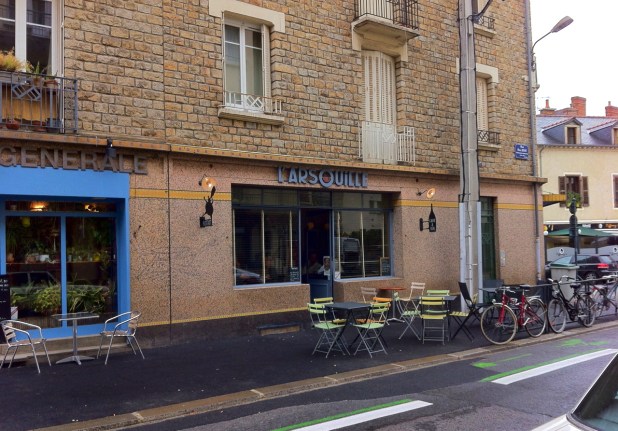
‘L’Arsouille’, Rennes, Brittany
Photographs by Mark Barron

Owing to chronic disruptions beyond our control, our usual timetable for new posts – roughly every six to seven days – must regrettably be abandoned for a while. ]

[ part 1 of ‘A boatload of words …’ is here ]

We are experimenting again — this time, with 21st-century ways of long-distance literary exploration. We are doing this in a multi-media collage — additions to some lines of poetry that we featured here last month.

Suppose that you discovered a beguiling poem that was a call to arms on behalf of an endangered language — lines saturated with the emphatically anti-glamorising spirit of a place, and adding up to a sort of love letter to its culture? Suppose that this place was Brittany, and that before you found the poem, you had only ever read the same clichés about its resilient, courageous, resourceful and fiercely independent people and been served, ad nauseam, the same images of its rugged coastline, its boats, its mizzling North Atlantic skies — without ever having heard a Breton speak?

Language arguably is culture.

Its sounds contain revelations inaccessible except by listening — a thought that came to mind playing back a recording of Roy Eales’s exemplary, playful-yet-serious reading of his own poem in its English original, then hearing his friend Fañch Peru recite his translation of it into his native Breton in ringing tones that are somehow both gritty and embracing. You can almost feel the inhospitable roughness of rock on your skin and taste acrid brine, halfway through the Breton version.

Beneath audio clips that any visitor to this blog can compare is the Breton text of Peru himself, a scholarly authority on the language – offered for listeners curious enough to read along. (Scroll down to the bottom of this post.)

( … The audio files that follow work on some machines; not on others. … We are still digging to get to the bottom of the mystery. )

Roy Eales reads ‘A boatload of words:

Fañch Peru reading his translation of the poem into Breton:

Near relations of ours were in Brittany earlier this summer, and to one of them we are indebted for the photographs at the start of this post. They were taken in Rennes, where the native people speak not Breton but Gallo, the other regional language of Brittany, but whose look and mien — in the images we were lucky enough to receive — do fit Roy Eales’s descriptions of the preference for substance over style in the culture of this province.

The correspondences between sound and meaning in Breton are so unexpected, to these post-Gutenberg ears, so captivating, that we consider ourselves enlisted in the cause of saving a language we have never heard in its own home – ‘virtual’ allies. In our last post about Breton and ‘A boatload, …’, we proudly displayed a drawing by the artist Sascha Juritz, another foreign campaigner, but one who considered Brittany a home for years before he died in 2003. It has taken a while for the photograph of him that we requested to reach us, but here it is – an image well worth waiting for:

Portrait of Sascha Juritz by Ursula Leipold

The Wikipedia entry for this region – Europe’s northwestern corner — says, in part:

In 1956, Brittany was legally reconstituted as the Region of Brittany, although the region excluded the ducal capital of Nantes and the surrounding area. Over this period the Breton language declined precipitously. Children were not allowed to speak Breton at school, and were punished by teachers if they did. Famously, signs in schools read: “It is forbidden to speak Breton and to spit on the floor” (“Il est interdit de parler breton et de cracher par terre”). As a result, a generation of native Breton speakers were made to feel ashamed of their language and avoided speaking it or teaching it to their children.

Victor Hugo (Les Misérables), who had a Breton mother he adored, unfortunately identified with the French capital’s prejudice against the place. As one of his biographers, Graham Robb, has explained:

According to Hugo, … his mother was a half-wild royalist Amazon, chased through the Breton undergrowth by republican soldiers, risking her life to rescue persecuted priests. Brittany itself, in Hugo’s Parisian view of the country, was an antediluvian land inhabited by hairy, tattooed peasants, squatting in their cottages or holes in the ground, surviving on milk and chestnuts, fanatically loyal to King and Church, their worldview bounded by the horizons of the ancient forests in which they hid, bristling with Druidic superstition and mindless animosity — a contrast, in Hugo’s personal mythology, to the mountain-born genius. Only the `wash-basin’ of the Atlantic Ocean was equal to the filth of Brittany, he wrote on a visit in 1836.

Oh, the obtuse pointlessness of prejudice … Here, two centuries after Hugo was born, is an extract from a Breton poem – Fañch Peru’s rendering into English of his eulogy for Sascha Juritz:

The black knight of summer

Every summer

The black knight

Came galloping to our country.

In clothes of velvet corduroy

And leather boots

He rode his white horse

Along green paths,

[…]

To meet friends

And talk together

With fervour and passion

Of art,

Of poetry,

Of the force of words,

Of Brittany, its language,

Of black and of white,

His chosen colours,

Of the wide world

Which turns the wrong way.

.

And we were happy.

[… continues in What matters most is what you make ]

En ur porzh-mor kozh e Breizh un den, ur gasketenn martolod gantañ war e benn harpet war e c’har zehou a selle pizh ouzh un dra bennak a bouez bras.

Treiñ a reas e benn hag ober a reas un hanter tro war e c’har gleiz evit cheñch plas hag e chomas aze war e c’har zehou adarre.

Tanañ a reas e gorn ha kontañ a reas ur marvailh. Setu petra ’ oa c’hoarvezet.

Ur beurevezh yen er goañv en hevelep porzh-mor e kludas un evn mor du war e skoaz hag e kontas dezhañ e brezhoneg penaos ul lestr bras tre ruilhet ha diruilhet e-maez da Vreizh war ur Mor Atlantel rust a reas peñse abalamour d’un taoldispac’h -eus e lestrad – ur sammad gerioù, e gwirionez, holl c’heriaoueg yezh ar ro.

Richanañ a rae an evn du en ur ziskleriañ penaos ar gerioù a oa da vezañ diskarget er mor, ul lev vat er-maez e seier du krouget start merket warne e ruz: DIEZHOMM dre urzh Ministrerezh ar C’hontrollerezh Diharz.

Evel-just ne voe ket laouen ar gerioù gant se. Bet e oant trec’het kent met biskoazh ken gwazh kinnig marv n’o doa bet.

En ur brezegenn nerzhus, Gwendal, e-penn al lestrad gerioù a c’houlennas digante sevel da stourm. Ijinañ a reas ur mod d’en em zifenn. Dieubiñ an holl a rafe an ampartañ gerioù, kas al lestr d’ar strad a rafe ar re bounnerañ. Goude e tistrofe an holl c’herioù war-varin d’o bro c’henidik.

Evned mor o nijal a – us d’al lestr a glevas dre guzh komz eus difennerezh ar gerioù. Goulenn a reas ar re-mañ digante skignañ buan ha buan kemennadoù e brezhoneg e touez ar bobl.

Evel-se e voe embannet prim ar c’heleier a-dreuz ar vro ha prestik holl aodoù Breizh a virvilh, beuzet a don hag a son hag a dud o koroll hag o kanañ dirak ar mor hag al lestr o vont d’ar strad en dremmwel.

Hag o tont davete ul liñsel eonenn gwenn war ar mor, un eonenn gerioù, yezh ar vro en he fezh a voe charreet gant lorc’h betek an aod gant ar gwagennoù evel un harozez.

Adalek an deiz-se e touas ar bobl ne lezfe biken ken he yezh he-unan da rentañpenn da n’eus forzh peseurt degouezh arvarus war ar mor pe e-lec’h all.

Translation, English to Breton : Fañch Peru, Breton poet and professor of the Breton language. From the book, What matters most is what you make … 

A poetic boatload of words and a foretaste of e-publishing as bringer of light and joy

Cover drawing by Sascha Juritz
What matters most is what you make
Roy Eales
Blackbird Editions, Pawel Pan Presse, 2004

Sit up and pay attention, all you change-resistant bookworms who see no good in e-publishing; nothing but the prospect of avaricious conventional publishers charging readers more than once for the same text repackaged in different media – and witless self-publishing writers drowning us in e-drivel.

This week, post-Gutenberg offers word nerds everywhere an example of the littérature-sans-frontières that the net could – will – soon give us as a matter of course. Undeniably, no e-book could replicate the pleasure of handling the slender volume printed on luscious, textured paper from which our extract comes. Never mind, read on. See proof in many dimensions of how the net could – conceivably — help to save literary culture.

These poetic, fanciful lines with something critical to tell us about real life are introduced by their writer, Roy Eales. In his book What matters most is what you make (2004), they appear translated into Breton – the language of the French province of Brittany – as well as in French and German, alongside the English original. (Only the second translation is reproduced here, but we hope to find time to transcribe the other two.)

Roy is a fine, original, unpredictable and unclassifiable English writer and poet living in Brittany who was made a Chevalier des Arts et des Lettres by official France in 2004. He is that rare scribe not born a ‘digital native’ who has leapt from print-only to blending literature with other art in readings of his work interwoven with musical performances by members of his group. A selection of his poems in five languages has been recorded on a CD, ‘Just in Case’ by Roy Eales and his friends (2010), with original music by artists in Brittany and Wales.

Beneath Boatload, on this page, is another excerpt from the same book– the first verse of a wicked, delicious, posthumous tribute to Sascha Juritz, the artist and friend whose drawings accompany Roy’s poems, prose meditations and vignettes.


.

.

A note from Roy Eales:

.

A boatload of words came to me in the middle of a night sometime in late 2003. Legend, mythology, mystery abound in Brittany, Bretons and their literature, and I searched for something satirical in which I could use these elements to castigate the French, heavily, for their stern, backward attitude towards other languages in their national space, and to challenge the Bretons, lightly, for not fighting back enough.

[ from the book’s introduction: ]

Boatload and the other poems in this book were dedicated to Sascha Juritz, brilliant artist, my friend and publisher of this and other books over the years. He died in 2003 as this book with his exquisite drawings was being published. He saw Brittany as a twin for Lausitz, his own Slav country locked into the Czech and Polish borders and colonized by Germany some centuries ago as independent Brittany was by the French. Like the Bretons, the people of Lausitz have sought to protect their culture and language despite the inevitable forces to conform to the ‘master’ French and German cultures and languages. 

.

[ If you are reading this on the blog’s ‘front page,’ please click on the title of this post to be taken to its own separate part of the site to read the following words set out as they are meant to be. WordPress’s automated layout software tends to destroy certain types of special formatting, such as spacing for poetry. ]

.

A boatload of words: a fable for Brittany

.

At an old port in Brittany a man wearing a peaked black cap was

leaning on his right leg staring capital in the face.

.

He turned his head and swivelled on his left leg to an alternative

position, and rested there on his right leg again.

.

He lit his pipe and told a tale. This is what happened.

.

One cold winter morning at the same port a black seabird

perched on his shoulder and told him in Breton that a huge boat

heaving off Brittany on a strong Atlantic sea had been wrecked

by a mutiny – of its cargo – a boatload of words, in fact, the entire

vocabulary.

.

The black bird twittered, in revealing that the words were to be

dumped at sea, three miles out, in black stranglehold sacks stamped in

red: SUPERFLUOUS, by order of the Ministry of Absolute Control.

.

Naturally, the words didn’t like this. They had been beaten before,

but never, so overtly, threatened with extinction.

.

In a mighty speech, Gwendal, their leader calls for a rebellion, and

draws up a plan. The cleverest words would free everyone, and the

heaviest words would sink the boat. Then all the words would float

back to their homeland.

.

Seabirds flying over the boat learnt secretly of the plan from the words,

who asked them to speed messages in Breton back to the people.

.

So the news spread quickly across Brittany, and soon all the shoreland

bristled full of music and people, dancing and singing, facing the sea

and the sinking ship on the horizon.

.

And coming towards them a sheet of white foam on the sea, a foam of

words, as the entire language was carried proudly ashore by the waves

like a hero.

.

From that day on the people vowed never again would they leave their

language alone to save itself from any perils at sea, or wherever they

may be.

.

Roy Eales, 2003 

.

. 

Une cargaison de mots: fable pour la Bretagne


Sur un vieux port breton, un homme portant une casquette de marin

noire s’appuyait sur sa jambe droite, fixant du regard un point d’une

importance capitale.

.

It tourna la tête et pivota sa jambe gauche pour changer de position

et se tint là de nouveau sur sa jambe droite. It alluma sa pipe et raconta

une histoire. Voici ce qui s’était passé.

.

Un froid matin d’hiver sur ce même port un oiseau marin se percha

sur son épaule et lui raconta en Breton qu’un énorme navire se soulevant

au large de la Bretagne sur une forte mer atlantique avait fait naufrage à

cause d’une mutinerie – de sa cargaison – une cargaison de mots, en

fait tout le vocabulaire de la langue du pays.

.

L’oiseau noir gazouillait, alors qu’il révélait que les mots devaient être

jetés à la mer à trois miles au large, étranglés dans les sacs noirs sur

lesquels était tamponné en rouge: SUPERFLU, sur ordre du Ministère

du Contrôle Absolu.

.

Naturellement, les mots ne furent pas contents. Ils avaient déjà été

battus, mais jamais, si ouvertement, menacés d’extinction.

.

Dans un vibrant discours, Gwendal, leur chef appelle à la rébellion

et établit un plan. Les mots les plus habiles libéreraient tout le monde,

et les plus lourds couleraient le navire. Puis tous reviendraient en

flottant jusqu’à leur terre.

.

Des oiseaux marins volant au-dessus du navire furent en secret mis au

courant du plan des mots, qui leur demandèrent de faire rapidement

passer un message en breton au peuple.

.

Ainsi les nouvelles se répandirent vite à travers le pays, et bientôt

tout le littoral grouillait, repli de musique et de gens qui dansaient

et chantaient, face à la mer et un bateau coulant à l’horizon.

.

Et venant vers eux, drap d’écume blanche sur la mer, une écume de

mots, toute la langue du pays, était portée fièrement au rivage par les

vagues, comme un héros.

.

Depuis ce jour le peuple fit serment de ne jamais plus laisser sa langue

toute seule faire face aux périls en mer, ou n’importe où ailleurs.

.

Roy Eales, 2003

Translated into French by Nanda Troadeg and Susan Eales ]

.

And here is a snippet of Roy’s tribute to Sascha Juritz, ‘Don’t Overdrive, my dear‘ … you can read the rest in your own copy of What matters most is what you make:

.

This time

Is there only the reality?

.  So don’t overdrive, my dear.

Where this genius is concerned

reality is irrationality.

The black lines

send off the normality

and poetry is just

.  a little shit

after which you feel better

and lose a bit of yourself.

.  It doesn’t matter, my dear.

.  They hear nothing

.  Say nothing

.  See nothing — scheisser — .

But every man is always

.  a Grand Poète,

has something to say,

. a small bird in the head.

.

[ … continues … ]

.

.