Why a keiretsu-cooperative is a gentle transition for old media — and how about saying, ‘an exaltation of bloggers’?

Parallel and convergent thinking about co-ownership

What’s in a name?

A lot, I suspect, when the subject is cooperatives.

Writers delete or tear up drafts, painters scrape paint off canvases that refuse to match the visions of a mind’s eye – and versions of co-owned enterprises, surely hundreds of thousands of them over the years, have ended up on some equivalent of the cutting-room floor.

But associations with failures of the past should hardly be allowed to stain the excellent solution cooperatives could be. Certainly not now, when – as noted on post-Gutenberg last week in a post about Facebook – the World Wide Web is proving to be a matchless engine for running them, and getting around the classic banes of collaborative ownership and administration.

What if our name for these organisations has become the chief enemy of their promise? Should we call them something else? Say, leaps – as in a leap of leopards, to convey a  jump in the right direction for co-ownership and co-action? Peer-to-peer pods, anyone? Straightforwardly, collaboratives? Or just flats, perhaps, as shorthand emphasising that these are anti-hierarchical, anti-authoritarian and decentralised structures.

The next few years should see the evolution of specialised terms for variations of such online organisations – or simply net-related groupings – that meet different needs. I have for some time been fondly considering an exaltation of bloggers for our key-tapping multitude, in a nod to the seductive title of James Lipton’s book about collective nouns, An Exaltation of Larks.

Since last week, search engines have led me to others who think that Facebook should be turned into a cooperative – although there was little open support for this suggestion when it was first proposed under the screen name ‘postgutenberg’ last September in a comment beneath David Mitchell’s semi-serious call for the ‘nationalisation’ of the social mega-network. (That comment, too, was inexplicably censored by The Guardian, but I have a copy of the page as it was before the axe descended.)

A writer for Reuters, Paul Smalera, carefully set out the reasons why a collaboratively owned and run Facebook makes sense:

Why not share the company itself? It’s fine to talk about technology’s power to change the world if you’re the one who’s going to profit from it. But this isn’t really a change […] it should become a nearly one-of-a-kind company for the technology sector: a co-op.

[…]

Facebook wouldn’t be forgoing its fundraising if it abandoned its IPO and became a co-op. […] In Facebook’s virtual community, its 845 million users could easily pay a small sum — say $5 in the U.S. and some locally adjusted equivalent in other countries — to become an owner. Some of that money would be used to buy out existing stock owners and set up the new management model — it would still have Zuckerberg as CEO with a management team, but with the same one vote that every other member has. Over time, if Facebook’s owners keep the cost of becoming a member as low as possible without in any way starving the site for cash, Facebook could even become the world’s first trillion-dollar company — just in a way no one has ever previously imagined.

He went on to give even more specific suggestions for how it might operate:

Facebook already offers voting tools, organization pages, recommendation links, polling, etc. With the help of a management team and committee structure, it would be pretty easy to let members assign themselves to committees and shape Facebook into the community they want it to be.

[…]

[T]hink of a sample proposal. Say a user wants Facebook to give 10 percent of its income to charity.

1. She creates a new page and persuades her friends to follow it. The page holds the pro and con discussions of the proposal.

2. After hitting a certain threshold of followers, the page makes the Revenue Committee agenda, where a subcommittee is assigned to study its feasibility and write a summary about the proposal’s impact on Facebook, including how it would affect the bottom line.

3. The committee then votes on the summary — if it’s approved, it goes into a general Facebook meeting, where the entire user base gets to vote. […]

Commenters on the Smalera piece were understandably pessimistic about the chances of Mark Zuckerberg handing over Facebook to its members. So was a colleague of his, Edward Hadas, in a critical but beautifully balanced consideration of his arguments a few days later. He concluded on an encouraging note:

[T]he limited success of the cooperative movement does not equate to a resounding triumph for its ideological opposite – the shareholder value cult. If profits were all that mattered for the economy, then more than a quarter of all American workers would not be employed by enterprises that function, often quite well, without profit motive – 17 percent by governments and another 11 percent by private, not-for-profit, organisations.

[…]

In organising the economy, greedy schemers and utopian dreamers are not the only alternatives. Like well-run government agencies and prudent shareholder-owned companies, well-designed cooperatives can be efficient servants of the common good.

The expectation of resistance to a pure cooperative explains why the keirestu-cooperative — first proposed two years ago for the evolution of publishing – does not entail starting a co-owned enterprise from scratch.

It lays out, instead, a scheme that amounts to a halfway house for old print media moving into the future. A newspaper publisher could experiment with sharing ownership of a segment of its site with readers paying small sums for their subscriptions or shares. This section would ideally be one in which readers already contribute most of the content today, in their role as commenters.

As part of the experiment, the co-owners would share any profits from advertising attracted to the trial site, which would give them an extra incentive to lure more readers and part-owners to it.

Setting up such a site – starting with software design and registering co-owners – would cost money. A newspaper publisher could share that, and the expense of site administration, by entering simultaneously into a funding partnership with, say, a book publisher catering to essentially the same audience.

That would make for a collaboration resembling the loose affiliations between firms that the Japanese call a keiretsu.

People who reject that word as too exotic need to know that it is easy to say – ky-ret-su – and should remember that there was a time when we were just as frightened of the word karaoke, which has since become as unremarkable as pizza.

The scheme is all. A keiretsu-cooperative by any other name would be fine by me – as long as someone, I mean, some few, are brave enough to try it out.


Leveson hearings: can a ‘blind and unreasoning’ or partisan press censoring citizen-journalists be good for democracy?

obscurity - postgutenberg@gmail.com

[ Addendum, 23 February:

Although The Guardian has unquestionably deleted courteous posts about proposals for press reform and media evolution from the Comment-is-free section of its site, as recorded on this blog on 7 November and 15 November, I might owe that newspaper an apology for suggesting in the entry below that its moderators broke links to post-gutenberg.com posted on its site in January. Please see the footnote** for details.  ]

A remarkable statement went unnoticed by the few commentators on a morning of superb theatre at the Leveson hearings on press practices, culture and ethics in Britain on 31 January.

As noted earlier on this blog, press coverage of the Leveson Inquiry has been scant. It has focused on tabloid phone-hacking and emphasised paeans to press freedom by well-known witnesses, but under-reported criticism of the media (for instance, the excoriating but mostly well-founded testimony of the former journalist and prime ministerial communications adviser Alastair Campbell.)

Giving evidence last week, Christopher Meyer, the former chairman of the Press Complaints Commission – a body roundly criticised for being too close to newspaper editors to handle accusations against them objectively — said in a fleeting aside that the press is free to be partisan in a democracy. He said that as if stating a self-evident truth, accepted as such. I could not find any record of his remark in the transcript of the proceedings, but there was this exchange between the ex-chairman and his surgically incisive interrogator, Robert Jay QC.

Q: … I think the point you’re making there is that the press is free to comment and be partisan and it’s not the role of the PCC in a democracy to seek to curb that democratic activity?

A:  Yeah, that’s fair enough.

That could stand as a marker for the extent of the shift from the last century’s ideal of a neutral press to one in which the media openly take sides – or, as The Economist put it last July, are becoming ‘more opinionated, polarised and partisan’.  Not the faintest note of doubt intruded on the former PCC chairman’s declaration or confirmation of his position on partisanship, even though media bias is not what the public wants, if we can take as representative the 73 per cent of 2,700-odd Economist readers who have so far voted ‘yes’ in answer to the question, ‘Should news organisations always remain impartial?’. Bias has rightly been worrying experts like this political scientist, who asked in 2010 on ‘a plain blog about politics‘:

Will we have a robust, vigorous, and almost completely partisan press?  Will there still be a place for neutrality?  How will this play out for state and local politics?  What kinds of norms will the partisan press develop?

Some of us who have noticed the British and American press grow more aggressively one-sided in recent years cannot help wondering whether that has meant getting fewer of the objective reports and facts that a democracy needs to make good decisions about policies and politicians.

Partisanship is disturbing in itself, when you consider the dictionary definition of ‘partisan’ as ‘adherent, esp. a blind or unreasoning adherent’ (Chambers, 2006).  How can it be consistent with this classic list of guidelines for journalists doing their ‘duty of providing the people with the information they need to be free and self-governing’ – from Bill Kovach and Tom Rosenstiel in The Elements of Journalism:

1. Journalism’s first obligation is to the truth.

2. Its first loyalty is to the citizens.

3. Its essence is discipline of verification.

4. Its practitioners must maintain an independence from those they cover.

5. It must serve as an independent monitor of power.

6. It must provide a forum for public criticism and compromise.

7. It must strive to make the significant interesting, and relevant.

8. It must keep the news comprehensive and proportional.

9. Its practitioners must be allowed to exercise their personal conscience.

Some of us have noticed ways in which partisan has begun to mean punitive – as in censoring healthy disagreement and opposition.

If we accept that a newspaper has the right to push a particular agenda at us, does that give it the right to stifle dissent about that agenda – from, for instance, citizen journalists, which all of us become when we react to articles in the comments sections of the online press? Moderators at online sites attached to famously liberal and left-wing mastheads unhesitatingly delete comments that challenge the biases of those newspapers, even when phrased cautiously and politely. (See ‘Why is The Guardian censoring debate about press reform and ignoring the Lord Chief Justice’s endorsement of citizen journalism?’)

There is proof that I am not alone in wondering about this in the Wikipedia entry for ‘Media democracy’ – a concept that elicited a curious response from an editor at the New York Times, mentioned in this spot last month.

The concept of “democratizing the media” has no real meaning within the terms of political discourse in Western society. In fact, the phrase has a paradoxical or even vaguely subversive ring to it. Citizen participation would be considered an infringement on freedom of the press, a blow struck against the independence of the media that would distort the mission they have undertaken to inform the public without fear or favor… this is because the general public must be reduced to its traditional apathy and obedience, and frightened away from the arena of political debate and action.

Addressing the Alpach Technology Forum in Germany last August, William Dutton, the outgoing director of the Oxford Internet Institute, identified ‘Journalists and the Mass Media – imitating, co-opting, competing,’ as one collective enemy of  the 5th Estate, which includes citizen-journalists. (See ‘The Future of the Internet for Networked Individuals of the Fifth Estate’.)

If not for Justice Leveson and his supremely necessary investigation, I might have been depressed by the results that came up when I typed into search boxes the once-hallowed phrase, ‘Without fear or favour’. It encapsulated a consensus among the most admirable practitioners of journalism about the importance of rising above partisanship.  When I used the English spelling of the word ‘favour’, the first Google results page brought up scarcely any links to sites unconnected with Africa, New Zealand, Australia or Malaysia. With American spelling, dropping the ‘u’, the first page of findings did supply links to sites related to the U. S., but too few of them led to anyone expressing the outrage about the increasingly hollow sound of those words that I had hoped to see.

A press that no longer sees neutrality as essential to democracy in the west would explain why some of us have been given our first visceral impressions of what samizdat resistance under the old Soviet Union felt like, as commenters repeatedly censored – improbably enough – by The Guardian, a standard-bearer for liberalism.

Since I published these posts deleted by that paper on this blog on 7 November and 15 November, interference with my comments appears to have turned covert.

In the last two weeks, every link to this site posted in comments there has been broken either by Guardian moderators or by some profoundly mysterious line of rogue code in the newspaper’s software. (Anyone curious enough to run a paranoia test can search on  ‘CheryllBarron’ beneath Peter Guillam’s contribution, ‘The capitalism debate is anaemic – it must dig deeper‘.  Compare the results from pasting the URLs I have posted there into your own browser with clicking on the same URLs on the Guardian page – which only leads to variations of ‘Oops! Page not  found’.)

‘Censor’ is a word that came to us from the Roman Empire – although it mainly alluded to a lofty being entrusted with conducting the census and guarding public morality. ‘Censorship’ was a novelty that the Gutenberg press spawned. As the historian John Hale has explained,

It was in Germany, where printing was pioneered, that censorship was first introduced. In 1475 the University of Cologne, jealous of the freelance expression of ideas, obtained from the Pope the right to grant licences for the publication of books and to punish those who published or read unauthorized ones.

[…]

By [1515] the flood of books and the realization that a new, less instructed and more excitable audience for them was being reached, moved a number of European secular authorities to insist on manuscripts being submitted to them before printing.

Who could have predicted a punitive partisan press being allowed – so far – to get away with silencing democratic opposition in our own media revolution, five centuries later?

______________________

** Links to post-gutenberg.com yielding a ‘not found’ notice

Since I reported on what appeared to be a novel form of censorship, I have discovered the identical problem on this WordPress site. Something has been – inconsistently – inserting an extra ‘http’into texts of mine where there should be only one in each URL, with results like this (the unwanted duplicate is highlighted in bold):

This curious repetition disables the link. A technical support specialist at WordPress has so far been unable to trace the trouble to its source – or explain it.

Until the investigation is concluded, I feel I owe The Guardian the benefit of the doubt – and an apology for an unjust accusation.

I hope to know more soon.

Publishing and the gatekeepers’ understandable fear of the penalty: what if we vetted and corrected people before they could speak?

Imagine that you were an editor at a London publishing house, circa 1930 — effectively a gatekeeper at the sacred portal of literature. Would you give these lines an up or down vote?

Extract 1    [ from a poem sent to Thomas McGreevy, 4 November 1932 ]

see-saw she is blurred in sleep

she is fat she is half dead the rest is freewheeling

past the black shag the pelt

is ashen woad

snarl and howl in the wood wake all the birds

hound the whores out of the ferns

this damnfool twilight threshing in the brake

bleating to be bloodied

this crapulent hush

tear its heart out …

Extract 2    [ from a poem sent to Thomas McGreevy, 13 May 1933 ]

Donabate sad swans of Turvey Swords

pounding along in three ratios like a sonata

like a reiter [for ritter] with pummeled scrotum atra cura on

the step

Botticelli from the fork down pestling the transmission

tires bleeding voiding zeep the high road

all heaven in my sphincter

müüüüüüde now

potwalloping now through the promenaders

this trusty all-steel this super-real

bound for home like a good boy

where I was born with a clunk with the green of the larches

oh to be back in the caul now with no trusts

no fingers no spoilt loves

belting along in the meantime clutching the bike …

I found those parts of drafts of Samuel Beckett’s poetry (included in his magnificent collected letters) invigorating, even when they were not forcing bursts of oxygen from uncontrollable laughter into my lungs. My fingers danced, typing out thought-streams nearly eighty years old. Yet it is strange to consider that even now, they would earn their author, as a writer still unknown, a long string of rejections.

Because modernism was well established decades before most readers of this blog and I were born, you might take it as a foregone conclusion that Beckett’s wordy jiggle-juggling would delight any lover of literature. But in literary chat forums on the net these last few years, I have been surprised to find that too many arbiters in high positions in publishing or the teaching of literature still dismiss rambunctious free verse very like that – when unattached to any famous name – as nonsensical, pretentious or illiterate (or all three).

Why they do that would take a conversation of several pots of coffee to sort out. All I will say, for the moment, is that every day, it becomes more absurd to think of anyone being paid to decide what collections of words and thoughts should be admitted to the public domain and backed with large or small sums of money, and marketing sweat.

Pity the poor gatekeepers. They must decide which texts meet the prevailing literary standards. They must both cater to contemporary taste and anticipate its evolution. They risk becoming Frank Sinatra mocked for pontificating that ‘Rock ‘n’ roll has no future.’

What if people’s accents, intonation, vocabulary and grammar were vetted and corrected every time we opened our mouths to speak? … Well! Now that everyone can tap out unmediated texts in some form all day long, that is exactly how absurd the gatekeeping enterprise in publishing will soon seem — in a future so close that it is very nearly our present.

In addition, only fools setting up as publishers will presume to decide what is appropriate reading matter for whom. This has been on my mind since I read the following paragraph on the New York Times site yesterday:

In 1962, when “A Wrinkle in Time,” after 26 rejections, was acquired by John Farrar at Farrar, Straus & Giroux, science fiction by women and aimed at female readers was a rarity. The genre was thought to be down-market and not up to the standards of children’s literature — the stuff of pulp and comic books for errant schoolboys. Even today, girls and grown women are not generally fans. Half of 18- to 24-year-old men say that science fiction is their favorite type of book, compared with only one-fourth of young women, according to a 2010 study by the Codex Group, a consulting firm to the publishing industry. And while a sizable portion of men continue to read science fiction throughout their lives, women don’t. Thirty-two percent of adult male book buyers are science-fiction fans compared with only 12 percent of women. When Joanna Russ, one of the few successful female science-fiction writers, died last year, her obituary in The New York Times referred to her as a writer who helped “deliver science fiction into the hands of the most alien creatures the genre had yet seen — women.”

A Wrinkle in Time is a children’s book by Madeleine L’Engle that went on to win more than one literary prize. It has never been out of print.

Yes, stories like this are tediously familiar. Why should anyone but the author of a text be asked to bet on whether it can defy stereotypical reader choices?

Approaching the keiretsu-cooperative: Nick Clegg, Jaron Lanier, and a bold move at Ladies’ Home Journal

… Now and then, as in this week’s entry, post-gutenberg.com will spotlight signs that the keiretsu-cooperative — a structure for co-owning media — is an idea whose time has come …

Ladies' Home Journal: Art Deco cover, 1922

Media maidens venturing boldly into the future

That the Ladies’ Home Journal – an American magazine founded in 1883 – was still being published at all came as a bigger shock than reading about its plan for avoiding extinction. It is a title I have only ever seen mentioned in biographies of writers and political history, but it apparently has a circulation of over three million. A headline caught my eye:  ‘A New Ladies’ Home Journal Written Mostly by Readers’.

Aha! I thought, could that signal an evolutionary leap in the treatment of  ‘user-generated content’? Had I stumbled on the experiment in co-owned media that is long overdue, for some of us – as a first stage of true media reform?

No it is not, but that could conceivably be the next stage of the LHJ  plan. From its March issue onwards, the magazine is to be filled with articles by amateurs paid at professional rates, whose facts will be checked by the editors. The publisher, Diane Malloy, explained that

research showed the magazine’s readers wanted more of their voices reflected in the content and to feel as if they belonged to a community.

If the LHJ  were to go on to give readers a stake in the magazine, that would ensure far more passionate commitment and loyalty to their community.

Nick Clegg

A speech for the ages by Nick Clegg

Co-owned media got an indirect vote of confidence from Nick Clegg, Britain’s deputy prime minister,  in a 16 January speech more thoughtful than any set of utterances by a politician I have seen for a long time. What he proposed, addressing business leaders in the City of London– no less – is the most intelligent solution to the widening social inequality on which the Occupy movement has focused our attention. Somehow, that clear implication of what he said went largely unreported in media coverage of the event.

[W]e … need a better distribution of power within our economy.

… [I]t’s not just shareholder power that matters. Ultimately investors seek profits … Some enlightened shareholders might see the benefits of a well-rewarded workforce, but the people best placed to look after the interests of staff are staff. And that is what, so far, has been missing from this debate: ordinary people.

[W]e don’t believe our problem is too much capitalism: we think it’s that too few people have capital. We need more individuals to have a real stake in their firms. 

Readers of this blog will know how closely aligned his conclusions are with ideas expressed here – in ‘Wanted: a brave newspaper for an experiment in which readers become stakeholders’, and ‘Co-owning media is on the horizon, and press coverage of the Leveson enquiry shows why we need this.’

In a speech last July,  the P. M.’ s deputy took a stand against the unhealthy concentration of power in the media:

[D]iversity of ownership is an indelible liberal principle because a corporate media monopoly threatens a free press almost as much as a state monopoly does.

Jaron Lanier

Jaron Lanier comes to the right conclusion about paying for content — or rather, paying whom

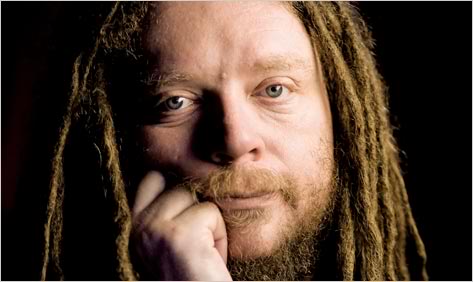
A super-geek he may be, down to his last dreadlock, but Jaron Lanier inspects the classic positions and tenets of the geekocracy with a coolly objective eye. He advocates compensating the ‘ordinary people’ Nick Clegg mentioned, not — so far — as stakeholders, but as suppliers of ‘content’ that media moguls and their giant corporations, like Facebook, are exploiting shamelessly. He asked in the New York Times last week:

What if ordinary users routinely earned micropayments for their contributions? If all content were valued instead of only mogul content, perhaps an information economy would elevate success for all. But under the current terms of debate that idea can barely be whispered.

Obviously, the editors at the Ladies’ Home Journal – paying their readers the same fees for content as professionals – are shouting, not  whispering, their understanding of the way media reform will now proceed.

Oxford Street branch of the John Lewis Partnership, 1936

An instructive poll for the Guardian

It was astonishing to see the results of a poll on the Guardian site related to the Clegg co-ownership proposal. Eighty-seven per cent of the poll-takers voted ‘yes’ in answer to a question referring to Britain’s most famous employee-owned company: ‘Would you like to live in a John Lewis style economy?’ That surely added up to endorsing a recommendation of  such a structure for ownership of the Guardian itself, or some part of it — even if proposals made in the online paper’s comments section for experimentally co-owning bits of it with readers  were censored more than once last year.  Ahem.

Nick Clegg and his personal think tank appeared to have anticipated precisely such — erm, discouragement, when he suggested in the same speech,

… giving employees a new, universal “Right to Request” shares. Imagine: an automatic opportunity for every employee to seek to enter into a share scheme, enjoying the tax benefits that come with it, taking what for many people might seem out of their reach, and turning it into a routine decision …

In other words, no one would be censored or punished simply for asking an employer for a stake in a company… Still, well done, Gruan, for conducting that poll.  Soon, you might almost be as brave as the Ladies’ Home Journal.