Notes from the post-print transition, 3: can members of a cooperative be ‘more equal’ than others without turning it into Animal Farm?

Poldo, MIL22

clouds, morselising 1

‘Morselizing’ (see below) – photographs: MIL22 (vanishingly small dog); postgutenberg[at]gmail.com

Generals only ever exist as temps in Switzerland, in the army in which all Swiss men must do a stint of compulsory training and service. As the Wikipedia explains:

General (Gen) – General (Gen); général (gén); general (gen); generale (gen): The rank is only assigned during time of war, when the Federal Assembly chooses one general to command the entire Swiss military. Otherwise the word “general” is not used.

This convention seemed worth drawing attention to after we read late last month, in The New York Times, about research confirming what everyone knows: that while people think equality ideal, they quake at the prospect of dispensing with a hierarchy. They fear that it amounts to inviting in chaos with open arms. This clichéd view of flat organisations — and of cooperatives — will soon look fuddy-duddyish and irrelevant, as young innovators we have mentioned here fashion tools to make collaboration and collective decision-making swifter and less fraught.

The second half of Matthew Hutson’s article – ‘Espousing Equality, but Embracing a Hierarchy’ — showed that other organisers have the same idea as the Swiss military of using transitional hierarchies as means to particular ends.

Increasingly, companies are valuing diverse input and turning to flatter structures. But even companies that supposedly deplore the value of hierarchy have status and power differentials, formally or informally.

The video game company Valve seems like a symbol for the flat organization. Valve posted its handbook for new employees online in 2012. “We don’t have any management, and nobody ‘reports to’ anybody else,” it says. […] Yet Valve has temporary team leaders who help coordinate projects, and employees rank one another when calculating compensation.

The design firm IDEO also aims for flatness but retains an element of verticality. “The idea of a flat hierarchy is a little bit of a myth that we even tell ourselves within IDEO,” Duane Bray, a partner, told me.

For instance, employees progress through four “levels of impact”: At the “individual” level they focus on their core skill set; at the “team” level they start to have responsibility for others; at the “portfolio” level they look at how collections of projects come together; and at the “enterprise” level they connect globally and take all of IDEO into account in their decisions.

Cameron Anderson, a psychologist at the Haas School of Business at the University of California, Berkeley, has written about the dysfunctions of hierarchy and encourages his M.B.A. students to pursue flatness — but not to its ultimate end. “It’s often useful to have at least one person who serves a role of leader,” he said, “even if that role is more of a coordinating function.”

Making the pigs temporary hierarchs in Animal Farm – to do particular jobs or serve particular functions with an expiration date, then revert to equality — could have dispensed with this objection of T. S. Eliot’s when he, like other top-tier publishers, rejected George Orwell’s manuscript: Animal Farm- TS Eliot And that is all we have to say in this entry – using the slow season to experiment with ‘morselizing’ thoughts, research findings and arguments, a neologism apparently invented by a wonderfully named Canadian professor of media studies, Sidneyeve Matrix.
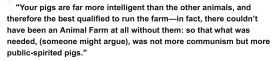
That seems exactly the right prescription for our new attention spans, shorter than the life of a firefly, and our endlessly interrupted reading — about which Tim Parks was recently complaining in The New York Review of Books. 'morselizing'- SIDNEYEVE MATRIX slide

Notes from the post-print transition, 2: astonishing confirmation — from medicine — that cooperatives fit the 21st-century’s zeitgeist

postgutenberg@gmail.com
Screen Shot 2014-07-15 at 23.22.56

Media resisting the unavoidable bow to the democratic future of media ownership are being shown up in Britain by, of all people, the bean-counters of medicine — the traditionally conservative, cautious and slow-moving top managers of the country’s most cherished public institution, the roughly £100 billion ($171 billion) National Health Service.

The pinch-me-I’m-dreaming headline at the top of The Independent’s home page on Monday read: ‘New government policy for the NHS could allow doctors and nurses to “own” hospitals’.

Before we get to the reasoning behind that proposal, let us quickly say that inviting readers and commenters – reader-commenters — to become part-owners of media organisations through subscriptions that would also be financial shares — making them small-scale co-owners – is an actual need in this sector, though not in British medicine. The flow of cash into the NHS is assured. It comes from taxpayers. But, as last week’s entry in this blog noted, the advertising revenue on which print journalism depends to pay its bills looks increasingly shaky as a supreme cash cow for online publishing, as it elbows print out of the way.

Moving towards co-ownership — or ‘mutualisation’ — is the one step that the boldest experimenters with new media structures are resisting. Declining to go that far, we pointed out last month, is the single disappointment in the otherwise wildly impressive reports about De Correspondent — the new Dutch publishing enterprise putting commenters at front and centre-stage in its publishing scheme. Nick Denton, the serial online media entrepreneur – most famous for co-founding Gawker in 2003 with Elizabeth Spiers – has perfectly expressed what we also believe, in describing his many excellent adventures in media redesign to Harvard’s Nieman Journalism Lab:

“Publishing should be a collaboration between authors and their smartest readers. … And at some point the distinction should become meaningless.”

These smartest readers are most likely to devote all the time they can to the success of an online publishing enterprise – whether a startup or a famous name in the news business ‘flipping’ co-ownership of a part or the whole of its web site to commenters – if they can justify that to themselves with the hope of sharing in its financial success, some day. Denton’s schemes allow reader-commenters to share the stage with professional writers and journalists. They are designed to make readers feel part of a larger family or club, and – as in the De Correspondent plan — to improve the quality of information disseminated on his sites, and the range of expertise on which it draws.

Giving performance and efficiency a gigantic boost is the ambition behind the remarkable news about the proposal for British medicine:

Ministers are drawing up plans to allow doctors and nurses to own and run the hospitals they work in as part of a radical blueprint to change the way the NHS is run.

Under proposals to be floated tomorrow, staff could be able to take over hospitals and other NHS responsibilities and run them as new mutual companies in the style of the department store chain John Lewis.

Staff would then become “shareholders” in the new company with the power to dismiss the chief executive and board members as well as set policy and targets for the new organisation.

Ministers are not ruling out the possibility that staff could even be given a financial stake in the organisations for which they work – sharing bonuses if their hospital makes a profit on NHS work. The new policy comes after an independent review, led by the independent think-tank the King’s Fund, found what it described as “compelling evidence” that NHS organisations with high levels of staff engagement delivered better quality care. […] Ministers have been particularly taken by the success of Hinchingbrooke Hospital in Cambridgeshire, which had been losing £10m a year and had very low levels of patient satisfaction until taken over by the private provider Circle, which manages it for the NHS. Circle is owned jointly by the staff who work for it and private-equity funders.

… We hope that the people in charge of making the rules for the ‘mutualised’ British hospitals will take care to head off any possibility of repeating one grave mistake in American medicine — allowing doctors to invest in medical testing laboratories, rightly blamed for countless unnecessary tests ordered by many of those doctors. These are notoriously a large part of the explanation for America’s expensive and inefficient health care.

The chief fear for the democratic redesign of media is that it will lead to the collapse of cultural standards; that it will usher in a depressing age of mediocrity. Again, the right rules have to be drafted to ensure that this does not happen. Who says that any such effort would lack supporters? Who says that the least talented co-owners of a media enterprise will not wish to celebrate and promote their most talented comrades, attracting honour, fame and new members?

A few weeks ago, there was news of opera-lovers panicking about performances in some places accompanied not by live musicians but digital recordings. A New York Times reader said, in a letter to the editor:

Live music is being performed by an ever-shrinking elite corps of musicians. This trend cannot be reversed. But it will bottom out. There will always be a market for elite musicians … On some level we want to see humans demonstrating their mastery.

 Who would disagree?

Notes from the post-print transition, 1: the advertising moonshot of Google’s Larry Page and Private Eye’s meerkat phobia

Meerkat to the Eye: ‘You surely don't mean, me?’ - postgutenberg [at] gmail.com

Meerkat to the Eye: ‘You surely don’t mean, me?’
– postgutenberg [at] gmail.com

Anyone sensible who, for decades, has bought nothing expensive without consulting Britain’s Which? (owned by the Consumers’ Association) or Consumer Reports in the U.S. (owned by Consumers Union) can understand Larry Page’s apparent belief, over a decade ago, that conventional advertising would soon be obsolete.

Advertising equals lifeblood in the traditional economic model for newspapers and magazines – the scheme that will soon look pre-historic. In a splendid Business Insider profile, in a section about the early years of the company Page co-founded with Sergey Brin, a far-out idea – known as a moonshot, at the search engine colossus — is described:

… [A]fter Google had become the Internet’s most successful advertising business, Page decided the company should destroy the advertising agency industry. To his thinking, it was obviously a highly inefficient system that could be erased with the help of technology. Not only did the company opt not to take on this battle, but [other top Google executives] did their best to make sure none of Google’s many important ad-agency clients caught wind of Page’s ideas on the topic.

His seems like a straightforward, logical conclusion to anyone who believes – as we do at post-Gutenberg – that

… the perfect search engine would understand whatever your need is. It would understand everything in the world deeply [and] give you back kind of exactly what you need.

That is also a quotation of Page, in the same article.

Private Eye — writing more frankly than any other print publication about the hopelessness of trying to carry the advertising-dependent print model for economic survival into the digital future – has had riveting news in recent ‘Ad Nauseam’ columns, information we have seen nowhere else. … Essential reading, even if the last snippet seems proof of a bizarre phobia at the indispensable satirical magazine – or, possibly, a regrettable instance of inter-species prejudice:

– from Private Eye, No. 1367, 30 May – 12 June, 2014:

The latest digital advertising medium to have its efficacy questioned is video ads.

Recent research suggests that nearly 60 percent of them are never seen by a human being, which does rather post the question as to what media buyers are actually paid for.

– from Private Eye, No. 1369, 27 June -10 July 2014:

Facebook recently admitted what everyone in advertising had already twigged – that no one is reading anything brands put on Facebook any more.

The company posted a long explanation for this, protesting loudly against the idea that it could possibly have anything to do with selling more ads, suggesting instead that it was a problem of there simply being too much ‘branded content’ on the platform. This is all well and good, except a) that problem is entirely of Facebook’s making, given that it has spent seven years telling all brands they have to be on there (without adequately explaining why); and b) all its solutions for brands to get over this issue involve, er, buying more adverts.

– from Private Eye, No. 1367, 30 May – 12 June, 2014:

The latest terrifying vision of the future comes via Personal Neuro, a company which is working with Google Glass to produce wearable technology, which can monitor a wearer’s brainwaves, gauge their mood or state of mind – and feed adverts directly into their eyeballs based on that data!

Welcome to a future in which you will never be able to escape that bloody meerkat, however hard you try

If Personal Neuro is real, not just a vision that came swimming into editorial brains at the Eye after a lavish liquid lunch, why does a Google search turn up no information about this Canadian startup in any other well-known print organ?

A surprising — but long overdue — condemnation of censorship by the press from The Guardian … and summer sign-watching

- postgutenberg [at] gmail.com

CENSORS in THE PRESS

‘Comment is free’, 30 June 2014

Let us hope that the admirably honest George Monbiot, with his huge following, can get this subject the attention it deserves. Regular readers have seen almost everything in his Guardian blog post on Monday here on post-Gutenberg.com — and his concluding sentence, two years ago, in ‘Censorship by the Press‘. We wrote that after some frustrating months of drawing attention to this problem:

Why is The Guardian censoring debate about press reform and ignoring the Lord Chief Justice’s endorsement of citizen journalism?

The solution proposed by the commenter ‘Natacha’ in her reaction beneath the Monbiot piece defines this blog’s very raison d’être: censors IN the press - NATACHA See:

Loomio: open-source tools from young New Zealand techies to make the dream of practical, efficient, sexy cooperatives come true

Just a short post, for today. We have been on the road, watching for signs – and here is one of our rewards: SIGN w freeway postgutenberg@gmail.com get happy 3

- photographs: postgutenberg [at] gmail.com

– photographs: postgutenberg [at] gmail.com