Great spring harbinger; brief spring break

spring bend 2013 - photograph by MIL22

– photograph by MIL22

Darling Pietro,

We are supposed to be on a short working holiday

– but cannot stop thinking of

Y-O-U

After the tulip tree that is really a sort of magnolia

erupted in its pink-and-white-and-magenta concatenation,

but before the wild mustard sang out in waves of rippling yellow

— weeks overdue —

Y-O-U

— perfectly on time.

Soon, you will be whizzing around that curve … as we, too many thousands of miles away, are gazing at …

mustard, finally 2 - photograph by postgutenberg[at]gmail.com

– photograph: postgutenberg[at]gmail.com

You, Pietro, born into a family that knows the secret-of-secrets better than most:

Keep a close eye on beauty, wherever you are, no matter what happens,

and it will see you through.

Though we, sadly, are no poets, we thought of a fine old one with words in the spirit of what we would like to say –

Labour is blossoming or dancing where

The body is not bruised to pleasure soul.

Nor beauty born out of its own despair,

Nor blear-eyed wisdom out of midnight oil.

O chestnut-tree, great-rooted blossomer,

Are you the leaf, the blossom or the bole?

O body swayed to music, O brightening glance,

How can we know the dancer from the dance?

— Among Schoolchildren, William Butler Yeats

Benvenuto, Pietro.

pear blossoms bark green leaves -photograph by postgutenberg[at]gmail.com

– photograph: postgutenberg[at]gmail.com

The spies among us: when will The Guardian and its editor, Alan Rusbridger, connect Facebook’s spying to the Snowden leaks — on the paper’s front page?

Secret, shadowy tunnels into our lives

Secret, shadowy tunnels into our lives
– photograph by postgutenberg [at] gmail.com

Long live the special relationship! Week after week, in its continuing co-leakage with Edward Snowden of documents about government spying, The Guardian, a British newspaper, is dishing up an unparalleled feast of examples to illustrate the use of ‘disconnect’ as a noun — as in, ‘their problem is a reality disconnect’ — classified by the Oxford English Dictionary as American English.

When will this newspaper and its otherwise admirable editor, Alan Rusbridger, acknowledge, in the same front page stories — such as last weekend’s about Britain’s GCHQ and America’s NSA storing intimate images from Yahoo webcams —

 … that the governments are only copying or helping themselves to vast stores of private data about us that companies have been amassing – for profit? 

… that any organisation collecting vast stores of such information about us – whether commercial or governmental – is at the heart of the problem?

Like some tragic accident victim whose brain hemispheres can no longer communicate, The Guardian cannot bring itself to integrate into its Snowden coverage these statements — published on the newspaper’s own site, on 24 February — by Ian Brown, associate director of Oxford University’s Cyber Security Centre:

Facebook has built its $173bn market valuation around profiling its users and showing them targeted adverts. It has refused to allow users to subscribe with money rather than personal data. […]

The business models of internet giants such as Facebook and Google are crucial to the future of privacy.

What is the proper order of blame for smashing the last vestiges of our privacy? This was beautifully set out in the first paragraph of a column last week by Joe Nocera in The New York Times, an occasional partner of The Guardian’s in publishing jets from the Snowden fount of horror. If pressed for time, dear reader, just read its last sentence:

We are fast approaching a privacy crisis in the United States. Google, Facebook and other big Internet companies collect information about us, which they deploy in the service of advertisers. Big data brokers, like Acxiom, have developed sophisticated tools that allow them to know almost as much about us as we know about ourselves; they then sell that data to all kinds of companies that want to learn everything from our habits to our health, from our sexual orientation to our finances. The digital age has made it easy to collect medical data, which is supposed to be protected under federal law. Huge data breaches at big retailers like Target have made it seem unsafe to use credit cards. And I haven’t even mentioned the Edward Snowden revelations about the massive data collection by the National Security Agency.

Next, we recommend reading an excellent interview in Salon with Julia Angwin, who has just published a book about the privacy crisis that draws on her years of scoop-laden reporting on this subject for The Wall Street Journal:

Both Silicon Valley and the government had a problem and they both came to the similar conclusion that the answer was collecting vast amounts of personal data. From the commercial side it turned out that the way to get advertisers interested in the Internet was to offer them incredible insights on the people that they were advertising against. And on the government side it was: If we collect a lot of information we can find these terrorists.

Unfortunately, what we’ve seen is these two things converge. […] Commercial data has become a honeypot that government likes to dip its hand into.

Are attitudes changing about privacy?

I think that the Snowden revelations have made it clear how intertwined government and commercial surveillance are. Before, maybe it wasn’t as obvious to people that the information that Google had accumulated was also being accessed by the government.

… Finally, those of us like one friend of post-Gutenberg’s playing dim in refusing to acknowledge the risk that stores of information, once collected, can change hands – should consider what one commenter noted, with perfect accuracy, beneath the Ian Brown contribution to The Guardian:

Snaga

24 February 2014 9:37am

It is a known fact that [Facebook and other companies] harvest whatever data they can about the user, and do so for their own corporate gain.

It is also now an established fact that security agencies can get hold of that data, and use it for whatever they believe to be in the interests of national security.

Remember, information can always acquire powerful new manipulators. Only last week, in Britain, the National Health Service was lambasted beneath headlines like this one: ‘Hospital records of all NHS patients sold to insurers’.

… As we have asked before, might The Guardian’s dogged refusal to connect commercial spying to security agency surveillance have anything to do with that newspaper’s invasive monitoring of its own readers – with the same surveillance software tools?

Support your favourite inkjet-stained wretches! Send an indie e-book — or three — for the price of a birthday card

red plate starburst 1

red and white 1

He grew red roses and white lilies on the edges of deep shade in his lush garden — the owner of the page for today in every diary that was ever ours — and the birthday card we could have sent him, if he were still here, might have been a salute to his green thumb.

But birthday cards addressed in familiar scripts on stamped envelopes have been making their way to the same old-media life-after-life as floppy disks. E-cards are a thin substitute. We have seen scarcely any not designed for mass appeal in styles that remind us of our multimedia-artist friend LCM’s opinion of the look of the Facebook site: ‘It’s like walking into Walmart.’ Paper cards, in the decade or two before they began to vanish, came in an infinite variety – from Hallmark-treacly and bland to clever, quirky, idiosyncratic and even cryptic, if you knew where to look. It was easy to find an offering that let you tell recipients what they meant to you either through a perfect reading of their taste, or some blend of graphics and words at a happy junction of their sense of aesthetics and yours.

What is better than an e-card in 2014?

Possibly, an e-book, preferably an indie e-book, an undiscovered gem spotted on the wayside in your net wanderings. If it is a text you love, you have the satisfaction of helping the writer to earn the cash for another manuscript. Unlike print greeting card artists who collect only a shockingly small fraction of what their publishers charge us, a scribbler brave enough to try independent e-publishing at this turbulent and nerve-wracking stage of its evolution can collect as much as 70 per cent of royalties on the U.S. site of the Amazon publishing platform.

Fiction delivered as an e-book now sets you back by no more than the price of a print construction on an ever more scantily-stocked supermarket greeting card shelf. It can cost embarrassingly less. Recently, when we sent two birthday e-books to someone whose cards chosen for us over a span of thirty years have a habit of falling out of books in our personal library, we were afraid that she might think us stingy – but could not decide what other title she might like.

Indie e-books already range from pulp to work that meets the most exacting literary standards. Really? We note the dubious pitch of that question, the arched eyebrow. Admittedly, first-rate literature by e-publishing indies is not easy to find. The well-known print reviews that most time-pressed connoisseurs of good writing still rely on to shrink the universe of reading possibilities to negotiable proportions still shun e-only works, and do not look at the exploding numbers of them without intermediaries in conventional publishing.

Anyone worried – rightly so – about falling into the error of prejudice against the future could, like us, try John A. A. Logan’s new novel, Agency Woman, which we have just started reading. ‘A dark, Scottish tale of conspiracy, espionage, murder and terrorism, with an existential edge,’ is its description on the author’s web site.

The few pages we have had a chance to absorb — in a time of seemingly unending chaos — are intriguing and, in the best way, nonconformist and unslottable. The tone is thriller-noir, but the sleuth-like main character is no whisky-soaked Inspector Rebus or Kurt Wallander getting by on a diet of microwaved cholesterol. He is a sensitive, dreamy, drifter who copes with being imprisoned in a chair for most of a day and night with ropes cutting into his skin by doing yoga breathing exercises. Offered food after hours of starvation, he asks if he can have something vegetarian. When a character we have so far assumed to be a villain quotes Kierkegaard, it does not seem to be intellectually pretentious tarting-up in place of characterisation, but fits the story’s half-real, half-otherworldly, atmosphere.

Taste tests have no equal for introducing writers, in our opinion, so we will end this post with the first paragraph of Agency Woman. It has a certain grand, leisurely, philosophical majesty, as well as poetic beauty – but soon, in a succession of subtle and deft transitions, the story’s pace accelerates and we are somewhere that both is and isn’t gritty modern Scotland, observed with a keen hawk’s eye; something like Antonioni’s London in Blowup — as in our second short extract, consecutive snippets from a tense sequence.

… Before we leave you to sampling: to say that John is proving a new medium and ‘business model’ for literary publishing is not unlike praising Graham Greene or Mikhail Bulgakov for raising the standard of ‘content’ created by combining stationery and typewriters. But with most members of the intellectual establishment still sceptical and, or, sour about e-publishing, that is a point that needs making. John is a pioneer who stands out.

Over to his mysterious Agency Woman — who wears high-heeled red shoes:
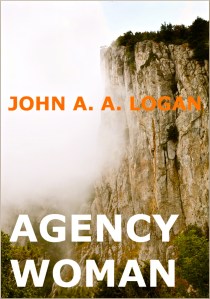
Agency Womanol

Extract One:

The old stories don’t need to be repeated endlessly. The ancient knights can be allowed to fall from their horses, lumpenly, and die. Even the horses, though with more grace, can be allowed to fall over and turn limp on the grass. Thus, in a moment, they are permitted their release from this arena. Their struggles forever on record, for perusal later, at a safe distance.

Extract Two

On the Scottish mainland, this month, for example, there are only twenty-seven of our agents in operation. Unlikely, then, to meet one in Tommy’s Café. And then there’s the head. Ten years ago, even five, there would never have been an agent with a head like that. The agent would always have been one of the other people in the café, one of the men or women I hadn’t even noticed. They would be from the Scottish Agency, and they would have been watching me ever since I came in today and sat down. But I have to remember that times have changed. Now, these days, anyone can be with the Agency. Anyway, here he comes. […] I don’t want him to sit with me. I want to sit alone, in peace.

His voice is shaking. There’s an edge to his voice like a dying rodent screaming. He punches the table-top right beside my mug. I feel the reactions of the thirty other customers who are sitting all round, openly watching the situation unfolding at our table. This man with the swollen head wants to explode. I look at his eyes for a few moments, but there is nothing there. Not even pain. I glance away from him, scan the faces at the other tables as they watch. If I speak too readily, I could easily say the wrong thing, and give him the release into action he is craving. If his story is real, then he wants me to react to his violent presence, give him an excuse to start something in the café. That way he’ll not have to make that court appointment. If the story’s a fabrication, if he’s an agent, then he’ll still use the story as the excuse for exploding.

 […]

 After a minute of silence I say,

 ‘I don’t mind talking to you but, I need to know, are you going to make trouble at any moment, maybe hit me? …


The surveillance business model — and did the New York Times mean to say that Snowden ‘plundered’ or ‘got the best of’ the National Security Agency?

Drawing attention to the ‘surveillance business model’ is a little lonely, for writers with any grasp of technology, in the artificially-manufactured Snowden hullabaloo - photograph by MIL22

Pointing to the ‘surveillance business model’ is a little lonely, for writers with any grasp of technology, in the artificially-manufactured Snowden hullabaloo
– photograph by MIL22

A few spectators have begun to see why nonstop commercial spying is easily as threatening as state surveillance and, conceivably, worse. Marzia Faggin — whose talent for witty graphical compression is in her painting, ‘Willy Bonkers,’ gracing our last post — has jokingly raised a Kafka-esque possibility for the ‘surveillance business model’ resembling the grimmest consequences of our monitoring by government spooks. In an email exchange, she said,

I research things for my artwork that I often worry might bring the police to my door. I don’t just feel the unsettling lack of privacy online either! I’ve become mindful about what I buy while grocery shopping, lest I get dropped by insurance for buying too much junk food.

That might seem ludicrous unless you happened to read the suggestion of Bernard Stewart, an editor at the cancer agency of the World Health Organization, a few days ago: ‘Can we – and should we – make laws against cancer?’ He explained:

Some cancers cannot be identified with particular carcinogens, but still involve personal choice, like the multitude of minor everyday decisions we all make around food, exercise and lifestyle that can add up to obesity and poor fitness.

As the hue-and-cry about soaring health and medical costs grows louder, who would absolutely rule out a future collaboration between the health insurance and food-vending businesses?

Though the Stewart piece appeared on The Guardian site, both that newspaper and The New York Times keep harping on about what Edward Snowden did or didn’t do, paying merely token attention to commercial surveillance. The contrast between two headlines in the NYT last Sunday helped to create the most bizarre newspaper story we have read for a very long time. On the front page, directly beneath the masthead, the story was titled ‘Cheap Software Helped Snowden Plunder Secrets’. On page 4, where it continued, the headline read, ‘Snowden Used a Low-Cost Tool to Best the N.S.A.’ .

It was indeed a fascinating account of how Snowden had driven the software equivalent of a gigantic moving van into the centralised data store of the National Security Agency and automated the theft of vital treasures, to save him having to schlep them himself, one at a time. But there is quite a difference between ‘plunder’ – commonly used in combination with ‘pillage’ and ‘rape’, in records of especially brutal wars – and ‘get the best of’, defined by the Free Online Dictionary as ‘overcome, usually through no fault or weakness of the person that is overcome. “Heart disease can get the best of us”.’

There appears to have been an argument between the copy editors (sub-editors in the UK) on the NYT about whether Snowden more closely resembled a lawless marauding barbarian, in the way he went about getting the information he leaked, or was just a bit sly, like plaque building up in arteries. … But no, having mostly written about him as a hero, it was too much to expect the NYT to be objective.

The newspaper’s true sentiments were obvious from asking readers to wait until the twenty-sixth of twenty-nine paragraphs devoted to this story to say:

But that leaves open the question of how Mr. Snowden chose the search terms to obtain his trove of documents, and why, according to James R. Clapper Jr., the director of national intelligence, they yielded a disproportionately large number of documents detailing American military movements, preparations and abilities around the world.

In his statement, Mr. Snowden denied any deliberate effort to gain access to any military information. “They rely on a baseless premise, which is that I was after military information,” Mr. Snowden said.

The head of the Defense Intelligence Agency, Lt. Gen. Michael T. Flynn, told lawmakers last week that Mr. Snowden’s disclosures could tip off adversaries to American military tactics and operations, and force the Pentagon to spend vast sums to safeguard against that.

Snowden’s promoters and defenders keep mentioning the billion-dollar budgets of branches of the military financing the monitoring his leaks outline. But since those billions are sanctioned by American tax-payers for their protection, should that accusation about the theft of military secrets — by Clapper, the country’s highest-ranking official in charge of security, no less – have only been tacked on to the end of the piece, like an afterthought?

For good or bad reasons, the spooks have refused to supply details of why the 58,000 documents Snowden stole from them were ‘mission-critical’. But should that mean that the NYT effectively decides that they were not?