What is a blog, in 2013? More parlour than platform, perhaps

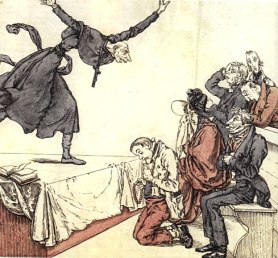
Bloggers can ‘speak truth to power’ as idiosyncratically as caricaturists  – An 1834 protest against corrupt clerics by the Swiss artist Martin Disteli: Wikimedia Commons

Bloggers are free to ‘speak truth to power’ as idiosyncratically as caricaturists
– an 1834 protest against corrupt clerics by the Swiss artist Martin Disteli: Wikimedia Commons

Blog posts can be as intentionally -- and unintentionally -- revealing about bloggers as parlour furnishing was about a house’s occupants

Blog posts can be as intentionally — and unintentionally — revealing about bloggers as parlour furnishing was about a house’s occupants

In 2013, a blog post — whether buoyant or morose — can tell you nothing about a blogger’s actual mood or state-of-life, unlike the exhibitionistic diaries that people originally thought web logs would be. The time has come to toss out stale do’s and don’ts about blog-running. A blog does not have to be run like a newspaper, newsletter or magazine for bloggers to supply information in the public interest . It can do its bit towards changing the world without round-the-clock, daily, or even regular posts – as long as it is written with care, and its existence is recognised by search bots.

It might or might not attract commenters, depending on whether a blogger has the time or inclination to chat with visitors and — on serious subjects that matter greatly — visitors’ willingness to risk looking foolish, or face the unintended consequences of comments discovered by their near-and-dear, employers or workmates.

Boosting site traffic is of keenest interest to bloggers blogging strictly in the hope of blog monetisation – which, as things stand, would mean that Florence Nightingale, if she were a contemporary, would have to shrink anything she had to say about medicine to thought-capsules insinuated between large nude ‘selfies’ in which strategically positioned cat pictures hid her peekaboo bits, all of this framed by cosmetics and fashion ads. She would need to devote rather more energy to luring ‘likes’ than to nursing.

It struck us that in 2013, although free – unmediated – expression is the aspect of blogs that gets the most attention, a blog today might be even more like a Victorian parlour than a soapbox or pulpit. But what was our idea of a parlour? A sort of outer sitting- or living-room, we thought – inviting, yes, but rather formal, and offering not so much statements as hints about the inner lives and passions of a household, for which it served as a sort of shield. It was mostly furnished in conformity with the taste of the era, epitomised by an ornamental, straight-backed chair. This is not to say that we think of blogs as typically stuffy or prissy – only that most bloggers are on sites hosted by the likes of WordPress, Blogger or Tumblr, using designs and organisation schemes that these hosts supply, which closely reflect contemporary taste.

But what of the original parlour, we wondered. The Wikipedia entry had this surprise – borrowed from the Oxford English Dictionary:

Parlour derives from the Old French word parloir — or parler (“to speak”), and entered English around the turn of the 13th century. In its original usage it denoted a place set aside for speaking with someone, an “audience chamber”.

We got curious, and dug further into ideas about the purpose parlours had served in the past. Should we forget all about Victorian parlours, now that we knew that they were relatively recent evolutions of a much older idea?

The parlour was of considerable interest to the Victorians … and it appears in Victorian genre painting and fiction as a newly significant space … [T]he parlour, whether in life or in art, is a site at which we can explore potentially explosive disturbances in psychic and social fields and can trace attempts both to articulate and resolve such differences.

The Victorian Parlour: A Cultural Study, Thad Logan, Cambridge University Press, 2001

Curiouser and curiouser. Very much like blogs, then – if Thad Logan’s suggestion is warranted, as we intend to find out when we read her book.

Net democracy: the great science magazines value readers’ comments, but a pop-sci counterpart shuts down discussions and criticism

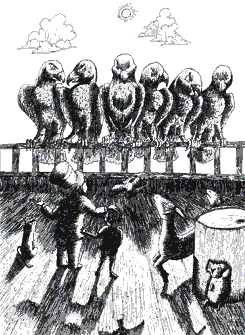
Reader-commenters are vacuous birds of prey for some members of the media's old guard - drawing by Hugh Lofting 1886-1947

Reader-commenters: vacuous birds of prey, to media’s old guard
– drawing by Hugh Lofting (1886-1947)

‘My user names and passwords … ’ the wrinkly figure in the drawing wheezes at the heirs leaning over his bedside, in a recent addition to Private Eye’s ‘Modern Last Words’ series. ‘I want you to continue my work as the most hated troll on the internet.’

Trolls. Harpies. Brainless vultures. Vacuous attack dogs. Surprisingly often, it is not just the media’s old guard but political liberals in occupations unrelated to publishing – status-obsessed and change-resistant types – who froth at any mention of commenters on media web sites. As this blog began with a proposal for newspapers to evolve into sites partially owned by reader-commenters, we at post-Gutenberg have been flabbergasted by reflexive references to public debate in these spots as unintelligent – usually, from people who have never devoted enough time or effort to ‘below the line’ conversations to discover how often these are more informative than the articles or posts that initiate them.

Imagine how amused we were to learn from a New York Times report last week about the reactions from illustrious upmarket competitors of Popular Science to the news that this magazine was shutting down commenting on its web site altogether. This is hardly a move you would expect from a publication whose headlines appear to be written by a teenager desperate to win a popularity contest: ‘Giant Carnivorous Plant Found In Silicon Valley,’ for instance, or ‘Eating Yogurt Does Weird Things To Your Brain’.

Grave as a sermonising clergywoman, Suzanne LaBarre, the magazine’s ‘online content director’ justified the decision to return to print media’s traditional one-way dialogue:

Comments can be bad for science. That’s why, here at PopularScience.com, we’re shutting them off.

It wasn’t a decision we made lightly. As the news arm of a 141-year-old science and technology magazine, we are as committed to fostering lively, intellectual debate as we are to spreading the word of science far and wide. The problem is when trolls and spambots overwhelm the former, diminishing our ability to do the latter.

That is not to suggest that we are the only website in the world that attracts vexing commenters. Far from it. Nor is it to suggest that all, or even close to all, of our commenters are shrill, boorish specimens of the lower internet phyla. We have many delightful, thought-provoking commenters.

But even a fractious minority wields enough power to skew a reader’s perception of a story, recent research suggests …

Really. In a justification that  revealed the power of intelligent and articulate readers as her real fear – an argument that would delight dictatorships all over the world, she added:

[C]ommenters shape public opinion; public opinion shapes public policy; public policy shapes how and whether and what research gets funded–you start to see why we feel compelled to hit the “off” switch. 

Her reasoning did not impress science magazines with a serious interest in science. Snippets from the NY Times story – for which that newspaper must be congratulated:

Fred Guterl, the executive editor of Scientific American: ‘I have to say I don’t think comments are bad for science. To a point I think it’s good when people talk about things and try their ideas out. Social media can go off the rails but I don’t think comments are worse than Twitter.’

Noah Gray, senior editor at Nature:

“There’s no doubt that uncivil discourse is bad for science,” Dr. Gray said by e-mail.

But, he said, comments can be very valuable, sometimes pointing out errors or alternative interpretations of the facts and theories presented in the article.

“The comments section can often express the openness of scientific debate,” Dr. Gray said, adding, “Removing this channel for feedback rather than exploring an alternative means to improve it simply ignores the problem.”

A reaction from a NY Times reader-commenter seemed especially apt:

Laird Wilcox, Kansas

I suspect that an individual’s capacity for objectivity depends upon their ability to entertain conflicting values, opinions and beliefs without feeling threatened by them. When you find someone who “can’t stand” another’s “ignorance” you may be dealing with an insecure bigort[sic] who fears contradiction or is woefully unsure of themselves.

But some egotistical old media professionals apparently cannot stand readers discussing their work as incisively as in this delicious exchange between Popular Science commenters – about a 2009 piece titled, ‘Could There Be A Planet Hidden On The Opposite Side Of Our Sun?: We ask a scientist who has peered around it.’

bdhoro87

04/20/2009 at 11:01 am

Behind the sun? This article is tempting me to use a lot of profanity. We travel to the other side of the sun and back every year, what does behind the sun mean? Behind the sun with respect to earth? So like where the Earth would be half a year from now? Or on a different axis or what? All logic tells me is the sun doesn’t have a front and behind… its pretty spherical and it rotates. Was this a search for a planet that maintains the exact orbit of earth but 180 degrees out of phase? Can someone please clarify how the sun could have “sides” and where “the other side of the sun” is?

Loschen

04/20/2009 at 12:07 pm

I’m guessing that what they mean is it revolves at the same speed as the earth but stays on the exact opposite side of the sun. Therefore, it is perpetually out of normal sight for earth. But, that’s just how I read and understood it. you’re right they didn’t do a very good job of clarifying…

qlmmb2086

04/20/2009 at 2:33 pm

One thing people need to realize about PopSci is that these are not scientific articles. It’s similar to, say, a CNN reporter writing an article on a scientific discovery; these are written by journalists, not scientists.

That having been said, this article does seem kind of pointless… Why bother debunking a theory about a hidden planet synchronized with earth’s orbit, when nobody thinks that anyhow? You may as well write an article to show that the earth isn’t flat.

… We can hardly type for laughing …

One hundred posts, but many more kudos to Annalisa Piras and Bill Emmott for a post-print work of genius focused on Italy

giac b+w title

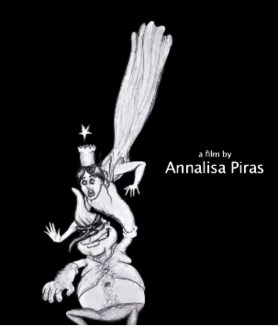
<i>Girlfriend in a Coma</i> encourages viewers to join its creators in knocking down and neutralising ‘Bad Italy’ – a podgy monster, in Phoebe Boswell’s conception of it

Girlfriend in a Coma urges viewers to join its creators in neutralising ‘Bad Italy’ – a podgy monster, in Phoebe Boswell’s conception

Phoebe Boswell

Phoebe Boswell
photograph by Sky Arts

[…an inadvertently belated appreciation…]

Our 100th post-Gutenberg entry amounts to a standing ovation for two old media journalists — one Italian, the other English —  who have unzipped their imaginations to create a model of transmedia fence-jumping, using digital tools to communicate subtler and more penetrating information than can be transmitted through either conventional opinion journalism or documentary film-making.

The key to realising their extraordinary ambitions for their collaborative video production, Girlfriend in a Coma, was the free hand they gave a hair-raisingly original and gifted young British artist and animator, the Kenyan-born Phoebe Boswell. Hers is a talent that had us scribbling the names of the manically brilliant English cartoonist Gerald Scarfe, his ghoulish American kindred spirits, Edward Gorey and Charles Addams, the Alice in Wonderland illustrator Tenniel, and Salvador Dali, as we ruminated about influences.

Girlfriend is based loosely on Good Italy, Bad Italy (2012), a contemporary portrait in a book by Bill Emmott, The Economist’s editor from 1993 to 2006. He is listed in the video’s credits as co-writer and co-director with Annalisa Piras, credited as director, and the prime mover behind the project. She is about ten years younger than Bill, who happens to be a former colleague of p-G’s remembered for true and exemplary collegiality. This makes it not in the least surprising that – as well as he plays his part as the video’s unassuming narrator, and as much as the narrative is technically filtered through his memories of Italy, his thoughts, and his feelings about Europe’s high-heeled boot — the production is saturated with a wildness and emotional intensity so unlike him that they could only have been conjured by his collaborators. Bill is clearly a first-rate encourager.

Annalisa (as referring to Bill as Emmott feels awkward, we’ll dispense with surnames) has explained how she sketched Girlfriend’s essential requirements for Phoebe and Jenny Lewis, Phoebe’s partner in animating her drawings and imaginings: ‘the Italian characters — the Good Italy, based on the female image since Roman times, the Bad Italy, a thug wearing a “Pulcinella” mask from the Commedia dell’Arte — and the ideas I wanted to convey, and they ran with it.’

Actually, they flew. Annalisa stayed closely involved: frame by frame, they flew together. (See updated Q & A about ‘the making of …’ here.) The result made p-G, a jaded lifelong observer of Italy, sit up and marvel, as if for the first time, about the paradox of a country easily seen as a screaming basket case — as far as economics and politics go — somehow managing to hold its place, for decades, among the world’s leading economies. If this trans-documentary has a single flaw, it is that it fails to offer an adequate explanation for the Italy that, against long odds, has not merely survived but often prospered mightily in modern times. But this is beside the point for Girlfriend — mistakenly slated by some critics for a lack of balance. It is a call to arms. It is a manifesto for the reform of a deeply marvellous but also staggeringly corrupt, inefficient, uncaring and misogynistic society.

Not that anything as dreary as ‘consciousness-raising’ remotely describes its tone. This is set by Phoebe’s surreal, dreamlike imagery, briskly intercut with footage frequently shot from clever camera angles that recalls the films of Michelangelo Antonioni, especially Blowup, and micro-clips from interviews – the interviewees as diverse as high-ranking politicians, Mafia prosecutors, all-too-understandably outraged feminists, top industrialists, historians, political theorists, the irresistible novelist-philosopher Umberto Eco, workers and inmates in a home for the disabled – that justify the video’s charming frame.

And what is that?

Italy is presented to us as a girl with whom Bill fell helplessly in love as a tourist in his student days. Not any old girl but an ethereal and languorous jeune fille who happens to be a touch eccentric, neurotic to the core, and assailed by homicidal inner demons – encapsulated in the figure of the mega-ogre with the Pulcinella mask. She has, for him, come to fit the skin-crawling title of a pop song by the Smiths; a girl so severely afflicted as to end up, virtually, on artificial life support.

No wonder Girlfriend was financed as an indie project – by Annalisa’s own company, Springshot Productions. Though her potted biography mentions her education in Rome in history, politics and cinematography, and two decades of shooting documentaries while she also served as the London correspondent of L’Espresso, we cannot imagine any part of the old media establishment backing such a commendably outlandish project.

That does say something disappointing in the extreme about the reluctance of our dominant communicators to get to grips with the future. Fear of the unfamiliar in other quarters – among arts reviewers – could also explain why p-G is writing about Girlfriend nearly a year after its release in Europe.

We learnt of its existence by accident, last month – having been mostly cut off from news about arts-and-letters at the time of its launch last November. Online searches show that though it did indeed cause the intended stir in Italy, at the loftiest levels, and was shown in art cinemas and nominated for awards in European cities, it has so far failed to be noticed for the right reasons. Though it has had some laudatory reviews in the Anglosphere, including a rave here and there, these have mostly been short (a single glowing paragraph in The Financial Times, for instance). Where, we have been wondering, are the lavish allocations of column-inches that this trans-documentary deserves? The colour photo-spreads? The probing investigations on the front pages of arts sections of how Annalisa, Bill and Phoebe came to be the pioneer-collaborators they are? The questions about their insights into the evolution of post-print media?

Funny, to say the least, that no one apparently saw plenty to write home about in watching the calm, gently reasonable ex-editor of a well-known magazine drifting in silhouette through shadowy stone arches, up and down dark stairways that evoke dungeons — sequences near the start of his narration that evoke both the vicious underside of Italy that includes the Mafia, and our narrator’s own unconscious mind.

Are we being invited, in this segment, to believe that Italy is where Bill’s muse or — from one perspective in psychological theory — anima, in the form of this Girlfriend, resides? Later in the video, one of the readings from Dante Alighieri that interrupt the narrative periodically goes, ‘O lady, you in whom my hope gains strength.’  This is stimulating allusiveness. In the hands of Girlfriend’s creative quartet, it hugely enhances all the information it packs in – is sophisticated, successful sugar-coating for the flow of statistics, miniature history lessons and political science lectures that barely register as anything so dull.

Some highlights (not necessarily in the right sequence):

• Blisteringly incisive insight and commentary in clips from interviews with Roberto Saviano, a (now) 34 year-old investigative journalist and novelist obliged to live in hiding, under police protection, from Mafiosi infuriated by his revelations. His handsome shaved head, winglike black eyebrows and dark eyes shot in stygian gloom are in perfect harmony with the sinister animation sequences.

• Bill talks to the intellectual and left-leaning Canadian-Italian industrialist, Sergio Marchionne, who made his name by restoring the fortunes of Fiat; who hopes that we will see the evolution of a healthier form of capitalism, and says that ‘People who engineer the free market have a responsibility to keep it clean.’ His point is underlined by the words of Dante – reaching us by way of the disembodied voice of the actor Benedict Cumberbatch – to which we listen looking at a panorama of industrial sprawl, probably Turin: ‘[Y]our avarice afflicts the world:/ it tramples on the good, lifts up the wicked.’

• Maurizio Viroli, a slender, elfin professor of political theory at Princeton sits at a dining table talking to us over the remains of what appears to have been a simple, vinous meal all the more delicious for its informality. He points out that the three main leaders of the 19th-century Risorgimento or ‘resurgence’ that created modern Italy – Cavour, Mazzini, and Garibaldi — ‘had a deep religiosity inspired by currents of Protestanism – Jansenism.’ He adds that ‘all three were critical of the Catholic attitude of making deals with those who are powerful,’ and he mainly blames the Catholic Church for the besetting national flaws, ‘sloth and moral weakness’.

• Sad, wraithlike, girlish figures sketched by Phoebe rise from Lake Pellicone, a dramatic expanse of blue set in a rock-walled canyon. Dante’s lines, here: ‘This miserable way / is taken by the sorry souls of those / who lived without disgrace and without praise. / They now commingle with the coward angels, / the company of those who were not rebels / nor faithful to their God, but stood apart. /’ In the rocks above the water, in another superimposed animation, the demonic ogre bashes Bill’s girlfriend.

• Bill cycles around a deserted, sparkling Ferrero chocolate factory, dressed in one of a succession of dapper outfits, many in brilliant colours that recall swinging ‘60s London. The ghastly, thankfully deposed Silvio Berlusconi, three times Italy’s prime minister – who did not keep his promise to appear in the film — was apparently thinking of Bill’s appearance as well as his politics in nicknaming him ‘Lenin,’ yet the cumulative impression he makes is a hybrid of Agatha Christie’s brainy Hercule Poirot, Charlie Chaplin in Modern Times, and Amélie’s beloved globe-trotting garden ornament in the film by that name.

Not many experimenters with post-Gutenberg communication will have either the funds or connections to match the excellence of the musical sound track, or engage the likes of Cumberbatch for poetry recitations. What any of us can still learn from Girlfriend is the importance of re-conceiving from scratch our presentation of what we want to say; of not merely pouring well-worn forms and conventions for shaping information into new-media bottles, but grabbing the chance to communicate what was virtually impossible to communicate before about non-fictional places, events and people.

As far as we can tell, Girlfriend is as scrupulously factual as the finest old-fashioned print journalism. But it exploits special capacities of moving pictures to show us how the facts about its subject impress and affect its chief observer and fact-gatherer, Bill, drawing us beneath the surface of hard reality into psyche – with the animation sequences drawn and directed by Phoebe ensuring a clear demarcation of the boundary between the actual and the strictly impressionistic. One parallel for such innovativeness that we mentioned in a recent post is Carl Djerassi’s revisiting, re-sifting, and powerful re-enlivening of the mental preoccupations and lives of pre-war intellectuals in his Four Jews on Parnassus – by recasting them as dialogue; as a spikily argumentative conversation.

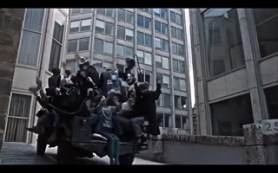
This appreciation of Girlfriend will end with a whiff of the uncanny. A day or so after we first watched it, we kept thinking of Blowup, and wondering why. After we had tapped a tentative explanation into a keyboard, we went to the Wikipedia looking for the year of the film’s release – 1966, and there was a New York Times arts correspondent attributing part of critics’ reaction to this ‘stunning picture’ to the way it is ‘beautifully built up with glowing images and color compositions that get us into the feelings of our man,’ its photographer-protagonist. No, there was nothing uncanny about that discovery. The spine-prickling came from being told something we never knew, in the same Wiki entry. Antonioni had used as the backdrop for Blowup’s carnivalesque opening scene (below) the plaza of a London office building — part of a streaky-concrete-and-glass specimen of Brutalist architecture — where we had once toiled long past sunset, years after we had forgotten details of the film. … And that was the office where, bizarrely, we once worked with Bill.

Did Girlfriend’s collaborators have Blowup in mind when they were mulling over the look and feel they wanted for their project? We must remember to ask.
Screen Shot 2013-09-21 at 00.23.13

The Guardian’s ‘moderation,’ again – and reader-commenters on newspaper sites correcting the unbalanced coverage of mass surveillance

Nikki de Saint Phalle’s one-tonne L’Ange Protecteur (Guardian Angel): could there be a more perfect emblem of The Guardian’s institutional persona? photograph: Wikimedia Commons

Nikki de Saint Phalle’s one-tonne L’Ange Protecteur (Guardian Angel): could there be a more perfect emblem of The Guardian’s institutional persona?
photograph: Wikimedia Commons

No, we do not dislike The Guardian at post-Gutenberg. It is a newspaper that meets a vital need. With its unstinting support of every vulnerable or marginalised social group – immigrants, same-sex lovers, the transgendered, disabled and poor – it is the single internationally famous old media name backed by a supremely feminine sensibility. It is a sort of zaftig, mammoth-breasted Ur-Mother angel, in spite of being led by a male editor, Alan Rusbridger. We arrived at this thought indirectly, after a male critic of p-G inexplicably characterised as ‘homophilic’** the excellent ProPublica site that has been The Guardian’s co-publisher (with The NY  Times) of Glenn Greenwald’s reports on mass surveillance by governments.

Yes, in our post on that subject last week, we were indeed criticising The Guardian – but for the reason we have in the past, on many occasions. (See ‘Good Guardian, bad Guardian …’) It censors reader comments in the Comment-is-Free section of its web site. Not, as you’d expect a priori, contributions by readers swearing or resorting to scatology, personal attacks or childish insults – most of which are allowed, to support the appearance of encouraging free speech and debate.

All over the net, there are groups of people complaining that The Guardian shuts down too many sharp, well-informed commenters who persistently disagree with certain of its cherished political positions and beliefs, or conventional wisdom that, in its view, should not be challenged. Type such strings as ‘comment moderation censorship Guardian’ into any good search engine from time to time, and you will find intelligent folk who write clearly and grammatically but are opposed to vaccinating children; do not believe that global warming is an actual phenomenon; or support Israel and have some objection to Palestinians.

Whatever the demerits of those stances might be, we believe that to support its boasts about fostering free expression, The Guardian should leave the job of opposing or condemning them to other reader-commenters.Its heavy-handed Mother Knows Best interventions are dismaying enough in these cases, but disgraceful when it deletes comments by — and sometimes bans — writers of posts that expose weaknesses in the research or arguments of its reporters and writers. (See ‘Should ordinary citizens be shut out of the debate about the media’s future?’)  As we said last week, the most disturbing instances of such censorship virtually shut down reader commentary on the Leveson Inquiry into press ethics, practices and behaviour. (See: ‘Why is The Guardian censoring debate about press reform and ignoring the Lord Chief Justice’s endorsement of citizen journalism?‘)

Interference with comments on the Leveson Inquiry on other newspaper sites, too, could partially account for the public’s low opinion of the press. The latest post on INFORRM (International Forum for Responsible Media) notes:

The […] anti-corruption NGO Transparency International, which publishes a Global Corruption Barometer every year […] asked 114,000 people in 107 countries which of 12 institutions in their countries they considered most corrupt.

Only in Britain, Egypt and Australia did the media top the table of perceived corruption. In Britain 69 per cent of respondents said the media were the most corrupt, up from 39 per cent three years ago.

Anyone scrolling through the archive for this blog can see that p-G is politically neutral. So there is a vanishingly small risk of being identified with raving on the political right when we say that most of the press coverage of the understandable rage about mass surveillance by governments is so one-sided that a space alien might conclude, first, that ‘special intelligence’ from spying is devoid of all value; secondly, that the west no longer has any enemies that need watching.

We are just as alarmed by the deadly possibilities of government spying – by our own or hostile foreign authorities — being used to control us. Stores of information, once they are gathered, can acquire new owners.

Unfortunately, good intelligence is one key to strong defence. The library of books dedicated to this subject would be immense. When we tried looking up the role of spies in Spanish conquests of the Americas, a dim memory, possibly from Jared Diamond’s Guns, Germs and Steel, we stumbled on a fascinating account by Zhenja La Rosa of human beings actually kidnapped as military intelligence tools.  Extract from ‘Language and Empire’:

The Spanish presence in America got its authority from language acts, such as that of taking possession and naming; it derived part of its military advantage through the control of interpreters, and therefore, of information; … Columbus […] initiated the practice of kidnapping natives to serve as interpreters for the Spanish conquistadors. Interpreters were an indispensable instrument in the military conquest of the Americas. […] As stated in Columbus’s record of the first encounter with the natives in the Caribbean, one of the first things Columbus did was “take” six of them in order to teach them Spanish. […] Greenblatt comments that: ‘The radically unequal distribution of power that lies at the heart of almost all language learning in the New World is most perfectly realized in the explorers’ preferred method for dealing with the language problem… From the very first day in 1492, the principal means chosen by the Europeans to establish linguistic contact was kidnapping.’

Nasty, indeed. … We recommend reading the one objective consideration of mass surveillance we have so far found in old media  — in a Canadian magazine, Maclean’s, posing the essential question: how and where do we draw the line on surveillance?

… Otherwise, in our usual haunts, we have found only reader-commenters supplying the essential balance to press coverage on this subject. A sample:

(from a reader of The Economist):

CA-Oxonian

Aug 15th, 16:09

Obama’s problem is purely political: if he reduces in any way the current measures and if some terrorist incident occurs that claims the lives of US citizens, then as sure as night follows day the Republicans will crucify him for sacrificing American lives on the altar of “liberal” values. Although there may be no plausible connection between an actual terrorist incident and the extraordinary intrusions of the NSA, such a link would undoubtedly be made by political opponents. So to keep himself safe (if not the rest of us) Obama will maintain the Bush-era over-reach and in the spirit of McCarthyism yet more of the Constitution’s supposedly guaranteed freedoms will be lost. But who cares so long as iStuff is available, movies on demand are cheap, and McDonalds continues to churn out its gut-busting fare?

** post-Gutenberg made a curious mistake in transcribing this single word from our lively critic’s email. He actually used the word ‘homophily’ — and, in the comments section below, explains that ‘homophilic’ means something else altogether.  Read our brief exchange for proof of how much we enjoyed what we learnt from our inadvertent sloppiness. … The error makes no difference to what we say about The Guardian. Thanks to A. A. for sparking a conscious realisation of where on the gender spectrum we have always placed the newspaper.