How Lord Justice #Leveson let down everyone who cares about the practice of journalism ‘without fear or favour’

Partisan press = blinkered view + distorted facts photograph: postgutenberg@gmail.com

Partisan press = blinkered vision + distorted facts
Reichenau Island, 2011, by postgutenberg@gmail.com

A few days ago, The New York Times columnist David Brooks, arguing from first principles, made the case against a partisan press incontrovertibly. Like all the best essayists, he did this by also constructing the best possible case for the opposing side, listing all the disadvantages of detachment.

That was not long after a Leeds scholar, Paul Wragg – speaking at a workshop of Oxford’s Foundation for Law, Justice and Society on the 12th of April –  expressed his dismay at Lord Justice Leveson’s failure, in his report, to explain or justify adequately his support of press partisanship. This, said Wragg, was inconsistent with the judge’s own repeated reminders of his mission — to find ways to stop the  ‘real harm caused to real people’ resulting from the ‘cultural indifference to individual privacy and dignity’ on the part of the British press.

This blog’s worst fears for the Leveson Inquiry into press ethics and behaviour were expressed in a headline last May:

Will Leveson end blessing press partisanship and slamming the brakes on the rise of new media and the 5th estate?

We had not quite given up hope before our earlier blog entry on the same subject, in February, when we had begun to sense — but not believe — the drift of the judge’s sentiments on partisanship, from his remarks during the hearings:

Leveson hearings: can a “blind and unreasoning” or partisan press censoring citizen-journalists be good for democracy?

We are dismayed by the proof that our pessimism was so fully justified. At the Inquiry’s inception, a speech by the Lord Chief Justice – who selected Leveson LJ for the job – had given us every reason to hope for a diametrically opposite outcome:

Why is The Guardian censoring debate about press reform and ignoring the Lord Chief Justice’s endorsement of citizen journalism?

Everyone should have a chance to weigh what David Brooks said about the virtues of detachment – of non-partisan journalism:

… The detached writer also starts with a worldview. If you don’t have a philosophic worldview, your essays won’t even rise to the status of being wrong. They won’t be anything.

But the detached writer wants to be a few steps away from the partisans. She is progressive but not Democratic, conservative but not Republican. She fears the team mentality will blinker her views. She wants to remain mentally independent because she sees politics as a competition between partial truths, and she wants the liberty to find the proper balance between them, issue by issue.

The detached writer believes that writing is more like teaching than activism. Her essays are generally not about winning short-term influence. (Realistically, how many times can an outside writer shape the short-term strategies of the insider politicians?) She would rather have an impact upstream, shaping people’s perceptions of underlying reality and hoping that she can provide a context in which other people can think. She sometimes gets passionate about her views, but she distrusts her passions. She takes notes with emotion, but aims to write with a regulated sobriety.

There are trade-offs, no matter what spot on the continuum you ultimately choose. The engaged writer enjoys a tight community and a powerful sense of commitment. The detached writer enjoys more freedom and objectivity. The engaged writer emphasizes loyalty, while the detached writer emphasizes honesty. At his worst, the engaged writer slips into rabid extremism and simple-minded brutalism. At her worst, the detached writer slips into a sanguine, pox-on-all-your-houses complacency and an unearned sense of superiority. The engaged writer might become predictable. The detached writer might become irrelevant, ignored at both ends.

These days most writers land on the engaged side of the continuum. Look at most think tanks. They used to look like detached quasi universities; now some are more like rapid response teams for their partisan masters. If you ever want to get a political appointment, you have to be engaged, working on political campaigns and serving the team.

But I would still urge you to slide over toward the detached side of the scale. First, there is the matter of mental hygiene. You may think you can become a political partisan without becoming rigid and stale, and we all know people who achieve this, but the risk is high.

Engaged writers gravitate toward topics where they can do the most damage to the other side. These are topics where the battle lines are clearly drawn, not topics where there is a great deal of uncertainty. Engaged writers develop a talent for muzzle velocity, not curiosity. Just as in life, our manners end up dictating our morals. So, in writing our prose, styles end up shaping our mentalities. If you write in a way that suggests combative certitude, you may gradually smother the inner chaos that will be the source of lifelong freshness and creativity.

Also, detached writers have more realistic goals. Detached writers generally understand that they are not going to succeed in telling people what to think. It is enough to prod people to think …

[ … Read the whole column here … ]

Why art needs more scientists like Carl Djerassi — not just as patrons but for visceral understanding

'DO NOT DISTURB:  Cultural transmission in progress'

‘Do Not Disturb:
Cultural transmission in progress’

'Sun in the mist' Claude Monet, 1890

‘Sun in the mist’
Claude Monet, 1890

To know a thing by its parts is science, to feel it as a whole is art.

— Lewis Mumford (1895-1990 — American critic most admired for his commentary on architecture)

We tell ourselves stories in order to live…

— Joan Didion, The White Album, 1979

… and one more thought for the mill: ‘We don’t treat artists well in this country.’ That was Margot H. Knight – talking to post-Gutenberg about the gap that arts foundations like hers strain to fill in America. She directs the Djerassi Resident Artists Program, a retreat on a converted cattle ranch on six hundred-odd idyllic acres of rolling uplands looking onto the Pacific Ocean, about an hour’s drive south of San Francisco.

In spite of her remark about the lack of respect for arts workers in the U.S., she had startling news. This was in her impression – from, she said, recent conversations — of an explosion in approaches to organisations like Djerassi for advice on turning farms, ranches, and other property in inspiring settings — some of them urban — into places for artists to make temporary or permanent homes. She considers the trend she perceives as a sign that many of her fellow-Americans are recognising, better late than never, how hard it can be for even outstanding artists to endure the struggle for time and money to make art. She predicts that the word eleemosynary – ‘meaning, the impulse to be generous, is one we’re going to be hearing a lot, soon, because of the huge transfer of wealth between generations that has begun.’

Why does this surprise us – even as an observation by just one alert cultural curator that we do not have time to compare with the impressions of others? No matter how clichéd mentions of starving scribblers or daubers in garrets are, there has always been a shortage of people willing to do more than throw them the odd crust – and nothing, not even the noise about Kickstarter and crowd-funding, has shown us any real evidence of a change. We would love to be mistaken.

We wish someone would study how attitudes to artists have been evolving. In a popular post here last summer, we suggested that audience jealousy of artists, of which we reproduced some hair-raising expressions, could explain why those in favour of destroying copyright protection apparently outnumber all of us anxious to defend artists’ right to eat – and why these opponents pretend as if the fight is all about preventing conglomerates in the music business from reaping obscene profits from selling millions of copies of the same CD.  The success of the anti-copyright campaigns is hard to reconcile with Margot Knight’s trend, unless there is a generation gap – with most anti-s belonging to the age-group after the one that might, or might not, contain growing numbers keen to focus their eleemosynary on artists.

Which of us know consciously how much human beings depend on art to get through life – that it is as indispensable as oxygen and calories?

Not many, in any generation, we suspect. It is still rare even for people with the wherewithal to acknowledge in tangible, practical ways, the extraordinary gift from, say, a musician, in the musical composition that ‘draws the sorrow out of you,’ as one sweet friend of this blog put it, the other day — or from a novelist, in the story or fictional character into which some of us made a habit of disappearing, imaginatively, in childhood, to survive or improve reality; or from a painter, in the alchemy capable of rendering joy on canvas with paint through a depiction of, say, light exalting a haystack, as Claude Monet could.

Carl Djerassi – born in Vienna in 1923, educated in the U. S., and still sprinting between continents at eighty-nine, lecturing and attending conferences – gave humanity chemical contraception in the form of ‘the pill,’ from whose manufacture he made a fortune. He proves how right C. P. Snow was to bewail an educational system in 1950s England that reflected a ‘two cultures’ divide in which workers at the literary coalface were seen as deeply incompatible with those in science – a prejudice that persists, especially in the Anglophone-Anglophile universe, to this day.

In his own life, Djerassi has demonstrated that operating in both spheres can be a perfectly natural switch between mental states (or neurocircuitry), and by no means as improbable as balletomane pigs dancing Swan Lake. He has published five novels, several short stories – and, with sculpture strewn across the grounds of his artists’ retreat, could hardly identify with the technologists complaining in the New York Times earlier this month about finding the arts community unwelcoming and intimidatingly clubby.

His ease in it is partly because he reacted to a family tragedy in the late 1970s by setting off on a quest to understand the lives of artists, and their realm. His daughter Pamela Djerassi, a painter and poet, died by suicide in 1978, and the Artists-in-Residence scheme is a memorial dedicated to her.

Reflecting on artists and scientists, Gustave Flaubert wrote, in an 1852 letter to his lover, Louise Colet, that ‘[t]he time for beauty is over … The more Art develops, the more scientific it will be, just as science will become more artistic. Separated in their early stages, the two will become one again when both reach their culmination.’

Flaubert could be wrong, but something important about the split has altered. In the England of C. P. Snow’s day, scientists were the underdogs. When British cultural influence was at its zenith, Britain was mostly run by clever people educated in the humanities.

Today’s heroes are rich American technologists and scientists, and one counter-complaint in the NYT article we mentioned – ‘Does Anyone Here Speak Art and Tech?’ – came from an art expert asking, ‘If these are our next Rockefellers, Carnegies, Fricks, … our wealthy American elite, why aren’t they supporting culture?’

A social media entrepreneur confessed that he would never mention collecting art to his fellow-technologists, who are ‘all so business-minded.’

Other techies fumed about being treated as nouveaux-riches trying to buy their way into acquiring reputations for taste and discrimination – and were appalled to encounter galleries selling works of art to people offering smaller sums of money than they had.

We know people like these technologists, even likeable ones, and their behaviour is consistent with the shift in social status that – to our alarm, and on both sides of the Atlantic — has led nearly all the highly-educated children of post-Gutenberg’s friends into careers in some branch of finance. We have begun to think of ‘quants’ as people who see themselves as being at the top of the social pyramid – not using the word exclusively in the sense in which it was coined in 1979, to mean ‘an expert at analysing and managing quantitative data,’ (Merriam-Webster) but also covering those most attracted to work whose value is easily quantifiable in numbers preceded by currency symbols.

That would leave out most artists and writers, as well as … well, mothers, or people including men who now do the essential, life-sustaining ‘home-making’ that only women once did.

If what we think of as art today is to have a future, any quants who care might look to Djerassi as a model for supporting its continuation — as he has had the intelligence and good luck to also prove himself a super-quant. A recent study confirmed the power of ‘monkey-see-monkey-do cultural shifts’ – certainly for Vervet monkeys. A Swiss primatologist commenting on it in the NYT said,

[I]f you define culture as socially transmitted knowledge, skills and information, it turns out that we see some of that in animals …

Personal proof from watching Margaret Thatcher’s funeral: the time of passive, captive, media-gazing has passed

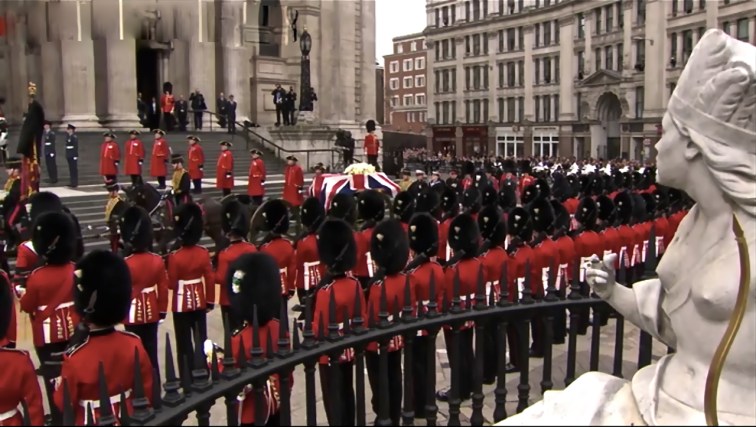
Procession arrives at St. Paul's Catherdral

Procession arrives at St. Paul’s Cathedral: the most graceful onlooker

The irresistible pull of old turf

The irresistible pull of old turf

In our age of pixels, one versatile midget-screen is worth more than cable television with two thousand and one channels on a hulking, high-definition display. This dawned on us as we said a silent, heartfelt thank-you to the BBC last week for the banner at the top of every frame of its ‘red button’ broadcast of Margaret Thatcher’s funeral: BBC LIVE. NO COMMENTARY.

Post-Gutenberg has not owned a working TV set for decades, by choice. But we were grateful to be lent one last Wednesday, hoping for deep absorption by London’s farewell to the steely, scrappy baroness, and the chance to imagine why people insist that Winston Churchill’s funeral was the most sublime, moving event in British public life in recent history. As she was accorded the military honours he was – in spite of a clinching argument against doing so by the right-wing political journalist Peter Oborne – we knew we would be observing similar, if not identical, rites of homage.

No sooner had we begun to watch the large screen than we felt irritable, as if we had ants crawling up our sleeves, anticipating the artificial voices of commentators bent on pre-digesting everything we saw. Because of these maddening intermediaries, the Beeb’s religion correspondent, Robert Pigott, would ordinarily have been quite right to say as he did – after the service in St. Paul’s – that no one outside the cathedral’s walls could have experienced the extraordinary ‘sense of occasion’ there. Yes, the talking heads have always had an annoying habit of proclaiming, ‘You really have to be here to know what the atmosphere is like’ – never acknowledging that this is at least in part because their chirping gets in the way. This time, Pigott was wrong. Possibly because his employer was savaged for its commentary on the last royal wedding, there were no all-knowing chirps at all.

In the great hush broken only by music and ceremonial words, occasional shouts of protestors, clumping horses, saluting guns, crunching military boots and church bells, any viewer of the BBC feed was free to get lost in personal trains of association — verses of hymns remembered from school assembly halls; watching someone close and dear on a parade ground when tiny; other memories and imagery. Just like anyone in the congregation. Bliss! … When we found the definition on our tablet screen crisper and truer to life than the one on the television display, we switched to viewing only the small screen.

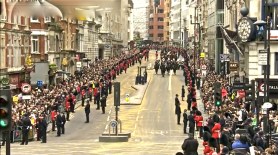
This also had something to do with seeing the procession skirt the edge of our old London neighbourhood, a street ten minutes away on foot from the flat that was home – and in a flash, realising that we could take a screen shot on the tablet computer for a personal reminder of grey spring mornings in Holborn. After that, we captured images from every angle, of every scene in the funeral service that interested us – and except for the frustration of being constrained by the exclusively horizontal orientation of the feed, were delighted by the perspectives Auntie offered us from her staggering twenty-four cameras inside St. Paul’s, alone.

We loved the active watching on the small screen, so much better for noticing. We love having our own visual records to inspect at leisure, blowing up details for closer deconstruction.

Other people probably listened to the drone of interpreters in war paint and plastic styled hair, switching back and forth between their TVs and laptops; followed the textual explanations of what we were looking at, on the BBC site, even as they tweeted reactions to their friends, and updated pages on social networking sites throughout the ceremony. And why shouldn’t they have done what suited them?

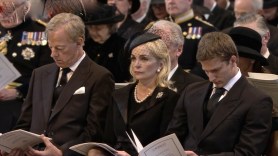
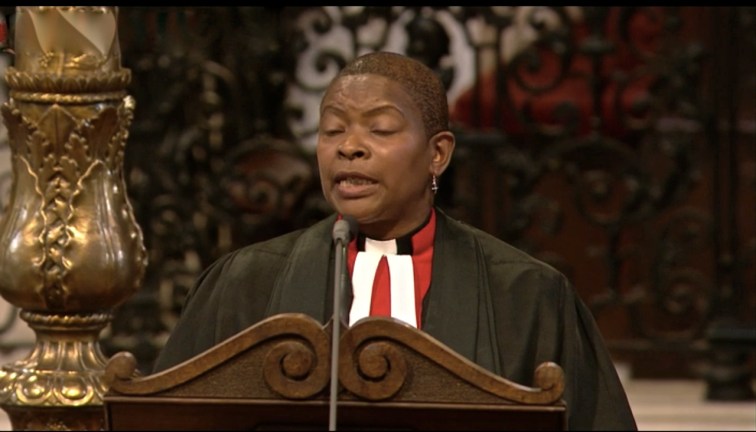
We only listened to a single stream of sounds; reflected; and made a scrapbook, from which this idiosyncratic selection of images comes – each screen re-touched to remove the BBC logo. At the funeral of Britain’s first and only woman prime minister, it was chiefly women’s faces that we found most engaging.

H.M. QE II

H.M. QE II

Mrs T's daughter-in-law, flanked her son and grandson

Mrs T’s son, daughter-in-law, and grandson

Marvellous eyebrows: the carving competes

Marvellous eyebrows: the carving competes

Young woman, officiating

Young woman, officiating

MT going where we all do -- to 'the cloud,' as the Bishop of London (not pictured) put it

MT going where we all do — to ‘the cloud,’ as the Bishop of London (not pictured) said

Cameras of every kind

Cameras of every kind

Gustave Flaubert’s multitasking score: 0 — and ‘flow,’ Mihaly Csikszentmihalyi’s secret of happiness

'Flow, don't freeze' postgutenberg@gmail.com

‘Flow, don’t freeze’
postgutenberg@gmail.com

Of all the anxieties related to the effects of digital culture on our brains – the way people reason, comprehend, do cerebral work, create and invent – the only one that we at post-Gutenberg truly share is the worry about attention. Especially, sustained attention. We have long found one facet of this – closer to immersion –  the most dependable font of happiness. It has been studied and named ‘flow’ by the Hungarian psychologist Mihaly Csikszentmihalyi, whose book on the subject was a birthday present to us from a vanished friend (Dessa, where are you?). Over to the Wikipedia:

In his seminal work, Flow: The Psychology of Optimal Experience, Csíkszentmihályi outlines his theory that people are happiest when they are in a state of flow— a state of concentration or complete absorption with the activity at hand and the situation. It is a state in which people are so involved in an activity that nothing else seems to matter. The idea of flow is identical to the feeling of being in the zone or in the groove.

Everyone accepts that our attention is being chronically, woefully, and hopelessly fractured by mobile telephones, email, tweeting, blogging, Googling, Binging (as opposed to bingeing) and so on – no matter how successful some of us are at glamorising the e-jitterbugging as ‘multitasking’.

How would a Gustave Flaubert write a novel of the depth and (depressing) intricacy of Madame Bovary? Whatever you think of the book – p-G sympathises with the critics who complain that the story lacks a single likeable or, we would say, engaging character – it probably deserves its renown, and its author his place among les immortels.

We have no answer to that question, but we do believe that no one has described the ‘flow’ state and its joys more gorgeously or entertainingly (definitively ‘over-the-top’) than Bovary’s inventor. The other day, opening our copy of The Letters of Gustave Flaubert 1830-1857 – only because we happened, for the first time for a decade and a half, to both look at and see it on its shelf, we entered a flow state ourselves, completely absorbed by the novelist’s words, beautifully translated and edited by Francis Steegmuller. The proof of the addictiveness of ‘flow’ is in these extracts, as is evidence that it is not always a picnic.

Highlights might be all most of us have time for, soon, the literary equivalent of what is well on its way to becoming the most popular convenience food, worldwide — sushi:

[ … to his friend — the lawyer-turned-dabbler/dilettante — Alfred LePoittevin; 13 May, 1845, Milan …]

You are wasting away with boredom, you say? Bursting with anger, dying of depression, stifling? Have patience, oh lion of the desert! I myself suffered a long period of suffocation, the walls of my room in the rue de l’Est still echo with the frightful curses, the foot-stampings, the cries of distress I gave vent to while I was alone there. How I roared in that room! And how I yawned! … Think, work, write, roll up your sleeves and cut your marble, like the good workman who refuses to be diverted from his task and keeps at it with sweat and good humour. … The only way not to be unhappy is to shut yourself up in Art and count all the rest as nothing. … I do not regret the absence of riches, or love, or the flesh, and everyone is astonished to see me behaving so sensibly. I have said an irrevocable farewell to the practical life. … From now until a day that is far distant I ask for no more than five or six quiet hours in my room, a good fire in winter, and a pair of candles to light me at night.

[ … to Louise Colet, a writer of recognised ability, also Flaubert’s mistress and – as most, though not all, authorities agree, the model for his tedious adulteress; 24 April 1852, Croisset … ]

… I have been in a great fit of work. The day before yesterday I went to bed at five in the morning and yesterday at three. Since last Monday I have put everything else aside and done nothing all week but sweat over my Bovary, disgruntled at making such slow progress. … You speak of your discouragement, if you could see mine! Sometimes I don’t understand why my arms don’t drop from my body with fatigue, why my brain doesn’t melt away. I am leading an austere life, stripped of all external pleasure, and am sustained only by a kind of permanent frenzy, which sometimes makes me weep tears of impotence but never abates. I love my work with a love that is frantic and perverted, as an ascetic loves the hair shirt that scratches his belly.

Sometimes, when I am empty, when the words don’t come, when I find I haven’t written a single sentence after scribbling whole pages, I collapse on my couch and lie there dazed, bogged in a swamp of despair, hating myself and blaming myself for this demented pride that makes me pant after a chimera. A quarter of an hour later, everything has changed; my heart is pounding with joy. Last Wednesday I had to get up and fetch my handkerchief; tears were streaming down my face. I had been moved by my own writing: the emotion I had conceived, the phrase that rendered it, and the satisfaction of having found the phrase – all were causing me the most exquisite pleasure. At least I think that all those elements were present in this emotion, which after all was predominantly a matter of nerves. There exist even higher emotions of this same kind: those which are devoid of the sensory element. These are superior, in moral beauty, to virtue – so independent are they of any personal factor, of any human implication. Occasionally (at great moments of illumination) I have had glimpses, in the glow of an enthusiasm that made me thrill from head to foot, of such a state of mind, superior to life itself, a state in which fame counts for nothing and even happiness is superfluous.