Proofs of concept for a keiretsu-cooperative to succeed the data collection and ad-dependent legacy publishing model— from TikTok, the online Daily Mail … and Shakespeare

By becoming a shareholder in an acting and theatre-owning joint-stock company, Shakespeare — a ‘country boy’ outsider — ‘was the first to turn playmaking into a potentially rewarding profession’ — Soul of the Age: A Biography of the Mind of William Shakespeare, Jonathan Bate

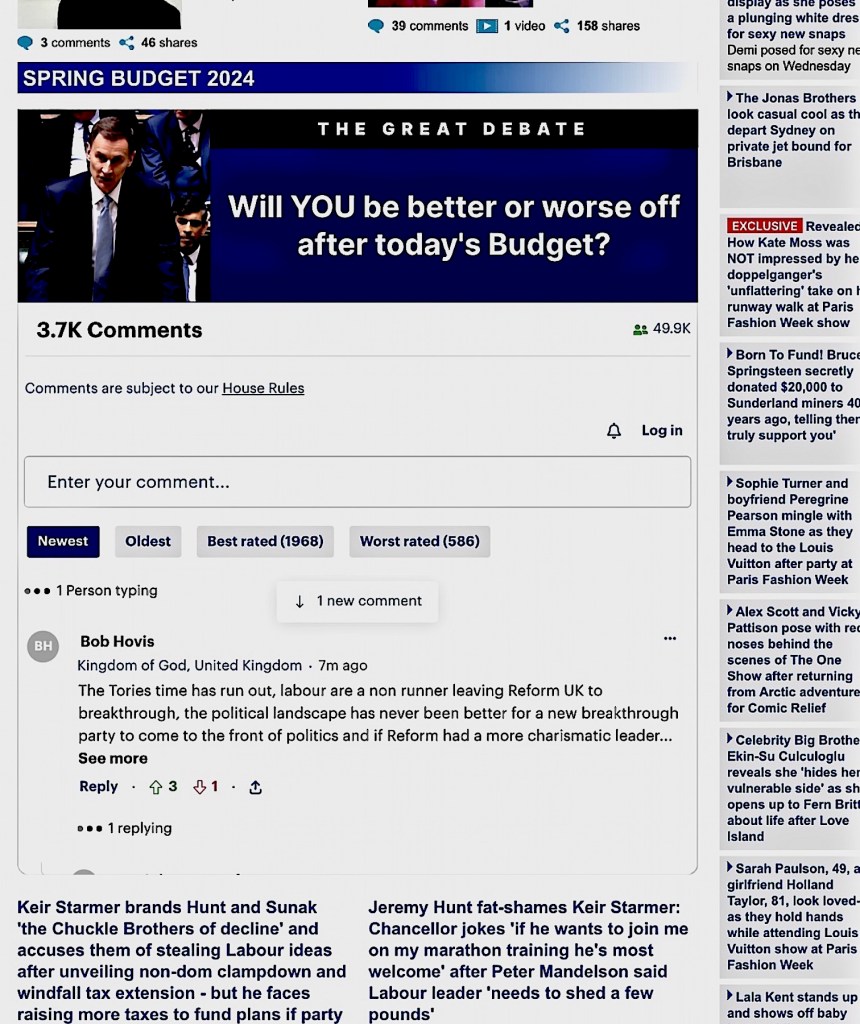
A live scroll of 3,700 readers’ comments on U.K. taxation and a comment invitation box on the 6 March home page of the online Daily Mail look like illustrations for William Dutton’s The Fifth Estate: The Power Shift of the Digital Age

Real-life counterparts of conceptions of things to come can appear in unlikely places, including some in the past. 

But, you may say — surely not the online Daily Mail coupled to the Chinese user-videos-plus-shopping platform, TikTok? Yes, and yes. But also from, of all people, the supreme William Shakespeare — or what literary experts and historians searching for the indisputable facts about his life have unearthed in recent decades. 

This improbable group answers the question of what evidence there is for the practicality of a keiretsu-cooperative to succeed the noxious advertising and personal data collection-dependent  surveillance business model for journalism and publishing. 

Though legacy media’s need for an innovative financing scheme and structure has proceeded from dire to desperate, this has somehow gone unmentioned in 2024’s mournful stream of reports about the decimation of employment in the news business. 

In noting that over five hundred jobs in U.S. print, broadcast and digital media fell to cost-cutters’ axes in January, Politico said that this followed layoffs of 3,087 in the same categories in 2023 and 2020’s high watermark of 16,060. A 5 March reminder in the Financial Times of 450 journalists losing their jobs in Britain’s dominant Reach publishing conglomerate last year — because of an advertising slump linked to a steep slide in its newspapers’ online reader numbers — was not accompanied by any discussion or speculation about ways to stop or reverse the trend. Legacy publishers exhibit no outward signs of interest in remedies except for tried and tired variations of subscription terms or experiments in taking paywalls up or down to limit what visitors to their sites can read. 

The New Year’s Day post here drew attention to the lone, faint glimmer in this doom-saturated panorama: old media managers do at last understand that reader-commenters are poised to become the core of their economic survival plans — the same people at the heart of the keiretsu-cooperative

These are the visitors — effectively, informal, indie micro-publishers — luring and engaging site traffic who in 2010 were still commonly referred to as ‘bloggers’. January’s  p-G jottings about them recorded that the business brains at some newspapers have begun to treat reader-commenters’ reactions and other ‘content’ like gold dust. As a result, some of them have begun — shamefully — to slap copyright claims with no legal justification onto those contributions from audience members, including many who are handing over cash as site subscribers.

How long is it going to take before most of them understand all the transformations underway sufficiently to see that reader-commenters are well on their way to morphing into: 

— CONVERSATION PARTNERS ON EQUAL TERMS 

or ‘interactive’ audiences who are no longer mere receivers for broadcasts by newspaper reporters and opinion writers. On 6 March, anyone popping in at the online Daily Mail would have noticed an apparent experiment — placing at the centre of its home page a blank commenting box inviting readers to have their say on the U.K. government’s spring taxation and budget announcement. 

This invitation was set in a screen within a screen with a moving scroll of other readers’ thoughts on the topic (see screenshot above, taken when the comment count had reached 3,700). 

The overall impression was of a live demo of William Dutton’s portrayals in The Fifth Estate (2023) of ‘networked individuals’ becoming powerful as ‘a new source of accountability, not only in government and politics but also in all sectors of society.’

— CO-PERFORMERS 

The online Daily Mail is the world’s fifth most-popular English language news title. It also magnetises more visitors to TikTok than any other purveyor of news on this Chinese-owned (ByteDance) social media platform where anyone can upload short videos they have made; earn cash from advertisers through product placements and promotions if they can lure enough traffic; and buy things hawked to them.

Publishing for people catching up on news where they go for relief from boredom, to play amateur auteur or entrepreneur, or to risk becoming shopaholics looks unavoidably like the future of journalism — because these people are disproportionately the youngest adults. 

In a mid-January feather-fluffing announcement, the Daily Mail Online claimed to have ‘surpassed 10 million followers’ on TikTok (estimated by backlinko.com, to have soared beyond X-Twitter, Telegram, Reddit, Pinterest and Snapchat in platform popularity measured by ‘monthly active users.’) 

The paper summed up its TikTok triumph as icing on the cake for its ‘unrivalled position as no.1 for engagement with audiences across all platforms.’ It explained that ‘[a]ccording to research by the Reuters Institute for the Study of Journalism, 20 per cent of 18-24s use TikTok to learn about current events, which was an increase of five percentage points from the previous year.’ A follow-up story in February quoted other research ‘showing that more than 40 per cent of 18-24s receive news from the Chinese-owned social media giant once or more times a day, compared with 19 per cent for the BBC, Instagram (44 per cent), Facebook (33 per cent) and Elon Musk‘s X (24 per cent), formerly known as Twitter.’

Luck being what luck is, my 2010 outline of a scheme for post-Gutenberg publishing, six years before the birth of TikTok, began:

New communication technologies have created a karaoke world. It is not just that we have the means to ensure, cheaply and easily, that—as Andy Warhol predicted— everyone could be world-famous for fifteen minutes … Practically nobody is content any more to be just a spectator, reader, passive listener or viewer. Audience participation as well as the right to talk back—which includes non-expert reviewing of works or performances by trained and seasoned professionals—have become absolutely standard expectations. 

— STAKEHOLDERS AND CO-DETERMINISTS

Few card-carrying cultural elitists inclined to shrug loftily about TikTokers earning cash from homespun, unmediated webcasting — making them de facto stakeholders in the platform’s success — will know that without the democratisation of culture in his own revolutionary epoch, we would never have heard of William Shakespeare. That man of mystery incommensurably more gifted than any other literary genius — forget TikTokers — has emerged from recent literary and historical sleuthing not as the aristocrat lurking behind a pseudonym in the centuries-old rumour, but incontestably a ‘country boy.’ 

He was ‘the grandson of a yeoman farmer and the son of a failed provincial shopkeeper,’ in his portrait by today’s pre-eminent Shakespearean scholar, Jonathan Bate, in Soul of the Age: A Biography of the Mind of William Shakespeare (2009). He got his start in playwriting by polishing the scripts of other writers while enduring mockery as ‘an upstart crow,’ a ‘rude groom,’ and a ‘peasant.’

But this book’s most unexpected revelation, for many, will be about Shakespeare’s business acumen, an asset as rare in writers then as it is now. He died a prosperous landowner at fifty-two, leaving his wife and the children he had fathered before his twenty-first birthday well provided for from his earnings as a shareholder in an acting company that operated very like a cross between an artists’ collective and a cooperative venture in our time.

Through becoming a shareholder, Shakespeare was the first to turn play-making into a potentially rewarding profession that could support a marriage and a family. His fortune was made not by a literary innovation but by a business decision. In his early career, Shakespeare would have noted the raw deal suffered by the script writers, who were paid only a few pounds per play. The serious money was made by manager Henslowe and lead actor Alleyn, who ran the Rose Theatre as an entrepreneurial partnership. Shakespeare and his close associates came up with an alternative arrangement: the Lord Chamberlain’s Men was formed in 1594 as a joint-stock company, with the profits shared among the players.

What could have been the equivalent of reader-commenter power for Shakespearean audiences? 

The 20th-century historian John Hale has shown that unlike the ‘patron-fostered painters of Italy, the Low Countries and Germany,’ the Bard ‘was reliant on popular support, as were his fellow playwrights.’ Their works and the venues for their performances were part of a democratically inclined ‘theatrical machinery that both responded to and increased the number of spectators and dramatists.’ Another impression from reading The Civilization of Europe in the Renaissance is  of how uncannily today’s social media frenzy resembles the explosion in early 17th-century mass entertainment in London:

During the boom period of new plays, 1600-10 … the places available each year in the commercial theatre, discounting Sundays and Lent, may have topped a staggering two million when the population of London was two hundred and fifty thousand. Never before in Europe had there been so heavy a vote of confidence in a single form of cultural activity.

In another prefiguring of the present, Civilization shows the joys of expanding free expression for playwrights soon proving to be too much for the authorities:

Altogether the appetite for theatrical dialogue and effects was so constant as to enable a playwright to indulge his own aspirations short of flagrantly inviting political and religious censorship; bawdiness was let slip with a shrug, a contributory reason for the Puritan criticism which led eventually, in 1642, to the order that the theatres should be closed altogether, an order honoured almost as much in the breach as in the observance.

Some of the Puritans especially disgusted by their inability to control this tide in public affairs presumably let a different one carry them away to found a new colony on the other side of the sea. But here we are now, being reminded that the most satisfying narrative arcs can turn out to be circles. 

The keiretsu-cooperative seems to rhyme naturally with what has gone before, not just with what will or should be.

The let’s-hear-from-everyone media revolution needs Elon Musk as much as he needs Twitter. His guides would be Robert Oppenheimer, Michelangelo and King Crimson


Should Elon switch species to a different, less complacent-looking bird for Twitter?


Musk focuses on what intrigues him as intently as a foraging woodpecker. He is studying an antique Samurai sword here during a 2018 podcast interview with Joe Rogan

[ 14.10. 2022 A quotation of an article on the Intelligencer site has been corrected for errors of transcription. ** ]

There could be no one better equipped to run Twitter for the public good than Elon Musk. Not that the link between past and present evidence of this is obvious. His exploits in space transport and electric cars have virtually eclipsed his beginnings as a pioneering new media entrepreneur. Riding on the slogan ‘We Power the Press,’ his maiden venture, Zip2 — a collaboration with his brother Kimbal — sold specialised software that helped US newspapers to dip their toes in the internet in 1995. Customers included The New York Times.

At the end of last month, a quarter-century later, Musk restored uncensored internet access to Iranians being blocked from posting, for instance, video records of police brutality. Deploying satellite technology in an unexpected caped-crusader move on their behalf, he created a communication alternative for citizens fighting steadily tightening state control through surveillance and personal data collection tied to digital identity cards unavoidable in using public health services, or buying rail or plane tickets.

Musk, more than any other technologist or legacy media operator, could engineer exactly the right transformation of mass communication. This will mean letting unmediated and dissenting voices compete with legacy publishing on less unequal terms without destroying what is best in the Fourth Estate tradition — a balancing act that is a crucial preoccupation of this website.

Musk could actually reshape Twitter expressly to democratise media, as he said he hoped to in April:

Having a public platform that is maximally trusted and broadly inclusive is important to the future of civilisation. […] Twitter has become kind of the de facto town square … It’s really important that people … are able to speak freely, in the bounds of the law.

He could supercharge the evolution of the complacent, smug-looking Twitter bird into an energetic woodpecker pecking apart any anti-social old media cliques, and disrupting their instinctive, tacit collusion — rather than active conspiring, I suspect — in only informing the public about what suits their interests and those of their allies and financial supporters, which now include Big Tech.

The scheme for phasing out the advertising-centred ‘business model’ for publishing with which this  post-Gutenberg.com (pG) site began eleven years ago aimed to correct that unfortunate tendency towards centralised control and throttling freedom of expression.

Unlike some high-profile attempts at new media creation — for instance, Truth Social and WT Social, started from scratch by a former U.S. president and a Wikipedia co-founder, respectively, at opposite ends of the political spectrum — pG’s proposal of a hybrid keiretsu-cooperative structure would grow new branches and leaves on existing rootstock.

Any significant transformation — however sensitively designed to calm the loss-of-status anxieties of old media — has to be led by an extrovert able to take it from a blueprint to a practical solution for the 21st century. That is certainly not this writer. I was surprised when certain reflexively sceptical thinkers approved of the keiretsu-cooperative’s logic instantaneously, when I sketched its outlines for them in December 2009. I was dispatched to William Dutton, the founder-director of the Oxford Internet Institute, who invited me to set down my proposal for publication as a discussion brief at the start of 2010.

In 2022, the ideas it blends together turn out to be remarkably like those of Elon Musk and some of his keenest supporters — notably, Mathias Döpfner’s. He is chief executive and part-owner of Europe’s largest mass media conglomerate, Axel Springer SE. In March, he texted Musk to say —

Why don’t you buy Twitter? We run it for you. And establish a true platform of free speech.Would be a real contribution to democracy.

Here are four reasons why Elon Musk could succeed in turning Twitter into something like a keiretsu-cooperative. They might seem a little odd, at first glance:

1. What physicists know about the foundations of the material world — in particular, ‘wave-particle duality’ — supports Musk’s belief that Twitter should be the equivalent of a town square equally open to voices from the political left and right

This correspondence between basic physics and politics occurred to Robert Oppenheimer — the so-called father of the atomic bomb — in the middle of the last century. It would be surprising if Musk, who studied economics and physics at university, did not know about the parallel he drew. 

A British physicist and decoder of Oppenheimer’s thinking, Brian Cox, has testified to the mental struggle of physics undergraduates confronting the bizarre truth that a single atomic particle at the core of seemingly solid material reality sometimes resembles a tiny billiard ball or marble; at others, is most like a water wave on the surface of a pond: ‘Neither description of it is absolutely right or absolutely wrong. They are both necessary.’ 

Just as fundamental science rules out absolutism, Cox has explained, Oppenheimer believed ‘it also has no place in politics or human affairs. It is a dead end.’ The American physicist-philosopher arrived at this conclusion in grappling with the dire, incommensurable weight on his conscience of the destruction of Hiroshima and Nagasaki. Recognising that he had given politics and politicians the power to blow up the whole world, he called for rejecting You’re either for us or against us absolutism in favour of complementarity

Almost like a poet, the exceptionally well- and widely-read Oppenheimer spoke in 1953 of ‘the life of the human spirit’ far more abundant than the ‘wealth and variety’ of physics or indeed all the natural sciences; ‘enriched by complementary, not at once compatible ways, irreducible to one another,’ and even so, part of ‘a greater harmony.’ 

2. Musk understands the new media platforms thoroughly from a user’s perspective — and is clearly addicted to Twitter, to which he could owe the vastness of his fortune 

A thoughtful long article on Intelligencer asserts that cannily calculated, massively escalated tweeting has been explosively enriching for him. Though he could be short-changing the Tesla chief’s engineering instincts — possibly, genius — the profiler, Lane Brown, is at least semi-persuasive when he says,

It’s hard to fathom how somebody could make more money faster than anyone ever has by tweeting, yet that’s pretty much what happened: A carrot was dangled, and Musk, likely figuring he would never reach it on the basis of such old-fashioned metrics as quarterly earnings, yoked Tesla’s stock to his Twitter feed and went goblin mode. A little like when Neo from The Matrix realized that reality was a mirage and therefore he could do kung fu without any lessons, Musk intuited the illusory nature of the stock market and social media and ran up a new all-time-high score. If Tesla might have been a $300 billion company under a generic Silicon Valley CEO, it was a $1.2 trillion company with the guy who turned it into a product cult.

3. He could afford to be one of those great revolutionaries who succeed wildly before they fail — on their way to a possible, grand, posthumous triumph 

For example: Einstein, much-quoted for saying that most of his ‘intellectual offspring end up very young in the graveyard of disappointed hopes.’ Long after he won the 1921 Nobel physics prize, he never stopped producing them and on the day before  he died in 1955, was still on his famous thirty-year quest for a unified theory capable of combining electromagnetism and gravity. 

Another example: Michelangelo. He could have luxuriated in retirement after his David and Pietà won him his place in sculpture’s firmament. He continued to hammer out new marvels instead, decade after decade, and spent seventeen of the last twenty years before his exit in 1564, aged eighty-nine, going full-tilt at his supreme accomplishment — the dome of St. Peter’s Basilica in the Vatican. He did that keenly aware that he would never see it in limestone, in its finished state. 

It would of course be better if Musk succeeds in his lifetime, but the worst case always bears thinking about.

4. Improvisational — like quicksilver, various, and adaptive — is a quality Elon Musk shares with cerebral-danceable progressive rock (prog) bands such as King Crimson in its earliest (mid-‘70s) incarnation 

It is a characteristic indispensable to successful new media management. 

To observers, Musk’s work and private lives look overwhelmingly chaotic. He already has his (tunnel-)Boring, Neuralink, SpaceX and Tesla companies competing for his attention, with regulators and packs of lawyers — in addition to his nine children and their three mothers; and past and present girlfriends. But this existence that few of us could tolerate for a week is a lot like prog, whose fractured and broken, jazz-like surfaces sound annoying in early encounters, until that breakthrough day when the listener perceives the serene, lush underlying harmonies borrowed by its most gifted musicians from modern classical music. 

‘All barricades are down with King Crimson but mayhem does not result,’ a New York Times reviewer remarked in 1973, after noting that the group ‘gallops into the neoclassical, pulls sharply back into rock, indulges in some just plain pretty music […] changes tempo and mood and comes up with some quirky surrealism in the lyrics.’ 

No matter what turbulence is roiling his families and companies, Musk himself seems to pile up impossible achievements steadily, relentlessly and, it must be said, bafflingly. It’s as though his mind has mysterious underlying harmonies in its depths.

Perhaps this natural sympathy between him and Crimson could encourage him to learn from a legend in prog history about the virtues of staying buttoned-up, at the right time — curbing his tendency to speak and act on impulse, for which his critics lambaste him mercilessly. A tender, exquisitely poignant improvisation for a quartet — ‘Trio’ on Starless and Bible Black — was recorded with only three actual players. 

Every time the drummer, Bill Bruford, wondered whether it was time for him to join in, he sensed that he would be messing with perfection. For never once uncrossing his drumsticks from over his chest for the entire session, his band-mates rewarded him with a co-writing credit for ‘admirable restraint.’

If the reports leaked in May about Musk’s plans for Twitter are reliable, they include halving the platform’s dependence on advertising for revenue, and introducing monthly user subscriptions to replace the lost cash.

Let us hope that he can do that as a first stage in the reinvention of media. 

How far will he go? 

A far-sighted text to him earlier this year from his friend Jack Dorsey — the Twitter co-founder who became estranged from his creation — said, in part:

Yes, a new platform is needed. It can’t be a company. That is why I left. … It can’t have an advertising model. Otherwise you will have surface area that governments and advertisers will try to influence and control.

** Huge thanks to John Logan for spotting my confusion of billions and trillions, and misspelling of kung fu. 

Leveson hearings: can a ‘blind and unreasoning’ or partisan press censoring citizen-journalists be good for democracy?

obscurity - postgutenberg@gmail.com

[ Addendum, 23 February:

Although The Guardian has unquestionably deleted courteous posts about proposals for press reform and media evolution from the Comment-is-free section of its site, as recorded on this blog on 7 November and 15 November, I might owe that newspaper an apology for suggesting in the entry below that its moderators broke links to post-gutenberg.com posted on its site in January. Please see the footnote** for details.  ]

A remarkable statement went unnoticed by the few commentators on a morning of superb theatre at the Leveson hearings on press practices, culture and ethics in Britain on 31 January.

As noted earlier on this blog, press coverage of the Leveson Inquiry has been scant. It has focused on tabloid phone-hacking and emphasised paeans to press freedom by well-known witnesses, but under-reported criticism of the media (for instance, the excoriating but mostly well-founded testimony of the former journalist and prime ministerial communications adviser Alastair Campbell.)

Giving evidence last week, Christopher Meyer, the former chairman of the Press Complaints Commission – a body roundly criticised for being too close to newspaper editors to handle accusations against them objectively — said in a fleeting aside that the press is free to be partisan in a democracy. He said that as if stating a self-evident truth, accepted as such. I could not find any record of his remark in the transcript of the proceedings, but there was this exchange between the ex-chairman and his surgically incisive interrogator, Robert Jay QC.

Q: … I think the point you’re making there is that the press is free to comment and be partisan and it’s not the role of the PCC in a democracy to seek to curb that democratic activity?

A:  Yeah, that’s fair enough.

That could stand as a marker for the extent of the shift from the last century’s ideal of a neutral press to one in which the media openly take sides – or, as The Economist put it last July, are becoming ‘more opinionated, polarised and partisan’.  Not the faintest note of doubt intruded on the former PCC chairman’s declaration or confirmation of his position on partisanship, even though media bias is not what the public wants, if we can take as representative the 73 per cent of 2,700-odd Economist readers who have so far voted ‘yes’ in answer to the question, ‘Should news organisations always remain impartial?’. Bias has rightly been worrying experts like this political scientist, who asked in 2010 on ‘a plain blog about politics‘:

Will we have a robust, vigorous, and almost completely partisan press?  Will there still be a place for neutrality?  How will this play out for state and local politics?  What kinds of norms will the partisan press develop?

Some of us who have noticed the British and American press grow more aggressively one-sided in recent years cannot help wondering whether that has meant getting fewer of the objective reports and facts that a democracy needs to make good decisions about policies and politicians.

Partisanship is disturbing in itself, when you consider the dictionary definition of ‘partisan’ as ‘adherent, esp. a blind or unreasoning adherent’ (Chambers, 2006).  How can it be consistent with this classic list of guidelines for journalists doing their ‘duty of providing the people with the information they need to be free and self-governing’ – from Bill Kovach and Tom Rosenstiel in The Elements of Journalism:

1. Journalism’s first obligation is to the truth.

2. Its first loyalty is to the citizens.

3. Its essence is discipline of verification.

4. Its practitioners must maintain an independence from those they cover.

5. It must serve as an independent monitor of power.

6. It must provide a forum for public criticism and compromise.

7. It must strive to make the significant interesting, and relevant.

8. It must keep the news comprehensive and proportional.

9. Its practitioners must be allowed to exercise their personal conscience.

Some of us have noticed ways in which partisan has begun to mean punitive – as in censoring healthy disagreement and opposition.

If we accept that a newspaper has the right to push a particular agenda at us, does that give it the right to stifle dissent about that agenda – from, for instance, citizen journalists, which all of us become when we react to articles in the comments sections of the online press? Moderators at online sites attached to famously liberal and left-wing mastheads unhesitatingly delete comments that challenge the biases of those newspapers, even when phrased cautiously and politely. (See ‘Why is The Guardian censoring debate about press reform and ignoring the Lord Chief Justice’s endorsement of citizen journalism?’)

There is proof that I am not alone in wondering about this in the Wikipedia entry for ‘Media democracy’ – a concept that elicited a curious response from an editor at the New York Times, mentioned in this spot last month.

The concept of “democratizing the media” has no real meaning within the terms of political discourse in Western society. In fact, the phrase has a paradoxical or even vaguely subversive ring to it. Citizen participation would be considered an infringement on freedom of the press, a blow struck against the independence of the media that would distort the mission they have undertaken to inform the public without fear or favor… this is because the general public must be reduced to its traditional apathy and obedience, and frightened away from the arena of political debate and action.

Addressing the Alpach Technology Forum in Germany last August, William Dutton, the outgoing director of the Oxford Internet Institute, identified ‘Journalists and the Mass Media – imitating, co-opting, competing,’ as one collective enemy of  the 5th Estate, which includes citizen-journalists. (See ‘The Future of the Internet for Networked Individuals of the Fifth Estate’.)

If not for Justice Leveson and his supremely necessary investigation, I might have been depressed by the results that came up when I typed into search boxes the once-hallowed phrase, ‘Without fear or favour’. It encapsulated a consensus among the most admirable practitioners of journalism about the importance of rising above partisanship.  When I used the English spelling of the word ‘favour’, the first Google results page brought up scarcely any links to sites unconnected with Africa, New Zealand, Australia or Malaysia. With American spelling, dropping the ‘u’, the first page of findings did supply links to sites related to the U. S., but too few of them led to anyone expressing the outrage about the increasingly hollow sound of those words that I had hoped to see.

A press that no longer sees neutrality as essential to democracy in the west would explain why some of us have been given our first visceral impressions of what samizdat resistance under the old Soviet Union felt like, as commenters repeatedly censored – improbably enough – by The Guardian, a standard-bearer for liberalism.

Since I published these posts deleted by that paper on this blog on 7 November and 15 November, interference with my comments appears to have turned covert.

In the last two weeks, every link to this site posted in comments there has been broken either by Guardian moderators or by some profoundly mysterious line of rogue code in the newspaper’s software. (Anyone curious enough to run a paranoia test can search on  ‘CheryllBarron’ beneath Peter Guillam’s contribution, ‘The capitalism debate is anaemic – it must dig deeper‘.  Compare the results from pasting the URLs I have posted there into your own browser with clicking on the same URLs on the Guardian page – which only leads to variations of ‘Oops! Page not  found’.)

‘Censor’ is a word that came to us from the Roman Empire – although it mainly alluded to a lofty being entrusted with conducting the census and guarding public morality. ‘Censorship’ was a novelty that the Gutenberg press spawned. As the historian John Hale has explained,

It was in Germany, where printing was pioneered, that censorship was first introduced. In 1475 the University of Cologne, jealous of the freelance expression of ideas, obtained from the Pope the right to grant licences for the publication of books and to punish those who published or read unauthorized ones.

[…]

By [1515] the flood of books and the realization that a new, less instructed and more excitable audience for them was being reached, moved a number of European secular authorities to insist on manuscripts being submitted to them before printing.

Who could have predicted a punitive partisan press being allowed – so far – to get away with silencing democratic opposition in our own media revolution, five centuries later?

______________________

** Links to post-gutenberg.com yielding a ‘not found’ notice

Since I reported on what appeared to be a novel form of censorship, I have discovered the identical problem on this WordPress site. Something has been – inconsistently – inserting an extra ‘http’into texts of mine where there should be only one in each URL, with results like this (the unwanted duplicate is highlighted in bold):

This curious repetition disables the link. A technical support specialist at WordPress has so far been unable to trace the trouble to its source – or explain it.

Until the investigation is concluded, I feel I owe The Guardian the benefit of the doubt – and an apology for an unjust accusation.

I hope to know more soon.

Stieg Larsson, 5th Estate forerunner, marginalised as a media critic

As a storytelling campaigner, Stieg Larsson puts Ayn Rand in the shade. Never mind that there was a time when only the Bible outsold her Atlas Shrugged. Though their diametrically opposite political affiliations would have made them furious about being mentioned in the same sentence, I suspect that they would have been equally enthusiastic about the possibilities of post-print publishing. Would they have had an easier time with the layout software I am still learning to use? Reader: please be patient with my M. C. Escher-esque menus and attempts at tables of contents as I await answers from helpers.

We of the 4th Estate, offspring of the Gutenberg press, are certainly using the internet. Nearly every print newspaper has a web site. But we are doing our best to downplay the shift in power to our successors in the 5th Estate, when we should – surely – be reorienting publishing to reflect it, to the last serif and pixel.

Networked individuals are becoming an independent source of social and political accountability – a Fifth Estate […]. The crowd has become an independent power – even independent from the press.

Until last month’s interview in Spiegel Online, practically no ranking newspaper or magazine had ever mentioned the 5th Estate or William Dutton, the founding director of the Oxford Internet Institute*, which has a celebration planned for its tenth birthday later this month. Those are his words – published in a 2007 paper – I have quoted in that clip. Although his term for the power shift is short, snappy and a perfect encapsulation of the internet’s implications for journalism and publishing, the mainstream media persist in referring instead to the rise of ‘the blogosphere’ – with its connotations of unwashed and unlettered barbarians at the gate. That is a remarkable mischaracterisation, considering that the most distinguished professionals who care about social justice – and many of those who do not – are present somewhere on the net.

4th Estate faces are also being averted from the most important reason why 50 million readers around the world have made Stieg Larsson and his Millennium Trilogy a posthumous publishing sensation. He was writing closely fact-based social and political criticism – set in Sweden, but applicable everywhere – cleverly disguised as Scandinavian-noir thrillers.

Last year, in a New York Times review, Michiko Kakutani did briefly mention that Mikael Blomkvist, the hero of the series, is driven by ‘a moral imperative […] to slash away at the tentacles of governmental, corporate and judicial corruption that he sees strangling the country.’ But most of her paragraphs focused on a single character, the beguiling, computer-hacking vigilante and anti-heroine, Lisbeth Salander. Just as I was, in my initial reaction to Larsson’s saga, Tim Parks – writing in the New York Review of Books in June – was most struck by its implications for sexual politics. Only near the end of his essay, almost as an afterthought, does he say that it is ‘the ingenuousness and sincerity of Larsson’s engagement with good and evil that give the trilogy its power to attract so many millions of people.’

Respected old media commentators have chosen to overlook what Eva Gabrielsson, Larsson’s partner for three decades, points out in Stieg and Me:

The Millennium Trilogy accuses the media of gradually abdicating their responsibilities towards society throughout the 1980s and 1990s. Investigative journalists had turned away from social problems, and financial journalists treated CEOs like rock stars …

That was the Larsson message that most impressed me, because of events dominating the news, when – with a belatedness that would do Rip van Winkle credit – I finally discovered who he was. In July, The Girl with the Dragon Tattoo had caught my eye when I raced into my library to find something to listen to on a car journey of seven hundred miles. I was stunned by the parallels between the targets of his wrath and the lesson for us all at the heart of the London phone hacking scandal: you cannot be paranoid enough about the abuse of power at the top. As William Dutton would put it to Spiegel, in discussing the internet’s usefulness for initiating political movements,

We can see that, for example, in the scandal over Rupert Murdoch’s News of the World — which is absolutely stunning stuff. There had been rumors for years over people hacking into private voicemail, but no one had seriously examined the issue. The media had become too entangled with politicians…

A few days earlier, David Carr concluded a stirring NYT column on the subject by observing that, on the net,

… social media had roamed wild and free across the story, punching a hole in the tiny clubhouse that had been running the country. Democracy […] has broken out in Britain.

A long hop and skip from Fleet Street, Larsson’s career and his stories add up to recursive confirmation of the 5th Estate’s power to give a voice to those shut out by its predecessor; people who might have something important to tell us.

Denied a place in a Swedish journalism school, according to two chroniclers of his career, he was forced to enter publishing as ‘a graphic designer’. Eva Gabrielsson says that even after he was allowed to make journalistic contributions at the Swedish news agency that employed him for twenty years, he was repeatedly rejected as a fully-fledged journalist with the explanation that ‘Stieg Larsson cannot write’. She hints that his refusal to give up came from his identification with the grandparents with whom he spent his early childhood, who did not meekly accept being marginalised as poor rural folk.

He co-founded Expo, an activist magazine that hobbled along on a shoestring budget, to get the stories he thought important into the world. Though major media – certainly in the English-speaking world – have failed to react to what he revealed about their failings, then and now, his books have let him say what he felt needed saying without their help.

Larsson died of brutal overwork that had led him to neglect his health, and perhaps of the exhaustion peculiar to lonely, extended struggles for causes with insufficient moral or financial support.

Surely the vast audience his work found after his death can – and must – help to ease the path of excluded writers like him.

Restructuring media for the 5th estate would be a good start. My own tentative proposal for an experiment in re-arranging media ownership was written after a rare Whitehall mandarin with a practical streak judged the scheme workable – if a bit outlandish, at first glance – and sent me to the Oxford Internet Institute. He guessed – correctly – that I would find sympathetic listeners in that spot. You can read, at no cost, not just about the scheme, but frank commentaries on it from four publishing luminaries here, as well as a summary, on this very site.

The proposal is crying out for help with refining its details. Reports from readers of anything closely resembling it being tried out – or that have been attempted elsewhere – will also be welcome. Messages to postgutenberg@gmail.com, please.

Cheryll Barron

* … admittedly, one reason for this failure could be summed up in the reaction to news of the OII’s existence from an American friend who was a student at Magdalen in the 1980s: ‘Is there really an Oxford Internet Institute? They were still working on plumbing and electricity when last I checked.’ To which the director’s swift response – after I pasted the remark into a note to him – was: ‘Thanks, but we were the first university with a printing press.’