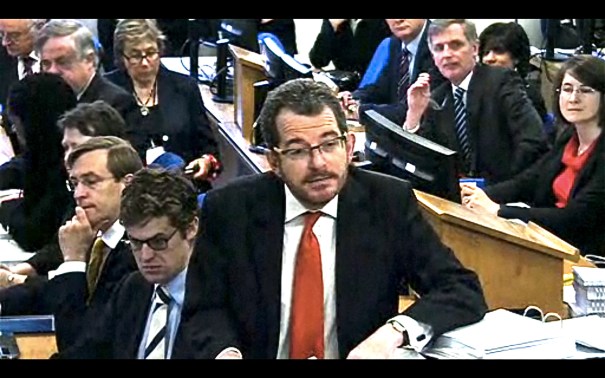
Quiet levity at ♯Leveson, and some thoughts on the film version of the Inquiry for Robert Redford’s scriptwriter

Leveson’s subtle cerebral swordsman, Robert Jay QC:
is he Hollywood material?

Robert Redford in 1976, playing
the Watergate reporter-hero
Bob Woodward.
Photograph: collectorsshangri-la.com

Nowhere in the commentary about the winding down last week of Part 1 of the Leveson Inquiry into press practices have we seen the lines we expected some old print publication or other to throw in for leavening. Only in the blogosphere have we found mentions, in this context, of …

You cannot hope to bribe or twist

The honest British journalist

But seeing what the man will do

Unbribed, there’s no occasion to.

There are minor variations of those four lines in circulation. They are the wittiest and best-loved summing-up in verse of the British tradition of journalism – at its best, still the world’s finest, in our opinion, which might have been influenced by sprinkling with  baptismal water in this branch of the craft. Long before then, the poem was on a page of a school poetry textbook to which some of us, at post-Gutenberg, often turned for relief from galumphing deconstructions of poems unfortunate enough to have been put on the syllabus.

Will Robert Redford find a way to include Humbert Wolfe’s 1920s quatrain in his script — if there is any substance in the speculation about him giving Leveson and the phone hacking scandal the Hollywood treatment? A Redford film about the Inquiry — showing us what an outsider makes of the Icelandic saga it has become — could be a treat. A clip from a BBC interview with the actor-director in April is irresistible. His tone becomes wondering, almost awed, answering a question about his impressions on a first visit to London for 30 years:

I come here and I watch the Leveson Inquiry. And whatever’s going on — I’m sure there’s some savage stuff going on — but it’s done in such a dignified, calm, graceful way that I think, gee! this is really fascinating. Somebody’s killing somebody, here, but you’d never know it.

Italian-born Humbert Wolfe
wrote the most famous poem
about British journalism.
Photograph: National Portrait Gallery

The poet Humbert Wolfe also had a stranger’s acute powers of observation. He was born in Milan. His mother started life as Consuela Terraccini. His pen strokes captured the journalism and journalists of his adopted country while he worked at a day job in its civil service.

But even if one of Redford’s most famous roles was in All the President’s Men (1976) — playing the Woodward half of Watergate’s heroic ‘Woodstein’ partnership at The Washington Post — it is not the British press but the lawyers and gracious conventions of British law in action that captivated him. At a press conference on the same trip, a reporter asked if he was watching the proceedings and ‘hoping for the return of proper investigative journalism’ – following his complaints elsewhere about the increasing ‘triviality of media’. He replied:

I’ve been very impressed with the dignity and elegance with which the process has gone forward. People take their time speaking. And in my country, things have become so accelerated and … so hyped up. … It’s sad for me to see because it blurs this more important part, which is, where are we going to find the truth? The democratisation of the internet has actually made truth harder to find — along with its positives.

Somehow, that vital qualification of his disappointment with democracy on the net was dropped from the Independent’s report of his remarks, with no indication of any omission. That paper, like the other broadsheets, never stops copying King Canute straining to command the sea to roll backwards – in its case, the evil digital sea of change obliging the 4th Estate to share its megaphone with new rivals.

Actually, Lord Justice Leveson and his chief counsel for the hearings, Robert Jay, have often struck post-Gutenberg as a brilliant pairing. In their uncannily well-coordinated forensic interrogation, they function like a legal Woodstein – even if not technically working as partners but in their distinct and separate roles. The background to their bravura performance could be an engaging part of the story, whenever Redford or someone else digs into it.

Admittedly, that is most likely to be a someone else – since the cinema only rarely conveys intellectual, as opposed to emotional, subtlety and complexity. Just as nearly every film ever made about the lives of artists and writers has failed to illuminate the mechanisms of their creativity, let alone uncover its secrets, there seems little chance of the cinema tackling judicial tactics and strategising of the highest sophistication.

Unless the presiding judge or some other senior member of the Inquiry’s legal team writes a completely frank account of its hidden dramas, there is just as little hope of our learning any details of the hearings’ behind-the-scenes manoeuvring – the pressure from vengeful old 4th Estate tigers distraught about the prospect of their de-clawing; the wily manipulations of politicians. We can only discern their effects – in, for instance, the ever more drawn and tired face and hoarse voice of Leveson LJ, in the concluding weeks of Part 1.

Would a Redford film explain the sort of thing keeping us hugely amused at post-Gutenberg? – the private joke we read into the judge thanking ‘the press who have reported on the inquiry, for keeping everybody informed,’ which made broadsheet headlines. Taking what he said strictly at face value (Lord Justice Leveson ends Inquiry by thanking journalists), those news reports missed his point entirely. To grasp what Leveson LJ was actually saying, you would have to know about this exchange between him and the admirably non-partisan Peter Oborne, chief political commentator at The Telegraph — and by far the most enlightening and accurate senior journalist testifying at the Inquiry:

P.O. : … [T]he reason why rival newspaper groups were unwilling to report phone hacking […] It’s only my views as an informed spectator, that … there was a reluctance of one newspaper group to embarrass another.

LJL : … If that is so, is that inevitable?

P.O. : I don’t know if it’s inevitable or not, but it has been a very, very — it has been a feature … [A]nd I think it’s been weakened a little bit, or even quite a lot, by blogs, and Private Eye has played a fantastically important cleansing function in the last 30 or 40 years. […M]aterial which has not found its way into mainstream publications has found its way into Private Eye.

LJL : Private Eye has also been publishing during the course of this Inquiry what the newspapers don’t publish. In other words, they’ve gone through a number of stories and said, “Actually, it’s rather interesting that this story appeared in this paper but it didn’t cover another aspect.”

Had the judge not been teasing huffy 4th-Estaters for their selective and misleading reporting on his hearings, he would have thanked all reporters and commenters – including bloggers, whose legitimacy and importance he has scrupulously underlined.

On that subject, we have a message for Robert Redford.  It is only because of the internet’s democratisation of the media that post-Gutenberg learnt that he acknowledged the constructive aspects of the rise of the net, even as he blamed it for the growing scarcity of good traditional journalism. As we have already noted in this entry, The Independent only printed the portion of his remarks that suits its agenda. But, thanks not only to a BBC video but a YouTube clip from his London press conference, we could all watch him speak his unedited thoughts and interpret them for ourselves.

And that is just one more tiny scrap confirming that expand and include; don’t compress and exclude should be the principle directing anyone powerful who has a say in shaping the media’s future – for reasons we recently explained here.

A poetic boatload of words and a foretaste of e-publishing as bringer of light and joy

Cover drawing by Sascha Juritz
What matters most is what you make
Roy Eales
Blackbird Editions, Pawel Pan Presse, 2004

Sit up and pay attention, all you change-resistant bookworms who see no good in e-publishing; nothing but the prospect of avaricious conventional publishers charging readers more than once for the same text repackaged in different media – and witless self-publishing writers drowning us in e-drivel.

This week, post-Gutenberg offers word nerds everywhere an example of the littérature-sans-frontières that the net could – will – soon give us as a matter of course. Undeniably, no e-book could replicate the pleasure of handling the slender volume printed on luscious, textured paper from which our extract comes. Never mind, read on. See proof in many dimensions of how the net could – conceivably — help to save literary culture.

These poetic, fanciful lines with something critical to tell us about real life are introduced by their writer, Roy Eales. In his book What matters most is what you make (2004), they appear translated into Breton – the language of the French province of Brittany – as well as in French and German, alongside the English original. (Only the second translation is reproduced here, but we hope to find time to transcribe the other two.)

Roy is a fine, original, unpredictable and unclassifiable English writer and poet living in Brittany who was made a Chevalier des Arts et des Lettres by official France in 2004. He is that rare scribe not born a ‘digital native’ who has leapt from print-only to blending literature with other art in readings of his work interwoven with musical performances by members of his group. A selection of his poems in five languages has been recorded on a CD, ‘Just in Case’ by Roy Eales and his friends (2010), with original music by artists in Brittany and Wales.

Beneath Boatload, on this page, is another excerpt from the same book– the first verse of a wicked, delicious, posthumous tribute to Sascha Juritz, the artist and friend whose drawings accompany Roy’s poems, prose meditations and vignettes.


.

.

A note from Roy Eales:

.

A boatload of words came to me in the middle of a night sometime in late 2003. Legend, mythology, mystery abound in Brittany, Bretons and their literature, and I searched for something satirical in which I could use these elements to castigate the French, heavily, for their stern, backward attitude towards other languages in their national space, and to challenge the Bretons, lightly, for not fighting back enough.

[ from the book’s introduction: ]

Boatload and the other poems in this book were dedicated to Sascha Juritz, brilliant artist, my friend and publisher of this and other books over the years. He died in 2003 as this book with his exquisite drawings was being published. He saw Brittany as a twin for Lausitz, his own Slav country locked into the Czech and Polish borders and colonized by Germany some centuries ago as independent Brittany was by the French. Like the Bretons, the people of Lausitz have sought to protect their culture and language despite the inevitable forces to conform to the ‘master’ French and German cultures and languages. 

.

[ If you are reading this on the blog’s ‘front page,’ please click on the title of this post to be taken to its own separate part of the site to read the following words set out as they are meant to be. WordPress’s automated layout software tends to destroy certain types of special formatting, such as spacing for poetry. ]

.

A boatload of words: a fable for Brittany

.

At an old port in Brittany a man wearing a peaked black cap was

leaning on his right leg staring capital in the face.

.

He turned his head and swivelled on his left leg to an alternative

position, and rested there on his right leg again.

.

He lit his pipe and told a tale. This is what happened.

.

One cold winter morning at the same port a black seabird

perched on his shoulder and told him in Breton that a huge boat

heaving off Brittany on a strong Atlantic sea had been wrecked

by a mutiny – of its cargo – a boatload of words, in fact, the entire

vocabulary.

.

The black bird twittered, in revealing that the words were to be

dumped at sea, three miles out, in black stranglehold sacks stamped in

red: SUPERFLUOUS, by order of the Ministry of Absolute Control.

.

Naturally, the words didn’t like this. They had been beaten before,

but never, so overtly, threatened with extinction.

.

In a mighty speech, Gwendal, their leader calls for a rebellion, and

draws up a plan. The cleverest words would free everyone, and the

heaviest words would sink the boat. Then all the words would float

back to their homeland.

.

Seabirds flying over the boat learnt secretly of the plan from the words,

who asked them to speed messages in Breton back to the people.

.

So the news spread quickly across Brittany, and soon all the shoreland

bristled full of music and people, dancing and singing, facing the sea

and the sinking ship on the horizon.

.

And coming towards them a sheet of white foam on the sea, a foam of

words, as the entire language was carried proudly ashore by the waves

like a hero.

.

From that day on the people vowed never again would they leave their

language alone to save itself from any perils at sea, or wherever they

may be.

.

Roy Eales, 2003 

.

. 

Une cargaison de mots: fable pour la Bretagne


Sur un vieux port breton, un homme portant une casquette de marin

noire s’appuyait sur sa jambe droite, fixant du regard un point d’une

importance capitale.

.

It tourna la tête et pivota sa jambe gauche pour changer de position

et se tint là de nouveau sur sa jambe droite. It alluma sa pipe et raconta

une histoire. Voici ce qui s’était passé.

.

Un froid matin d’hiver sur ce même port un oiseau marin se percha

sur son épaule et lui raconta en Breton qu’un énorme navire se soulevant

au large de la Bretagne sur une forte mer atlantique avait fait naufrage à

cause d’une mutinerie – de sa cargaison – une cargaison de mots, en

fait tout le vocabulaire de la langue du pays.

.

L’oiseau noir gazouillait, alors qu’il révélait que les mots devaient être

jetés à la mer à trois miles au large, étranglés dans les sacs noirs sur

lesquels était tamponné en rouge: SUPERFLU, sur ordre du Ministère

du Contrôle Absolu.

.

Naturellement, les mots ne furent pas contents. Ils avaient déjà été

battus, mais jamais, si ouvertement, menacés d’extinction.

.

Dans un vibrant discours, Gwendal, leur chef appelle à la rébellion

et établit un plan. Les mots les plus habiles libéreraient tout le monde,

et les plus lourds couleraient le navire. Puis tous reviendraient en

flottant jusqu’à leur terre.

.

Des oiseaux marins volant au-dessus du navire furent en secret mis au

courant du plan des mots, qui leur demandèrent de faire rapidement

passer un message en breton au peuple.

.

Ainsi les nouvelles se répandirent vite à travers le pays, et bientôt

tout le littoral grouillait, repli de musique et de gens qui dansaient

et chantaient, face à la mer et un bateau coulant à l’horizon.

.

Et venant vers eux, drap d’écume blanche sur la mer, une écume de

mots, toute la langue du pays, était portée fièrement au rivage par les

vagues, comme un héros.

.

Depuis ce jour le peuple fit serment de ne jamais plus laisser sa langue

toute seule faire face aux périls en mer, ou n’importe où ailleurs.

.

Roy Eales, 2003

Translated into French by Nanda Troadeg and Susan Eales ]

.

And here is a snippet of Roy’s tribute to Sascha Juritz, ‘Don’t Overdrive, my dear‘ … you can read the rest in your own copy of What matters most is what you make:

.

This time

Is there only the reality?

.  So don’t overdrive, my dear.

Where this genius is concerned

reality is irrationality.

The black lines

send off the normality

and poetry is just

.  a little shit

after which you feel better

and lose a bit of yourself.

.  It doesn’t matter, my dear.

.  They hear nothing

.  Say nothing

.  See nothing — scheisser — .

But every man is always

.  a Grand Poète,

has something to say,

. a small bird in the head.

.

[ … continues … ]

.

.

♯Leveson must protect citizens’ rights to comment alongside a 4th Estate incapable of self-regulation: see Private Eye No. 1317

‘f&f’
Photograph by MIL22

One after another, members of the 4th Estate have been parroting some version of the same frightful cliché – don’t throw out the baby with the bath water! – as they warn Lord Justice Leveson about the risks of imposing any form of regulation on the press.  Google offers roughly 21,200 search results for the terms ‘baby + bathwater + Leveson’.

You might suppose that someone would have the wit to find a new metaphor after this year’s revelations about decades of collusion between politicians and the largest 4th Estate empire by far, the one run by Rupert Murdoch – disclosures that have shown us that the wretched baby is being bathed skinless to divert attention from its reeking, putrid condition.

Last week, in another part of this site, we posted a mention of an important study by a London School of Economics researcher about comment moderation policies on the websites of newspapers. We found it only by accident, on the day we wrote the post. For reasons obvious from five minutes spent reading the study’s findings, no newspaper has given it any publicity whatsoever. We hope that the Leveson Inquiry’s team of investigators has copies of the LSE researcher Sanna Trygg’s paper, ‘Is Comment Free? Ethical, editorial and political problems of moderating online news‘, which underlined in various ways these observations:

In the past, ‘traditional’ or ‘mainstream’ media have been considered as the main public forum for free speech, critique and discussion. Today, readers are also invited to participate in the debate directly online. The main platform for this is the comment field attached to news articles published online.

[…]

Comment fields on newspaper websites offer great potential for participation in democratic dialogue. […] It is important to continue to strive for real engagement between people with different viewpoints, even when those views are marginal. The danger remains that people will not learn by having their views challenged.

[…]

Readers’ participation is still not a priority in the newspapers organization. [Comment] [m]oderation is being performed on the terms of the newspaper and is a product of a relatively narrow policy. This issue matters if it drives people away from ‘reasonable’ moderated discourse. […] It is a central problem for the creation of a truly networked journalism or Fifth Estate.

Trygg — whose work experience includes a stint as web editor for Skånska Dagbladet, a newspaper in her Swedish homeland — was pessimistic about the likelihood that the Inquiry will address the most vital media-related issue that needs resolving. That is not simply to note the 4th Estate’s replacement by the 5th , but firmly discourage today’s still-dominant print media from suppressing the voices of citizens who disagree with its positions and expose its flaws in newspaper comments sections. She surmised:

At present it does not seem likely that Leveson will deal with news website moderation directly, but surely it should be considered in any investigation into newspaper editorial practices and their contribution to British public life?

As we keep saying here, there is only one widely circulated print publication in Britain writing ‘without fear or favour,’ the way a real newspaper should – and as only bloggers and other unmediated writers publishing on the net do. In late June, Private Eye supplied a detailed contradiction of misleading testimony by David Cameron at the Leveson hearings that the rest of the 4th Estate either ignored or mentioned glancingly.

The Eye’s evisceration of that testimony referred to Jeremy Hunt, a culture-minister-in-waiting who in 2010 had boosted his party’s chances of winning the election by securing the support of Rupert Murdoch’s Sun – through spouting, like a ventriloquist’s dummy, all the positions on media policy that Rupert’s son James had outlined a few days earlier in delivering the annual, high-profile MacTaggart lecture at the Edinburgh International Television Festival.

“THERE was no overt deal for support, there was no covert deal, there were no nods and winks,” David Cameron told Leveson, dismissing the suggestion that the Tories agreed to back the Murdochs’ commercial interests in return for the support of the Sun before the 2010 general election. Hmm…

As the Eye pointed out before Cameron gave his evidence, there was, however, an uncanny resemblance between James Murdoch’s MacTaggart Lecture on 28 August 2009 and an article that the then shadow culture secretary Jeremy Hunt wrote in the Sun three weeks later on 19 September – just before the paper switched its support to the Tories.

Hunt echo

In the MacTaggart, Murdoch complained about a “land grab” by the BBC, claiming that “the scale and scope of its current activities and future ambitions is chilling”. Hunt echoed that in his Sun article, warning that “something is going wrong at the broadcaster”.

Murdoch declared: “Rather than concentrating on areas where the market is not delivering, the BBC seeks to compete head-on for audiences with commercial providers.” Or, as Hunt wrote three weeks later: “The BBC needs to focus on what it does best – great family entertainment and programmes the market will not provide.”

Murdoch rant

Murdoch complained that “the BBC’s income is guaranteed and growing”. Ditto Hunt: “We should not be having inflationary rises in the licence fee.” Murdoch then ranted about the “particularly egregious” expansion of the BBC’s commercial arm, BBC Worldwide. Lo and behold, Hunt argued: “It’s time to rein in the activities of its commercial arm, BBC Worldwide.”

Murdoch’s fury extended to the BBC Trust. “You need deep pockets, sheer bloody-mindedness and an army of lawyers just to make the BBC Trust sit up and pay attention,” he fumed. Hunt promptly “pledged to replace” the BBC Trust “with a truly independent body”.

Perish the thought that any of this might amount to evidence of a mating dance between the Tories and the Murdochs.

We hope that the Leveson Inquiry will do all it can to ease the way for more media of every sort to fill crucial gaps in mainstream reporting as only the Eye does, at present.

Appearing before the Inquiry last Tuesday, Lord Hunt (no relation to Jeremy), the present head of the press-run Press Complaints Commission all but universally acknowledged to have failed at the job of self-policing, failed to melt Lord Justice Leveson’s heart when he begged for a second chance for his organisation. Every month brings fresh evidence of the hopelessness of any claim that the press is capable of regulating itself.

Two such scraps on our minds at post-Gutenberg today:

• Last summer, even with the whole world transfixed by emerging details about phone hacking by Murdoch’s minions, the media tycoon announced his intention of mucking out his corporation’s stable with an internal investigation that struck critics as woefully unconvincing. It was led by Joel Klein, a New York lawyer and education expert, freshly hired by News Corp.. The New York Times noted earlier this year:

Shareholder groups have expressed concerns about Mr. Klein’s independence in leading the investigation. His compensation package at News Corporation was more than $4.5 million last year, according to company filings with the Securities and Exchange Commission.

“His salary was a huge bump, so he’s clearly beholden to Murdoch and should not be running an internal investigation,” said Michael Pryce-Jones, a spokesman for the CtW Investment Group, a shareholder advocacy group based in Washington that works with pension funds for large labor unions.

Last month, Joel Klein handed over that smelly job for a head groom to another senior News Corp executive – but that was someone hired at his behest, and his having been entrusted at all with the sanitising task did not inspire confidence in the likelihood that Britain’s heftiest media conglomerate is capable of putting the public interest above considerations of narrow commercial advantage.

• Newspapers ignore complaints about the suppression of citizens’ comments about their policies and behaviour  — even censoring, with peerless irony, a post about an opinion piece by the chief executive of Index on Censorship, a British watchdog group chiefly concerned with spotlighting censorship outside Britain.

One reason for starting this post-Gutenberg blog last September was to draw attention to comments censored by newspapers. Obviously thinking on closely parallel lines, Sanna Trygg suggested in her paper, published in January:

[W]e would argue that in the long run it is worth newspapers continuing to push for more transparent moderation … For example, would it be worthwhile making records of deleted comments public? Since no publicly available records exists, all we know is that comments are being deleted, but not which ones and why.

The latest tactic by old print media worthies determined to neutralise the Leveson Inquiry is to claim that neither the presiding judge nor any of the lawyers assisting him – all educated at élite institutions — are capable of looking after the interests of ‘Joe Public,’ since none of them are part of the tabloid-reading majority of customers for Britain’s newspapers.

This will be seen as a particularly ill-judged attempt to ensure the unchallenged reign of the 4th Estate if the Inquiry acts on what Lord Justice Leveson plainly understands well, which is that ordinary citizens are best served by any newspaper that gives its readers a chance to freely express their opinions.

A source quoted by Sanna Trygg encapsulated why this is exactly what members of the public need:

Research by the Swedish survey Institute Sifo in 2011, showed that workers, unemployed and less educated people think that reader comments in themselves are more important than civil servants, self-­‐employed, private employees and highly skilled:

“A qualified guess is that people with higher education and status in society feel that they already have the opportunity to be heard. For people with lower status are comment fields however, an important platform to make their voices heard.” 
Sofia Mirjamsdotter (Swedish journalist, blogger and social media expert.)

Might audience jealousy of artists explain why copyright is being officially destroyed on the internet?

Do artists deserve to eat?
Photograph by Mark Barron

In a March post, post-Gutenberg asked,

As more writers and artists without formal qualifications but with undeniable gifts find audiences for their work on the net, will micropayments finally take off?

[…]

So far, so-called Millennials – the generation in their twenties and early thirties now shaping our experience of the net — have shown little enthusiasm for […] experimenting with micropayments — direct transactions between buyers and sellers […]

Many ardent campaigners for the so-called ‘Freemium’ economy willingly pay small ransoms for the latest gadgets – even when these are only minor improvements or enhancements of last year’s versions, and are designed to fatten the profits of the hated capitalists. Few of them learn to cook simple meals from scratch: they are happy to pay huge mark-ups for bland microwaveable fare cooked and packaged by giant corporations, or to patronise fast-food chains.

Why is it seemingly only art that turns them into Scrooges?

For people working in the arts, the grim news last week – ‘European Parliament Kills Controversial ACTA’ — marked surging public support for depriving them of any protection from online piracy:

The European Parliament rejected the controversial global Anti-Counterfeiting Trade Agreement in a crucial vote on Wednesday. […] ACTA, abbreviation for Anti-Counterfeiting Trade Agreement, mandated that signatory countries implement legislation to criminalize certain types of downloading content such as music and movies, from sites not sanctioned by rights owners …

ACTA was killed by a vast online social network expressly formed to oppose paying creative artists for downloading copies of their work. There were some eye-popping attempts at justifying this European vote in the comments section of a furious protest against ACTA’s defeat by the Scottish novelist Ewan Morrison: ‘Throwing out Acta will not bring a free internet, but cultural disaster’.

To study that thread is to pick up a persistent undercurrent of jealous resentment – whose real target is not, as so many of those commenters claimed sanctimoniously, the ‘content conglomerates’ or multinational music publishers and film studios charging inflated prices for CDs and DVDs. It is the musicians, actors, and other ‘content-producers’.

One commenter seemed to speak for many in this post:

Bauhaus

Culture is shared and owned by everyone.

Floggin plastic discs, is a business, and nothing to do with culture.

A flurry of comments belaboured the point that artists must simply accept that technological change has made it difficult or impossible to prevent people from helping themselves to art free of charge.

At post-Gutenberg, we wondered why these stalwart defenders of freeloading have yet to form a movement against paying farmers for food. As tillers of the soil use air, earth, and knowledge of crop-growing ‘owned by everyone’, why not risk arrest and imprisonment by ganging up to pirate vegetables, eggs, milk and poultry from fields and farms unprotected by fences or other low- or high-tech barriers?

As heatedly as they insisted on freedom for themselves, the commenters crowing about ACTA’s defeat demanded that artists – especially musicians – work on their terms. These go beyond requiring musicians to ‘share’ recordings of their work for nothing. Never mind if they are brilliant composers with crippling stage-fright, or who would simply prefer not to perform live, these audience members know what is best for them … and some wrote strings of posts making essentially the same demands:

bleeper

The world has changed, and it has been changing for well over a decade now. A generation have grown up expecting free music and it’s nothing to do with being ‘radical’ or ‘hip’, it’s just the norm.

I suggest becoming a renowned performer rather than relying on CD sales.

To put it bluntly : adapt or die.

whitesteps

This little rant is of course based on the assumption that the grotesque wealth that has, in recent history, accompanied success in music or acting or writing is in any way desirable. 

wh1952

Pirating is wrong, but […] maybe the artists need to perform more. Those “used to be musicians” might still be if they’d got out of the studio and into the pubs and clubs like their predecessors did.

dirkbruere 

So music will once again be about artists performing live, instead of corporate fatcats presiding over billion dollar industries.

What a tragedy. 

seeingclearly

Most of the people you are talking about and their businesses, those in the creative industries, willingly use and exploit the free internet to give a wider audience a taste of what they are about and to use its capacity as free advertising for their events. The bonus of this is that live events which had been dying have now been invigorated.

wh1952 

[…]

[Musical artists must] do what most musicians have always done, flip burgers during the week and live for the gigs on Friday and Saturday night.

alloomis

[…]

… [U]nregulated web will lead to musos having to play guitar solo on street corners for thrown coins. can’t see anything wrong there. 

Existangst 

[…]

If you create something outstanding and expect to live off the work for the rest of your life, and your family for 70 years after your death, then you must charge a sufficient amount to invest the proceeds and live off the investment income.

Otherwise you need to continually produce new works, or perform existing works.

We did not have more than a few minutes to test our impression of artist-envy in a search engine trawl. Two results – not enough to prove anything, but admirably frank, and revealing:

From a post titled ‘Why we are insanely jealous of artists’ on Jason Kallsen’s Vinethinking blog:

At a certain point, usually in our youth … we stand alone in front of the mirror with thumb raised and sing along to a song that is pounding out of the stereo.  And during our dream sequence, we see thousands of screaming fans before us, cheering us on.  Yes, deep down, at some point, we all want to be that person.

[…]

We love artists, and we are jealous of them for two reasons: they live their life doing what they want to do without permission or apology, and their career creates legacy projects naturally. [his bold type]

From Momus’s click opera blog:

I’m jealous of artists especially when a shiny new copy of ARTFORUM arrives. I flick through the pages looking at the ads.

It’s important to be jealous, without rejecting. Jealous and full of desire.

[…]

I’m jealous of the super-elite art tribe who ride the global flow from one biennial to the next.

And I’m ultimately jealous of the fact that our society has evolved to such a level that we indulge people as if they were children, and let them act out the whims and games of children in public, and pay them for it. It seems that being an artist — in the West, or in China — is the ultimate evolutionary point of the individual. Perhaps it’s a point we’ll recede from as times get tougher later this century, but a world without these selfish, clever, silly children isn’t a better one.

Jason Kallsen points the way to the right solution – which is most definitely not to deprive artists of copyright:

[W]e can all live fuller lives than we probably do.  Even if you are chained to a desk (for now) find an outlet that allows you to creatively do whatever the hell you want to do.  A painting class, doing more personal writing, visiting museums more often, taking the camera around town on a daily mission to make one great photo, etc.

It is only a small leap from there to the reason why this post-Gutenberg blog was started last September – to campaign for changing the ownership structure of media to let members of the audience become co-owners, and give them the chance to perform and publish themselves. See, for instance: ‘Co-owning media is on the horizon …‘.