Why have The Economist and The New York Times gone silent on ♯Leveson — since 2012? Why is a media columnist writing about manholes, instead?

photograph in honour of the Chinese Year of the Snake: www.sheffieldkungfu.com

photograph in honour of the Chinese Year of the Snake: http://www.sheffieldkungfu.com

Abdication of responsibility is a serious charge.

Even as we type, we are close to fainting from disbelief that The Economist and The New York Times deem the deliberations about press reform in a leading democracy – negotiations in which a prime minister is directly engaged – unworthy of either reportage or commentary. Neither of these leaders in print journalism has run a single piece about the Leveson Inquiry since they recorded the publication of its report.  Unless Google is mistaken, the scintillating newspaper in St. James’s last pronounced on the subject on 8 December; the grey lady, proud of treating the world as its oyster on other subjects, on 5 December

For reasons explained here in two earlier posts – passing on advice from the Chinese sage Lao Tse, and pointing to the pointlessness of making new rules for a dying institution – post-Gutenberg sees press regulation as wasted effort. But over 75 per cent of the British public does seem to want the recommendations of the Leveson report put into practice. Surely this, and the haggling over Leveson’s conclusions by the British government, politicians and media, merit analysis and debate?

Skilled and eminent doctors have to treat and be treated by other doctors, when they fall ill. Judges are not above the law; lawyers must be prosecuted and defended by other lawyers.  The equivalent, for the press, of ‘Physician, heal thyself,’ has to be ‘Journalist, your work is not above dissection and condemnation by colleagues, without fear or favour.’

We once admired the NYT’s media columnist David Carr for his apparent fearlessness and perspective (see ‘Why not occupy newsrooms?’ 23 October 2011). For over a year, most of his columns have left us wondering just who tied and gagged him. Yet none of his timid recent work has been as alarming as his bizarre focus yesterday on the lengths to which an energetic Midwestern newspaper columnist went to trace the hands that took a photograph of an exploding manhole cover in Omaha. That’s right — not a column about, say, media coverage of  the responsibility for the explosion; just a mildly entertaining ramble about the origin of the image. There have been reports over the years of infinitely more ingenious sleuthing that has, for instance, united the finder of a camera lost in one country with an owner thousands of miles away in another – by altruistic amateur detective work by strangers that entailed uploading pictures from the device to the net and posting requests for help on social media.

As for Carr’s subject, surely it was the photographer with the fast reflexes of a citizen-journalist who deserved his praise, and not ‘[gums]hoe leather’ that, according to this NYT columnist, ‘never looked or smelled so good.’  The reader is left baffled by his conclusion: ‘And it’s a useful reminder that even though daily newspapers are a threatened species, they continue to have value in the informational narrative.’ Phew.

More to the point, what is Carr doing, writing about manholes but not ♯Leveson – a subject of keen interest to the planet, judging by the attention the Inquiry has been getting on every continent? (as search engine analysis of traffic brought to this blog, for one, confirms). Was his upgrading of an amusing dinner table anecdote to the focus of a whole media column actually an encoded scream for help – a demonstration of the humble scraps that a good reporter like him is obliged to offer his readers because barred by someone (precisely who?) from doing his job?

If the NYT did not anticipate reactions exactly like ours to its media columnist’s disappearance down a manhole – façon de parler — why is the column closed to comments? (or certainly was, when we last checked a few hours ago?)

But as for the infinitely more critical cause for anxiety, what vital information is that newspaper, like The Economist, failing to give audiences?

Go to the website of the International Forum for Responsible Media (INFORRM) – run by lawyers – and look up:

Hacked Off responds to the draft Royal Charter: “a surrender to press pressure”’, 12 February 2013

… and …

Leveson: It is impossible to overstate the Daily Mail’s fear of proper press regulation’,  17 February 2013

You will be afraid, very afraid, when you read what highly regarded publications do not want you to see — and of what there would be no record of at all, without blogs like INFORRM’s.

… Only psychologists, Chinese mystics and lovers of poetry will want to know that as post-Gutenberg awoke last Sunday, the exquisite final lines of a D. H. Lawrence poem came floating to mind, out of the blue, on an unexpected wave of the sort of happiness with which we witness beauty:

And I have something to expiate:
A pettiness.

They belong to ‘Snake,’ poetry at its greatest, for more reasons than we have time to suggest. As we puzzled over the mysterious reminder of them, fingers tapping into a search engine box, we found that the poem had been the subject of a lovely meditation by Jacques Derrida.

The ‘I’ in the poem is overwhelmed by admiration for the way the reptile looks and moves, but, obeying ‘the voices of my accursed human education,’ throws a stone at it – and

… suddenly that part of him that was left behind convulsed in undignified haste.
Writhed like lightning, and was gone
Into the black hole, the earth-lipped fissure in the wall-front,
At which, in the intense still noon, I stared with fascination.

And immediately I regretted it.

[…]

And I thought of the albatross
And I wished he would come back, my snake.

[…]

And so, I missed my chance with one of the lords
Of life …

… About which Derrida proposes, with Gallic convolution, that

‘It is indeed on the side of chance … and toward the incalculability of another thought of life, of what is living in life, that I would like to venture under the old and yet still completely new and perhaps unthought name democracy.’ [his emphasis]

The Chinese Year of the Snake began either on the 4th or 10th of this month, depending on which authority you consult. Did the dream-like entrance of the ‘Snake’ lines have more to do with the private or public sphere? Was it something like a parental warning not to descend to the pettiness of a particular someone whose physical bulk is in direct, inverse proportion to a tendency to small-mindedness and jealousy? In the wider realm, a snake might easily be symbolic of all the forms of competition from citizen-journalists and bloggers so hated and feared by the old press establishment – unwelcome power-sharing.

Yes, democracy.

And that is as far as we will get with de-mystification – for the present.

Which is worse: fantasy presented as fact by a high-ranking veteran journalist — or by film-makers not in the documentary business?

Third view of 'The Mysterious Baths,' Giorgio De Chirico (see the last two posts)Photograph by MIL22

Third view of ‘The Mysterious Baths,’ Giorgio De Chirico (see the last two posts)
Photograph by MIL22

Surrealism. Surely, the art movement for our time.

What other tradition in image-making supplies better backdrops for recent events in — say, the dance between media and human life?

On that subject, we are making quick notes about what we know we will find impossible to believe without them, at some future date:

Item 1: a well-known columnist and ex-editor, Simon Jenkins, howls in outrage about facts twisted to heighten the drama in two feature films inspired by recent history.

His opinion on the subject matters. He has been chosen as a special adviser on decisions related to future press regulation, the focus of governmental negotiations with newspapers in the wake of the Leveson Inquiry. This is an appointment that, for reasons deducible below, amounts to giving the machine-wrecking Ned Ludd of Luddite fame a job as factory foreman.

Simon says, about two new films, Argo, whose subject is the escape of U.S. diplomats from Iran in 1979, and Zero Dark Five, a dramatisation of the military operation that killed Osama bin Laden:

Makers of films captioned as “true stories” claim either that fabrications do not matter as they are “just making movies”, or that they are justified in a higher cause. Yet they can hardly be both. Cinema in my view is the defining cultural form of the age. It deserves to be taken seriously, and therefore to be criticised for shortcomings. If the most celebrated of “docudramas”, Spielberg’s Schindler’s List, could go to lengths to authenticate its storyline, why should not any film claiming truth to history?

This is an intrinsically odd objection. The tradition of pretending to tell the truth in the service of art goes back as far as the book considered by some authorities to be the first novel, in the West, Don Quixote (originally, The Ingenious Gentleman Don Quixote of La Mancha; 1605). Miguel de Cervantes, the author, pretended to be merely the translator of an actual historical record of Quixote’s adventures by a Moorish scribe, Cide Hamete Benengeli. The exhausting true title of the book most of us know as Robinson Crusoe (1719) is The Life and Strange Surprising Adventures of Robinson Crusoe, of York, Mariner: Who lived Eight and Twenty Years, all alone in an uninhabited Island on the Coast of America, near the Mouth of the Great River of Oroonoque; Having been cast on Shore by Shipwreck, wherein all the Men perished but himself. With An Account how he was delivered by Pirates.

A delightful essay about Daniel Defoe’s winking invention of Crusoe — unrelated to the subject of this blog — appeared in The Wall Street Journal a few days ago. It describes critics complaining about Defoe ‘going too far in in creating the novel’s solid sense of actuality’. But that is irrelevant to its status in posterity. The essayist, Danny Heitman, is hardly isolated in declaring that ‘the book’s most abiding message is its affirmation of literature itself.’

Item 2: the same journalist, Simon Jenkins, foists a bizarre reality-distortion field on readers every time he writes about internet culture and our increasingly computer-permeated lives.

Against ever-longer odds, he strains to persuade us in elegant prose that we are well on our way to post-digital life. Is he joking? Apparently not, as he goes to pains to present curious factoids for substantiation — for instance, these:

A mild sensation was created this summer by the revelation that Google, Apple and Yahoo executives were sending their children to California’s Waldorf schools, where computers are banned. The masters of the e-universe appear convinced that computers “reduce attention spans and inhibit creative thinking, movement and human interaction”. Classes have reverted to using blackboards, chalk, pens, paper, books and even teachers.

Post-digital is not anti-digital. It extends digital into the beyond. The web becomes not a destination in itself but a route map to somewhere real.

Really? How many children were involved in this trend supposedly sweeping Silicon Valley? An inconsequential sub-fraction — according to one blogger’s good humoured evisceration of the non-evidence in an excellent post on Papyrus News about the rather less overblown report in The New York Times on which Simon was apparently leaning:

The article [mentions] four Silicon Valley firms: Google, Apple, Yahoo, and Hewlett Packard. Between them, those firms have tens of thousands of employees, with tens of thousands of children. A total of 294 children go to the Waldorf School (not all of whose parents work in high-tech industries). Does that mean that 99% of employees in high-tech firms believe that computers do have a role in education?

Nowhere are classrooms ‘reverting’ to chalk and blackboards. In the very week in which Simon wrote his screed, the most-discussed news in education was the explosion in disembodied learning through online courses offered by universities like Stanford and internet tutoring in maths and science for school children.

Nor has he yet produced a single convincing argument or anything resembling a fact to support his prediction of a transition to ‘post-digital’ existence — now mentioned by him in at least three columns.

In 2009, he announced — and was congratulated by several naive commenters for his revelation — that there was a reason why ‘the ghost of Gutenberg’ was about to ‘die laughing.’ And why was that? According to Simon, a new venture was downloading text from the internet and selling on the streets of San Francisco a publication called The Printed Blog. Lo! he crowed triumphantly, ‘[F]or the Jeremiahs who tell me that I and my medium are doomed to litter the fish-shop gutter, I have news. . .’.

If nothing was heard of this thundering victory before he wrote his column or since, it is because there never was any such publishing exercise in San Francisco. You might imagine that either he or his editors should have discovered that themselves — simply by checking, a basic act in journalism — for the column grandly titled ‘Old is new. Even Gutenberg’s ghost has returned to live in Silicon Valley.’ (N.B.: a detail: San Francisco is not and never has been considered a part of the cradle of high technology.)

Yet, last weekend, there was Simon himself playing scolding schoolmaster,

Fiction may be free and facts expensive, but film-makers are not short of researchers. Commentators may be accused of choosing facts to prove their opinions – plague the thought – but that is different from falsification. Nor do they excuse lies as higher truth. The licence to report carries responsibilities.

Well. Erm … yes.

Item 3: a judge cites the fictional spy James Bond’s wide renown to justify a real-life decision unfavourable to chiefly female petitioners treated by undercover police as sexual prey. Some of these policemen had children by the women, even five-year relationships with them, then disappeared without a trace.

In a column last week, Jonathan Freedland recorded with fully-warranted fury that

Mr Justice Tugendhat […] ruled on whether a case brought by 10 women and one man duped into fraudulent relationships by undercover police officers should be heard in open court or in a secret tribunal.

The decision hinged on whether the law governing agents of the state allows them to form sexual relationships with those they spy upon. The good judge believes that when MPs wrote the Regulation of Investigatory Powers Act (Ripa) in 2000, permitting undercover police to form “personal or other” relationships, they must have meant it to include sexual relationships. After all, the legislators were bound to have had one particular secret agent in mind. “James Bond is the most famous fictional example of a member of the intelligence services who used relationships with women,” Tugendhat declared, lending “credence to the view that the intelligence and police services have for many years deployed both men and women officers to form personal relationships of an intimate sexual nature”.

[…]

Those involved tell of deep and genuine attachments, the men integrated into their lives as partners, living together, travelling together, attending family gatherings, sitting at a parent’s bedside, even attending a funeral.

[…]

[T]his was the hacking of people’s lives, burrowing into the most intimate spaces of the heart in order to do a job, all authorised by the police. It is state-sanctioned emotional abuse …

Such horror was nearly as hard to believe as Simon Jenkins’s assertions that print was on its way to re-capturing eyeballs lost to screens, or that computers were on their way out of education — only it was actually inflicted on real people.

Item 4: a teacher of the storyteller’s art complained in The New York Times, a fortnight ago, that most of his students were no longer capable of constructing narrative fiction that made sense of the world.

That will hardly surprise any reader who has reached this paragraph of our post. The teacher, Steve Almond — whose splendid essay deserves to be read in full said, in part:

About 10 years ago, in creative-writing classes I was teaching, I began to encounter a particular species of student story. The hero was an unshaven man who woke in a strange room with no idea where he was or why. Invariably, something traumatic had happened to him, though he didn’t know exactly what. The rest of the story sought to reconstruct his arrival in these dire circumstances, via scenes that had been chronologically mutilated for maximum profundity.

My standard reaction to such pieces was to jot earnestly flummoxed queries in the margins like “Where are we?” and “Is it possible I’m missing a page?”

[…]

The underlying … question is whether the story of our species — the greater human narrative — has simply become too enormous, too confused and terrifying, for us to grapple with. This might explain why so many of us now rely on a cacophony of unreliable narrators to shape our view of the world and ourselves …

… So, to summarise these jottings in reverse order: people whose job is to tell stories have given up on trying to make sense; judges justify police mistreatment of citizens, citing figments of a novelist’s imagination as proof of societal sanction for it; a journalist prone to presenting wild invention as fact admonishes spinners of screen fantasies for not doing what is supposed to be his job — strict adherence to the truth.

There is an ancient Hindu conception of the world as all-maya — which means, illusion.

There was a time, not long ago, when it was hard to understand.

How high ambition hobbled Lord Justice Leveson’s chance to be a shining model for guiding media evolution and put new muscles on democracy

MIL22 + p-G leggitrice

Comrades across time: a scholarly girl of the 19th c. and a debater-netizen at a university today. (See our last two posts)
Sculpture by Pietro Magni, 1861, Villa Reale, Milano
Photomontage: MIL22 and post-Gutenberg

In social situations I try and leave telling people I am a lawyer to the end. I would much rather they see me first as an innovator, explorer, change agent, problem solver or entrepreneur.

— excerpt from article by Geoff Wild in the Law Gazette, selected for Private Eye‘s ‘Pseuds Corner,’ 14 December 2012

Why has Lord Justice Leveson turned against free speech on the net, after wisely refraining from doing any such thing during his hearings on press ethics and practices? His report and the aftermath of its publication, subjects of our last two entries in this blog, confirmed our grimmest expectations. The header of a post in May actually read:

Will Leveson end blessing press partisanship and slamming the brakes on the rise of new media and the 5th Estate?

Though honest, incisive journalists and editors of the highest rank justified — at the Leveson hearings — the public’s perception of the dangers of a fact-bending partisan press, the Leveson report said:

We want the news in the press to be true and accurate; we do not want to be misled or lied to. But we want, or are content for, it to be presented in a partisan way. We want a measure of balance and context, but we also want a perspective. We want the truth, but we understand that there are many versions of the truth, and incompleteness in all versions. […] [‘F]act’ and ‘comment’ […]  are by no means distinct and watertight categories. The very act of describing a fact is to comment on it. All forms of recording are selective.

As we interpret that, hair standing on end, the judge now fully supports newspapers and proprietors of the likes of Rupert Murdoch in their wish to protect their power base  — no matter what damage partisanship does to the presentation of the truth. In our May post in this spot, quoting the Leveson testimony of Alastair Campbell, the famously Machiavellian political adviser to Tony Blair who deeply regrets his own manipulations, we explained:

Why is the press so desperate to convince us that media partisanship is a good thing? Because, if the public approves of the press siding with particular political leaders and parties — instead of preferring press impartiality,  as it actually does, at present – the 4th Estate can continue to assume king-making powers.

Politicians will continue to put themselves at the beck and call of newspaper proprietors and editors in the hope of winning their nominations in elections. As Campbell pointed out yesterday, Murdoch’s is not the only press fiefdom involved in […] ‘a co-dependent relationship between politicians and the media’.

And then, just as we feared in early summer, in remarks made earlier this month, the judge has disappointed everyone who understands the internet as our best hope of accelerating and refining democracy — the steady trend across centuries, in the world’s free societies, towards making one human being more fully the equal of another in, above all, the right to unfettered expression.

Where did he go wrong?

It is clear that this happened at the very beginning.

The judge’s big mistake was in announcing at the start of his excavation into press misbehaviour that he did not want his recommendations for improvement to gather ‘dust on an academic’s shelf’ — along with the reports of several failed 20th-century attempts at tackling the job he was handed by David Cameron in 2011.

If Lord Justice Leveson only knew that he stood no chance of being a force for the good if he showed how much he cared about putting his ideas into practice.

This is because turning his conclusions into policy is the work of politicians. A politician sees getting re-elected as his or her most important duty. Politicians still believe that the support of the famous names in the newspaper business is crucial to winning elections — in spite of the internet’s destruction of the financial viability of these mouthpieces and readers’ growing reliance on other, net-based sources of information.

If only #Leveson LJ — who so impressed many of us watching the hearings with his intellectual rigour, meticulousness, and scrupulous disinterestedness — could have realised that in revealing that his supreme aim was to make his mark on history, he had fallen into the role of the hapless innocent in fairy tales who blindly promises the evil wizard his first-born child tomorrow, in exchange for magic that lets him slay dragons today.

During Tony Blair’s testimony at the hearings in late May, the judge implored the ex-prime minister to help him make his dream come true. What this lofty witness said proved that politicians fear falling out with powerful old print media to an unimaginable degree — as France 24 reported:

‘With any of these big media groups, you fall out with them and you watch out, because it is literally relentless and unremitting once that happens,’ Blair, looking tanned and smart in a navy suit and white shirt, told the Leveson inquiry.

‘My view is that that is what creates this situation in which these media people get a power in the system that is unhealthy and which I felt, throughout my time, uncomfortable with. I took the strategic decision to manage this and not confront it but the power of it is indisputable.’

What should the judge have concluded, from that remarkable, quaking confession of intimidation? That committing himself to being steered by politicians would mean losing his ability to offer wise, objective counsel about rules for fair combat in the evolutionary struggle between fading old media and their digital successors.

Which is how the Leveson Inquiry shows every sign of sinking ever-deeper into the muck of political bargaining and infighting in which politicians — now the main actors — will use every delaying tactic they can think of to ensure that the Inquiry’s clear demonstration of what needs to be repaired, discarded and replaced in British media comes to naught.

But then, isn’t the point of the Law to ensure that the behaviour of people and institutions conforms to rules and standards wrought from yesterday’s ideas? In that sense, lawyers and judges are innately, unavoidably, conservative — preoccupied with conserving the values of the past until forced to do otherwise.

So of course Lord Justice Leveson’s speeches in Australia earlier this month amounted to threatening the internet, or mass communication’s future, to please his new friends — the fogeys of the old print press.

Forget the debates now droning on about choices for self-regulation by the press, with or without statutory support. The judge has become the chief protector and champion of that same institution he seemed bent on purging, sanitising, and returning to the marvellous ideal of an incorruptible and deeply moral 4th Estate, mere months ago.

Will sic transit gloria do, for a Christmas message?

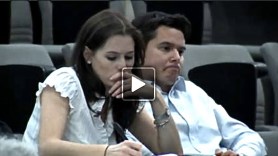
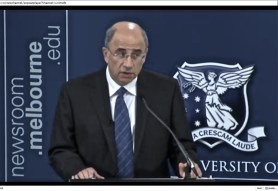
Quick screen grabs: the internet generation reacts to #Leveson LJ lecturing about laws on the way for online life

SUPER sceptical blonde student Screen Shot 2012-12-12 at 00.06.54

Watching Lord Justice Leveson speak to a predominantly middle-aged audience at the University of Melbourne’s Centre for Advanced Journalism four hours ago, post-Gutenbergers were struck by the extraordinary scepticism and disengagement on the few young and youthful faces among his listeners. The yawning gap in perspective is unsurprising. How could someone who has never blogged, tweeted, or commented on articles online understand the power and glory of communicating on the web? How could he be expected to do more than issue grim warnings about freedom’s end?

We rushed to take some fast-and-dirty screen shots.

In a future post — before the new year, time thieves permitting — this blog should have rather more to say about the judge’s speech.

tweet tries boring int into submission Screen Shot 2012-12-12 at 00.59.18

sceptics, 2, young, small scr Screen Shot 2012-12-11 at 23.58.52

lev S sceptical pink Screen Shot 2012-12-11 at 23

sceptical or sleeping aud members Screen Shot 2012-12-12 at 00.11.29
sceptical yng mn wmn Screen Shot 2012-12-11 at 23.40.14
sceptical blonde girl (b) Screen Shot 2012-12-12 at 00.06.51
LJL warning Screen Shot 2012-12-11 at 23.42.19

tweet lev pedestrian + BLOGGERS NOT NECESS A DANGER Screen Shot 2012-12-12 at 01.02.11