No one in old media apparently wants to transmit the cheering reasons for the gap between America’s trust in its military vs. its elected leaders

Barred from the medieval bell tower; but in the age of blogging we need no key to get the message out -photograph: postgutenberg[at]gmail.com

Barred from the medieval bell tower; but in the age of blogging, we need no key to get the message out
-photograph: postgutenberg[at]gmail.com

achilles LARGE

[ After this entry was posted, we followed a tweet to Glenn Greenwald’s report on The Intercept about dire consequences of militarising the police – his reaction to the nightmare killing of young and unarmed Mike Brown in Missouri. It is essential reading. But because polling results showing exceptional public esteem for the military have been so drastically under-reported for years, most people would find it hard to understand why the authorities blithely assumed that the citizenry would approve of arming and equipping policemen like soldiers. Media biases badly need counterweights. ]

We have searched and searched again but, so far, failed to find in online newspapers – well-known or obscure – any mention of, or solution to, the puzzle in our last post, the question of why Americans trust their military vastly more than other public institutions. If we were using all the wrong search terms, Google could hardly have served up the missing explanation in a persuasive paper by three collaborating scholars from which we will paste in a segment below.

But first, we must draw attention to a caveat, and then the reason why traditional media’s neglect of this subject is tragic – showing just how much the world needs the new media space that independent blogs have created:

• ‘The military’ is distinct from the political decisions its armed forces are obliged to execute – that is, which wars they fight, and where, and in broad strategic terms, by what means (eg., bombs dropped by drones vs. boots on the ground). Jonathan Shay, a psychiatrist of rare gifts who made his name treating veterans of the Vietnam war for post-traumatic stress disorder (PTSD), makes this essential point: ‘The justice of overall war aims and of operational theories – “strategic” bombing of civilians to weaken the industrial capacity to wage war is an example of such a theory – is not within the individual soldier’s scope of moral choice, unless he or she is willing to face imprisonment or death by refusing to fight.’

• Media hostility to, or neglect of, what the military does for civilians, since the Vietnam war — not just in America but in similar disenchantment elsewhere — could account for why it has been far more common for veterans of recent wars than for their historical predecessors to have the mental afflictions now called PTSD. That fits Shay’s suggestion in his brilliant Achilles in Vietnam (1995) – in which he drew riveting parallels between the tragedy of Achilles and his comrades, Homer’s subject in The Iliad, and the disturbances in Americans who fought the Vietnam war twenty-seven centuries later. He says, in extracts slightly rearranged, here, for concision:

What a returning soldier needs most when leaving war is not a mental health professional but a living community to whom his experience matters … [W]e should care about how soldiers are trained, equipped, led and welcomed home when they return from war. … [H]ealing from trauma depends … on being able safely to tell the story to someone who is listening and who can be trusted to retell it truthfully to others in the community. … Economically, unhealed combat trauma costs, and costs, and costs. Recall that more than 40 percent of Vietnam combat veterans … reported engaging in violent acts … Between a tenth and a quarter of all males in prison are veterans … When combat trauma results in domestic violence … there is an intergenerational transmission of violence.

The New York Times, for one, has published excellent and massive reports about sufferers from PTSD and their families. But, as far as we know, it has devoted no equivalent analysis to – or run any report on – the shining public image of the military, as revealed by Gallup’s stunning findings about the confidence gap in which the military reigns virtually unchallenged as a reservoir of trust. For that, anyone curious must hunt down a 2012 American Academy of Arts and Sciences dissection of similar results in an opinion poll a year earlier, unenticingly titled, ‘The Origins & Lessons of Public Confidence in the Military’.

First, it notes a contradiction:

[T]he relationship between the American people and its defense establishment has historically been anchored in two opposing sentiments: on one side, Americans see a large, standing military as a potential threat to liberty; on the other, they revere the U.S. military for its role in establishing the nation in revolution, preserving it against rebellion, and defending it from foreign aggression.

The start of the next extract is a hugely welcome surprise for anyone depressed by the impression — seemingly based on irrefutable facts — that Americans care most about wealth creation, and the feeding of the gigantic getting-and-spending beast we call capitalism:

In addition to valuing competence, society also expects institutions to serve a greater good. This public-mindedness is grounded in three principles: selflessness, accountability, and fairness. These factors are highlighted by the other institutions that enjoy widespread public confidence: small business and the police. According to a 2011 Gallup poll, 78 percent of Americans expressed “a great deal” or “quite a lot” of confidence in the military; 64 percent said the same for small business, and 56 percent for the police. In contrast, Congress (12 percent), the presidency (35 percent), and big business (19 percent) are held in relatively low regard by the American public.

What does the military have in common with the police and small business? In the case of the former, unselfish service is a common trait. The police (ideally) have no other purpose than to protect and serve the nation’s communities. In performing this service, capable men and women make sacrifices. They give up potentially lucrative and rewarding opportunities in other jobs. They put themselves in danger, sometimes sacrificing their lives. Small business is perceived to share two key traits with the military: fairness and accountability. In small business, Americans see the best qualities of the nation’s economic system (opportunity for those who seek it, rewards for those who succeed), absent the abuses and corruption that they impute to big business and banks. Small business owners pursue self-interest, but their success is deserved because it emerges from their own hard work and not from a manipulation of the system’s resources. Small businesses create wealth and opportunity; they are a gateway for immigrants to enter the American middle class, and they evoke the entrepreneurial spirit and mythos of American economic history – think of Andrew Carnegie, Bill Gates, the fictional heroes of Horatio Alger stories, and so on. Furthermore, small business owners are exposed to risk; if a small business fails, it is left to fail. Thus, fairness works both ways. [the highlights in bold type are post-Gutenberg’s]

The essay is a good read, all the way …While on the subject of strangely unpublicised opinion poll findings, here is a question for dining table entertainment: are Democrats or Republicans likely to be more sympathetic to the NSA’s spying on American citizens?

Gallup’s startling answer, from June of 2013:

There are significant partisan differences in views of the government’s program to obtain call logs and Internet communication. Democrats are more likely to approve, by 49% to 40%. Independents (34% vs. 56%) and Republicans (32% to 63%) are much more likely to disapprove than approve.

The newspapers associated with the left, which broke this story, do not seem to have paid much attention to what turns out to be a strictly partisan split in opinion. Gallup’s explanation makes it unlikely that the poll would have a very different result today:

In 2006, when Gallup asked the similar question about a program that came to light at that point, Republicans were significantly more likely to approve than Democrats. The differences in partisan reaction between 2006 and 2013 reflect the party of the president under whose watch the programs were carried out at those two points in time.

Now, why has the information in this blog post had virtually no attention in traditional media, as far as we can tell?

Might the shockingly low numbers for public trust in the media solve the mystery? As we recorded last week, in Gallup’s poll earlier this summer, the 74 per cent statistic for the military compared with just 22 per cent for newspapers – in an ever-narrowing gap in status with ‘news on the internet,’ deemed trustworthy by 19 per cent of those surveyed. Still, that was several cuts above the 7 per cent for the U.S. Congress – to which we saw theadvocates.org blog referring, pointing to

… a Public Policy Polling poll last year (reported in the Liberator Online) … found Congress less popular than lice, root canals, cockroaches, hemorrhoids, and colonoscopies, among other plagues and pests.


Kudos to The Register for dusting off its 2004 prediction that the spooks would soon take to watching us with Google’s panoptic lens

It should be general knowledge that newspapers spy on readers: Guardians that live in King’s Cross glass houses should not throw … - photograph by MIL22

It should be general knowledge that newspapers spy on readers: Guardians that live in glass houses should not throw … (ahem)
– photograph by MIL22

Guardian HQ, King's Cross -- photograph: vice.com

The Guardian, King’s Cross, London
photograph: vice.com

Why does this blog, post-Gutenberg, care about the mass surveillance kerfuffle? Mainly for the fun of noting the post-print 5th Estate — bloggers, reader-commenters, chatters on geeky online forums and other small voices — exposing the misinformation delivered in confident, booming tones from sections of the old media establishment, the 4th Estate.

A usually intelligent American friend uncharacteristically obtuse about government surveillance – we’ll call him Playah, in this post – believes the misinformation, distortions and mis-cueing. He takes as virtual gospel all the pompous finger-pointing at US and UK spooks for supposedly inventing Orwellian-grade spying on us. He really does believe that the secrets leaked by Edward Snowden matter because they are news – not, as we do, because of their vast destructive scale and specificity, apparently designed to maximise their usefulness to enemies of the Anglosphere and its allies.

In his misplaced trust, Playah has millions of others for company – people, some of them rather important, who ordinarily pay so little attention to conversation in the techie world as to be willingly taken in by Al Gore’s claim to have invented the internet, or the canard that gives Steve Jobs credit for the computer revolution (discussed in an earlier entry here).

We include obscure techie publications like The Register in the 5th Estate. No one – certainly at The Guardian – has given any sign of having seen a piece dated 7 November, titled, ‘How Google paved the way for NSA’s intercepts – just as The Register predicted 9 YEARS AGO’.

We only stumbled on it serendipitously, in checking search engines for our own remarkably similar (non-prescient) post on the subject last week.

Much hilarity has greeted [Google chairman] Eric Schmidt’s deeply sincere “outrage” at his “discovery” that the NSA was spying on Google. For example, Vanity Fair pointed Mr Schmidt to some helpful Google searches.

But the NSA is merely treading in some well-worn footsteps – some of which were made by Google itself. Let us refresh your memory of one of the most prescient and chilling pieces of prediction in the last decade. For all this was forecast here at The Register in early 2004 – nine years ago.

In early 2004, Google launched Gmail. Gmail performed an automated interception of your email, and – having scanned the contents and guessed at its meaning – ran contextual advertising alongside it.

Former security advisor Mark Rasch, an attorney who had worked in the Department of Justice’s cyberfraud department during the Clinton administration, and was writing for Security Focus, raised a very interesting problem. If Google could search through and read your email without explicit legal authorisation, then surely the security agencies could do the same.

Rasch argued that Google had redefined the words “read” (“learn the meaning”) and “search”, which protect citizens, when it unveiled its new contextual ads service. It had removed explicit human agency from the picture. An automated search wasn’t really a search, and its computers weren’t really “reading”.

“This is a dangerous legal precedent which both law enforcement and intelligence agencies will undoubtedly seize upon and extend, to the detriment of our privacy,” forecast Rasch, here, in June 2004.

“Google will likely argue that its computers are not ‘people’ and therefore the company does not ‘learn the meaning’ of the communication. That’s where we need to be careful. We should nip this nonsensical argument in the bud before it’s taken too far, and the federal government follows.”

Remarkably, Rasch even suggested where the security services might most effectively put this into practice.

“Imagine if the government were to put an Echelon-style content filter on routers and ISPs, where it examines billions of communications and ‘flags’ only a small fraction (based upon, say, indicia of terrorist activity). Even if the filters are perfect and point the finger only completely guilty people, this activity still invades the privacy rights of the billions of innocent individuals whose communications pass the filter,” he wrote. “Simply put, if a computer programmed by people learns the contents of a communication, and takes action based on what it learns, it invades privacy.”

Well, fancy that.

… What else isn’t news in the great surveillance exposé of 2013? Well, surely it’s about time The Guardian told us all about its surveillance of its own readers, mentioned here (again), one entry ago? And isn’t the bigger story that everyone is going to be spying on everyone else, very soon? Here is another overlooked techie, Jamais Cascio – trying to draw attention to our perfectly horrible privacy-free future in a lecture on 4 May 2005 titled ‘The Rise of the Participatory Panopticon’:

Soon — probably within the next decade, certainly within the next two — we’ll be living in a world where what we see, what we hear, what we experience will be recorded wherever we go. There will be few statements or scenes that will go unnoticed, or unremembered. Our day to day lives will be archived and saved. What’s more, these archives will be available over the net for recollection, analysis, even sharing.

And we will be doing it to ourselves.

This won’t simply be a world of a single, governmental Big Brother watching over your shoulder, nor will it be a world of a handful of corporate siblings training their ever-vigilant security cameras and tags on you. Such monitoring may well exist, probably will, in fact, but it will be overwhelmed by the millions of cameras and recorders in the hands of millions of Little Brothers and Little Sisters. We will carry with us the tools of our own transparency, and many, perhaps most, will do so willingly, even happily.

I call this world the Participatory Panopticon.

The Panopticon was Jeremy Bentham’s 18th century model for a prison in which all inmates could be watched at all times. The term has in more recent years come to have a broader meaning, that of a world in which all of us are under constant surveillance.

continues … ]

… Perhaps the blogosphere is beginning to make progress with essential de-bunking. Headlines demanding ‘transparent’ spying by spies, and close monitoring, by us, of decision-making by the loftiest administrators of espionage, have been getting less common, lately. The headline-writers have presumably begun to realise that even less attentive members of the public – such as our friend Playah — have begun to see these for what they are: quite simply, daft.

What is a blog, in 2013? More parlour than platform, perhaps

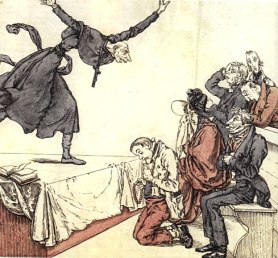
Bloggers can ‘speak truth to power’ as idiosyncratically as caricaturists  – An 1834 protest against corrupt clerics by the Swiss artist Martin Disteli: Wikimedia Commons

Bloggers are free to ‘speak truth to power’ as idiosyncratically as caricaturists
– an 1834 protest against corrupt clerics by the Swiss artist Martin Disteli: Wikimedia Commons

Blog posts can be as intentionally -- and unintentionally -- revealing about bloggers as parlour furnishing was about a house’s occupants

Blog posts can be as intentionally — and unintentionally — revealing about bloggers as parlour furnishing was about a house’s occupants

In 2013, a blog post — whether buoyant or morose — can tell you nothing about a blogger’s actual mood or state-of-life, unlike the exhibitionistic diaries that people originally thought web logs would be. The time has come to toss out stale do’s and don’ts about blog-running. A blog does not have to be run like a newspaper, newsletter or magazine for bloggers to supply information in the public interest . It can do its bit towards changing the world without round-the-clock, daily, or even regular posts – as long as it is written with care, and its existence is recognised by search bots.

It might or might not attract commenters, depending on whether a blogger has the time or inclination to chat with visitors and — on serious subjects that matter greatly — visitors’ willingness to risk looking foolish, or face the unintended consequences of comments discovered by their near-and-dear, employers or workmates.

Boosting site traffic is of keenest interest to bloggers blogging strictly in the hope of blog monetisation – which, as things stand, would mean that Florence Nightingale, if she were a contemporary, would have to shrink anything she had to say about medicine to thought-capsules insinuated between large nude ‘selfies’ in which strategically positioned cat pictures hid her peekaboo bits, all of this framed by cosmetics and fashion ads. She would need to devote rather more energy to luring ‘likes’ than to nursing.

It struck us that in 2013, although free – unmediated – expression is the aspect of blogs that gets the most attention, a blog today might be even more like a Victorian parlour than a soapbox or pulpit. But what was our idea of a parlour? A sort of outer sitting- or living-room, we thought – inviting, yes, but rather formal, and offering not so much statements as hints about the inner lives and passions of a household, for which it served as a sort of shield. It was mostly furnished in conformity with the taste of the era, epitomised by an ornamental, straight-backed chair. This is not to say that we think of blogs as typically stuffy or prissy – only that most bloggers are on sites hosted by the likes of WordPress, Blogger or Tumblr, using designs and organisation schemes that these hosts supply, which closely reflect contemporary taste.

But what of the original parlour, we wondered. The Wikipedia entry had this surprise – borrowed from the Oxford English Dictionary:

Parlour derives from the Old French word parloir — or parler (“to speak”), and entered English around the turn of the 13th century. In its original usage it denoted a place set aside for speaking with someone, an “audience chamber”.

We got curious, and dug further into ideas about the purpose parlours had served in the past. Should we forget all about Victorian parlours, now that we knew that they were relatively recent evolutions of a much older idea?

The parlour was of considerable interest to the Victorians … and it appears in Victorian genre painting and fiction as a newly significant space … [T]he parlour, whether in life or in art, is a site at which we can explore potentially explosive disturbances in psychic and social fields and can trace attempts both to articulate and resolve such differences.

The Victorian Parlour: A Cultural Study, Thad Logan, Cambridge University Press, 2001

Curiouser and curiouser. Very much like blogs, then – if Thad Logan’s suggestion is warranted, as we intend to find out when we read her book.

Log-rolling turns transparent as e-publishing and online art promotion come of age

'Spanky' and N -- LCM 2

‘Niko and Spanky’ - photographs by Willodel http://www.facebook.com/Willodel

‘Niko and Spanky’
– photographs by Willodel http://www.facebook.com/Willodel

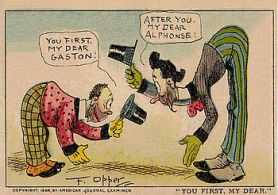
‘Alphonse et Gaston’ – the gold standard for mutual feather-stroking – from the Wikipedia

‘Alphonse et Gaston’ – the gold standard for mutual feather-stroking – from the Wikipedia

‘She is too reserved for the big internet world,’ read the message pounded into a keyboard a fortnight ago at hypersonic speed typical for B, post-Gutenberg’s inseparable friend at roughly ten years old. ‘She does not promote herself at all, but all the same has a whole lot of faithful admirers and buyers, so she remains old style.’

This description of a shy artist, K, lucky enough to have been born into a family exceptionally well-connected with prosperous buyers of art, gave us pause. Our immeasurably dear B — who only ever posts her own work online in disguise — was signalling a preference for arts workers who adopt the old unwritten creed of aristocratic reserve. Once, this might have been our choice, too – because we share K’s innate, incontestably genetic, cringing-violet introversion and dislike of egotistical puffery. These days, we are less sure of its rightness – for at least three reasons.

• Everything to do with attracting attention to new art and literature, even mere blogs, has become confusing — at least as perplexing as those members of the ancien régime marched to the guillotine in revolutionary France in spite of siding openly against their lofty origins. B, for example, had introduced us to K’s work with a link to one of her pictures – a serene, meditative portrait in the yellow-brown-ochre palette that Paul Gauguin often used in his time in the South Seas – and a request to vote for it on the web site of a gallery using a contest as a promotional device.

By coincidence, this happened in the same week in which we witnessed a fight between two writers who had entered one of the many online literary contests nowadays, also designed for audience-building. One of them was accusing the other of an attempt at vote-rigging – a charge that struck us as dubious. The accused writer had done no more than openly suggest reciprocal voting – that they each vote for each other’s entries.

How, we wondered, is that any different from the latest evolutionary leap of the old ‘gentleman’s game’ of traditional, print publishing – behaviour to which Private Eye routinely draws its readers’ attention, with nearly audible guffaws? In its 26 July-8 August issue, for instance, spotlighting recommended summer reading by literary power brokers in London newspapers:

”Tasha is my sister-in-law,” declared Lee Child, selecting a Tasha Alexander novel in the [Mail on Sunday]. Robert Winder’s book about Wisden, “for which I wrote a foreword”, was David Kynaston’s pick (Times). And “I can’t wait to read my friend Mark Lawson’s astonishingly expansive, hilarious and heartbreakingly dark The Deaths,” gushed Julie Myerson (Observer), enthusing too about a novel from “the latest to be published from my husband’s creative writing MA”.

Such advice was most influential – with the naïve and unsuspicious — when the recommenders hid their ties to authors. Post-Gutenberg is all for letting in the sunlight and dropping the pretence of objectivity. But after that, the point of such recommendations is – precisely what?

• Aristocratic reserve has passed its sell-by date — for aristocrats. Long before the internet sped up the digitisation of human life in every pore, the Duke and Duchess of Devonshire, avidly promoting tours of Chatsworth, his ancestral pile, were only among the most successful English grandees hawking their ‘brand’.

With unabashed Teutonic frankness, the home page of a successful expatriate painter (and wife of a friend lost to distance and time) announces its owner, in gold-on-black lettering, as ‘Antoinette Baronesse von Grone’. From there, she proceeds immediately, without any timorous beating about the bushes, to

ARTIST BIOGRAPHY

I was born and raised in Northern Germany, in a village that has been the seat of my family for over 500 years.

• Declining to dirty your hands with audience-building for yourself can mean failing to acquire any power to help other people.

Post-Gutenberg has long discouraged friends from initiating even semi-intimate conversations in the comments section of this blog because we can find clubbiness on other blogs off-putting. Even so, we liked last week’s justification of e-barn-building by Cally Phillips, an engagingly exuberant, extempore Scottish blogger (yes, we follow each other’s blogs):

It’s an interesting thing this ‘you read my book I’ll read yours’  It seems that there’s a notion that we  should think there’s something a bit suspect in that  (like trolls or sock puppet alerts) but hey folks, that’s part of what ‘indie’ writing is about. It’s about finding people you have some kind of a connection with – and guess what – you’ll probably find you might like their writing.

Of course sometimes they write in genres you’re not that familiar with (or claim not to like – for me thrillers and sci fi) But sometimes it’s worth stepping out of your comfort zone.  And when folks bother themselves with my writing, yes I do feel some compunction to ‘explore’ the worlds they have created and ‘meet’ them through their writing. I’m not ashamed to say that. […] I don’t think that being mediated by gatekeeper, guardian mainstream publishers guarantees me a ‘good read’ and I’m happy to take the responsibility on for myself to find what I want to read.  And if, in the process I make virtual (or real) friends of other writers, I’m not going to be embarrassed about that. It’s a good thing.

[Y]ou can read things you’d never have read while you grazed from the mainstream trough.  And that’s no bad thing.  Unless you want all your reading pre-packaged and homogenised off the supermarket shelves (in which case I’m sure you’re not even reading this!)  […] If you like what someone writes TELL THEM.  And tell other people.

Anyone who resists the new honesty about connections and self-interest risks being outed anyway, as in a delicious item in the other edition of Private Eye last month – featuring one Sam Baker, a columnist for Harper’s Bazaar, recommending a novel by Jonathan Grimwood:

”From the moment I encountered four year-old Jean-Marie d’Aumout sitting on a dung heap eating beetles, I was obsessed by this sensuous tale of one man’s search for the perfect taste,” she raves. “Part Perfume, part Pure, 100% original.” In a fit of absent-mindedness, Baker omits to add that Grimwood is also 100% her husband.

No publication pretends to despise the internet more than the net-spurning Eye does. Yet – as we have shown in an earlier entry, here – no rag is more gloriously infused with the take-no-prisoners spirit of the blogging world.