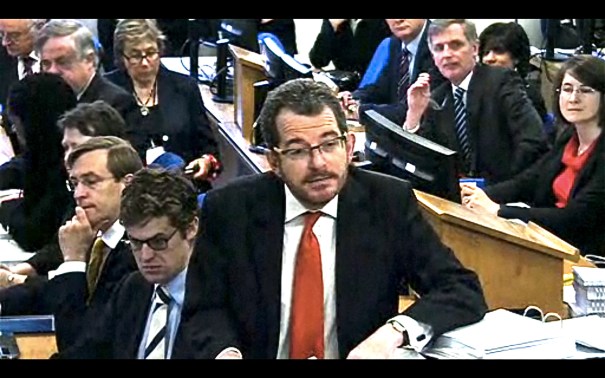
On the threshold of ♯Leveson’s d-day, The Guardian shuts reader-citizens out of the debate


Citoyens
 should be king in a democracy, but are being denied free speech on press regulation — by the press.
Photograph by postgutenberg@gmail.com

In the autumn of last year, in the prelude to formal hearings for the Leveson Inquiry, Baron Judge, the Lord Chief Justice, said:

It is the birthright of the citizen that the press should be independent. It is therefore not a right of one section of the community, not just a sectional right. It is the right of the community as a whole. It is, if you like, our right, the right of every citizen.

Reporting on the curious omission by newspapers of any mention of that warning to the press, post-Gutenberg asked:

Why … is no one in the British media mentioning the prohibition by a leading newspaper of free discussion – by ordinary citizens – of the future of the press, on three separate occasions last week?

On the last Sunday before d-day — the 29th of November, when Lord Justice Leveson is due to deliver his report – The Guardian belatedly opened to comment by readers two vital contributions to the press regulation debate from Observer writers. Reader commenting had been barred for most of the day after these pieces were posted in the (ahem) Comment-is-free section of the web site shared by these newspapers but administered by The Guardian (which bought its rival several years ago).

That must have been quite a fight behind the scenes, before The Guardian relented and, by mid-morning on the 25th, let justice and common sense prevail.

Read the excerpts from these opinions The Guardian found so threatening, and be amazed. Better yet, follow our links, read the rest – especially the few reader comments permitted before commenting was once again closed, after less than half a day – and be astounded by the usual categorisation of The Guardian as a ‘liberal’ newspaper.

(i)

— from the Will Hutton column, ‘Why I, as a journalist and ex-editor, believe it is time to regulate the press’ [24 November 2012]:

The precious freedom of speech of an individual is different from the freedom of speech of a media corporation with its capacity to manipulate the opinions of millions, which is why it must take place within the law and within a framework of accountability. Freedom is not only menaced by the state; it is also menaced by private media barons and their servants, …

An avalanche of highly spun journalism to serve partisan interests has become habitual. The public realm has become degraded. The trade and craft of journalism has been abused; the journalists who work in newsrooms, where standards are routinely sidelined, need protecting.

(ii)

— from an editorial in The Observer, ‘Leveson report: do we need a new law to rein in the press?’ [24 November 2012]:

The press – as anachronistic as that term now sounds in a digital age – have not, on the whole, been a great advert for plurality in the last month. In that time, they have fixed Leveson in their cross hairs and unleashed a ferocious ordnance in his direction.

[…]

There are reasonable, cogent arguments to be made about regulation or the lack thereof. There is a proper debate that we need to have post-Leveson, one characterised less by tribalism and more by reason.

As we wondered, last November:

[The] question no one in the media apparently wants to face is, will the public grant professional journalists a continuation of special privileges in the digital age if they no longer adhere to the traditions of fairness, neutrality and dedication to the truth that won them those privileges in the 18th century? Earlier this month, this blog mentioned the media’s refusal to acknowledge – or indeed discuss at all – the public’s dismay about an increasingly partisan press.

There are other alarming silences …

Now you see them, now you don’t …

Harry Potter Politics for Dummies — or why professional book critics forced Joanne Rowling to write The Casual Vacancy

Mystery portraitist: write to postgutenberg@gmail.com for credit, please

Once upon a time, a few decades ago, no self-respecting novelist or aspiring or actual literary star spoke of writing book reviews except as work dashed off to pay the grocer, replenish a wine cellar, or finance the abortions of a careless mistress. Editors doled out book reviewing assignments to support writers they believed in, who got drunk in the same watering holes or clubs, or had long ago been cricket or baseball-playing mates.

Some book reviews might have been incisive and elegant enough to be described as lapidary, but what mattered infinitely more than fairness to the book and writer under inspection was showing off well. Showing off about what? The speed at which a charming prose confection was constructed – the ideal result being the literary equivalent of iron claws in a velvet glove; an attack on a book that every chatterer who cared about remaining a member of the chattering classes was obliged to buy, boosting the circulations of book-reviewing publications. Complaints by authors about mistaken characterisations of their books, misquoting, abysmal incomprehension of them or other consequences of arrogant or desperate skim-reading, were treated as unsporting and ungrateful.

Now, that was book reviewing in the glory days of literary print culture, when its power was at its zenith. It has not lost all its sway yet. There is still a literary establishment and, as the example we will soon supply demonstrates, it was sufficiently self-confident a decade ago to imagine that its judgments would pass unchallenged.

That establishment is feeling rather insecure these days, as anyone following the spate of recent attacks on ‘citizen-reviewers’ and blogging book critics will have noticed.

Some of its arguments are eye-popping in their hollowness. We quote, for illustration, the tack of one of the most likeable old print pundits – Robert McCrum, the former literary editor of The Observer, who has endeared himself to many a commenter by replying politely to ferocious attacks on his credibility, even when addressed as ‘McCrumble’. Imagine post-Gutenberg’s astonishment at reading on the books-blogging site of a newspaper, last week, this McCrumbly description of a professional book review:

Before publication, it will be subjected to a prolonged and intense process of subediting. Crucially, it will be signed, and usually paid for. Compared with the raw material of your average blog, it has been refined and distilled to within an inch of its life.

None of this guarantees that such a review will not be savage, destructive, ad hominem or partisan, but it will be considered, …

Considered? … Really? That would mean putting the actual reading of subjects of reviews, and pondering, weighing and reflecting, above dashing off – cloddish clog-dancing by comparison with the impeccably executed, once-over-lightly pirouette still sanctioned in many a respectable home for print.

… Which brings us to the subject of Joanne Rowling, who has just published The Casual Vacancy, her first novel for adults, to deafening fanfare. The print literary establishment, discovering that she has, in spite of her success, written a better than respectable novel campaigning fiercely for have-nots, might have been a lot less astounded if its members had gone to the trouble of reading the books that made her famous. Because so many of them only deigned to notice her at all when she became odoriferously rich, they fell into the error of confusing her work with dim and, or, absurd mega-bestsellers, like the one built around a witless ‘code’ poor old Da Vinci would have choked on – which could only have been invented to make Dan Brown the agreeably tweedy and self-deprecating fat cat author he has become.

By contrast, any actual — adult — reader of the Harry Potter series might, like post-Gutenberg, have been most amused not by either the wizards or monsters but the social commentary at the edges of J. K. Rowling’s picture. Could any Londoner who has ever visited, say, the Department of Industry in Victoria Street, fail to explode in laughter, meeting its perfect fictional twin in Rowling’s Ministry of Magic – not just because of her descriptions of its atmosphere, its corridors and the attitudes and work ethic of the dispirited bureaucrats shuffling down them, but because of the delicious wheeze of including such an institution in this particular story?

At the start of the Harry Potter mania, one book-reviewing journalist and essayist, Pico Iyer, was given enough space in The New York Times to hang himself comprehensively – having managed, somehow, to read Rowling’s cod obvious political sympathies back-to-front. The most obvious point of his contribution in the dashed-off tradition was boasting about his educational pedigree. In his eagerness to use a consideration of Harry Potter’s success as a peg and excuse, he forgot to check that the parallels he drew were justified by any part of the boy magician’s adventures, or their framing.

As a boy, I went for many years to the Dragon School in Oxford. The rooms in which we lived were called ”Leviathan” and ”Pterodactyl” and ”Ichthyosaurus”

[…]

I mention all this because, as Harry Potter’s adventures conquer the nation … readers on this side of the Atlantic may not appreciate how much there is of realism, as well as magic, in the exotic tales of young sorcerers being trained at the Hogwarts School of Witchcraft and Wizardry. The classical boarding-school process favored by the English middle classes is esoteric […]and Friday nights would find us bouncing up and down in our pajamas, reciting the principal parts of Greek irregular verbs. Every Sunday night, in our flowing black robes (we were known as ”tugs”), we would gather in a classroom dating from 1441 to sing hymns in Latin …

[…]

When I was at school, it was always assumed that all the years of quasi-military training (”Hard work and pain are the best teachers if you ask me,” the Hogwarts caretaker says) were meant to teach us how to rule the Empire and subdue the natives around the world.

Well done, you!  the weary reader of that extended exercise in feather-fluffing is liable to have exclaimed, as it ran on … and on. To the credit of the NY Times – never mind that it failed to vet Iyer’s reflections on Rowling the way Robert McCrum claims professional book reviews do — it promptly published, the following week, this deflating reaction:

October 31, 1999

To the Editor:

In his essay ”The Playing Fields of Hogwarts” (Oct. 10), Pico Iyer reveals a blinkered — i.e., thoroughly Mugglesian — misreading of J. K. Rowling’s intentions. Her Harry Potter books don’t ”recast” the elitist English boarding school experience ”in a positive light”; they are gloriously subversive.

Whereas English public schools have traditionally subjected their pupils to lives of Spartan deprivation, the food at Hogwarts is delicious and abundant. Students sleep in four-poster beds hung with velvet curtains. More telling than these details is that Hogwarts resembles a conservatory or any other meritocratic school for gifted children, not an establishment designed to train the children of the elite ”to rule the Empire and subdue the natives around the world.”

Belonging to old magical families confers no special advantage on Hogwarts pupils; only talent counts. Both Harry and Hermione, one of his two best friends, receive letters inviting them to attend the school — and are plucked out of Muggles families because their innate talent for wizardry has mysteriously been discerned by Hogwarts administrators.

The prodigiously gifted J. K. Rowling is doing a great deal more than tweaking Iyer’s Etonian experience ”in a magical direction.” Contrary to his assertion, her theme is absolutely universal. She tells about both the vulnerability and the protective insulation that come with artistic talent, about the escape route that an imagination offers from the horrors of real life. To say that the charm of the Harry Potter books lies in ”their fidelity to the way things really are” is to grievously shortchange Rowling’s brilliance.

The writer of that old-fashioned, mediated citizen-review known as a ‘reader’s letter to the editor’ – the only chance a member of the public once had to draw the same reading audience’s attention to mistakes or idiocy inflicted on it – has scrupulously avoided becoming a professional assessor of books.

We could not agree more with Robert McCrum, pronouncing,

[T]he citizen journalist’s review is not the same as the professional critic’s.

Indeed not. As the woman who brought Potter to life said, in a BBC interview on her reasons for writing The Casual Vacancy:

Ultimately, the people who have read the book, who are not paid to have an opinion, are generally the best benchmark of whether you have done what you set out to do.

#Leveson, as anticipated by Elie Wiesel, 83 – in his turn, trailing fellow-activist Zhou Youguang, 106, in the blogosphere

‘Giant pawn’ MIL22

Earlier this month, a post-Gutenberg entry on the Leveson Inquiry had the honour of being put in the Twitter ‘favourites’ queue of Hans Peter Lehofer – an administrative law judge and former head of the Austrian Communications Authority, which decides the rules for broadcasting in that country.

No, we did not interpret our inclusion in his list as a gold star of approval. He almost certainly uses the ‘favourites’ button on the glorified e-notice-board the way we do – as an online bookmark. Never mind if, exactly like us — making the same point to #Leveson the other day — he doubts that merely passing laws affecting the way the press works can guarantee our getting what we need, which is ‘broadcasting’ representative of society as a whole.

What did please us is that Herr Lehofer’s interest bears out our forecast in May that Lord Justice Leveson’s recommendations on press regulation would influence the debate about media policy around the world. Austria is lucky to have such a curious and progressive rule-maker. Anyone in Britain worrying about bloggers and citizen-journalists being treated as mere pawns in the chess game the Inquiry is being forced to play with politicians in the final weeks before it delivers its report is bound to be heartened by this judge’s grasp of the size of the leap in thinking about media that we need from the judiciary. He has a blog of his own, and also blogs collaboratively on more than one site.

Gerard Hogan, another intelligently au courant judge — a specialist in constitutional law at Ireland’s High Court — recently accorded the blogosphere a right traditionally reserved for professional journalists. In what the International Forum for Responsible Media (INFORRM) reckons as ‘the first Irish judgment to consider the position of bloggers,’ the court allowed Mike Garde, the blogger-director of an Irish organisation helping people brainwashed by cults, to protect his sources of information.

Hogan J’s judgment read, in part:

Part of the problem here is that the traditional distinction between journalists and laypeople has broken down in recent decades … Mr. Garde’s activities fall squarely within the “education of public opinion” envisaged by Article 40.6.1. A person who blogs on an internet site can just as readily constitute an “organ of public opinion” … [T]here is a high constitutional value in ensuring that his right to voice these views in relation to the actions of religious cults is protected.

How much longer, we wonder, will it take Elie Wiesel – twice quoted on this blog in recent weeks, and cited yet again, below – to join the unmediated conversations in the blogosphere? He has used every other medium in his extraordinary record of ‘bearing witness’ to the murder, torture and terrorisation of European Jews in World War II – after surviving Auschwitz, where he was dispatched as a 15 year-old.

His age today, which is 83, hardly explains his failure to start a blog. Last spring, The New York Times ran an inspiring profile of a Chinese human rights activist, 105 at the time, using a blog to broadcast his thoughts. This astonishing Zhou Youguang – still blogging at 106, if the net is to be believed — is the inventor of the Pinyin or ‘Romanised’ system for converting Chinese sounds into the English alphabet. For his transmissions on the net,

Mr. Zhou … uses a typewriter that converts Pinyin into characters to deliver ever-more pointed critiques of the party in essays and on his as-yet-uncensored blog.

The explanation for the deep hooks sunk into post-Gutenberg’s brain by Elie Wiesel’s short 2010 novel, The Sonderberg Case, is the startling correspondence between this author’s reflections on the role of the press in society, and the actual debate over the Leveson Inquiry. He also uses the trial at the heart of his story to weigh the relative worth of the work of lawyers and journalists – most engagingly.

Our final excerpt from the book is about a fight at a dinner party in New York. It seems uncannily prescient about the precise arguments being used in real life by the media’s old guard – here presented by the main character, Yedidyah, a journalist, and the hostess, Emilie, his only ally – as opposed to those of the public, on whose behalf Yedidyah’s wife Alika, an actress, spars victoriously.

There seems no doubt whatsoever about which side the author is on:

We talk about journalism. Is it useful to a democratic society? Honest or corrupt like everything else? A reliable source of information, a necessary tool for forming an opinion? Emilie and I stand up for the media, primarily because they represent an indispensable element in protecting individual and collective liberties. Alika is our most violent opponent. I’ve rarely seen her as fierce in her opinions. For her, even the best daily papers disgrace their readers. And she goes on to quote and appropriate the remark of a big British press baron concerning a well-known magazine. ‘It isn’t what it used to be … and actually it never was.’ And this applies to all publications, she tries to convince us, with no exceptions. Alex agrees with her. So do their guests. Emilie and I valiantly stand up to them. Alika flares up.

‘How can the two of you stick up for all those miserable newspapers and weeklies? I’m prepared to think you don’t read them! Even the cultural pages are over-politicized. As for the literary supplements, what do they tell us except ‘long live the buddy-buddy network’? What kind of moral rectitude is that? And what about the right to truth?’

[…]

Calm and resolute, Emilie pursues her counterattack and cites the facts: Can we really suspect such and such a writer, at such and such a newspaper, of dishonesty? And can we honestly question the integrity of such and such a professor, who writes in such and such a journal?’

Without the slightest compunction, Alika answers with a shrug of the shoulders. ‘Yes we can. And we should.’

‘In other words,’ Emilie says, ‘they’re all guilty until proven innocent, is that it?’

‘No,’ Alika concedes. ‘I wouldn’t go that far. But I maintain that as a reader, I have the right to wonder about their conception of ethics.’

… Happy birthday, tomorrow, Elie Wiesel.

Quiet levity at ♯Leveson, and some thoughts on the film version of the Inquiry for Robert Redford’s scriptwriter

Leveson’s subtle cerebral swordsman, Robert Jay QC:
is he Hollywood material?

Robert Redford in 1976, playing
the Watergate reporter-hero
Bob Woodward.
Photograph: collectorsshangri-la.com

Nowhere in the commentary about the winding down last week of Part 1 of the Leveson Inquiry into press practices have we seen the lines we expected some old print publication or other to throw in for leavening. Only in the blogosphere have we found mentions, in this context, of …

You cannot hope to bribe or twist

The honest British journalist

But seeing what the man will do

Unbribed, there’s no occasion to.

There are minor variations of those four lines in circulation. They are the wittiest and best-loved summing-up in verse of the British tradition of journalism – at its best, still the world’s finest, in our opinion, which might have been influenced by sprinkling with  baptismal water in this branch of the craft. Long before then, the poem was on a page of a school poetry textbook to which some of us, at post-Gutenberg, often turned for relief from galumphing deconstructions of poems unfortunate enough to have been put on the syllabus.

Will Robert Redford find a way to include Humbert Wolfe’s 1920s quatrain in his script — if there is any substance in the speculation about him giving Leveson and the phone hacking scandal the Hollywood treatment? A Redford film about the Inquiry — showing us what an outsider makes of the Icelandic saga it has become — could be a treat. A clip from a BBC interview with the actor-director in April is irresistible. His tone becomes wondering, almost awed, answering a question about his impressions on a first visit to London for 30 years:

I come here and I watch the Leveson Inquiry. And whatever’s going on — I’m sure there’s some savage stuff going on — but it’s done in such a dignified, calm, graceful way that I think, gee! this is really fascinating. Somebody’s killing somebody, here, but you’d never know it.

Italian-born Humbert Wolfe
wrote the most famous poem
about British journalism.
Photograph: National Portrait Gallery

The poet Humbert Wolfe also had a stranger’s acute powers of observation. He was born in Milan. His mother started life as Consuela Terraccini. His pen strokes captured the journalism and journalists of his adopted country while he worked at a day job in its civil service.

But even if one of Redford’s most famous roles was in All the President’s Men (1976) — playing the Woodward half of Watergate’s heroic ‘Woodstein’ partnership at The Washington Post — it is not the British press but the lawyers and gracious conventions of British law in action that captivated him. At a press conference on the same trip, a reporter asked if he was watching the proceedings and ‘hoping for the return of proper investigative journalism’ – following his complaints elsewhere about the increasing ‘triviality of media’. He replied:

I’ve been very impressed with the dignity and elegance with which the process has gone forward. People take their time speaking. And in my country, things have become so accelerated and … so hyped up. … It’s sad for me to see because it blurs this more important part, which is, where are we going to find the truth? The democratisation of the internet has actually made truth harder to find — along with its positives.

Somehow, that vital qualification of his disappointment with democracy on the net was dropped from the Independent’s report of his remarks, with no indication of any omission. That paper, like the other broadsheets, never stops copying King Canute straining to command the sea to roll backwards – in its case, the evil digital sea of change obliging the 4th Estate to share its megaphone with new rivals.

Actually, Lord Justice Leveson and his chief counsel for the hearings, Robert Jay, have often struck post-Gutenberg as a brilliant pairing. In their uncannily well-coordinated forensic interrogation, they function like a legal Woodstein – even if not technically working as partners but in their distinct and separate roles. The background to their bravura performance could be an engaging part of the story, whenever Redford or someone else digs into it.

Admittedly, that is most likely to be a someone else – since the cinema only rarely conveys intellectual, as opposed to emotional, subtlety and complexity. Just as nearly every film ever made about the lives of artists and writers has failed to illuminate the mechanisms of their creativity, let alone uncover its secrets, there seems little chance of the cinema tackling judicial tactics and strategising of the highest sophistication.

Unless the presiding judge or some other senior member of the Inquiry’s legal team writes a completely frank account of its hidden dramas, there is just as little hope of our learning any details of the hearings’ behind-the-scenes manoeuvring – the pressure from vengeful old 4th Estate tigers distraught about the prospect of their de-clawing; the wily manipulations of politicians. We can only discern their effects – in, for instance, the ever more drawn and tired face and hoarse voice of Leveson LJ, in the concluding weeks of Part 1.

Would a Redford film explain the sort of thing keeping us hugely amused at post-Gutenberg? – the private joke we read into the judge thanking ‘the press who have reported on the inquiry, for keeping everybody informed,’ which made broadsheet headlines. Taking what he said strictly at face value (Lord Justice Leveson ends Inquiry by thanking journalists), those news reports missed his point entirely. To grasp what Leveson LJ was actually saying, you would have to know about this exchange between him and the admirably non-partisan Peter Oborne, chief political commentator at The Telegraph — and by far the most enlightening and accurate senior journalist testifying at the Inquiry:

P.O. : … [T]he reason why rival newspaper groups were unwilling to report phone hacking […] It’s only my views as an informed spectator, that … there was a reluctance of one newspaper group to embarrass another.

LJL : … If that is so, is that inevitable?

P.O. : I don’t know if it’s inevitable or not, but it has been a very, very — it has been a feature … [A]nd I think it’s been weakened a little bit, or even quite a lot, by blogs, and Private Eye has played a fantastically important cleansing function in the last 30 or 40 years. […M]aterial which has not found its way into mainstream publications has found its way into Private Eye.

LJL : Private Eye has also been publishing during the course of this Inquiry what the newspapers don’t publish. In other words, they’ve gone through a number of stories and said, “Actually, it’s rather interesting that this story appeared in this paper but it didn’t cover another aspect.”

Had the judge not been teasing huffy 4th-Estaters for their selective and misleading reporting on his hearings, he would have thanked all reporters and commenters – including bloggers, whose legitimacy and importance he has scrupulously underlined.

On that subject, we have a message for Robert Redford.  It is only because of the internet’s democratisation of the media that post-Gutenberg learnt that he acknowledged the constructive aspects of the rise of the net, even as he blamed it for the growing scarcity of good traditional journalism. As we have already noted in this entry, The Independent only printed the portion of his remarks that suits its agenda. But, thanks not only to a BBC video but a YouTube clip from his London press conference, we could all watch him speak his unedited thoughts and interpret them for ourselves.

And that is just one more tiny scrap confirming that expand and include; don’t compress and exclude should be the principle directing anyone powerful who has a say in shaping the media’s future – for reasons we recently explained here.