Post-Gutenberg media could give have-nots an essential hand in shaping history — in the Studs Terkel tradition

rose seeds closeup

Last week’s entry on David Lankes’s ideas for redesigning libraries to be centres of brimming invention and maximally engaged enlightenment for communities led to two discoveries. The first was a new post on his personal blog about his recovery from a terrifying illness — a turnaround owed to a harrowing but successful stem cell transplant — which, we hope, will be swift, strong and complete. In this report, he tells – in passing – of having been the target of exceptionally nasty attacks by some fellow-librarians.

All genuine reformers have stories like this – and the hostility is often in direct proportion to the importance of the changes being seeded and sown. Anyone who doubts this need only read Tuesday’s report in The New York Times about the resentment at the World Bank of a reorganisation instigated by its president, Dr. Jing Yong Kim, who has also – as an expert in fighting epidemics — made it his personal mission to put the Bank’s resources at the disposal of Ebola-stricken African countries at a speed insiders thought impossible, before the fact.

Next, we learnt about a contest organised by the Knight Foundation in which competitors are invited to submit schemes for turning libraries into more or less the places Lankes envisages – although it does not actually say so in its brief for contestants. This organisation’s charter entails financing ‘transformational ideas that promote quality journalism, advance media innovation, engage communities and foster the arts.’

The proposal of Phil Shapiro, the other future focused librarian mentioned here last week, captured our attention because it describes – down to its precise technological components – a way for ordinary citizens to create biographical and historical multi-media records by interviewing each other. Any fan of Studs Terkel’s brilliant and moving Working: People Talk About What They Do All Day and How They Feel About What They Do (1974) hardly needs an explanation for why that is such a good idea in itself. The contestants clarify their ideas in a crisp interrogation.

In one sentence, describe your idea as simply as possible.

Video booths at public libraries that allow community members to interview other community members over the web with the video and audio captured locally in high quality — and merged after the fact using free, open source software or a web video editing service such as Wevideo.com

Briefly describe the need that you’re trying to address.

Libraries are about the sharing of ideas. Some of the best ideas are in the minds of people who are not famous and who also do not have the video or computer skills to create their own YouTube videos. By giving community members a chance to interview each other, many interesting new ideas will be uncovered that will spark new conversations and new thinking about communities.

Reading that Q and A revived a memory of how social inequality can unbalance the historical record – and of an unsuccessful attempt, a few years ago, to lobby for a remedy at famously left-wing Berkeley. It inspired the following contribution to the feedback that Knight wants members of the public to leave on the competing plans — which fits this blog because it could help some suffering traditional publishers, writers, artists and media workers to understand why it isn’t just that the post-Gutenberg revolution cannot be stopped. Painful as it is for us, it should and must continue, with our encouragement and support.

… Years ago, in researching a book about the culture and characters in the most cosmopolitan segment of American farm country – the Napa Valley — I drew on a superb collection of transcripts from the Bancroft Library’s Regional Oral History Project at Berkeley. Comparing what the same subjects told me with what they were willing to tell the Bancroft interviewers was fascinating.

A decade or so after that, I rang the BROHP director with a proposal to interview someone in California ranch country, a woman of about my mother’s age who was the librarian in a small town to which she and her husband had migrated when he got a job as a ranch hand nearby. She had a sharp and original mind, a biting wit, and a fabulous hoard of stories about her past — for instance, surviving the Depression with her family, as a girl, helping sheep to give birth, and working at two jobs to help keep the family afloat.

I told the Bancroft director: most of the records of the local historical society focus on the top strata of the ranching communities in the region. What if an interview with this particular subject was the first in a series about families at the other end of the economic scale?

He said that that wouldn’t be possible. His organisation relied on donations from the outside to supply the money for the video recording equipment, video editing, travel, and so on. The reason why the Napa Valley was so well represented in the Bancroft collection was that the ‘wine industry’ had been outstandingly generous with funding. But wouldn’t that unbalance the history of rural California, I asked. His answer amounted to a shrug. He agreed with me, but didn’t know how to solve the problem.

I don’t know that the Bancroft’s oral archive still has this flaw. I hope that the bias has been corrected …

roses setting seeds

Roses setting seeds in a drought (part 2 of a story in pictures)

Roses setting seeds in a drought (part 2 of a story in pictures) — postgutenberg [at] gmail.com


O public libraries, what are you doing in the great indie book publishing revolution? A letter to a far-sighted master-librarian

Will the online ‘libreria’ or bookshop, where this picture was taken, replace the ‘biblioteca’ -- the Italian for library – everywhere, in the digital revolution? - photograph: MIL22

Will the flexible, accommodating online counterpart of the ‘libreria’ or bookshop everywhere supplant the change-resistant ‘biblioteca’ — Italian for library – in the digital revolution?
– photograph from Napoli: MIL22

This entry tells a true story of our time about a public library that recently turned down a modest proposal for listing on its web site books published independently by its patrons and members. Note that there was no request to include these – necessarily – in the library’s catalogue. The frame for our tale is an open letter about an exciting vision for libraries of the future by an inventive leading librarian.

cover expect moreDear David Lankes,

Can public libraries supercharge the flowering of indie publishing and go back to being vibrant centres of creativity?

I have been reading your slender Expect More a book I will call thrilling. As you know, that is not a word that I or anyone else thinks of, any more, in connection with libraries. Least of all, those of us who saw them as unrivalled homes of enchantment, growing up; entertainers for which no television set, nor the most luxurious cinema with the biggest screen was any match. Part of what you have set out so well is that if the visions of a true 21st-century librarian can be realised — in, around and beyond the stacks — libraries could return to their glory days, in ancient times, going all the way back to the legendary 3rd-century BC Library of Alexandria.

I note that you are a professor of library science in Syracuse, in New York state, and a leader in information studies exploring ‘how participatory concepts can reshape libraries and credibility’. You say:

Too many librarians see their collections, not the community, as their jobs. Too many librarians are seeking to survive instead of innovate, … [… ] Great libraries … require open communication about your needs, your challenges, and your dreams. […] Libraries ‘for the people’ is an old way of looking at libraries. The new view is the library ‘of the people.’

When a library director has to be replaced, does the typical library board – or electorate, when the vetting is democratic – know what to look for, to choose the right leader for our times? That would be someone like you or Phil Shapiro, whom I’ve seen described as an educator at a public library near Washington D.C., who ‘teaches an occasional graduate educational technology class at American University’. His @philshapiro  notices on the Twitter bulletin-board are quirky, sometimes impish, and essential reading, and led me to you and your book. In a 2008 entry on his ‘Community Voices’ blog on PC World’s site — ‘Should Public Libraries be Welcoming Homes for Ingenuity?’ — a biographical note explained:

In high school he built a hot water solar collector from an abandoned shopping cart and hauled it up onto the roof of his house with a rope. His parents thought that was a good idea. The neighbors were not entirely thrilled with the shopping cart. On the roof. Of the house.

That suggests that the questions people selecting library chiefs should be asking in job interviews or library-related elections are, ‘How young were you when — if — you appalled people by doing things that later confirmed you as one of the pioneers in your circle, and can you give us some examples?’

In my life divided between several perches, in recent years, experiences at public libraries amply bear out your characterisation of too many people working in them as ‘stuck in a sort of professional conservatism that favours what they do over why they do it.’

Not long ago, I asked one head librarian whether our library might support the indie e-book revolution by encouraging patrons to list on the library web site the titles of any independently published books for which they were responsible. I said that I envisaged a bare-bones listing of each book’s title and subject – with, perhaps, a link to the author’s personal web site. This stark recording, I thought, would discourage competitive promotional hype and one-upmanship. The idea for the list had occurred to me when I realised that a number of potential readers of my first e-publishing experiment — a short book (or long essay), Jung on men and women: a Swiss travelogue  — happen to live in this particular library’s catchment zone. It is not unusual to meet local residents who are widely travelled, devour travel literature, and are interested in psychology, Switzerland, the fight for women’s rights, and the theories of Freudian psychology’s chief 20th-century rival, Carl Jung.

It seemed to me that libraries might be able to link local readers to writers in ways that the algorithms of Google and Amazon cannot. I would love to glean, from a constantly updated record of books they were publishing, impressions of the obsessions, preoccupations, passions and undisguised money-making schemes of people who live nearby. Living in the same place can mean much more than a shared or neighbouring postal code. Among those of us situated where we are from choice, not just necessity, it seemed as if there could be indefinable but powerful resonances predisposing us to being interested in each other’s literary and graphic creations. Whether I was right or wrong in this assumption, it seemed worth a test.

The head librarian — someone said to be charming whom I have never met in person — replied both directly and through a mutual friend. The idea, I gathered, was a non-starter. The staff already had too much to do without making and updating my proposed list. Though the library is neither a valiant inner-city nor struggling rural branch but located in a large, rich suburb, there were no funds for hiring new workers. What about letting volunteers – patrons – do the job? No, that was out of the question. Why? Because the library chief had tried working with local volunteers and quickly been worn out by the complications of being assisted by those most in need of occupation, bossy ladies-who-lunch types, many of them strangers to workplace discipline. In addition, an overbearing patron who had just published a book for teenagers had been hounding library staff members for help with publicity.

I was sympathetic to these reasons for the proposal’s nervous reception. Well then, I suggested, how about making a specific request for help from seasoned professionals in the ranks of the town’s retirees? What about letting retired administrators or book-keepers, doctors, teachers, company managers, accountants, lawyers and so on, get involved? But I made this counter-suggestion hesitantly, in fading tones, accurately anticipating defeat – because I had by then detected a faint but unmistakable whiff of hostility in a reference in one email from the librarian’s intimate friend to ‘this promotional idea’. I had been careful to explain that the list of e-books published by locals that I envisaged was plain enough to be the antithesis of anything sales-y. To no avail, apparently.

Prejudice can get in the way of reading or hearing what someone has actually said. What would the prejudice be, in this case? At a guess – your characterisation of the typically change-resistant librarian’s view of the purpose of a library – ‘providing access to knowledge,’ where that is perceived as a ‘passive … accumulation of facts,’ and not, as you say it should be, ‘intimately tied to the passions of the individual … dynamic, ever changing and alive.’ Too many libraries, you add, ‘support consuming knowledge instead of creating it.’

Phil Shapiro, arguing along closely parallel lines in a post titled ‘Towards a National Transition Plan for Libraries,’ asks whether libraries should ever close their doors:

In an information-based economy where knowledge workers drive almost all innovation, shouldn’t the public knowledge place be open seven days a week? If 7-Eleven and FedEx Office and McDonald’s can stay open 24 hours a day, is it not possible for libraries to do so, too?

As it happens, a few days before I read that, I’d made the nearly identical point to the circulation staff of a library. I said that they were surely sealing their institution’s doom with rigid, daft rules and systems that make it look more out of touch with reality, every day, to patrons accustomed — for example — to being able to buy discounted books online at any time of day or night, and avail themselves of exceptionally elastic and forgiving returns policies to unload themselves of purchasing mistakes. Don’t libraries realise, I railed, that their worst policies are so despised by patrons that some of us have been whittling down our reasons for borrowing anything from them at all – and actively developing other routes to acquiring everything that they alone could once supply?

I’d been complaining bitterly about being obstructed from paying a late fee because it fell below the threshold for permitting a credit card transaction at the circulation desk – though, by some impenetrable logic, if I went home and logged into my library account from there, I would meet no obstacle to settling my bill with my plastic rectangle. When I actually attempted to do this a few hours later, there was a block on the account because … no, no, I’ll stop there: the reason is too petty, tediously complicated and batty to recount.

As for the good sense in Phil’s advice about adjusting to the information economy — well, a library worker in another branch for whom I have nothing but high praise once explained that the reason why the software download speed on his library’s network can slow to approximately zero megabits per second — even forty-five minutes before closing time — is that the staff do not want patrons getting in the way of closing time routines. They simply shut down internet access to encourage these patrons to leave. I asked how that was possible when the library’s wifi network is supposed to be on all day and night. ‘Right,’ he said. ‘So when you’ve all left, they turn it on again.’ This reminded me of a minder of the public internet-access section of a library, a woman I had never seen before, hovering nearby, tidying desks and watching me type my library card number into the login box at least nine times in a row, trying to get online — with no success. Only when asked for help did she explain that she had already tucked the wifi system into bed – fifteen minutes before the end of her work day.

So, David, imagine trying to make the mental transition from that — a set of far from uncommon reasons for contemporary libraries being a depressing subject of conversation — to your description of ancient Egypt’s fabled book-haven in Alexandria. A place that you say was ‘not a huge document warehouse’, but ‘much more akin to universities of today’, where ‘[s]cholars from the known world were brought together and encouraged to talk and create.’

The contrast is agonising and will get worse, unless you, Phil and other advocates for reform can find a way — fast — to add people like yourselves to the staff of public libraries in senior positions. My happiest discovery in your book is that my modest proposal for patrons letting each other know about their indie publishing projects is directly in line with the transformed library-land you perceive as essential:

In essence, too many libraries have defined access as providing access to their stuff. You must expect more from your library. You need to expect it to provide a platform where you can access the ideas of others, as well as a platform for you to provide others access to your own ideas.

I note, by the way, that you published Expect More yourself. I didn’t buy the e-book. I bought the attractive print-on-demand paperback, childishly delighted – as always – by the idea of a book printed specially for me.

Incidentally, I would love to know how you would have treated my suggestion for a continuously updated list of indie books published by members of a public library. If you ever see this post and feel moved to reply, I hope you will leave a comment here – or on some site of your own.

Best wishes,

CB

Amazon needs competition as much as Hachette does … let’s do something about that and let the caravan move on

 Cherish the old and get on with the new: the classic, by way of the digital photographs by EF and postgutenberg[at]gmail.com

Cherish the old and get on with the new: the classic, by way of the digital (lens)
– postgutenberg[at]gmail.com

There has been a shortage of calm, witty, Establishment voices answering the foes of Amazon.com howling about Jeff Bezos hammering the last nails into the coffin of literary culture. One of these rare birds is Clay Shirky, an American writer and prescient media scholar. Though we had his permission to reblog the whole of his post on the subject on Medium.com — within five minutes of asking — this entry will only link to it and quote its most courageous and wickedly entertaining sections.

Courageous? Absolutely – for anyone following the coverage of the Amazon-Hachette brawl in New York, whose leading newspaper last Monday had a banner headline in its business section shouting, ‘Literary Lions Join Protest Against Amazon’, and recorded Philip Roth (scowling ferociously in a photograph), Orhan Pamuk, Salman Rushdie, V.S. Naipaul and Milan Kundera diving in to bash Amazon with their computer mice and vintage clack-clackers-with-carriage-return.

Restricting this post to extracts from Shirky’s consideration of all the good Amazon is doing – which makes it merely an agent of a revolution that can hardly be held back – leaves room for quotations of some of the most constructive reactions to what he has to say.

Like him, we wish that Amazon had found a less aggressive way to persuade Hachette to share the costs of its book-discounting strategy that it says is designed to put more money into authors’ pockets. But, as we pointed out in a post here two years ago, it is hugely surprising to hear anyone in charge of the commerce of publishing care about and speak up on behalf of writers. (See ‘Is Amazon a bully, beating publishers into submission?‘) … We are also worried about Amazon getting much too big. We would love to see as a competitor what DuckDuckGo and its anonymising search engine are to Google – an alternative filling a vital need that the giant leader did not acknowledge or accommodate.

Over to Clay Shirky and his first responders, now:

More energy is being spent right now attacking Amazon than defending the five big publishers … because they aren’t easy to defend. There is some handwaving around the irreplaceability of their discerning taste, an argument undermined by their recent habit of acquiring ebooks they passed on the first time around, like “Still Alice” and “The Toiletpaper Entrepreneur”; their willingness to produce print editions of books that initially found their readers electronically, like “Trylle” and “Fifty Shades of Grey”; and by their building or acquiring self-publishing platforms, as with Penguin’s Author Solutions and Book Country.

Similarly, the idea that only the Big Five will fund speculative work for small audiences doesn’t jibe with the growth of niche publishing enabled by lower publishing costs. (A quarter-million titles have appeared on the Kindle in the last 90 days.) Nothing here is magic. Books are large chunks of writing. Digital publishing creates many new ways to get those chunks from writer to reader. Only some of those new ways require the services of people who work in lower Manhattan.

[…]

I say this as a beneficiary of that older system. I earned hundreds of thousands of dollars in advances for my last two books, to say nothing of the opportunities those books opened up, so the system has worked admirably well for me. However, I am a WASP, an Ivy League graduate, a tenured professor, and a member of the Sancerre-swilling East Coast Media Elite. Of course the existing system works well for me — it’s run by people like me, for people like me.

Despite my benefitting from it, I am unwilling to pretend that this system is beneficial for readers or for writers who lack my privilege. I’d always aspired to be a traitor to my class (though I’d hoped it would be for something a bit more momentous than retail book pricing), but treason is as treason does, so here goes: The reason my fellow elites hate Amazon is that Amazon refuses to flatter our pretensions. In my tribe, this is a crime more heinous even than eating one’s salad with one’s dessert fork.

The threat Amazon poses to our collective self-regard is the usual American one: The market is optimized for availability rather than respect. The surface argument is about price, but the deep argument is about prestige. If Amazon gets its way, saying, “I published a book” will generate no more cultural capital than saying “I spoke into a microphone.”

Given their deep ambivalence about expanded participation in the making and selling books, it’s worth noting some scenarios Amazon’s critics aren’t afraid of: They aren’t afraid that books will become less accessible. They aren’t afraid that there will be fewer readers. They aren’t afraid that fewer books will be published.

Reactions by commenters on the MagellanMediaPartners.com site:

Baldur Bjarnason

Sep 18, 2014 at 10:41 AM

I’ve found the publishing industry supremely inhospitable to even debating important issues.

The debate in publishing circles surrounding Clay Shirky’s piece depresses me. It echoes and rhymes with every debate I’ve been in personally and it demonstrates just how little has changed over the past ten years in the publishing industry.

But, […]debating this is pointless.

You don’t change people’s world-views with dialogue. If you want change you have two options:

You wait until the believers in the old paradigm die, experience an apostasy, or become irrelevant.

You try and build things that don’t rely on them (i.e. work solely in the new paradigm) in ways that minimises the harm they can do to your work.

It’d be wonderful if the field could debate itself into some sort of sensible middle ground—in fact, that’s what the publishing world view people think they are trying—but world views and paradigm shifts don’t have a middle ground.

The publishing industry is stuck in the mythology that was invented when mass production took over publishing. Challenging that mythology is like challenging a religious fanatic: their response is to repeat themselves, just more loudly. […]

Hugh McGuire

Sep 18, 2014 at 04:59 PM

… No one is even near Amazon in terms of reach to the buyers of books; that “problem” is just going to get worse …so publishers who want to keep doing business as they always have, will be forced through the Amazon “value extraction choke point,” with decreasing leverage.

There are two solutions to this problem as I can see it:

a) support other channels (Oyster, Scribd etc) & hope that they really start to matter

or

b) start building businesses whose prime objective is to capture the relationship with the reader directly

For a) we’ve seen grudging signs of movement; and for b) nothing.

As Baldur says, for the loyal opposition, the only option seems to be: “You try and build things that don’t rely on (publishers)” […]

adam hyde

Sep 18, 2014 at 04:41 PM

It seems to me that these discussions increasingly go nowhere. It would be more interesting to have a forum where those that have the ‘outsiders’ view could gather and build on ideas. Each time I see this conversation brought to the ‘insiders’ it just turns into a pointing and frothing match. It stops creative discussion …

The dogs bark and the caravan moves on. We are all dogs barking about this remaking of media. Better to go silent and get on with getting to the next stage, making it as close to universally enriching as we can …

In the Scottish referendum’s brilliant success, there was a crucial message for everyone designing the future of publishing

from The Canterbury Puzzles - Henry Ernest Dudeney, 1907

The Canterbury Puzzles and Other Curious Problems – Henry Ernest Dudeney, 1907

While everyone else ruminating about the Scottish referendum has been preoccupied (or horrified) by the inevitable demands for English devolution that followed it, post-Gutenberg has been transfixed by the 84 per cent turnout in Scotland last Thursday. This is stunning when you consider the rules for who was allowed to vote – amounting to an invitation to participate that could be unique in the history of national referendums:

everyone aged 16 or over, even though the age requirement is usually 18 years in general elections

 alongside Scots, British citizens and those from the European Union and Commonwealth countries who live permanently in Scotland

We call this radical inclusiveness. The only competition we can think of was in an experiment in Switzerland in 2011 (‘See ‘E-votes for all! Switzerland looks to the web to integrate immigrants,’ Prospect, 12 February 2011).

What Scotland’s voting eligibility spelt out for people there is: your opinion counts, and you really can make a difference. We remember sixteen as an extraordinarily impressionable age, and Scots teenagers who seized their first chance to use a ballot box might well be more actively engaged in political decision-making for the rest of their lives. As Jonathan Freedland said in his commentary on the referendum in a Guardian blog post, ‘If what started in Scotland this late summer is not to disappear by midwinter, it is its spirit that has to be nurtured and replenished. … [I]f you want people to come up with the biggest answers, you have to trust them with the biggest questions.’

How might this apply in publishing? If our regular readers will kindly excuse us repeating ourselves ad nauseam, we have set out

… an outline of a means for old media organisations to move into post-print publishing in a Networking Age in which readers want to be more than passive audiences – to do more than influence stage management and be free to perform themselves. [It is] a scheme for turning readers into financial stakeholders or co-owners – experimentally, at first, on parts of newspaper sites …

With eye-popping Scottish inclusiveness on our minds, we stumbled on an observer most struck by extraordinary exclusion in the post-referendum debate. Tim Garton Ash hurled these thunderbolts:

The absence of references to Europe in the barrage of first reactions to the Scottish referendum result was gobsmacking. Ukip leader Nigel Farage told the BBC that the issue now is how we create “a fair, federal United Kingdom”, which he explained as “a fully devolved, federal UK”. So federalism, the dreaded F-word, trademark of all those nefarious Napoleonic designs of beastly Belgians, is now suddenly a good thing. […H]ow on earth can we talk about a federal settlement for Britain without discussing the powers that belong to Europe?

How indeed. The trouble is, citizens of EU countries do not seem to think of each other very much, from day to day. They know remarkably little about each other’s lives in terms of intimate – mundane – details. That requires frequent contact, which tends to deepen acquaintance and can inspire some degree of identification. Instead, there are language gaps that explain obliviousness and ignorance. Too often, national and cultural pride tend to encourage head-in-the-sand chauvinism.

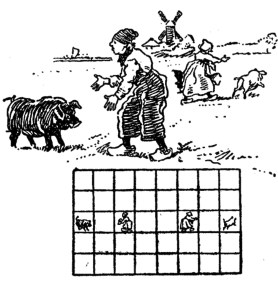
…(ahem) Can the British man and woman in the street be expected to think of themselves as European when, for instance, knowing about the temperament of an ordinary species of farm animal a mere Channel-hop away still probably means you have to be a near genius like the mathematician Ernest Henry Dudeney, a hundred years ago – even after decades of virtual travel by television? See his last line, below, in his puzzle illustrated at the top of this post:

Catching the Hogs

In the illustration Hendrick and Katrün are seen engaged in the exhilarating sport of attempting the capture of a couple of hogs.

Why did they fail?

Strange as it may seem, a complete answer is afforded in the little puzzle game that I will now explain.

Copy the simple diagram on a conveniently large sheet of cardboard or paper, and use four marked counters to represent the Dutchman, his wife, and the two hogs.

At the beginning of the game these must be placed on the squares on which they are shown. One player represents Hendrick and Katrün, and the other the hogs. The first player moves the Dutchman and his wife one square each in any direction (but not diagonally), and then the second player moves both pigs one square each (not diagonally); and so on, in turns, until Hendrick catches one hog and Katrün the other.

This you will find would be absurdly easy if the hogs moved first, but this is just what Dutch pigs will not do.

The Canterbury Puzzles and Other Curious Problems, Henry Ernest Dudeney, 1907