Sorry, Schumpeter, part 2 … John Gardner could have explained why writers cannot be turned into ‘authorpreneurs’


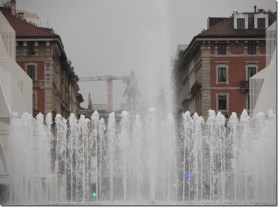
Imagine a writer straining to stay immersed in a narrative unfolding in her mind, set in the Milanese mid-winter -- because she has to keep showing up on social media to tweet about spring -- photograph by MIL22

Imagine a writer straining hard to stay immersed in a narrative unfolding in her mind — a scene set in the Milanese autumn — because she has to keep showing up on social media to tweet about spring
— Statue of the Italian Unification leader Garibaldi on horseback: photograph by MIL22

[ part 1 is here ]

Not at home, yet not exactly travelling, post-Gutenberg offers in this week’s entry a few more reasons for deep bafflement by the sanguine acceptance, in some surprising places, of the idea that writers who are retiring, introverted moles — a large proportion, if not most members of the breed — must transform themselves into booming glad-handers and performers on social networks and lecture podiums, or face failure and inevitable extinction. Quoting The Economist’s Schumpeter column again:

… Last month Simon & Schuster, a publisher, announced it would sell online video courses led by some of its authors. Things are more difficult for fiction writers: the organisers of conferences and other events pay good speaking fees to non-fiction writers with a bit of name recognition, but not to the average novelist.

The 20th-century American novelist John Gardner thought more comprehendingly and revealingly about the essence of what makes a writer, and how writers work, than almost anyone else who has pronounced on this subject. Read these two sets of extracts from his wise, beautiful paragraphs on ‘The Writer’s Nature’ and do, please, post a comment here if you can work out how any of the qualities he describes fit the conformist — anything-for-a-‘like’ — thinking and harmony on social platforms:

I

… As for the quality of strangeness, it is hard to know what can be said. There can be no great art, according to the poet Coleridge, without a certain strangeness. Most readers will recognize at once that he’s right. There come moments in every great novel when we are startled by some development that is at once perfectly fitting and completely unexpected … One has to be a little crazy to write a great novel. One must be capable of allowing the darkest, most ancient and shrewd parts of one’s being to take over the work from time to time.

… If I could explain what I mean here, I could probably do what I think no one has ever done successfully: reveal the roots of the creative process. The mystery is that even when one has experienced these moments, one finds, as mystics so often do, one cannot say, or even clearly remember, what happened. In some apparently inexplicable way the mind opens up; one steps out of the world. One knows one was away because of the words one finds on the page when one comes back, a scene or a few lines more vivid and curious than anything one is capable of writing – though there they stand. … All writing requires at least some measure of trancelike state: the writer must summon out of nonexistence some character, some scene, and he must focus that trancelike state in his mind …

II

… After verbal sensitivity, accuracy of eye, and a measure of the special intelligence of the storyteller, what the writer probably needs most is an almost demonic compulsiveness. No novelist is hurt (at least as an artist) by a natural inclination to go to extremes, driving himself too hard, dissatisfied with himself and the world around him and driven to improve on both if he can.

… By the nature of the work it is important that one way or another the novelist learn to depend primarily on himself, not others, that he love without too much need or dependency, and look inward (or toward some private standard) for approval and support. Often one finds novelists are people who learned in childhood to turn, in times of distress, to their own fantasies or to fiction, the voice of some comforting writer, not to human beings near at hand. This is not to deny that it also helps a novelist finds himself with one or more loved ones who believe in his gift and work.

John Gardner, On Becoming a Novelist, 1983

Sorry, Schumpeter, Ivan Doig could not have been a great literary mage and an ‘authorpreneur’


for Ivan Doig -- postgutenberg[at]gmail.com

for Ivan, who as a small boy tagged along after his father to ‘hire on haying crews’ in saloons
— postgutenberg[at]gmail.com

The Economist should have credited the Australian author Hazel Edwards for her neologism, ‘authorpreneurship,’ in her book published three years ago advising mere scribblers on the importance of turning themselves into scribbler-salesmen to save their skins in the post-Gutenberg transition. In its Schumpeter column on 14 February, the magazine made exactly the same point:

Publishers are increasingly focusing their efforts on a few titles they think will make a splash, neglecting less well-known authors and less popular themes …

Authors must court an expanding variety of “influencers”—people whose opinions can determine a book’s success. … a host of bloggers and social-media pundits …

The trouble with many budding writers is that they are not cut out for this new world. They are often introverts, preferring solitude to salesmanship …

Three years ago, this blog made the identical observation about the mismatch between temperament and the shallow new conventional wisdom about requiring writers to start leading an intensely social existence on digital media. Not, however, about ‘budding’ scribes, but some of the greatest of the great, including Beckett, Wittgenstein and Kafka — at any stage of their careers.

It is surely not beyond the wit of Schumpeter at The Economist and clever-clogs elsewhere, handing out the same prescription — that inwardly-oriented writers must hurry up and turn themselves inside-out — to devise alternatives to it. Alternatives that use the flexibility of digital technology and the net to let the mountain come to Mohammed. That is, adapt the medium for the idiosyncrasies of this category of user.

People leave footballers to be as dim as they wish, never mind how great a leap it would be for humanity if — for instance — David Beckham himself, and not a team of Japanese mechanical engineering experts, had been able to tell us that when he kicks the ball, he is ‘carry[ing] out a multi-variable physics calculation in his head to compute the exact kick trajectory required, and then execute it perfectly,’ or that his brain ‘must be computing some very detailed trajectory calculations in a few seconds purely from instinct and practice’.

Why shouldn’t writers be allowed the incapacities that, for so many, come with doing what they can do?

In its affectionate obituary ten days ago, the Great Falls Tribune — a Montana newspaper of record roughly a hundred miles from his birthplace in White Sulphur Springs, in ranch country — quoted an acquaintance of the literary mage Ivan Doig explaining that he ‘preferred “old school” technology over the instantaneous communications of the Internet age.’

It is impossible to imagine this sublimely modest man, who described himself as an introvert reared among the ‘lariat proletariat,’ writing as he did between tweets and Facebook updates. When not actually writing, in the years that shaped his unique style, he spent hours and days talking to his father and grandmother in variants of a Scots dialect that crossed the Atlantic with their ancestors — conversations that were crucial to bringing richly alive on the page the extraordinary existence they had led together, in his childhood.

What delighted him in 1977, when his breakout book earned him the critical acclaim he deserved, was not the flattering adjectives it collected but what should matter most to a writer — reviewers paying closest attention to his poetic, clear-eyed, all-seeing prose in reviews dominated by ‘long, miraculous patches of pure quotation from This House of Sky’.

This is how that book opens:

Soon after daybreak on my sixth birthday, my mother’s breathing wheezed more raggedly than ever, then quieted. And then stopped.

The remembering begins out of that new silence. Through the time since, I reach back along my father’s telling and around the urgings which would have me face and forget, to feel into these oldest shadows for the first sudden edge of it all.

It starts, early in the mountain summer, far back among the high spilling slopes of the Bridger Range of southwestern Montana. The single sound is hidden water — the south fork of Sixteenmile Creek diving down its willow-masked gulch. The stream flees north through this secret and peopleless land until, under the fir-dark flanks of Hatfield Mountain, a bow of meadow makes the riffled water curl wide to the west. At this interruption, a low rumple of the mountain knolls itself up watchfully, and atop it, like a sentry box over the frontier beneath the sly creek and the prodding meadow, perches our single-room herding cabin.

Alone here on our abrupt tiny shelf, the three of us eased through May and the first twenty-six days of June secure as hawks with wind under our wings. Once a week, the camptender from the home ranch would come the dozen miles of trail to us. The blaze-faced sorrel he rode and the packhorse haltered behind would plod in from the shadows which pooled in our valley under the shouldering slopes, until at last the rider stepped off from his stirrups into the cabin clearing and unknotted from the packsaddle the provision boxes, dark-weathered in their coverings of rawhide, which carried our groceries and mail …

… This post originally stopped at the end of the extract. Then this blog’s most essential reader complained, understandably, about feeling abruptly abandoned by the blogger. But who would interrupt magic, unfolding? Slipping away on tip-toe seemed right …

Will Charlie Hebdo lead the way to media’s still misty, co-owned future?


DSC00476

– postgutenberg[at]gmail.com

[ Late addition: support for an impression of growing disenchantment with hierarchy as a form of organisation came from a surprising source, yesterday. Never mind if it only amounts to a single ‘data point’ — in a short essay by a pilot-turned-architect reflecting on the Germanwings plane intentionally crashed in the Alps earlier this week. See footnote. ]

If ever arguing about a proposal seemed superfluous – because a kindergartener could convince the child on the next play stool of its merits – that would be true of the insistence, by staff members who survived the massacre at Charlie Hebdo, that they deserve ownership stakes in the agent provocateur newspaper, as they risk their lives by carrying on after the bloodbath. An item in The Wall Street Journal last week said:

Some staff members live under round-the-clock police protection, with armored policemen wielding automatic weapons stationed in front of their homes.

Making a paper’s workers co-owners is going only halfway towards what post-Gutenberg sees as a necessary bow to the egalitarian spirit of net-centred life – rejecting hierarchies in favour of structures that value every contribution to the welfare of the enterprise.

Including readers and commenters as co-owners would be even better — certainly do more for economic stability and growth — if enough thought and care were put into adapting the rules and culture of organisations to make sure that efficiency was preserved.

But at Charlie Hebdo, even politically radical major shareholders have, so far, declined to let staffers share the tidal wave of cash flowing into the paper’s coffers – nearly £22 million, since the jihadist attacks on 7 January.

That is, … as far as we can tell. Updates on the dispute are hard to come by because the most famous names in journalism tilting left have been ignoring it altogether. Nothing in The New York Times or Guardian whatsoever, so far, unless we have been typing the wrong terms into search boxes. All the big brand-name papers on the political right have run reports, including three of Rupert Murdoch’s stars — The Times in the U.K., The Wall Street Journal in the U.S., and in his homeland, The Australian — as well as the Daily Mail and The Telegraph.

We are guessing that behind their straightforward news stories on the subject, right-wing editors are sniggering discreetly about idealistic leftie journalists at the French satirical weekly quarrelling about filthy lucre — while co-ownership is an awkward subject for their counterparts on the left, who know that it makes perfect sense, but cannot bring themselves to make any significant move towards it.

The Telegraph report last week said, in part:

Eleven staff members have called for all employees to become equal shareholders in the magazine, setting them up for a battle with the current management.

Charlie Hebdo is currently 40 percent owned by the parents of Charb, the former director of the magazine who was killed in the January 7 attacks, 40 percent by cartoonist Riss, who is recovering in hospital from shoulder wounds and 20 percent by joint manager Eric Portheault.

But one of the Charlie Hebdo journalists, Laurent Leger, stunned the editorial conference on Wednesday by announcing the creation of a group to open talks on an equal division of the magazine’s capital.

[…]

…[H]e said in [a] letter that a more equal division of the funds would allow more “transparency”.

“The wider the control, the more decisions will be taken collectively and that’s better for everyone,” … **

There was an echo of Leger’s words in a post on the website of Harvard’s Nieman Journalism Lab — ‘In media companies, the editorial staff shouldn’t be kept in the dark about finances’ — by Celeste Lecompte, a senior manager at Gigaom, an online American publisher specialising in blogging about technology, which abruptly went out of business earlier this month:

Our industry is undergoing incredible changes, and finding a way to thrive amid the new economic and technology context is critical …. Managers with direct budget responsibility tend to focus on meeting goals and targets in the short term. But when other employees have access to this information, they can contribute to the conversation in different ways, supporting and critiquing strategic efforts.**

If a co-owned Charlie Hebdo emerges from horror of eleven staff members murdered in plain sight, that will be at the top of the class of unlikely geneses – just right for now, with T. S. Eliot’s cruellest month getting ready to breed, from land seemingly beyond resurrection, its improbable lilacs …

Something else in that category, and in the realm of publishing — only a long time ago, in 16th-century Venice, is the life of a co-inventor of italic type. At post-Gutenberg, we find the typeface useful, but would list, at the top of reasons why we have never much liked it, that it is irritatingly spidery and insubstantial and dainty-bordering-on-effete. So. Who collaborated, dear reader, with Aldus Manutius – an early printer, in the Gutenberg hall of fame — in the creation of italics? The answer, a small feast of the bizarre — in a review of an exhibition devoted to Aldus in the NY Times last month — is that he was …

… the type cutter Francesco Griffo, a shadowy fellow who broke with Aldus acrimoniously and then slugged a man to death with an iron bar before reputedly meeting his own demise at the end of a hangman’s rope. Italics, which were intended to mimic the humanist handwriting of the day, first appeared in a modest five words in a 1500 edition of the letters of St. Catherine …

Yes, … italics.

** After we posted this entry, we read an essay by Andrew McGee in The New York Times that — incidentally — made the same point as Laurent Leger and Celeste Lecompte in another sphere – airline safety:

In the 1960s and ’70s, several crashes were judged primarily a result of pilot error, some stemming from the hierarchical relationship between the captain and the co-pilot. Co-pilots were often afraid to challenge the captain’s decisions, and the results could be disastrous. In training, they played us a cockpit voice recording of a co-pilot timidly telling the captain they were running out of fuel; he didn’t mention it again before the engines flamed out.

Inventory-taking time for post-Gutenberg.com

Note on 27.12.2020: This stale and outdated inventory of pG posts will, with luck, be replaced — in some week in which there are fewer excitements than the Great Conjunction of Jupiter and Saturn on the Winter Solstice last Monday. See fuzzy white specks on lower-right margin


 …

Indoors or out, no one relaxes
In March, that month of wind and taxes,
The wind will presently disappear,
The taxes last us all the year.

Ogden Nash, ‘Thar She Blows,’ Versus (1949)

How spring came to be blighted by reckoning is a mystery we must remind ourselves to investigate, some day. At post-Gutenberg — in the spirit of the season — we have been taking stock of what we have been doing in this space. Here is a capsule history:

In 2011, an unexpected development guaranteed an audience for proposals for new economic structures or ‘business models’ for media organisations – such as the scheme with which this blog began. The British prime minister ordered a judicially supervised public investigation of the practices and culture of the British press, in the wake of a scandal about the widespread, routine hacking by reporters at — chiefly tabloid — newspapers of private communications of targets who included celebrities and prominent public figures, extending all the way up to government ministers and heirs to the throne.

In the prelude to this Leveson Inquiry, supervised by Lord Justice (Sir Brian) Leveson — charged with making recommendations for press reform, if necessary — the Lord Chief Justice at the time, Lord (Igor) Judge, made a historic speech reminding his fellow-citizens that:

‘the liberty of the press is the birthright of every citizen, that is, the community as a whole. It is birthright of the citizen that the press should be independent. It is therefore not a right of one section of the community, not just a sectional right.’

Because traditional media in Britain are unhappy about the competition from citizen journalists and feared that the Leveson Inquiry would lead to government regulation of the press — ending the historic independence of the Fourth Estate — this speech went virtually unreported.

But the LCJ’s theme perfectly fit the reasoning behind a proposal for an inclusive ‘keiretsu-cooperative’ scheme as a gentle transition towards, and possible replacement for, the traditional economic structure for media.

The Leveson hearings, commencing on 15 November 2011, were closely monitored by media round the world. In spite of this interest, for several weeks, the traditional British press virtually boycotted or (very) selectively reported on the Inquiry – as if blind to the unique parade of witnesses that included newspaper proprietors, chief editors, famous columnists, leading politicians and ex-prime ministers and their advisers. Post-Gutenberg.com and INFORRM (The International Forum for Responsible Media Blog) — a site administered from London by a prominent barrister, Hugh Tomlinson — and a scattering of other bloggers, ran analyses and long excerpts from the extraordinary testimony broadcast live and in full by the BBC.

The Inquiry helped to establish post-Gutenberg.com’s focus on:

+ what might be gained from harnessing the greater, international inclusiveness of the internet in various spheres – not just citizen journalism, but regular attention to the cultural traditions, achievements and conversations of large and increasingly important countries, such as China and India; challenging mutual biases against literary taste and conventions in English-speaking cultures on both sides of the Atlantic; contributing to the conversation about literature that can and cannot be translated from other languages successfully with detailed, specific examples.

supplying and proposing corrections for biased reporting and analysis by the traditional press – about, for instance, the Snowden leaks, and the subsequent debate about ‘mass surveillance’; and of distortions of the historical record, such as the mistaken assignment to Steve Jobs of credit for the user-friendly technological core of Apple’s well-loved products.

drawing attention to the weakening of democracy and cost to society of a proudly partisan press, parts of which feel under no obligation to present opposing views or information that undermines their positions.

highlighting examples of successful power-sharing in collaborative and consultative organisations, such as cooperatives – and, in more than one post-Gutenberg.com entry, the inspiration that Switzerland and Swiss institutions provide; as well as suggesting how digital technologies might be used to overcome traditional handicaps of democratic decision-making (slowness; difficulty sharing complex information; quarrelling between members of organisations and groups).

non-traditional media organisations and specialists leading and accelerating the pace of the post-Gutenberg revolution – responsible not just the explosive growth of indie e-book and self-publishing, but novel journalistic enterprises operating on schemes closely parallel to the sketch of a keiretsu-cooperative (De Correspondent in the Netherlands, for example.)

chatty, informal, often lighthearted commentary on effects and implications of the transition to a post-Gutenberg world – and nods to the spontaneity, intimacy and friendliness of social media, including entries to mark personal experiences of the seasons and religious holidays.