Should The Guardian be taking its own advice to a beloved London restaurant — to turn itself into a cooperative to keep from going under?

- photograph by MIL22

– photograph by MIL22

Funny to catch The Guardian dishing out, to an old Hungarian restaurant, the same advice that post-Gutenberg has been offering the newspaper for at least two years. Astonishing that The Gay Hussar is the spot just off Soho Square where we, in our dewy twenties – when it still had  genuine ‘socialist’ prices we could afford – ate many of our most cheering lunches in the upstairs room run by Albert, always at the table next to the flower box packed with saucy red geraniums.

But what advice could that possibly be? And why should an institution with the power and heft of this London newspaper pay any attention to an obscure little blog like ours? … Even closer to impossible than improbable, we agree. But scroll down anyway:

Extract from editorial in The Guardian, 25 October 2013: ‘The Gay Hussar in Soho could become a socialist model for today’s politicians’:

The Gay Hussar is … one of the most celebrated venues in the history of the post-war left. On these red plush banquettes, immortalised by the great cartoonists of the past 60 years, Bevanite heroes – Aneurin Bevan himself, Michael Foot, Barbara Castle – would scheme and plot, usually unsuccessfully. But they are long dead now, and the place needs a new owner. To the dismay of the loyal staff, it’s to be auctioned at Christie’s sometime in early December. Time surely to reclaim history and bring its traditional values into a modernised setting.

[…]

The real change would come from a new model of ownership, the previously untried diners’ co-operative … somewhere between the John Lewis model of profit-sharing for the staff and the Co-op model of dividends for regular customers. A socialist model for today’s politicians.

Extract from post-Gutenberg entry, 5 September 2011 — ‘Wanted: a brave newspaper, for an experiment in which readers become stakeholders’ — quoting a commenter reacting to a statistic in an opinion piece:

How would you redesign the ownership of newspapers? How about starting here:

Last month, for example, 51 million individual users clicked into the Guardian site — a number that should please online advertisers.

Great! So what if the Guardian were to let us readers/commenters buy shares in the comments sections of its site?

– Reader commenting on,‘At their best, newspapers became beautiful objects, I shall miss them’

Ian Jack, The Guardian, 24 September 2011

 Extract from post-Gutenberg entry, 6 December 2011: Co-owning media is on the horizon …’:

A stranger, someone astute and entrepreneurial, [said] about a comment posted in a discussion about the future of journalism on the site of Harvard’s Nieman Lab. ‘I think you’re on the right track …’. … He was referring to an outline of a means for old media organisations to move into post-print publishing … The essence of the idea was that every reader’s subscription would also be a share or financial stake in prospective profits. It would be an inducement for each reader or viewer to help bring many more visitors to a site. It would both help the site owner to attract more advertising and – implicitly – reduce dependence on advertising, if the concept of subscription-stakes caught on and went viral.

‘I tried an experiment along [those lines.]  ‘It was a tremendous success … as far as it went.’

[…]

‘Ownership can be transferred at any time. The trick is to have something worth transferring first. … There could be NGO funding possibilities from which a larger community trust with cooperative member ownership could emerge…’.

And that, strangely enough, is very close to the proposal for a ‘keiretsu-cooperative’.  A publishing enterprise with a thriving community of reader-commenters could easily progress to sharing ownership of the commenting sites where readers already supply most of what there is to read or watch.

Come on, Guardian, surely it’s time to take the plunge?

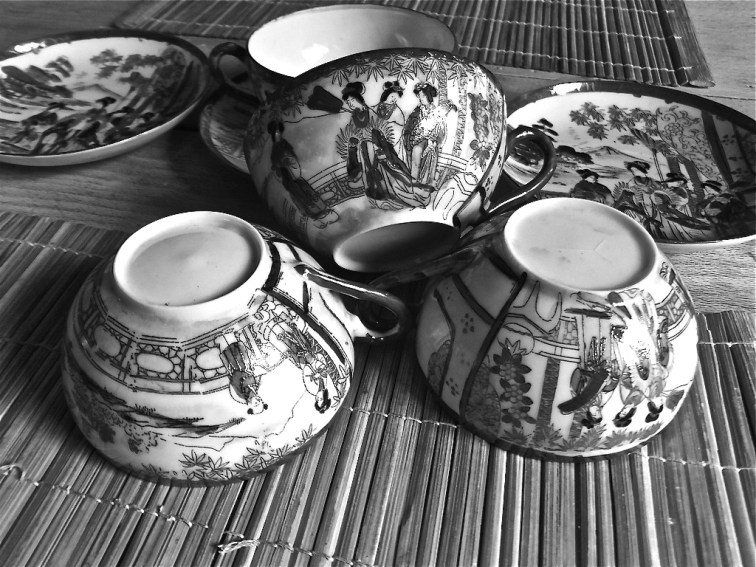
Does copyright law turn art into commodities? part 2: copying China, here, is hardly the right road to take

‘Nonna’s teacups’ – the original (below, by MIL22) displays the Chinese colour sense, something missing from this uncomprehending adaptation

‘Nonna’s teacups’ – the original (below, by MIL22) displays the Chinese colour sense, something missing from this uncomprehending adaptation

chinese cups disarranged 22luckyseeds 9287353120_2a9a94b6cc_b

Surely America, supremely the land of individualists, is the most unlikely destroyer of copyright?

In the home of Thoreau, Walden Pond’s immortal hermit; of Gertrude Stein, so original that she revelled in her incomprehensibility – also the country that reveres the hard act to follow of a Janis Joplin flaring up, dying young, and leaving behind an inextinguishable brilliance – you might expect to read that copyright law is …

… concerned with the moral rights of authors, which are based on the author’s creative sense of self. Moral rights are the author’s right to protect his or her personal relationship with their work.

But no, those thoughts of a lawyer, Anna Spies, were published on an Australian website dedicated to discussions of intellectual property law. She was referring not to the American perspective on copyright, or the antipodean one, but to the historical view of ‘civil law countries in continental Europe.’

Today’s America — or certainly the one envisaged most enthusiastically by its youngest adults — apparently looks forward to adopting Chinese practices that do not, by long-established tradition, place any value on the shaping of work by a distinctive sensibility and the quirks in the exercise of a particular individual’s talent and skills.

This is not a little ironic. As post-Gutenberg’s last post showed, rich countries outside Asia have been showing scarcely any interest in digging down into the roots of Chinese culture and philosophy. Yet intelligent thinkers, with Americans in the lead, are making a case for replacing the glorification of creativity and originality that sparked and drove the Renaissance with deeply Chinese arguments in favour of wholesale imitation, extending to wide-ranging intellectual and commercial piracy. Last month, a Reuter’s blogger with a following among power-brokers was citing a respected scholarly journal when he rallied his fellow copyright opponents:

[L]ook at the Chinese YouTube, Youku, which is displacing television in large part because it has no copyright verification. As Chinese media companies evolve to take advantage of Youku, they will be much better placed to compete in the 21st Century than US companies which rely on copyright laws to keep consumers boxed in to increasingly-unnatural modes of consumption. […]

Chinese piracy also brings innovation within the grasp of a huge population of poorer Chinese, with long-term positive effects for all … [… from …] shanzhai — low-cost copies of items which would not be affordable otherwise.

Like so much else in China, the meaning of shanzhai is undergoing a drastic change. As The Wall Street Journal recently noted, “Once a term used to suggest something cheap or inferior, shanzhai now suggests to many a certain Chinese cleverness and ingenuity.” Indeed, Beijing seems to believe that shanzhai is something to cultivate. In 2009, an official from China’s National Copyright Administration declared that “shanzhai shows the cultural creativity of the common people.” He added, “It fits a market need and people like it”…

Might ‘Yay, shanzhai!’ … have replaced ‘The East is red!’ for sinophiles among those U.S. intellectuals bent on aligning themselves with the future? Anyone interested in reading the curious case for that in the blogger’s source, Foreign Affairs, is blocked by a paywall protecting …well, could you ever have guessed, copyright? This is so absurd, and what we have gleaned of Foreign Affairs’ endorsement of shanzhai so underwhelming, that we see no point in handing over $5. 

‘How the World Benefits from Chinese Piracy’ is the Reuters blogger’s title. Fine, bring it on … if – as he and some of his commenters (below his post) agree – the Chinese pirates’ targets are multinational pharmaceutical giants, or other obscenely profitable and dishonest corporations or business sectors. Unfortunately, it does not stop there, and both the Reuters blog and what we have gleaned of the Foreign Affairs essay fail to impress, for at least two reasons:

• Benjamin Franklin, the American founding father most admired for his inventiveness, is dragged in to sprinkle holy water on intellectual piracy because he ‘made a substantial sum from republishing the works of British authors without permission or payment.’ Surely that has to be reckoned as an act of aggression, not a feat of commercial genius? Franklin’s dislike of his transatlantic cousins is notorious. (See  ‘The fine and noble china vase, the British Empire …’ — or, for a contemporary perspective, ‘Ben Franklin Really Fucking Hated the British …’ in cracked.com.)

•  Once again, it seems, the greed of monster corporations in the music business has been spotlighted to justify depriving, of even their token crusts, the majority of artists and musicians getting by on their equivalents of Grub Street.

Foreign Affairssummary of the essay says:

Traditional music labels have decried the copying of recorded music, arguing that it discourages the composition and performance of new music. According to the authors, that is simply not the case: it is the traditional business model of the labels that is under threat, not the production of music. And copyright was conceived to protect creative activity, not particular business models.

By now, this line of attack on copyright is not merely unconvincing but verges on lazy and boring. Why not pour the mental energy into finding ways to separate the needs of creative artists from the exploitation of copyright by large corporations selling copies of works of art?

The ‘author’s creative sense of self’ to which Anna Spies refers in the Australian blog post at the start of this entry encapsulates what we sensed about an outstanding friend of this blog, as we watched Crofters, a marvel of documentary film-making about a small crofting community in the Scottish Highlands, shot in 1945.

Screenshots from the film ‘Crofters’ (1945) about everyday life in Achriesgill. Seated woman (below) is polishing an oil lamp, her source of night light. Director: Ralph Keene. National Library of Scotland.

Screenshots from the film ‘Crofters’ (1945) about everyday life in Achriesgill. Seated woman (below) is polishing an oil lamp, her source of night light. Director: Ralph Keene. National Library of Scotland.

Screenshots from the film +++Crofters+++(1945) about everyday life in Achriesgill. The seated woman is polishing an oil lamp, her source of night light. Director: Ralph Keene. National Library of Scotland.

Writing movingly about losing his mother, Agnes, in May, John Logan (or, to avert Google-fusion, John A. A. Logan) said on the Authors Electric  site that she was ‘the best person I ever knew’. She is the smallest girl in the party of schoolchildren following their teacher in our still photograph (above) and, her son has told post-Gutenberg, gave his work her enthusiastic, unqualified, unstinting support.

Listening to the lovely concision in the language of folk in Achriesgill, where she lived at that age, you realize that you have heard their echoes in the dialogue in John’s finest short stories, of which we have featured samples, here. In the film, someone is heard speculating about the destination of Nurse McKay, also the local midwife: ‘I wonder, now, where will it be she’s off to in her wee car this morning?’ A female voiceover, in footage of a woman cleaning a lamp: ‘I wonder, now, when will we get the electricity that there’s been so much talking about?’

The anti-copyright crowd insists that all art is ‘remix’ or ‘mashup’ trickery – a bizarre and anachronistic re-definition based on capacities for simulating artistic creation that were impossible before we were given today’s technological equipment. The words of long-dead artists are misconstrued for credibility (of the inattentive):

Although remix has always been an aspect of human culture the phenomenon takes on more significance in the digital age, because of the ease with which a creator of a new cultural artifact can “steal” to use the term from Stravinsky’s observation that all composers steal and the great composers steal the most. Music, text and images are easily transferred from one digital device to another especially because of the Internet which allows this phenomenon to take place on a global scale.

This remix culture means, apparently, that no artist deserves to expect to make anything like a living from his art (a subject that goes unmentioned in the movement’s manifestoes). But, like John’s, any work of literature or art is both saturated with and dictated by family and place – or their rejection; with psychological inheritances and consequences – indistinguishable, in other words, from personal experience and individuality.

It is from studying the techniques of artistic forebears that most arts workers learn how to shape this raw material, which bears the stamp of its influences. That is not the same as puffed up cut-and-paste exercises or shameless copying. Both the ability and opportunity to make use of gifts of personal history and talent are almost always hard-earned – or, as so many biographies testify, when seemingly effortless, can extract the steep price in misfortune that often follows success.

There are Chinese cultural traditions worthy of surpassing respect and even imitation. Why conflate bringing consumer goods — manufactured commodities — and prescription drugs within the reach of poor Chinese, with rights of artistic ownership, depriving all artists of the means to earn the occasional soupçon of calories – if not, as the internet pioneer Jaron Lanier insists, the chance to grow rich?

Why not distinguish between copyright protection for individual creators and corporations hawking the fruits of creativity? Why not help to make micropayments for artists routine — as unremarkable as online shopping? (See: ‘Do we need a campaign for micropayments to support “lyric perception”?’)

Could a pope getting respect on atheist blogs make co-operatives his weapon for fighting poverty?

Might co-ops help to correct Rupert Murdoch’s delusional prediction and become Pope Francis’s silver bullet?

Might co-ops end the reign of press barons like Rupert Murdoch and become Pope Francis’s silver bullet?

It began as a lament about the disposal of a mountain of spring weeds, the conversation that got us thinking about the new Vatican leader’s inaugural promise to ‘embrace with tender affection the whole of humanity, especially the poorest,’ and his wish expressed elsewhere to see ‘a church that is poor and for the poor.’ He sounds remarkably like someone on an Occupy soapbox. But unlike members of that well-meaning but chaotic movement, he has a massive organisation behind him to help point followers in the right direction.

We have been astounded by the evidence search engines supply of wide interest in a Christian spiritual figure among so many typically secular intellectual institutions – The New Yorker, for instance — and stretching as far as blogs like one called Non-Prophet Status declaring, ‘Why this atheist is (tentatively) optimistic about Pope Francis’. Soon, he could win a popularity contest with the Dalai Lama, among non-believers.

There was even a surprise for us close to home. Though there have been no Catholics among our blood relations for three generations, one scrupulously apolitical member of our family about the same age as the pontiff, and paying close attention, insisted last week that the papal mission was doomed. ‘Because,’ he explained, ‘most of the world is poor and always will be. As he won’t be able to make any difference to the impoverished far outnumbering everyone else, why choose certain failure?’

While we considered that opinion, a question occurred to us: what single lever could Pope Francis choose to concentrate on, to prove the pessimists wrong? What might be his equivalent of the Lone Ranger’s silver bullet?

Unexpectedly, an answer suggested itself not long after we heard from a grizzled, kindly Greenlander living on the edge of San Francisco about his reason for being incensed by an argument with his local garbage collector. This rubbish-disposal engineer, on his weekly round, had haughtily spurned, then left behind, several giant plastic bags into which the Greenlander’s neighbours had taken pains to squeeze a towering weed-pile. No bags, he said. Nothing but greenery.

When the Greenlander appealed for mercy — an exception made for neighbours who were still newcomers, the haul-away man said it was time that they learnt the rules.  No, the Greenlander said later, shaking his head, the smelliness of the work did not excuse the man’s unfeeling intransigence. ‘Don’t you know how much money these garbage guys make? A fortune!’

The next person to enter the conversation filled in some fascinating details. He said that the average income of a rubbish collector working for Recology, the dominant garbage company in the region, is $80,000 – or roughly twice the salary of the average American schoolteacher or policeman. Though we have not, so far, been able to check the precise accuracy of that number, we suspect that it is correct, or nearly so, because it was part of a case handled by our informant, a lawyer with a good memory.

We thought this salary fair, and said as much. Imagine the stench for mile after mile, working on a trash-collecting truck in summer heat! But then came a bigger – and even more welcome – shock. Recology is entirely employee-owned. Historically, its workers had ancestry in common with Pope Francis. This cooperative’s website says :

Our company’s roots have always been in recycling and employee ownership.

[…]

The original Bay Area garbage men, or “scavengers”, came to San Francisco from Italy in the late 19th century. At that time, scavenging in San Francisco was a disorderly and inefficient business. Hundreds of independent collectors competed for business. The 1906 earthquake and fire temporarily improved business, but did little to bring order to the chaos of garbage collection.

The website boasts that Recology has an outstanding record for innovation, and one item on the list it offers as proof suggests a startling interest in the radical 1960s Arte Povera (art from poverty) movement in Italy:

The world-renowned Artist in Residence Program in 1990 allowing local artists to find materials in our processing facilities to create art.

… Anyway, we were, as we said, reminded by this chat of Pope Francis committing himself to helping not merely the indigent but ‘the weakest, the least important, …’. Could there be a better salve for the lowly status of garbage-collecting than a bank balance honestly earned through joint ownership?

Post-Gutenberg began as a spinoff of a paper setting out a detailed proposal for saving journalism from the machinations of press barons like Rupert Murdoch through a ‘keiretsu-cooperative’ – owned by workers and customers.

Pope Francis, being a Jesuit, a member of the religious order famous, for centuries, for being frighteningly intelligent, would know about the remarkable success of huge cooperatives in, for instance, Switzerland. He would certainly stand a far better chance of pushing a new cooperative movement than any blink-and-you-miss-it blog like ours, or any of the pundits making the case for employee ownership on newspaper sites often, but to little avail – so far.

How Swiss audience inclusion and a certain sort of nudity might be the key to success for post-Gutenberg media

Diccon Bewes, a member of Swissinfo.ch's five-man Public Council

Diccon Bewes, a member of Swissinfo.ch’s five-man Public Council

Swiss Watching NEW ED

Naked hiking is alarmingly popular, even in winter … Public nudity is not a trauma in Switzerland. Many Swiss bathing areas have FKK (Freikörper-kultur or free body culture; that is, nudist) sections … It’s still not on the German scale, where you never know when the next naked person might appear. Have a picnic in the wrong section of Munich’s English Garden and you’ll never eat another Scotch egg.

Swiss Watching: Inside the Land of Milk and MoneyDiccon Bewes, (2010)

The dispenser of advice on hazardous unclothing, Diccon Bewes, has written the wittiest, most elegantly informative and indispensable manual on today’s Switzerland for English-speaking foreigners. His whirling outline of Swiss history at the start of his book is spliced into an account of a winding walk chosen for historical associations, which gives a reader mnemonic imagery for its highlights. Bewes knows better than to frighten the Swiss, restraining what the glowing review in the Zurich paper Tages-Anzeiger called ‘typically black English humour.’

Yet encoded in his skipping prose is the style of such unforgettable thought-capsules, in 1066 and All That — the unsurpassed (1930) parody of history text-books – as, ‘[King] Alfred noticed that the Danes had very long ships, so he built a great many more much longer ones, thus cleverly founding the British Navy.’ This is specially admirable in a practical guide so astute at gauging what outsiders need to know to survive in a place where English is missing even from multilingual train announcements and museum placards, that every new visitor touching down on a Swiss tarmac could use a Bewes-on-CH (Confoederatio Helvetica) mobile app spun off from Swiss Watching.

Our overview of the visible talents of Diccon Bewes is not offered from any interest in boosting Swiss tourism, or encouraging expatriation to the Alps. He has caught our attention for an entirely unrelated reason. What we outside CH most need from him is a detailed, step-by-step education by an insider in how the Swiss make extreme democracy work, or what Beppe Grillo and the Occupy movements must do to realise their dreams. Specifically, it is media of the Gutenberg era baffled by — and resisting the transition to — post-Gutenberg inclusiveness who most need his assistance. As we have said before –

Techno-optimists are sure that our egalitarian internet that brought you to this blog will flatten power structures in organisations, both online and offline, and usher in an age of extreme democracy. Cynics say that they are wrong. Whisper to them tentatively about, for instance, reorganising the media to make readers and viewers part-owners and managers, and they will roar at you, “Ridiculous! Disastrous! It could never work!’

You must then reply in calming tones, ‘True, if you do it like California, but not if you copy Switzerland.’

So, how exactly do you copy CH? Few English-speakers have either Bewes’s hands-on experience of working with Swiss colleagues inside Switzerland – his home for the last eight years – or gift for cross-cultural explanation, backed by a degree in International Relations from the London School of Economics.

What would make his counsel particularly valuable to future-focused media people is his experience as the English-language specialist on the five-man Publikumsrat or Public Council of Swissinfo.ch – the internet adjunct of the Swiss Broadcasting Corporation (SBC) founded in 1999 that specialises in news about, and of special interest to the Swiss, and crisply-written features that illuminate foreigners. All this, every day, is translated into ten languages.

The style of government that makes Switzerland the world’s most democratic democracy is replicated in organisations of every size and kind in CH – including its many businesses run as cooperatives, two of which make the list of the world’s top twenty-five in sales.

The Publikumsrat gives Swissinfo’s editors and journalists detailed feedback on their choice of subjects as well as on the way these are tackled. It makes suggestions for new topics. It also defends Swissinfo from its detractors.  More than once, in the last ten years, it has led  campaigns to protect it from accountants wielding budget-slashing axes – inspiring ‘Save Swissinfo!’ petitions from as far away as New South Wales, in Australia.

Post-Gutenberg has been browsing on the Swissinfo site for three years. The experience of reading there has been hugely surprising – nothing like the teasing love-letter to CH that Swiss Watching’s tone suggests, but equipping Swiss-bashers with ammunition. Its coverage of the most embarrassing, even humiliating, topics for the Swiss is frank enough to suggest that, more than a mere pastime, nude hiking in glacial cold could be a metaphor for … well, the naked honesty in the conversational style of the Schweizerdeutsch, the German-speaking Swiss who dominate the population. In our experience, they express themselves freely and with graphic precision on almost any subject, even chatting to strangers (unless these are identified as journalists, a reviled profession in CH), as long as they respect basic standards for civility and friendliness.

Part of the reason why Swissinfo’s coverage of topics is startlingly direct is that there is no room for subtle and idiomatic expression in any text that has to scan as well, in the language of its composition, as in its Portuguese, Chinese and Russian versions. Of course, this is also true of the work of the BBC World Service – but the unflinching Schweizer style does seem to make for extra-bluntness.

Readers of this blog can wander over to Swissinfo.ch and see for themselves. We have been stunned by some reports there on the Nazi Gold scandal – in part of which Swiss banks were accused of conspiring to deny descendants of Holocaust victims access to their families’ Swiss bank accounts, or about academic studies blaming lax gun control policies for Switzerland ranking, with America, at the top of the statistics for gun-related suicides. Far from any cover-up, there is a relentless succession of articles quoting critics of gun ownership. This is especially brave in a country in which every referendum on the subject shows the Swiss refusing to be weaned off weapons ownership. (We cannot conceive of a cowardly Swissinfo blackout of news about press reform, if this had the attention of Swiss government leaders.)

Forthrightness – and audience involvement, through the Publikumusrat — could make Swissinfo a model for news coverage in the UK and US, where, as one poll after another shows, public trust in the media has never been lower.

Until recently, the point of having Swissinfo was to help Swiss nationals living abroad stay sufficiently well-informed to make the best possible decisions when they vote remotely in referendums and elections. This part of its charter is no longer as important as demystifying Switzerland for foreigners, because free online editions of so many Swiss newspapers give Swiss expatriates the facts they need.

But doing a good job of serving Swiss voters abroad meant that the information the site supplied had to be politically neutral, or carefully balanced across the spectrum of political opinions. That this approach has not changed, even after Swissinfo’s staff and budget were each cut back last year by roughly a third, only adds to the attractions of the site – since, as this blog has underlined in the past, the reading public prefers to be served news undistorted by politics.

The British press ignores this preference. Both during and since the Leveson hearings on press ethics, one editor after another insisted – invoking  time-hallowed tradition as frantically as the Catholic Church fighting for respect, in recent weeks —  that political slanting has always been part of its lifeblood.

Though mockers of the Occupy movements keep insisting that extreme democracy could never be either practical or realistic, Switzerland, the über-democracy, is proof to the contrary. With its tiny population of not quite 8 million, CH can boast of being not just one of the world’s richest countries but the one at the very top of economists’ table for individual wealth – per (adult) capita.

Here is some food for meditation from Swiss Watching’s chapter titled ‘Ask the audience’:

Walking through the centre of Bern means running the gauntlet of clipboard-thrusting pen holders wanting your name. These aren’t charity muggers desperate for your cash … And the papers are not futile petitions that will be delivered to the government without any prospect of anyone taking notice. This is not Britain. This is Switzerland, where the people have power, and they use it. Collecting signatures is the first step towards a referendum, the basic tool of the direct democracy system. Don’t like a government decision? Then collect names to change it. Want to create a new law? Then collect names to initiate it. Hate minarets? Then collect signatures to ban them [ … ]

For outsiders, it’s hard to imagine how a country can function if every law and government action is subject to a government vote. For the Swiss, it’s hard to understand how any country can be run without just that. […] The Swiss people can initiate legislation or destroy it; they can force the government into new policies or reject decisions it’s already made. No one person or party ever has complete control – the people do. Forget China and North Korea; if any country deserves to be called a People’s Republic, it is Switzerland.

Swisscellany 300 dpi for web