Must journalists and writers wait for salvation in heaven, or Godot? Facebook cares more about helping publishing businesses than creators


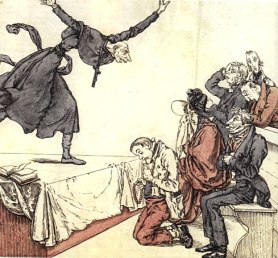
This gorgeously illustrated 1997 essay in The New York Times is proof that the destruction of the livelihood of print journalists began long before the digital revolution in publishing. - Graphic by Phillipe Weisbecker

This gorgeously illustrated 1997 essay in The New York Times is a marker in the destruction of print journalists’ traditional means of economic survival — which began before the digital revolution in publishing.
– Graphic by Phillipe Weisbecker


‘Genius has patience,’ Michelangelo reportedly said, but how much patience can reasonably be expected of ordinary mortals? This week’s announcement by Facebook of a clever ploy for co-opting some of the most famous print newspapers into serving its own ambitions led post-Gutenberg to re-read a passage about waiting for salvation in heaven in Wuthering Heights. What saves the chapter from soppiness is that Cathy, like any actual, lively little girl, frequently has to be scolded for cheekiness by her father, the beneficent Mr. Earnshaw, and this happens just before he dies, when she and her darling Heathcliff — who has yet to turn into the über-monster of romantic fiction — are close by. A few hours later the housekeeper, Nelly Dean, checks on them.

I ran to the children’s room: their door was ajar, I saw they had never lain down, though it was past midnight; but they were calmer, and did not need me to console them. The little souls were comforting each other … no person in the world ever pictured heaven so beautifully as they did, in their innocent talk; and while I sobbed and listened, I could not help wishing we were all there safe together.

Why will drawing such a parallel make strange, bordering on bizarre, reading for anyone not closely acquainted with journalism and the writing life? Because no one has been broadcasting the harrowing stories of bottomless insecurity, agony, havoc, misery and ghastly compromises in the private lives of journeymen scribblers who have been mown down by the juggernaut of online publishing.

Why not? Pride. Denial. Never-say-die bravado that makes affecting Beckettian irony and superficial detachment, when discussing the topic at all, preferable to bleeding onto the carpet. If there has been a richly documented multi-part series on this subject in a well-known newspaper — some counterpart of award-warning coverage of, say, the suffering of iron and steel factory workers in the West put out of work by foreign competition, or about shamefully exploited and underpaid electronics and garment industry workers in the East – post-Gutenberg has somehow missed it.

Numbers — related not to journalists but their comrades in the making of books — are the chief evidence of the despair on which no one is reporting noticeably.  A headline in the Guardian last month inspired by a University of London study of writers’ earnings read, ‘Median earnings of professional authors fall below the minimum wage’. [p-G’s emphasis] Most shocking was that ‘17% of all writers did not earn anything at all during 2013,’ even though ‘98% of those authors had published a work every year from 2010 to 2013.’

A report earlier this month on a panel discussion of the same subject organised by the American Authors Guild stated that preliminary results of a similar survey of U.S. authors revealed that …

… 49% of U.S. authors assessed their writing income has decreased over the last five years. Respondents’ median writing-related income decreased 24% in that time frame, to $8,000, while they spent nearly 50% more time marketing themselves and their work.

Now, here comes Facebook, bearing gifts – none of them directly designed to help reporters, writers and editors, working in-house or as freelances, or any other actual creators of the stuff of news, as opposed to media owners and their financial managers and overseers:

This week, Facebook launched Instant Articles, a feature that allows publishers to host their news stories and content directly on Facebook. For consumers, this is a much faster, richer, and easier experience for reading articles directly on their News Feeds and primarily on mobile. For Facebook, this is a big improvement to the user experience and to its app “stickiness.”

That is an extract from a report in Forbes the old ‘capitalist’s tool’, and the business-and-technology section of the NY Times said:

The news publishers can either sell and embed advertisements in the articles, keeping all of the revenue, or allow Facebook to sell ads, with the social network getting 30 percent of the proceeds. Facebook is also permitting the news companies to collect data about the people reading the articles with the same tools they use to track visitors to their own sites.

For publishers, the Facebook initiative represents the latest in a series of existential balancing acts. The social network, which has more than 1.4 billion active users worldwide, captures more attention of mobile users — and prompts more visits to news sites — than virtually any other service.

While we seem to be watching Mark Zuckerberg lead newspaper bean-counters to the Promised Land, a piece of news about him at the week’s end was hardly what those of us worrying about media concentration and mogul megalomania wished to see. Maybe his intentions were all-virtuous; maybe not:

 …Facebook founder Mark Zuckerberg has responded to Ukrainians’ complaints about “unfair” deleting and blocking of their Facebook posts and accounts. The tech boss says they were too hateful.

In a Thursday Q&A session, Zuckerberg dismissed claims of Russian influence being behind the blockings. He was responding to a complaint that had garnered almost 50,000 likes. …

Post-Gutenberg would be infinitely more comfortable with decisions about censorship made by a moderation panel made up of democratically elected Facebook users than unilaterally, by the big chief himself. Once Zuckerberg has enough newspapers beholden to him, will he prove capable of resisting corruption by excessive power?

We prefer Google’s openness to new conceptions of media organisations and digital publishing: 

Google is spearheading the creation of a new fund that will give grants to European news organisations that are creating “high-quality journalism.”

The new Digital News Initiative (“DNI”) is being launched as a partnership with eight European newspapers: Les Echos, FAZ, The Financial Times, The Guardian, NRC Media, El Pais, La Stampa and Die Zeit.

The money will not be spent at those titles. Rather, they will advise on the spending of a €150 million fund to help news organisations “demonstrate new thinking” in digital journalism.

Google is also going to invest in training and research for journalists, including staff in London, Paris, and Hamburg who will train newsrooms in digital skills. It will invest in training partnerships, as well as funding research into digital journalism. …

About time, too. A 1997 article that turned up in forgotten clippings files about a year ago reminded us that digital disruption has merely accelerated the destruction of traditional publishing that began decades ago. In ‘The Writer Is Dead. But His Ghost Is Thriving,’ Jack Hitt anatomised the train of events through which scribblers ghosting books for celebrities earned the living wages they no longer could, writing under their own names.

With any luck, the spheres of exploration in Google’s Digital News Initiative will include co-owned media — the subject about which this blog drones on tirelessly. Leaving out the cooperative idea, which has the support of the wildly popular Pope Francis, some Charlie Hebdo staffers and the rapper Jay Z  — a group diverse enough to have been imagined by a lunatic — would make not the smallest particle of sense.

Also for paying attention to the needs of creators of all stripes, we would like to see Facebook and Google do more in copyright protection, so that tragedies of throttled creativity, such as the one described in this outstanding contribution to the bulletin of the venerable Authors Guild, can be averted:

… In the nineteenth century, American magazines printed pirated British prose rather than pay American writers; the practice stunted the emergence of a national literary culture. We could read Dickens without paying him; was that worth sending Melville to work in the Customs House? Who knows what he might have produced with greater financial security? In my case, I planned a really expansive digital edition of my next book, with dynamic interactive maps, embedded with videos, and ways for readers to explore the intertextuality of this book with my previous two. But why send readers to an edition that will earn me less than the hardcover, that will be pirated immediately, and that Google might appropriate? I’m not running a charity. That is a digital work that will not come to be, because of piracy and the attacks on the value of digital creations.

T. J. Stiles, ‘Among the Digital Luddites,’ Authors Guild Winter 2015 Bulletin 

Kudos to The Register for dusting off its 2004 prediction that the spooks would soon take to watching us with Google’s panoptic lens

It should be general knowledge that newspapers spy on readers: Guardians that live in King’s Cross glass houses should not throw … - photograph by MIL22

It should be general knowledge that newspapers spy on readers: Guardians that live in glass houses should not throw … (ahem)
– photograph by MIL22

Guardian HQ, King's Cross -- photograph: vice.com

The Guardian, King’s Cross, London
photograph: vice.com

Why does this blog, post-Gutenberg, care about the mass surveillance kerfuffle? Mainly for the fun of noting the post-print 5th Estate — bloggers, reader-commenters, chatters on geeky online forums and other small voices — exposing the misinformation delivered in confident, booming tones from sections of the old media establishment, the 4th Estate.

A usually intelligent American friend uncharacteristically obtuse about government surveillance – we’ll call him Playah, in this post – believes the misinformation, distortions and mis-cueing. He takes as virtual gospel all the pompous finger-pointing at US and UK spooks for supposedly inventing Orwellian-grade spying on us. He really does believe that the secrets leaked by Edward Snowden matter because they are news – not, as we do, because of their vast destructive scale and specificity, apparently designed to maximise their usefulness to enemies of the Anglosphere and its allies.

In his misplaced trust, Playah has millions of others for company – people, some of them rather important, who ordinarily pay so little attention to conversation in the techie world as to be willingly taken in by Al Gore’s claim to have invented the internet, or the canard that gives Steve Jobs credit for the computer revolution (discussed in an earlier entry here).

We include obscure techie publications like The Register in the 5th Estate. No one – certainly at The Guardian – has given any sign of having seen a piece dated 7 November, titled, ‘How Google paved the way for NSA’s intercepts – just as The Register predicted 9 YEARS AGO’.

We only stumbled on it serendipitously, in checking search engines for our own remarkably similar (non-prescient) post on the subject last week.

Much hilarity has greeted [Google chairman] Eric Schmidt’s deeply sincere “outrage” at his “discovery” that the NSA was spying on Google. For example, Vanity Fair pointed Mr Schmidt to some helpful Google searches.

But the NSA is merely treading in some well-worn footsteps – some of which were made by Google itself. Let us refresh your memory of one of the most prescient and chilling pieces of prediction in the last decade. For all this was forecast here at The Register in early 2004 – nine years ago.

In early 2004, Google launched Gmail. Gmail performed an automated interception of your email, and – having scanned the contents and guessed at its meaning – ran contextual advertising alongside it.

Former security advisor Mark Rasch, an attorney who had worked in the Department of Justice’s cyberfraud department during the Clinton administration, and was writing for Security Focus, raised a very interesting problem. If Google could search through and read your email without explicit legal authorisation, then surely the security agencies could do the same.

Rasch argued that Google had redefined the words “read” (“learn the meaning”) and “search”, which protect citizens, when it unveiled its new contextual ads service. It had removed explicit human agency from the picture. An automated search wasn’t really a search, and its computers weren’t really “reading”.

“This is a dangerous legal precedent which both law enforcement and intelligence agencies will undoubtedly seize upon and extend, to the detriment of our privacy,” forecast Rasch, here, in June 2004.

“Google will likely argue that its computers are not ‘people’ and therefore the company does not ‘learn the meaning’ of the communication. That’s where we need to be careful. We should nip this nonsensical argument in the bud before it’s taken too far, and the federal government follows.”

Remarkably, Rasch even suggested where the security services might most effectively put this into practice.

“Imagine if the government were to put an Echelon-style content filter on routers and ISPs, where it examines billions of communications and ‘flags’ only a small fraction (based upon, say, indicia of terrorist activity). Even if the filters are perfect and point the finger only completely guilty people, this activity still invades the privacy rights of the billions of innocent individuals whose communications pass the filter,” he wrote. “Simply put, if a computer programmed by people learns the contents of a communication, and takes action based on what it learns, it invades privacy.”

Well, fancy that.

… What else isn’t news in the great surveillance exposé of 2013? Well, surely it’s about time The Guardian told us all about its surveillance of its own readers, mentioned here (again), one entry ago? And isn’t the bigger story that everyone is going to be spying on everyone else, very soon? Here is another overlooked techie, Jamais Cascio – trying to draw attention to our perfectly horrible privacy-free future in a lecture on 4 May 2005 titled ‘The Rise of the Participatory Panopticon’:

Soon — probably within the next decade, certainly within the next two — we’ll be living in a world where what we see, what we hear, what we experience will be recorded wherever we go. There will be few statements or scenes that will go unnoticed, or unremembered. Our day to day lives will be archived and saved. What’s more, these archives will be available over the net for recollection, analysis, even sharing.

And we will be doing it to ourselves.

This won’t simply be a world of a single, governmental Big Brother watching over your shoulder, nor will it be a world of a handful of corporate siblings training their ever-vigilant security cameras and tags on you. Such monitoring may well exist, probably will, in fact, but it will be overwhelmed by the millions of cameras and recorders in the hands of millions of Little Brothers and Little Sisters. We will carry with us the tools of our own transparency, and many, perhaps most, will do so willingly, even happily.

I call this world the Participatory Panopticon.

The Panopticon was Jeremy Bentham’s 18th century model for a prison in which all inmates could be watched at all times. The term has in more recent years come to have a broader meaning, that of a world in which all of us are under constant surveillance.

continues … ]

… Perhaps the blogosphere is beginning to make progress with essential de-bunking. Headlines demanding ‘transparent’ spying by spies, and close monitoring, by us, of decision-making by the loftiest administrators of espionage, have been getting less common, lately. The headline-writers have presumably begun to realise that even less attentive members of the public – such as our friend Playah — have begun to see these for what they are: quite simply, daft.

What is a blog, in 2013? More parlour than platform, perhaps

Bloggers can ‘speak truth to power’ as idiosyncratically as caricaturists  – An 1834 protest against corrupt clerics by the Swiss artist Martin Disteli: Wikimedia Commons

Bloggers are free to ‘speak truth to power’ as idiosyncratically as caricaturists
– an 1834 protest against corrupt clerics by the Swiss artist Martin Disteli: Wikimedia Commons

Blog posts can be as intentionally -- and unintentionally -- revealing about bloggers as parlour furnishing was about a house’s occupants

Blog posts can be as intentionally — and unintentionally — revealing about bloggers as parlour furnishing was about a house’s occupants

In 2013, a blog post — whether buoyant or morose — can tell you nothing about a blogger’s actual mood or state-of-life, unlike the exhibitionistic diaries that people originally thought web logs would be. The time has come to toss out stale do’s and don’ts about blog-running. A blog does not have to be run like a newspaper, newsletter or magazine for bloggers to supply information in the public interest . It can do its bit towards changing the world without round-the-clock, daily, or even regular posts – as long as it is written with care, and its existence is recognised by search bots.

It might or might not attract commenters, depending on whether a blogger has the time or inclination to chat with visitors and — on serious subjects that matter greatly — visitors’ willingness to risk looking foolish, or face the unintended consequences of comments discovered by their near-and-dear, employers or workmates.

Boosting site traffic is of keenest interest to bloggers blogging strictly in the hope of blog monetisation – which, as things stand, would mean that Florence Nightingale, if she were a contemporary, would have to shrink anything she had to say about medicine to thought-capsules insinuated between large nude ‘selfies’ in which strategically positioned cat pictures hid her peekaboo bits, all of this framed by cosmetics and fashion ads. She would need to devote rather more energy to luring ‘likes’ than to nursing.

It struck us that in 2013, although free – unmediated – expression is the aspect of blogs that gets the most attention, a blog today might be even more like a Victorian parlour than a soapbox or pulpit. But what was our idea of a parlour? A sort of outer sitting- or living-room, we thought – inviting, yes, but rather formal, and offering not so much statements as hints about the inner lives and passions of a household, for which it served as a sort of shield. It was mostly furnished in conformity with the taste of the era, epitomised by an ornamental, straight-backed chair. This is not to say that we think of blogs as typically stuffy or prissy – only that most bloggers are on sites hosted by the likes of WordPress, Blogger or Tumblr, using designs and organisation schemes that these hosts supply, which closely reflect contemporary taste.

But what of the original parlour, we wondered. The Wikipedia entry had this surprise – borrowed from the Oxford English Dictionary:

Parlour derives from the Old French word parloir — or parler (“to speak”), and entered English around the turn of the 13th century. In its original usage it denoted a place set aside for speaking with someone, an “audience chamber”.

We got curious, and dug further into ideas about the purpose parlours had served in the past. Should we forget all about Victorian parlours, now that we knew that they were relatively recent evolutions of a much older idea?

The parlour was of considerable interest to the Victorians … and it appears in Victorian genre painting and fiction as a newly significant space … [T]he parlour, whether in life or in art, is a site at which we can explore potentially explosive disturbances in psychic and social fields and can trace attempts both to articulate and resolve such differences.

The Victorian Parlour: A Cultural Study, Thad Logan, Cambridge University Press, 2001

Curiouser and curiouser. Very much like blogs, then – if Thad Logan’s suggestion is warranted, as we intend to find out when we read her book.

Net democracy: the great science magazines value readers’ comments, but a pop-sci counterpart shuts down discussions and criticism

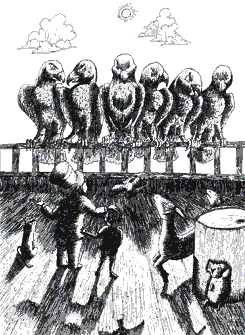
Reader-commenters are vacuous birds of prey for some members of the media's old guard - drawing by Hugh Lofting 1886-1947

Reader-commenters: vacuous birds of prey, to media’s old guard
– drawing by Hugh Lofting (1886-1947)

‘My user names and passwords … ’ the wrinkly figure in the drawing wheezes at the heirs leaning over his bedside, in a recent addition to Private Eye’s ‘Modern Last Words’ series. ‘I want you to continue my work as the most hated troll on the internet.’

Trolls. Harpies. Brainless vultures. Vacuous attack dogs. Surprisingly often, it is not just the media’s old guard but political liberals in occupations unrelated to publishing – status-obsessed and change-resistant types – who froth at any mention of commenters on media web sites. As this blog began with a proposal for newspapers to evolve into sites partially owned by reader-commenters, we at post-Gutenberg have been flabbergasted by reflexive references to public debate in these spots as unintelligent – usually, from people who have never devoted enough time or effort to ‘below the line’ conversations to discover how often these are more informative than the articles or posts that initiate them.

Imagine how amused we were to learn from a New York Times report last week about the reactions from illustrious upmarket competitors of Popular Science to the news that this magazine was shutting down commenting on its web site altogether. This is hardly a move you would expect from a publication whose headlines appear to be written by a teenager desperate to win a popularity contest: ‘Giant Carnivorous Plant Found In Silicon Valley,’ for instance, or ‘Eating Yogurt Does Weird Things To Your Brain’.

Grave as a sermonising clergywoman, Suzanne LaBarre, the magazine’s ‘online content director’ justified the decision to return to print media’s traditional one-way dialogue:

Comments can be bad for science. That’s why, here at PopularScience.com, we’re shutting them off.

It wasn’t a decision we made lightly. As the news arm of a 141-year-old science and technology magazine, we are as committed to fostering lively, intellectual debate as we are to spreading the word of science far and wide. The problem is when trolls and spambots overwhelm the former, diminishing our ability to do the latter.

That is not to suggest that we are the only website in the world that attracts vexing commenters. Far from it. Nor is it to suggest that all, or even close to all, of our commenters are shrill, boorish specimens of the lower internet phyla. We have many delightful, thought-provoking commenters.

But even a fractious minority wields enough power to skew a reader’s perception of a story, recent research suggests …

Really. In a justification that  revealed the power of intelligent and articulate readers as her real fear – an argument that would delight dictatorships all over the world, she added:

[C]ommenters shape public opinion; public opinion shapes public policy; public policy shapes how and whether and what research gets funded–you start to see why we feel compelled to hit the “off” switch. 

Her reasoning did not impress science magazines with a serious interest in science. Snippets from the NY Times story – for which that newspaper must be congratulated:

Fred Guterl, the executive editor of Scientific American: ‘I have to say I don’t think comments are bad for science. To a point I think it’s good when people talk about things and try their ideas out. Social media can go off the rails but I don’t think comments are worse than Twitter.’

Noah Gray, senior editor at Nature:

“There’s no doubt that uncivil discourse is bad for science,” Dr. Gray said by e-mail.

But, he said, comments can be very valuable, sometimes pointing out errors or alternative interpretations of the facts and theories presented in the article.

“The comments section can often express the openness of scientific debate,” Dr. Gray said, adding, “Removing this channel for feedback rather than exploring an alternative means to improve it simply ignores the problem.”

A reaction from a NY Times reader-commenter seemed especially apt:

Laird Wilcox, Kansas

I suspect that an individual’s capacity for objectivity depends upon their ability to entertain conflicting values, opinions and beliefs without feeling threatened by them. When you find someone who “can’t stand” another’s “ignorance” you may be dealing with an insecure bigort[sic] who fears contradiction or is woefully unsure of themselves.

But some egotistical old media professionals apparently cannot stand readers discussing their work as incisively as in this delicious exchange between Popular Science commenters – about a 2009 piece titled, ‘Could There Be A Planet Hidden On The Opposite Side Of Our Sun?: We ask a scientist who has peered around it.’

bdhoro87

04/20/2009 at 11:01 am

Behind the sun? This article is tempting me to use a lot of profanity. We travel to the other side of the sun and back every year, what does behind the sun mean? Behind the sun with respect to earth? So like where the Earth would be half a year from now? Or on a different axis or what? All logic tells me is the sun doesn’t have a front and behind… its pretty spherical and it rotates. Was this a search for a planet that maintains the exact orbit of earth but 180 degrees out of phase? Can someone please clarify how the sun could have “sides” and where “the other side of the sun” is?

Loschen

04/20/2009 at 12:07 pm

I’m guessing that what they mean is it revolves at the same speed as the earth but stays on the exact opposite side of the sun. Therefore, it is perpetually out of normal sight for earth. But, that’s just how I read and understood it. you’re right they didn’t do a very good job of clarifying…

qlmmb2086

04/20/2009 at 2:33 pm

One thing people need to realize about PopSci is that these are not scientific articles. It’s similar to, say, a CNN reporter writing an article on a scientific discovery; these are written by journalists, not scientists.

That having been said, this article does seem kind of pointless… Why bother debunking a theory about a hidden planet synchronized with earth’s orbit, when nobody thinks that anyhow? You may as well write an article to show that the earth isn’t flat.

… We can hardly type for laughing …