Christo preceded Banksy in wresting material security or ‘business models’ from ephemeral, unshackled art — offered to all with no admission fee

Christo married nature to the built world with a modernist eye for straightforward surrealism — going beyond the real — in art that often abstracted bits of pattern or contour from a landscape, then displayed his ideas there temporarily by covering up great hunks of it in fabric, or by fastening objects onto it ( See: samples )

Banksy’s stencilled goat (L) compared to an American Indian cave painter’s freehand rendering of a nanny goat kidding with human aid, a pictograph that could be six thousand years old

Christo could have no equal in his extravagantly inventive reinvention of payment for art. Applying artistic license to finance, he exercised it to the limit. Heaven only knows how he worked out his methods of getting paid not for his barely-there/short-stay/vanishing/ephemeral works of ‘land art’, seemingly dreamt up at their gargantuan scale by giants — in fact, by a bespectacled figure as slight as an idea still being translated into flesh — but mainly for his creations’ equivalents of amniotic sacs, their eggshell-fragments, their tadpole tails. 

Getting paid, that is, without government arts-and-culture grants or fat cat patrons or by lending his face or images of his creations to purveyors of luxury goods, to flatter their status-seeking buyers by association. If there were artists before him who showed him how to thrive by unconventional means, they go unmentioned in encyclopaedia entries, journalists’ potted biographies, and on Christo fan sites. 

Christo as the signature not noticeable on projects such as Wrapped Coast in 1969 — in which an entire small bay and its cliffs in Australia were draped in grey erosion-control fabric for ten weeks — eventually referred to both the primary mover and his collaborator and wife, two artists born in different countries on the same June day in 1935. 

They were married in the late 1950s in Paris, where he had arrived by way of Vienna and Geneva, having fled Bulgaria, where he was born, as a penniless 21 year-old stowaway on a railway car — to escape military conscription and being forced by the Communist government to paint propagandist imagery. She was a Moroccan-born socialite living there, the stepdaughter of a distinguished French general, when he was commissioned to paint a portrait of her strikingly beautiful mother.

Her family’s wealth was probably the psychological safety net for the Christo partnership’s confident, early rejection of the usual ways of earning money for art to seek alternatives. His contribution was psychological drive — motivation that children of the well-off typically do not find on their own. It originated in dire family travails and his own struggle for free expression in Bulgaria, where his father had been imprisoned ‘for being part of the intelligentsia,’ leaving a household that had been prosperous impoverished and subjected to oppressive state surveillance.

Combining actual names for credits would have hinted at these complex antecedents but made an indigestible nomenclature soup: Christo Vladimirov Javacheff and Jeanne-Claude Denat de Guillebon. 

Part of their earnings came from the sale of original lithographs related to their creations; the rest from purchasers of the sketches and collages, preparatory drafts, plans, and scale models of their spectacular finished works — for whose execution they hired other hands, or accepted help from volunteers. They insisted that their contributions to art should be seen as encompassing their exhausting extended battles to overcome public and governmental opposition to realising their imaginings — most famously, a fight for nearly a quarter-century ’across six Bundestag presidents,’ for permission to wrap old imperial Germany’s Reichstag, its supreme government building, still serving in that role today.

Some of us spent the end of summer waiting for any plausible cultural commentator to invoke Christo as the crucial predecessor — part-inspiration, surely? — of Banksy, the pseudonymous and elusive street artist-cum-prankster from Bristol who cheered everyone up after the mass rioting following Britain’s change of government in July.

The goat mural that attracted worldwide attention in early August was obviously in the stencilling tradition he is so proud of — because it lets him put up murals he has worked on in his studio at top speed. Not so as to shine as a time-and-motion virtuoso, but to avoid getting arrested. He could still work fast and stealthily in a freehand line but, no, he prefers the mechanical look of stencils with none of the élan or genius of the cut-outs Matisse turned out like hotcakes in his old age. These Banksy templates actually look as if they were never drawn at all but traced from documentary photographs, reminding the viewer of his reputation as a copycat’s copycat — since stencilled graffiti have been associated since the early 1980s  with a Parisian artist, Blek le Rat, who has complained mildly about the imitation.

None of this is to deny the charm or wit in Banksy’s antic political protests, from his very first graffito in 1997, a mural with a cartoon teddy bear hurling a Molotov cocktail at hapless riot policemen.

Like Christo, Banksy also earns his money — millions of pounds a year, it is said in unsubstantiated reports — by thumbing his nose at traditional sources of income for art. (He could be an invisible man with no visible means of support except for the unavoidable conclusion from visits to art world sites, that he and mainstream media have an unofficial pact to keep the wheeze about his indeterminable identity going for as long as possible, to give us something to smile about.)  As a street artist determined to avoid being dictated to, exploited or edited by gallery owners, he sells representations or versions of his murals — ‘stencil works, silkscreens, and lithographs rendered in the same style as his wall pieces, and in many cases [using] the same imagery’ — according to a long, absorbing and apparently well-informed account of his ‘business model’ on Art Space’s website

He seems never to have sought to stop ‘art dealers and property owners … tearing apart walls to remove and sell Banksy works.’ For a span of years ending in 2018, he collaborated with other graffiti specialists to sell modestly-priced prints of their images through a printshop and website. That collective, Pictures on Walls, was shut down six years ago with this impressive statement:

Inevitably disaster struck—and many of our artists became successful. Street Art was welcomed into mainstream culture with a benign shrug and the art we produced became another tradeable commodity. Despite attempts at price fixing regrettably some POW prints have become worth tens of thousands of pounds. 

Either unable or unwilling to become part of the art market we once so self-righteously denounced — we called it quits.

Banksy apparently continues to circumvent the art world’s mercantile establishment by selling his work exclusively through private arrangements with buyers — again, according to Art Space’s worshipful exegesis.

Search engines produce few or no results for simple queries combining Christo’s and Banksy’s names — yield no evidence of anyone noticing their similarities. A list of rough jottings:

— art displayed for no charge in public spaces — playfulness/ a spirit of fun even when protesting about collective obtuseness/social injustice

— earn money (lots) from tangentials, incidentals and representations of — not the works themselves 

— art that is not made with permanence as the objective 

— BUT is also part of a personal fight against authority of some kind — for C, with governments or collective administrators; for B, against gallery owners and other ruling powers in art merchandising establishment

—  art that offends some — B’s sometimes referred to as defacements or vandalism; C’s infuriated eg., Parisians who objected to the wrapping of the Arc de Triomphe, and it took decades to overcome objections to several public projects, even when he and Jeanne-Claude won

Christo and Banksy matter naturally to this p-G website because financial innovation for a different category of arts worker is the point of the proposal for a keiretsu-cooperative — a constructively social, egalitarian scheme for using the internet to nudge publishing into its post-Gutenberg future.

Alas, no writers appear to have accomplished what these artists have in setting their enviable terms for making art pay, and handsomely. 

This is less true of Christo — who survived Jeanne-Claude by eleven years and died in 2020 — than of Banksy, who does not lend his image or scraps of autobiography to hawking his pictures. What contemporary, real-life equivalent is there of the wholly fictional M. N. Opie, a gifted, principled storyteller in a new novel by Neel Mukherjee, who ‘refuses to jump through the hoops of book promotion, will discuss editorial matters over email but avoids social media and will volunteer no personal information, not even a gender’? The LRB reviewer, Adam Mars-Jones, believes like most professional novelists that they are powerless to oppose being required to appear before the public like plucked chickens: ‘These days self-promotion, the business of presenting to the world your trauma or cheekbones (ideally both) is not optional …’. Brilliant M. N. Opie’s story collection does not find enough readers to save it from imploding into utter obscurity.

We must reach once again to the past and a certain Elizabethan playwright for an example of a scribbler soaring above the constraints and humiliations bedevilling writers to succeed in a bold new way of earning a living — the subject of a p-G post in March. Jonathan Bate — the Shakespeare expert whose deductions about the Bard’s financial acumen from decades of research featured there, effectively makes a case for Shakey being a sort of Banksy avant la lettre, for his own reasons. 

The dearth of verifiable flesh-and-blood facts about the man from Stratford-on-Avon, Bate suggests, is not in the least accidental. It is what he intended for posterity. Philosophy in Shakespeare’s day was conditioned by the Greeks and Romans. They warned about the double-sidedness of fame; that with glory comes Rumour, ‘the evil of the highest velocity,’ envisaged as a shameless surveillance she-monster whose body is pocked all over with ‘vigilant eyes’. Bate singles out Epicurus as the crucial influence — homing in on ‘the Epicurean precept that would have been the perfect motto for Shakespeare: “HIDE THY LIFE.”’ [ JB’s emphasis ]

That could hardly be an injunction for the rest of us, now. What defence has the resourceful Banksy himself against the ever-intruding snouts of the data collection apps in our devices, the treacherous software in the internet of things; against our collectively spineless, toothless — or uncomprehending — submission to an AI-ruled future? Or does Banksy rely on human couriers networking with carrier pigeons to communicate, and post on Instagram through intermediaries? Questions for a future p-G installment.

Proofs of concept for a keiretsu-cooperative to succeed the data collection and ad-dependent legacy publishing model— from TikTok, the online Daily Mail … and Shakespeare

By becoming a shareholder in an acting and theatre-owning joint-stock company, Shakespeare — a ‘country boy’ outsider — ‘was the first to turn playmaking into a potentially rewarding profession’ — Soul of the Age: A Biography of the Mind of William Shakespeare, Jonathan Bate

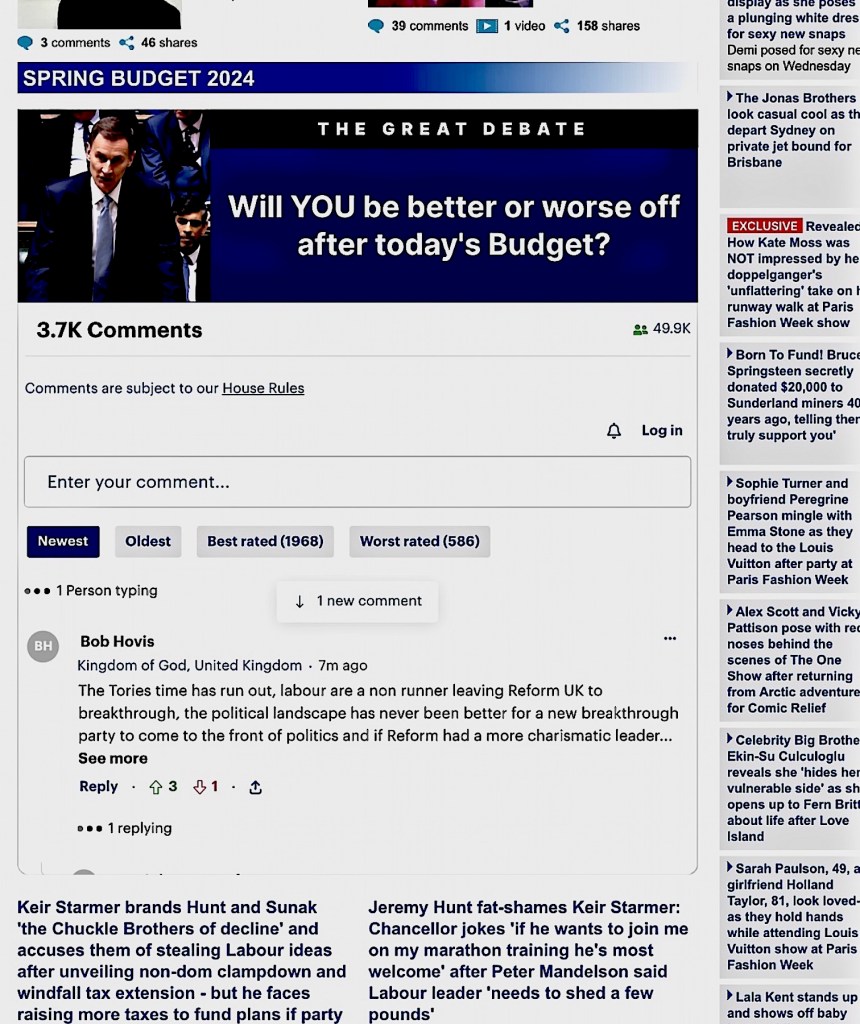
A live scroll of 3,700 readers’ comments on U.K. taxation and a comment invitation box on the 6 March home page of the online Daily Mail look like illustrations for William Dutton’s The Fifth Estate: The Power Shift of the Digital Age

Real-life counterparts of conceptions of things to come can appear in unlikely places, including some in the past. 

But, you may say — surely not the online Daily Mail coupled to the Chinese user-videos-plus-shopping platform, TikTok? Yes, and yes. But also from, of all people, the supreme William Shakespeare — or what literary experts and historians searching for the indisputable facts about his life have unearthed in recent decades. 

This improbable group answers the question of what evidence there is for the practicality of a keiretsu-cooperative to succeed the noxious advertising and personal data collection-dependent  surveillance business model for journalism and publishing. 

Though legacy media’s need for an innovative financing scheme and structure has proceeded from dire to desperate, this has somehow gone unmentioned in 2024’s mournful stream of reports about the decimation of employment in the news business. 

In noting that over five hundred jobs in U.S. print, broadcast and digital media fell to cost-cutters’ axes in January, Politico said that this followed layoffs of 3,087 in the same categories in 2023 and 2020’s high watermark of 16,060. A 5 March reminder in the Financial Times of 450 journalists losing their jobs in Britain’s dominant Reach publishing conglomerate last year — because of an advertising slump linked to a steep slide in its newspapers’ online reader numbers — was not accompanied by any discussion or speculation about ways to stop or reverse the trend. Legacy publishers exhibit no outward signs of interest in remedies except for tried and tired variations of subscription terms or experiments in taking paywalls up or down to limit what visitors to their sites can read. 

The New Year’s Day post here drew attention to the lone, faint glimmer in this doom-saturated panorama: old media managers do at last understand that reader-commenters are poised to become the core of their economic survival plans — the same people at the heart of the keiretsu-cooperative

These are the visitors — effectively, informal, indie micro-publishers — luring and engaging site traffic who in 2010 were still commonly referred to as ‘bloggers’. January’s  p-G jottings about them recorded that the business brains at some newspapers have begun to treat reader-commenters’ reactions and other ‘content’ like gold dust. As a result, some of them have begun — shamefully — to slap copyright claims with no legal justification onto those contributions from audience members, including many who are handing over cash as site subscribers.

How long is it going to take before most of them understand all the transformations underway sufficiently to see that reader-commenters are well on their way to morphing into: 

— CONVERSATION PARTNERS ON EQUAL TERMS 

or ‘interactive’ audiences who are no longer mere receivers for broadcasts by newspaper reporters and opinion writers. On 6 March, anyone popping in at the online Daily Mail would have noticed an apparent experiment — placing at the centre of its home page a blank commenting box inviting readers to have their say on the U.K. government’s spring taxation and budget announcement. 

This invitation was set in a screen within a screen with a moving scroll of other readers’ thoughts on the topic (see screenshot above, taken when the comment count had reached 3,700). 

The overall impression was of a live demo of William Dutton’s portrayals in The Fifth Estate (2023) of ‘networked individuals’ becoming powerful as ‘a new source of accountability, not only in government and politics but also in all sectors of society.’

— CO-PERFORMERS 

The online Daily Mail is the world’s fifth most-popular English language news title. It also magnetises more visitors to TikTok than any other purveyor of news on this Chinese-owned (ByteDance) social media platform where anyone can upload short videos they have made; earn cash from advertisers through product placements and promotions if they can lure enough traffic; and buy things hawked to them.

Publishing for people catching up on news where they go for relief from boredom, to play amateur auteur or entrepreneur, or to risk becoming shopaholics looks unavoidably like the future of journalism — because these people are disproportionately the youngest adults. 

In a mid-January feather-fluffing announcement, the Daily Mail Online claimed to have ‘surpassed 10 million followers’ on TikTok (estimated by backlinko.com, to have soared beyond X-Twitter, Telegram, Reddit, Pinterest and Snapchat in platform popularity measured by ‘monthly active users.’) 

The paper summed up its TikTok triumph as icing on the cake for its ‘unrivalled position as no.1 for engagement with audiences across all platforms.’ It explained that ‘[a]ccording to research by the Reuters Institute for the Study of Journalism, 20 per cent of 18-24s use TikTok to learn about current events, which was an increase of five percentage points from the previous year.’ A follow-up story in February quoted other research ‘showing that more than 40 per cent of 18-24s receive news from the Chinese-owned social media giant once or more times a day, compared with 19 per cent for the BBC, Instagram (44 per cent), Facebook (33 per cent) and Elon Musk‘s X (24 per cent), formerly known as Twitter.’

Luck being what luck is, my 2010 outline of a scheme for post-Gutenberg publishing, six years before the birth of TikTok, began:

New communication technologies have created a karaoke world. It is not just that we have the means to ensure, cheaply and easily, that—as Andy Warhol predicted— everyone could be world-famous for fifteen minutes … Practically nobody is content any more to be just a spectator, reader, passive listener or viewer. Audience participation as well as the right to talk back—which includes non-expert reviewing of works or performances by trained and seasoned professionals—have become absolutely standard expectations. 

— STAKEHOLDERS AND CO-DETERMINISTS

Few card-carrying cultural elitists inclined to shrug loftily about TikTokers earning cash from homespun, unmediated webcasting — making them de facto stakeholders in the platform’s success — will know that without the democratisation of culture in his own revolutionary epoch, we would never have heard of William Shakespeare. That man of mystery incommensurably more gifted than any other literary genius — forget TikTokers — has emerged from recent literary and historical sleuthing not as the aristocrat lurking behind a pseudonym in the centuries-old rumour, but incontestably a ‘country boy.’ 

He was ‘the grandson of a yeoman farmer and the son of a failed provincial shopkeeper,’ in his portrait by today’s pre-eminent Shakespearean scholar, Jonathan Bate, in Soul of the Age: A Biography of the Mind of William Shakespeare (2009). He got his start in playwriting by polishing the scripts of other writers while enduring mockery as ‘an upstart crow,’ a ‘rude groom,’ and a ‘peasant.’

But this book’s most unexpected revelation, for many, will be about Shakespeare’s business acumen, an asset as rare in writers then as it is now. He died a prosperous landowner at fifty-two, leaving his wife and the children he had fathered before his twenty-first birthday well provided for from his earnings as a shareholder in an acting company that operated very like a cross between an artists’ collective and a cooperative venture in our time.

Through becoming a shareholder, Shakespeare was the first to turn play-making into a potentially rewarding profession that could support a marriage and a family. His fortune was made not by a literary innovation but by a business decision. In his early career, Shakespeare would have noted the raw deal suffered by the script writers, who were paid only a few pounds per play. The serious money was made by manager Henslowe and lead actor Alleyn, who ran the Rose Theatre as an entrepreneurial partnership. Shakespeare and his close associates came up with an alternative arrangement: the Lord Chamberlain’s Men was formed in 1594 as a joint-stock company, with the profits shared among the players.

What could have been the equivalent of reader-commenter power for Shakespearean audiences? 

The 20th-century historian John Hale has shown that unlike the ‘patron-fostered painters of Italy, the Low Countries and Germany,’ the Bard ‘was reliant on popular support, as were his fellow playwrights.’ Their works and the venues for their performances were part of a democratically inclined ‘theatrical machinery that both responded to and increased the number of spectators and dramatists.’ Another impression from reading The Civilization of Europe in the Renaissance is  of how uncannily today’s social media frenzy resembles the explosion in early 17th-century mass entertainment in London:

During the boom period of new plays, 1600-10 … the places available each year in the commercial theatre, discounting Sundays and Lent, may have topped a staggering two million when the population of London was two hundred and fifty thousand. Never before in Europe had there been so heavy a vote of confidence in a single form of cultural activity.

In another prefiguring of the present, Civilization shows the joys of expanding free expression for playwrights soon proving to be too much for the authorities:

Altogether the appetite for theatrical dialogue and effects was so constant as to enable a playwright to indulge his own aspirations short of flagrantly inviting political and religious censorship; bawdiness was let slip with a shrug, a contributory reason for the Puritan criticism which led eventually, in 1642, to the order that the theatres should be closed altogether, an order honoured almost as much in the breach as in the observance.

Some of the Puritans especially disgusted by their inability to control this tide in public affairs presumably let a different one carry them away to found a new colony on the other side of the sea. But here we are now, being reminded that the most satisfying narrative arcs can turn out to be circles. 

The keiretsu-cooperative seems to rhyme naturally with what has gone before, not just with what will or should be.

What should a writer’s position be on the battle between Amazon and the Hachette publishing conglomerate? Let’s have some basic information, for a start

alley

– photograph by MIL22

As print publishing firms competing with digital rivals have less than ever to give the majority of writers – who have no record as best-sellers — where should scribblers’ sympathies lie in the fight between the Hachette publishing empire and Amazon?

The essential details of what they are quarrelling about are being hidden from us on grounds of commercial secrecy — as noted in one report after another**. These are negotiations conducted down dark alleys. Without those details, we can only puzzle over the tones of ringing certainty in which newspaper commentators have unanimously been denouncing Amazon – although the bookselling giant was plainly wrong to punish Hachette and its authors in these ways noted by The Los Angeles Times:

Amazon is subjecting many books from Hachette to artificial purchase delays. Books that had been available for next-day delivery now take 2-5 weeks to ship. Some titles don’t surface in search as they should. … As a result, Hachette will sell fewer books.

Strangely absent from coverage of the war is an eye-popping point for writers made by a sharp-eyed reader of The New York Times:

To the Editor:

Neither Amazon nor the publishers are pure of heart. Amazon is facing serious pressure on the profitability front from investors, so it is looking to increase margins and reduce costs.

The publishers see e-books as their largest profit area. A Publisher’s Lunch article last year showed the profit breakdown for HarperCollins:A $27.99 hardcover provides a $5.67 profit to the publisher and a $4.20 royalty to the author; a $14.99 e-book provides a $7.87 profit to the publisher and a $2.62 royalty to the author.

While the publishers are making a claim to a noble struggle against Amazon’s efforts to devalue publishing, they are also seeking to protect their higher profits on e-books, not higher royalties for writers. While Amazon claims to want to offer readers the best pricing, Amazon has no qualms about using its powerful market leverage to get what it seeks while inflicting collateral pain on readers to boost its profits.

The two players that are suffering in this situation are the authors (book sales delayed or prevented, dramatically lower royalties) and the consumers, many of whom have invested heavily in the Kindle-based environment.

CHRIS WATSON

Barrington, R.I., May 31, 2014

For authors to extract a bigger share of e-royalties, we are guessing that more scribblers with market power ranging from middling to great will have to start publishing e-books on their own, and do well at it. What advantages of being conventionally published do they give up, when they take the indie road? Fewer and fewer. Many more authors who have tried both the old route to being published and the new say exactly what this Guardian reader did last month, reacting in the comments section of a blog post about self-publishing:

remittancegirl

29 May 2014

I’m not a fan of self-publishing, but I don’t think this article addresses some of the salient reasons for its rise. Nothing is mentioned of the radical shift in traditional publishing to put marketing efforts into nothing but established writers with blockbuster track records, or its abandonment of a good editorial process.

Having been one of those writers who did get published by a major publisher, it quickly became obvious that it was a waste of time and financially costly. The royalty rates offered (especially on electronic sales) are, frankly, laughable. There is no effort at marketing. As a new author, you are expected to do all the publicity and marketing for yourself anyway. The least one might expect was a decent line edit, but the book I published through a major house was published with typographical errors aplenty. So, exactly how does it benefit new writers to even consider submitting to a traditional publisher?

Forget the money. What about the cultural landscape? Are publishers are lining up to publish radically new forms of narrative? No. In fact, the chances of you getting a publishing deal for your book depends, most notably, on how much it resembles another book that’s done well.

And if a writer opts for self-publishing and does well with it, there is a far better chance of having a major publisher will pick you up, republish your work, offer far better terms, better editors and some marketing – now that you no longer need it.

… [T]he disdain in this article for the self-published work doesn’t take into account what is driving many authors to circumvent the publishing apparatus altogether.

The Independent noted,

At least one author, Barry Eisler, is standing up for Amazon, saying: “More people are buying more books than ever and more people are making a living by writing them. Why do millionaire authors want to destroy the one company that’s made this all possible?”

The problem for many in publishing is that the dominance of this one company, with its Kindle store, keeps growing. It is estimated that e-book sales will soar to almost $9bn this year in America, while print book sales fall below $20bn, down from $26bn in 2010.

Yes, it’s clear from those numbers that Amazon has too much power in e-publishing. But to see what can be done about it, let’s have some more information about precisely what terms it was arguing about with Hachette.

Transparency, please.

** For instance, although The Los Angeles Times’s handy summary of the dispute is highlighted as an instance of ‘an unusually public battle’ — in ‘Amazon and Hachette: The dispute in 13 easy steps,’ — its step 6 says:

Amazon has not commented to The Times regarding this dispute other than to point us to a message-board posting in the Kindle discussion forums on its site. There, it explained that Hachette was one of its 70,000 suppliers and that the two had been unable to reach acceptable terms (without disclosing what was being negotiated).