Nigella, no longer a ‘domestic goddess,’ has risen through work and the post-print power of the true image to a more dependable claim on our affection

nigella portrait

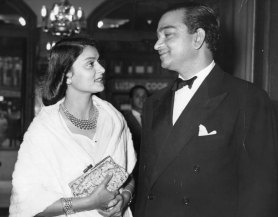
Nigella on screens last week; Maharani Gayatri Devi with the Maharaja of Jaipur, 1955 - The Evening Standard

Nigella on screens last week; Maharani Gayatri Devi with the Maharaja of Jaipur, 1955
– The Evening Standard

Before we get to Nigella Lawson hammering the last nails into the coffin of the domestic goddess myth, we must record a milestone reached in the suicide last month of 49 year-old L’ Wrenn Scott, the ethereal clothes designer and domestic partner of Mick Jagger. No doubt she killed herself in a tragic confluence of exterior and interior pressures. Entirely unprecedented in the celebrity universe, as far as we know, was the prominence accorded — in speculation about a female suicide — to the possibility that her failure as an entrepreneur could have been the deciding factor. This is a species of tragedy we associate exclusively with the lives of men.

For reasons of interest to no one else, we have in mind today both the miserable and triumphant potential in the lives of women – because of a particular woman we are sending a birthday greeting she can no longer read. What connects the topic to this blog’s interest in post-print media is

• how Nigella’s vindictive ex-advertising mogul ex-husband, Charles Saatchi, was undone by his over-reliance on what remains of his once-tremendous old media influence and connections

• how Nigella’s mediagenic genius – more than mere physical beauty greater and more mysterious than the sum of its parts – came to her rescue in an age of communication dominated by images. How it became the steel-plated shield that excellence in the domestic arts can no longer supply, for her or any other woman – any more than the womanly heart-over-head softness that traditionally went with that

In making work her principal occupation, L’Wrenn Scott – about five years younger than Nigella – had satisfied the now inescapable requirement that a woman establish her worth, both monetary and otherwise, independently of any man. Never mind if she is a delectable nineteen year-old besieged by suitors from every point on the compass bearing engagement rings .

Last month in Britain, following a Law Commission recommendation that British courts actually honour pre-nuptial agreements instead of, presumably, treating them as philosophical tracts, the Guardian columnist Lucy Mangan lauded the guarantee, in these contracts, that she could take what is hers if her marriage should fail. That is too simple a reason for wanting one. The harsh fact is, the action a woman needs to take to protect herself from the peculiarly female forms of vulnerability in long-haul relationships has to precede any such contract.

The setting of terms for a pre-nup will usually entail a chilling discussion. Yet these unenticing agreements that we see becoming indispensable for ordinary people, not just celebrities, set a value on what the chief monetary contributor to a household – still generally male – will owe the provider of non-monetary sustenance, comforts and gifts, including child-bearing, if an ‘uncoupling,’ whether ‘conscious’ or otherwise, becomes inevitable. Unless she has a large inheritance for a lifelong security net, the contributor in kind rather than cash will, ideally, prove her economic value long before any such negotiation; years before she even thinks of spending a span of years working principally as a nurturer.

As any specialist in family law would tell her, one crucial consideration in a court’s decision on what she should receive, in a financial settlement at the end of a partnership, is the size of the cheques from employers that she gave up when she and her partner agreed that she would switch from working outside to inside their home.

The numbers on those cheques could even prove critical in legal proceedings that have nothing to do with divorce. Say that she is a single woman and artist whose forte is highly-praised but uncommercial watercolours, someone who does not see herself settling into marriage for years. She will want to establish the highest possible pre-marital price-tag for her toil in the ‘day jobs’ she does to support herself. Why? As any personal injury lawyer would tell her, that earning power would be weighed in determining what she was owed if — after she has married and taken herself off the market, for any reason – she became the unlucky victim of a road accident.

Her ‘historical’ earning ability could be the chief index of value for the insurance company of the drunk driver who, say, knocked her off her bicycle and hurt her seriously enough to cripple her ability to work for months or years afterwards. If she dropped out of dentistry school or an internship in financial trading to give birth to twins, her compensation from the insurer for the work she has done since, as a loving housewife and mother, would be only a fraction of what she would be owed as a worker who clocked up a few years of practising the profession in which she won her spurs.

… Which brings us back to Nigella, and the particular advantages flowing from her ease before a camera, which have helped to make her story seem part of the life stories of millions of audience members who actually have nothing in common with her. She, of course, sought no financial compensation or alimony in her divorce last summer. That was in spite of submitting to one wrenching adjustment after another in a marriage ‘always on his terms’, and the lustre she lent the Charles Saatchi persona – an especially valuable contribution to a specialist in advertising and the fabrication of glamour-by-association.

In the high drama of having to defend herself, last December, against Machiavellian allegations of a cocaine habit, during the trial of former housekeepers of hers and Saatchi’s, the media commentariat made no reference to the reports, last autumn, that she had agreed to make no financial claims on him. According to the rumours, then, that was partly in the hope of defusing his threat to expose a particularly damaging secret about her. This bargain did her no good, as many signs pointed to his having had some never quite specified role in inspiring the housekeepers’ claims of being indirectly bribed by Nigella to hide her cocaine store and – as she admitted, with unfortunate consequences that have stretched to being declined permission to enter the U.S. last Sunday — occasional use.

For a less resilient woman, becoming the target of Saatchi’s spite, in the latest chapter of a life pock-marked by exceptional suffering, might have been ruinous. But on screens only last week, there were signs of a Nigella recovering her radiance, and drawing on the tremendous capital in respect and affection she has created for herself by following the path that her first husband, John Diamond, put her on. It was he who spotted the potential for the witty, sexy, glamour-puss television cook before anyone else could envisage her in such a role – going by the accounts of other family members and friends.

Alas, a domestic goddess needs a devoted domestic god for a mate. Nigella had one in Diamond, but after he died much too young, she married Saatchi – who, perhaps out of jealousy of the famously enjoyable, casual and spontaneous John-and-Nigella hospitality – proudly broadcast his preference for breakfast cereal over anything from his third wife’s kitchen, and for feeding people in restaurants over anything cooked by her.

As things turned out, at the zenith of her fame as a de-mystifier of the art of cooking – in roughly the last ten years – with a superb, eclectic palate to guide her, Nigella was obliged by Saatchi to be a virtual, if not quite fake, model of a household divinity. Out of consideration for his (understandable) dislike of being invaded by bustling TV crews, her kitchen in the house they shared was replicated in a television studio. In the footage much-loved by her audience of her raiding her refrigerator for nocturnal snacks, she was only acting — like any other performer on a set. Her cookbooks, according to the housekeepers’ court-room testimony, were written in the dead of night, her concentration assisted by whiffs of cocaine. By day, according to other reports, she was responsible for the kind of physical chaos abhorred by Saatchi but more or less typical for creative types of any stripe, though possibly not for chopping-board deities – none of it visible on-screen.

Yet nearly everyone who has watched her at work in a kitchen willingly suspends disbelief to get lost in the parade of beguiling images she offers us, and her self-deprecating and populist – though never condescending – charm. She is a supremely mediagenic phenomenon – all the more so for her emotional transparency. On the day she was photographed striding into court, head held high, she looked as if she was going to do precisely what she did – be ashamed, proud and defensive, all at once; admit to drug use she had fought hard to conceal, but also deny the most extreme related accusations, and explain the excruciatingly painful circumstances (watching her first husband die slowly) in which she was introduced to cocaine.

She made no attempt to hide her tear-swollen and angry face as she left the court. Transparency is what she almost always seems to be delivering, with looks that make her a late-born member of a tiny club of iconic 20th-century women that includes Jackie Kennedy and India’s Gayatri Devi, whose name Google supplies when a searcher does no more than tap in the first few letters of her title, ‘Maharani’. Millions of us exposed repeatedly to free, digitally replicated images of them puzzle over and marvel at their uncanny magnetism.

And Saatchi? There is nothing of presence or anything personal in his form of media power. He made his name as an advertising genius – a canny, intuitive shaper of public perception who, with his much nicer brother and business partner Maurice, put Margaret Thatcher into No. 10, Downing Street. Print barons vied for their agency’s patronage, for the streams of advertising revenue they could put their way – lifeblood, for their newspapers.

Apparently blind to that difference between the sources of his and Nigella’s sway, he imagined that he could reverse the ineradicable damage done by last summer’s tabloid photographs of himself with his hand on her throat with a blizzard of photo-ops arranged to depict himself as genial and aspirationally elegant. In the decades when print media still dictated what the public saw of anyone famous – or not – he could have insisted on only being photographed from his most flattering angles. His is a closed face with calculation written all over it.

Nigella’s, on the other hand, is inexplicably WYSIWYG, as the computer geeks say – ‘what you see is what you get’. Inexplicable, because the truthfulness characteristic of her somehow gets through the layers of television makeup she must often wear, and the contrived domestic haven in the backdrop of her cooking shows. Something about her, as well as plain old hard work, has helped her to create the defences against exploitation and degradation that every woman ought to have.

Will this April Fool’s Year of canonising whistleblowers, any whistleblower, never end?

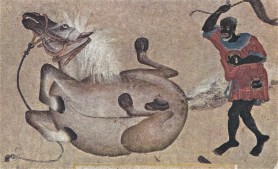
Whipped, if not quite dead: the putative whistleblower’s surveillance story -- with legs  -- ‘Horse and groom,’ 15th-century, Turkish Miniatures, Mentor-UNESCO, 1965

Whipped, if not quite dead: the surveillance story — with legs
— ‘Horse and groom,’ 15th-c., Turkish Miniatures, Mentor-UNESCO, 1965

Might the back-to-front spy story fingering government spooks rather than the villains subjecting us to the ‘surveillance business model’ be the longest-running April Fool’s wheeze in history?

Simon Jenkins in The Guardian, 27 march 2014:

Whistleblowers are not always right, let alone easy companions, but then nor were saints. Few can be saved from a degree of martyrdom. But we can at least canonise them as saints rather than persecute them as devils.

Surely that is a wickedly batty, not to mention irresponsible, suggestion — unless or until we are sure that any particular whistleblower is tooting for our collective benefit, not merely as a rebel in search of a cause? Anyone reading the closing paragraph of the Jenkins column would have proof that Spiked Online was hardly going overboard, last summer, when its editor, Brendan O’Neill, suggested …

Let’s call a halt to the worship of whistleblowers

11 June 2013

The cult of the whistleblower is getting out of hand

In 24 hours, Edward Snowden has gone from being a former contract worker at America’s National Security Agency to a godlike figure who has apparently ‘saved us’ from ‘the United Stasi of America’. It’s the religious terminology that is most striking. For leaking info about how the NSA keeps tabs on the communications of both American and foreign citizens, Snowden has been referred to not only as a saviour but also as a ‘martyr’. He’s praised for revealing to us, the sleeping ones, ‘the truth’ about our world. Journalists fawn over the ‘earth-shaking magnitude of the truth’ he has revealed. His own codename in his dealings with hacks was Verax, Latin for ‘one who tells the truth’ and a recurring word in the writings of old-world Catholic scholars on the lives of the saints and seers. If Snowden possesses Christ’s capacity for ‘saving’ people, he lacks His humility.

 As befits a modern-day teller of the truth, Snowden has been turned into an overnight icon by the guardians of liberal values. The Guardian itself plastered his picture across its front page yesterday, even taking the very unusual step of moving its own masthead down and replacing it with the words: ‘The whistleblower.’ This wasn’t news reporting; it was a secular beatification, an invitation to readers to look into the eyes of St Snowden, the latest in a line of brave revealers of liberal gospel, who, according to one Guardian columnist, has carried out ‘extraordinary human acts’ and showed ‘an endless willing to self-sacrifice’ – just like You Know Who. The creepy Jesus allusions are even more apparent in the Twittersphere, where Snowden is referred to as saviour, martyr, even ‘libertarian messiah’.

 The speedy beatification of Snowden reveals a great deal about the increasingly irrational worshipping of the whistleblower. Primarily, the cult of the whistleblower speaks to the profound passivity and deep moral lassitude of both modern journalism and radical politics …

Just as we are — as in recommending, two entries ago, a Laziest Journalism Ever award for the shrill, over-amplified Snowden coverage — Spiked’s O’Neill has been horrified by what it says about the state of the craft of journalism:

[J]ournalism … seems to have transformed itself into a passive receiver of ‘truth’ rather than active seeker of stories. Journalists are increasingly reliant upon sneaked-out information from the citadels of power. This is bad for so many reasons: because journalists lose their dirt-digging drive and instead become grateful recipients of discs or graphs from disgruntled individuals; because it redefines ‘the truth’ to mean something graciously given to us by those in the know, rather than something we shape through the very act of seeking it, of analysing and understanding what we have found out; and because it inevitably nurtures shoddy, rushed, ill-thought-through journalism. Indeed, some of the claims about the NSA are now being called into question, which suggests that getting mere info from one man is no substitute for spending a long time looking for a story, and then discussing it, checking it, contextualising it, and making it something bigger than simply, ‘Look at what was whispered in my ear….’.

… This is, admittedly, a somewhat lazy entry on the blog. We have too much to say, on a very different subject – and are waiting for all that to settle and simmer down to manageable proportions before we return.

Will there be a half-pint Pulitzer for The Guardian’s Snowden job, like the Paul Foot ‘special investigation award’? … & A Guardian overseer acknowledges ‘mass surveillance’ of readers

Secret, shadowy, tunnels into our lives, 2 - photograph: postgutenberg@gmail.com

Secret, shadowy tunnels into our lives, 2
– photograph: postgutenberg@gmail.com

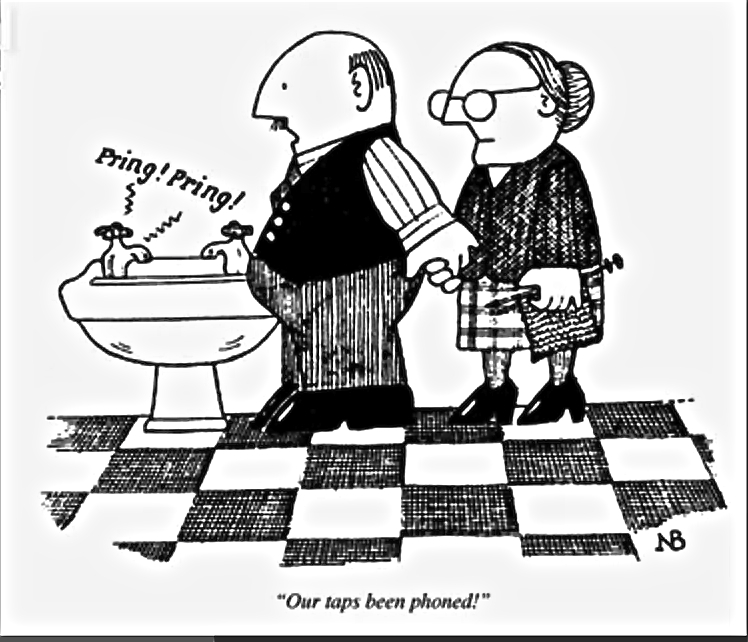
‘Our tap’s been phoned.’ Neil Bennet, 1989, Private Eye: A Cartoon History

‘Our tap’s been phoned.’ Neil Bennet, 1989, Private Eye: A Cartoon History
– ( the subject of a staged National Theatre conversation: video clip)

In Britain the question of whether the barrage of banner headlines about the Snowden leaks deserves the highest journalistic honours has already been decided – but only, on the evidence, with deepest ambivalence.

No, we do not know any of the judges behind the 2013 Paul Foot Award ‘for campaigning and investigative journalism,’ established in memory of a legendary Private Eye investigative reporter who died in 2004. When we thought to look up its winner, after last week’s post about the argument over a possible Pulitzer for the Snowden story, we made the brow-raising discovery that although the Paul Foot prize was awarded last month to David Cohen of The Evening Standard for a series about London’s criminals, a ‘special investigation award’ went to The Guardian’s Snowdenia saga.

How in Hades could that have happened? Private Eye has had strikingly little – mostly, nothing — to contribute in any form of commentary (not even as cover cartoons or inside drawings) to the Snowden brouhaha. And yet anyone can see that the saga has an infinitude of giggly possibilities. The prize-givers made the predictable nod, in their citation, to ‘one of the biggest stories of the decade.’ But it seemed bizarre that as a compromise between handing The Guardian’s surveillance-consciousness-raising team the £5,000 main prize and the £1,000 that four shortlisted finalists took home, a £2,000 consolation prize had to be specially invented to placate … someone or other.

We took the logical next step, which was to look into the source of the prize money. Ah. The Paul Foot Award is co-sponsored by the Eye and … none other than The Guardian. … Just fancy that. … For anyone as mesmerised as we have been by the hopelessly confused allegations of ‘Orwellian mass surveillance’ – a misplaced cliché that seems mercifully to have been put to bed, in most coverage – the recording of Ian Hislop, the Eye’s editor, summing up l’affaire Snowden on Have I Got News for You, is a must-see. His body language telegraphed irrepressible glee, last October, as he delivered an explanation that seemed to account for his magazine’s lack of interest in the story:

The new head of MI5 has said that The Guardian has acted really irresponsibly in pointing out that we’re spying on people. It’s pointed out that we’re all being spied on all the time. [ … ] It’s a matter of consent, really. You can debate this and say, ‘Yes, I’d like to be spied on.’ I know I would. Anyone showing any interest in my life would be terrific. [Howls from live audience.] I’d be very, very, happy with that. But it’s a matter for public debate. And if we want to pass laws saying we can spy on people, we can. […] It’s just what The Guardian did was point out this is happening and nobody knows it.

Nobody would have needed telling if, as this blog has pointed out with tedious frequency, papers like The Guardian and The New York Times had only been listening to their own technology correspondents – instead of treating them as back-room bores. The public would have been educated about the all-pervasive ‘surveillance business model’ keeping track of everything we do on the internet, all the better to manipulate us for profit.

We complained earlier this month about the failure of the journals of record for the Snowden fount of classified information to acknowledge that it was corporate spying – as by internet giants of the likes of Google and Microsoft and most newspapers – that led to copycat government spying in the UK and US. The lead story in the business section of last Thursday’s New York Times by Nick Wingfield and Nick Bilton on the paper’s technology reporting team was titled, ‘Microsoft Software Leak Inquiry Raises Privacy Issues’. Its opening paragraphs said:

Technology companies have spent months denying they know anything about broad government spying on people who use their Internet services.

But a legal case filed this week against a former Microsoft employee shows the power these companies themselves have to snoop on their customers whenever they want to.

That is still a long way short of shouting about the government’s adoption of people-tracking tools routinely used by businesses, but it reveals Microsoft’s and other technology companies’ protests against NSA monitoring as resoundingly hollow.

Shortly before that, on 17 March, came a virtual admission of reader surveillance by Emily Bell, one of twelve non-executive directors of Scott Trust Limited, which owns The Guardian, and a former director of digital content for that newspaper who is now a senior academic in New York. We suggest reading past her obligatory parenthetical softening of what she had to say last Tuesday:

Using NSA-style techniques (although naturally much more benignly), the Guardian or any other publisher can track every movement you make on an online piece, where you come from, where you go to, whether you are actively reading or whether you have tuned out.

We do not think it mad to insist that it is time for both our corporate and government spies to admit that they are all equally guilty and proceed to the public debate about solutions — just as Ian Hislop said.

LOOKALIKE ( with thanks to Private Eye for vision-sharpening )

postgutenberg[at]gmail.com

A Pulitzer prize for typing up the Snowden leaks? We suggest the Laziest Journalism Ever award

We saw no fine journalistic instincts unfurled; no dogged sniffing, and above all, no sweaty investigative reporting: only papers playing mouthpiece to boost circulation  - photograph: postgutenberg[at]gmail.com

We saw no fine journalistic instincts unfurled; no dogged sniffing, and above all, no arduous investigative reporting: only papers trying to boost circulation
– photograph: postgutenberg[at]gmail.com

Preposterous. That is what Politico evidently thinks of bestowing a Pulitzer journalism prize next month on one of the hyperbolic leak-and-spin collaborations between Edward Snowden and journalists who have made the über-leaker famous enough for search engines to suggest that we really want him when we ask them about Snowdon – the Welsh mountain.

We agree especially with the last reason Politico gives for doubting the rightness of elevating the Snowden-and-NSA story above — for instance — the kind of wrenching immersive reporting on the mentally retarded that won the fearless, compassionate Katherine Boo her Pulitzer public service medal in 2000. In ‘Edward Snowden looms over Pulitzer prizes’ its media reporter Dylan Byers argues:

Finally, there is the issue of effort. Though [two reporters who disseminated Snowden’s leaks] have dismissed the suggestion that Snowden’s trove of NSA files simply fell into their laps, the Pulitzer Board could feel conflicted about giving an award to the recipients of stolen documents when other applicants may have dedicated a significant amount of time and resources to old-fashioned shoe-leather reporting on, say, a local government issue. In several instances throughout its history, the Board has honored reporting based to a significant degree on the amount of effort and diligence shown by the reporters.

[… quoting a USA Today editor:] “Not to minimize the role of the reporters — it’s not just stenography. You have to sift through the information, present it clearly, explain why it matters, put it in context, etc. The real challenge would be if you had entries where reporters had to go to extraordinary lengths to pry out information of vital interest to the public, as opposed to having it turned over to them. If you had examples of great magnitude, that would make it complicated. That said, this was clearly the story of last year.”

“There’s a real question about whether this is reporting,” [a veteran Washington Post reporter] said. “It might be a public service award, but it’s not a great reporting coup when a source comes to you and hands you this stuff.”

Post-Gutenberg would also like to remind readers about an … ahem … significant detail – that the Guardian’s and New York Times’s endless column-inches on government surveillance have the story back-to-front, by failing to acknowledge that the NSA watchers in the U.S. and their GCHQ equivalents in the U.K. are only doing what privacy-scoffers at the commercial technology giants and most newspapers running on the ‘surveillance business model’ have done for far longer. (See ‘Spooky yarn-spinning: just how did the Guardian and New York Times get the surveillance story back-to-front?‘ … and … ‘When will the #TeamSnowden newspapers admit to using the same spying tools as the spooks at the NSA and GCHQ?)

Bill Gates, we are pleased to note, has made the same point as we have about Snowden’s lack of judgment and selectivity in what he chose to make public, to snatch his place in history:

‘…[I]f he had been careful in terms of what he had released, then it would fit more of the model of “OK, I’m really trying to improve things.” You won’t find much admiration from me.’

He said that in an interview with Rolling Stone on 13 March – and we recorded the identical objection in a post on this blog last November, with the help of the Mannekin Pis.