The coercion which the police state exercises on thought and art is indeed appalling. Yet the damage done may, in the final analysis, be no greater than that caused by the absolutism of the mass market. … The censorship which profit imposes on the media is as destructive, perhaps more so than that of political despotism.
George Steiner, My Unwritten Books, 2008
That Fleet Street editors are once again ganging up to attack the Leveson Inquiry into press ethics and practices — concentrating their salvos, this time, on its as-yet-unpublished first report and recommendations – could turn out to be a great good thing.
Their aggression is inviting attention. It is giving everyone who cares about getting reliable news and facts undistorted by hidden agendas and special interests — for instance, the International Forum for Responsible Media (INFORRM) — a chance to remind the 4th Estate that public opinion is firmly on the Inquiry’s side.
… there is an important case to be fought in the court of public opinion over the next couple of months. A careful eye needs to be kept on press attempts to distort and manipulate the arguments to support the self-interest of its proprietors.
The self-interest to which it refers is, of course, the profit motive. That is true despite the longstanding tradition in which most of those proprietors have supported newspapers losing money decade after decade, as if red ink were simply natural for them, as intrinsic as spots for leopards or nuclear scent for polecats. Hardly anyone needs to be told, any more, that the reason why these proprietors have long competed ferociously for the privilege of owning papers is because of the fantastic levers they are for piling up profits in other spheres, and buying political influence.
We have quoted those words of George Steiner in this post’s epigraph before and we will quote them again – as often as necessary. That is, until it becomes common-or-garden wisdom that, just as the Wikipedia has brought us closer to the ideal of what an encyclopaedia can be, we need to refine forms of collaborative journalism. It has to be universally understood that journalism at its best has to be divorced from the profit motive. Just as the excellence of the Wikipedia has no connection whatsoever to improving any corporate ‘bottom line,’ there is no reason why journalism has to be directly or indirectly wedded to it any more.
The reason why no leader at the head of any prominent newspaper has risen to post-Gutenberg’s challenge – ‘Wanted: a brave newspaper, for an experiment in which readers become stakeholders‘ – is because they are beholden to the old system of organising the dissemination of facts. They are well-paid indentured servants of the profit motive, enshrined as the ‘advertising-based business model’ for running papers.
The best possible outcome of the Leveson Inquiry is not in the least complicated. It would be an evolutionary restructuring of journalism to restore as its fundamental and only raisons d’être:
the quest for truth
and
forcing transparency in the exercise of political power.
It is this parallel with the Wikipedia that matters. The co-ownership of media and various forms of collaborative operation, in the practice of journalism, are simply the most logical means to that end.
Until we reach it, passages like this — from The Sonderberg Case, an Elie Wiesel novella about the harm that Nazism inflicted on the Nazis’ own descendants – will seem depressingly unattainable:
Actually, I had discovered journalism well before working in the field. My uncle Meir, early on, considered it the finest profession … He ranked the committed journalist as the equal of writers and philosophers.
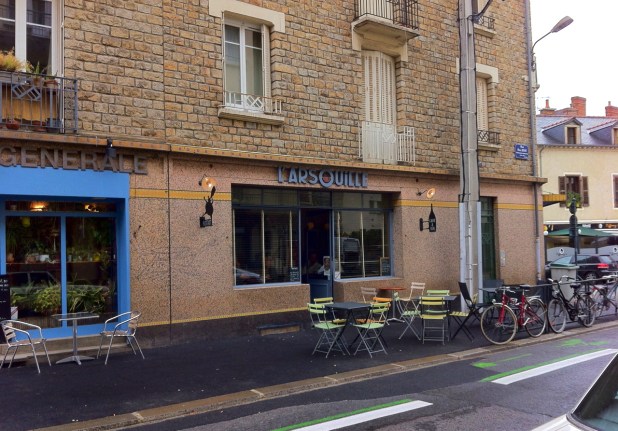
‘L’Arsouille’, Rennes, Brittany Photographs by Mark Barron
[ Owing to chronic disruptions beyond our control, our usual timetable for new posts – roughly every six to seven days – must regrettably be abandoned for a while. ]
We are experimenting again — this time, with 21st-century ways of long-distance literary exploration. We are doing this in a multi-media collage — additions to some lines of poetry that we featured here last month.
Suppose that you discovered a beguiling poem that was a call to arms on behalf of an endangered language — lines saturated with the emphatically anti-glamorising spirit of a place, and adding up to a sort of love letter to its culture? Suppose that this place was Brittany, and that before you found the poem, you had only ever read the same clichés about its resilient, courageous, resourceful and fiercely independent people and been served, ad nauseam, the same images of its rugged coastline, its boats, its mizzling North Atlantic skies — without ever having heard a Breton speak?
Language arguably is culture.
Its sounds contain revelations inaccessible except by listening — a thought that came to mind playing back a recording of Roy Eales’s exemplary, playful-yet-serious reading of his own poem in its English original, then hearing his friend Fañch Peru recite his translation of it into his native Breton in ringing tones that are somehow both gritty and embracing. You can almost feel the inhospitable roughness of rock on your skin and taste acrid brine, halfway through the Breton version.
Beneath audio clips that any visitor to this blog can compare is the Breton text of Peru himself, a scholarly authority on the language – offered for listeners curious enough to read along. (Scroll down to the bottom of this post.)
( … The audio files that follow work on some machines; not on others. … We are still digging to get to the bottom of the mystery. )
Roy Eales reads ‘A boatload of words:
Fañch Peru reading his translation of the poem into Breton:
Near relations of ours were in Brittany earlier this summer, and to one of them we are indebted for the photographs at the start of this post. They were taken in Rennes, where the native people speak not Breton but Gallo, the other regional language of Brittany, but whose look and mien — in the images we were lucky enough to receive — do fit Roy Eales’s descriptions of the preference for substance over style in the culture of this province.
The correspondences between sound and meaning in Breton are so unexpected, to these post-Gutenberg ears, so captivating, that we consider ourselves enlisted in the cause of saving a language we have never heard in its own home – ‘virtual’ allies. In our last post about Breton and ‘A boatload, …’, we proudly displayed a drawing by the artist Sascha Juritz, another foreign campaigner, but one who considered Brittany a home for years before he died in 2003. It has taken a while for the photograph of him that we requested to reach us, but here it is – an image well worth waiting for:
Portrait of Sascha Juritz by Ursula Leipold
The Wikipedia entry for this region – Europe’s northwestern corner — says, in part:
In 1956, Brittany was legally reconstituted as the Region of Brittany, although the region excluded the ducal capital of Nantes and the surrounding area. Over this period the Breton language declined precipitously. Children were not allowed to speak Breton at school, and were punished by teachers if they did. Famously, signs in schools read: “It is forbidden to speak Breton and to spit on the floor” (“Il est interdit de parler breton et de cracher par terre”). As a result, a generation of native Breton speakers were made to feel ashamed of their language and avoided speaking it or teaching it to their children.
Victor Hugo (Les Misérables), who had a Breton mother he adored, unfortunately identified with the French capital’s prejudice against the place. As one of his biographers, Graham Robb, has explained:
According to Hugo, … his mother was a half-wild royalist Amazon, chased through the Breton undergrowth by republican soldiers, risking her life to rescue persecuted priests. Brittany itself, in Hugo’s Parisian view of the country, was an antediluvian land inhabited by hairy, tattooed peasants, squatting in their cottages or holes in the ground, surviving on milk and chestnuts, fanatically loyal to King and Church, their worldview bounded by the horizons of the ancient forests in which they hid, bristling with Druidic superstition and mindless animosity — a contrast, in Hugo’s personal mythology, to the mountain-born genius. Only the `wash-basin’ of the Atlantic Ocean was equal to the filth of Brittany, he wrote on a visit in 1836.
Oh, the obtuse pointlessness of prejudice … Here, two centuries after Hugo was born, is an extract from a Breton poem – Fañch Peru’s rendering into English of his eulogy for Sascha Juritz:
En ur porzh-mor kozh e Breizh un den, ur gasketenn martolod gantañ war e benn harpet war e c’har zehou a selle pizh ouzh un dra bennak a bouez bras.
Treiñ a reas e benn hag ober a reas un hanter tro war e c’har gleiz evit cheñch plas hag e chomas aze war e c’har zehou adarre.
Tanañ a reas e gorn ha kontañ a reas ur marvailh. Setu petra ’ oa c’hoarvezet.
Ur beurevezh yen er goañv en hevelep porzh-mor e kludas un evn mor du war e skoaz hag e kontas dezhañ e brezhoneg penaos ul lestr bras tre ruilhet ha diruilhet e-maez da Vreizh war ur Mor Atlantel rust a reas peñse abalamour d’un taoldispac’h -eus e lestrad – ur sammad gerioù, e gwirionez, holl c’heriaoueg yezh ar ro.
Richanañ a rae an evn du en ur ziskleriañ penaos ar gerioù a oa da vezañ diskarget er mor, ul lev vat er-maez e seier du krouget start merket warne e ruz: DIEZHOMM dre urzh Ministrerezh ar C’hontrollerezh Diharz.
Evel-just ne voe ket laouen ar gerioù gant se. Bet e oant trec’het kent met biskoazh ken gwazh kinnig marv n’o doa bet.
En ur brezegenn nerzhus, Gwendal, e-penn al lestrad gerioù a c’houlennas digante sevel da stourm. Ijinañ a reas ur mod d’en em zifenn. Dieubiñ an holl a rafe an ampartañ gerioù, kas al lestr d’ar strad a rafe ar re bounnerañ. Goude e tistrofe an holl c’herioù war-varin d’o bro c’henidik.
Evned mor o nijal a – us d’al lestr a glevas dre guzh komz eus difennerezh ar gerioù. Goulenn a reas ar re-mañ digante skignañ buan ha buan kemennadoù e brezhoneg e touez ar bobl.
Evel-se e voe embannet prim ar c’heleier a-dreuz ar vro ha prestik holl aodoù Breizh a virvilh, beuzet a don hag a son hag a dud o koroll hag o kanañ dirak ar mor hag al lestr o vont d’ar strad en dremmwel.
Hag o tont davete ul liñsel eonenn gwenn war ar mor, un eonenn gerioù, yezh ar vro en he fezh a voe charreet gant lorc’h betek an aod gant ar gwagennoù evel un harozez.
Adalek an deiz-se e touas ar bobl ne lezfe biken ken he yezh he-unan da rentañpenn da n’eus forzh peseurt degouezh arvarus war ar mor pe e-lec’h all.
And what about the collective memory of artistic creation? For every Prometheus and Sisyphus haunting scholars, how many of their former equals are barely stirring and covered in dust?
The Sonderberg Case, Elie Wiesel (2010)
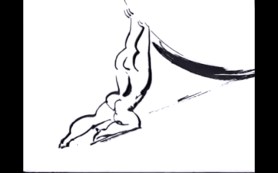
Our screen shots from a short Jankovics Marcell animation, Sisyphus(1974) — a work of genius in nearly every frame — could be depicting the struggle to change the monetary terms on which artists make art. We would like, in this lifetime, to see that accursed rock stop and stay still, where it ought to. By that, we mean that some self-sustaining way of letting artists and writers keep up with plumbers must somehow be put into practice.
Presumably Marcell, a Hungarian, earned enough from licensing a giant US multinational to adapt his haiku-like video for a (comparatively crude and clod-hopping) tv advertisement to make the world a gift of his original, so that anyone can watch it, free. But only a sub-microscopic fraction of creators can afford such generosity.
We still shudder, remembering the relentless succession of hostile posts in the discussion on a newspaper site we quoted extensively the last time we wrote on this subject, last month. Artists have starved and suffered throughout history, ran the argument – if we have to dignify rants with that word. So what? … the ranters raged.
It is asking for nearly inhuman self-control, to suppress the vituperative and scatological reply that comes immediately to mind, on hearing that question. People all over the world were actual serfs for aeons, but then became merely virtual serfs – wage-slaves – a few centuries ago. Being a baby-making machine, year after year, and – as someone once put it, ‘tied by their tits’ to their broods – was seen, for most of humanity’s time on earth, as the unavoidable fate of women. If injustice could be defended merely by precedent, and by precedence extending to pre-history, how odd that we no longer accept chaining and whipping our fellow-beings like defenceless animals.
Poverty was once universally accepted as the inevitable lot of most scholars. The great 17th century Dutch rationalist-philosopher Spinoza – whose idea of God, Albert Einstein said, was closest to his own — is known to have lived on porridge, groats and milk, or was certainly obliged to eat that diet more often than most of us would think endurable. Then someone invented tenure, and certainly in rich countries – even after years of budget cuts – few contemporary academics share the abject insecurity, at the level of penury, that too many artists among their fellow-citizens do.
We have returned to the subject not to say anything new as much as underline the importance of change – and because we forgot to mention, earlier, that thoughtful interpreters of Greek mythology consider the fates of Prometheus and Sisyphus to be allegories for the life of inventors and creators. What most of these theorisers have in mind, in drawing their parallels, is not money and financial survival but the interior, psychological struggles of creative people — and the punishment for extraordinary talent, in both stories.
This post ends with a semi-non-sequitur, an extract from an essay by Rollo May (1909-1994) – a disconcertingly perceptive, often poetic, writer on the psychology of workers at creativity’s coalface – for which our excuse is simply that we have been admiring the passage for a very long time.
It earns its hopefulness; is as far as possible from Pollyanna optimism. As May explains to the uninitiated in a terse footnote, ‘Sisyphus was a king of Corinth condemned by Zeus to roll a large stone ceaselessly up a hill.’ (Alternatively, as Nick Pontikis claims in an irresistible, fleshed-out version of the legend on his Thanasis blog — we are indebted to the stoical monarch for the birth of rock ‘n’ roll.)
… Are we doomed to live in a world no one can make sense of? …
… Out of that … despair is born this myth which is new but eternally old, the only myth that fits this seemingly hopeless situation. This is the myth of Sisyphus. The one myth which … goes no place at all, seems to be a repetition, every day and every act being forever the same in perpetual monotonous toil and sweat.
But that is to omit its crucial meaning. One thing Sisyphus can do: he can be aware of each moment in this drama between himself and Zeus, between himself and fate. This – because it is most human – makes his reaction completely different from that of the dark night of the mountain up which he rolls his rock …
… The myth of Sisyphus is sometimes interpreted as the sun climbing to its apex every day and then curving down again. Nothing could be more important for human life than these circular journeys of the sun. …
… [W]e face monotony in all we do; we draw in and exhale breath after breath in ceaseless succession through every moment of our lives, which is monotony par excellence. But out of this repetitiveness of breathing the Buddhists and Yoga have formed their religious meditation and a way of achieving the heights of ecstasy.
For Sisyphus is a creative person who even tried to erase death. He never gives up but always is devoted to creating a better kind of life; he is a model of a hero who presses on in spite of his or her despair. Without such capacity to confront despair we would not have Beethoven or Rembrandt or Michelangelo or Dante or Goethe of any others of the great figures in the development of culture …
Sisyphus’ consciousness is the hallmark of being human. Sisyphus is the thinking reed with a mind which can construct purposes, know ecstasy and pain, distinguish monotony from despair, and place the monotony – the rolling of the stone – in the scheme of his rebellion, the act for which he is condemned. …
Sisyphus … must have noticed in his trips some wisp of pink cloud that heralds the dawn, or felt some pleasure in the wind against his breast as he strode down the hill after his rock, or remembered some line of poetry to muse upon …
… [In t]he myth of Sisyphus … [w]e are required … to recognise our human state of consciousness in progress or without it, … with the disintegration of the world or without it. It is this that saves us from destruction when our little rules prove unavailing.
This is what led Albert Camus to conclude his essay on Sisyphus, ‘We must consider Sisyphus happy.’
… Rollo May does mention money in a passage before that extract, not in connection with artists who have too little of it, but showing us why their poverty so often elicits self-righteous scorn. He says, in a profoundly intelligent dissection of greed, focused on America, but applying widely on every continent:
There has been in America no clear-cut differentiation between right and wrong ways to get rich. Playing the stock market? Finding oil under your shack in Texas? Deforesting vast tracts of Douglas fir in the state of Washington? Amassing piles of money for lectures after getting out of prison as a Watergate crook? The important thing in the American dream has been to get rich, and then those very riches give sanction to your situation. The fact of your being successful is proof that God smiles on you and that you are among the saved. It is not hard to see how this, in true Calvinistic tradition, drifted into getting rich as the eleventh commandment.
Bukidnon women of the Philippines island of Mindanao — Hans Brandeis
Norwegian women: Minnesota Historical Society
Are women instinctively more cooperative than men?
Annoyingly, post-Gutenberg cannot seem to get off the fence, on that question.
There is no equivalent, for the other gender, of Woman’s Inhumanity to Woman — a blood-curdling, too often accurate, book about the scope of this category of unkindness by a respected psychologist, Phyllis Chesler. On the other hand, women have never fashioned whole careers from bludgeoning each other, the way legions of men did for most of human history — serving both noble causes and evil ones.
Nor has highly organised, male-dominated aggression disappeared. Our eyebrows went shooting ceilingward when we discovered, the other day, that in the country proud to think of itself as the land of Gandhi, elite business school students gather as rapturously as American hipster-cultists at Burning Man for a contest in strategic capitalist thinking called the Mahindra War Room. Om mane padme … oh dear, … we thought.
We would like to know whether there is any substance in the idea that women involved in running organisations tend naturally to a more consultative and collaborative style. Should women be encouraged to lead in promoting cooperative ownership as the fairest and most engaging way to organise people working together, wherever coops make sense?
We care about the answer because we have been obsessed by coops for some time. As we explained in a February post, the internet — used as both frame and engine for cooperative organisations — could vaporise many of the handicaps and inefficiencies that plagued failed coops of the recent past. More than once, we have linked to an outline of a scheme for making readers and commenters co-owners of media – a collection of ideas marinated in 2009, then lightly grilled and put on the table in January of 2010.
We could all be witnessing the start of capitalism’s evolution into an array of highly motivated, updated cooperative workplaces. It hardly matters that beady-eyed commenters spotted the questionable logic in one specific comparison in an otherwise accurate Guardian piece, last week, on the growing enthusiasm for cooperatives: ‘Co-operatives and mutuals keep outperforming the UK economy’. A reader, @johnjm, remarked acidly: ‘Comparing co-operatives, which are largely in retailing, with GDP is spurious and arguably financially illiterate.’
If @johnjm is honest, he will concede that some eminent economists find the concept of GDP itselfunsatisfactory. Scrolling down all the reader comments on that article by Greg Rosen does suggest that its premise — that a ‘cooperative renaissance’ is underway — is warranted. Growing numbers of us see coops — warts and all, without any expectation of being led to paradise on earth — as the shrewdest solution to the problem of the 1% that Occupy campaigners turned into high drama. Even if Rosen’s is a flawed comparison, it was intriguing to see these numbers side-by-side – and the next sentence rang deeply true:
While the real level of GDP in the UK in 2011 was 1.7% lower than in 2008, co-operative sector turnover has grown 19.5% over that period.
Some parts of the co-operative economy have been resilient for the past 40 years – but without public recognition.
That said, how are we to get more people to demand cooperative organisations? Could women hold the key to that galvanisation? If forced at gun point to guess either way, a few months ago, post-Gutenberg might have ventured, with cringing reluctance, that females are probably somewhat less adept at friction-free collaboration than men are (see Phyllis Chesler, above).
But lately, these scraps have come floating to the front of our mental screens — on eddies of serendipity:
• Elinor Ostrom, the first and only woman ever to win the Nobel prize for economics (2009), made her name as a specialist in ‘examining the use of collective action, trust, and cooperation in the management of common pool resources’ – such as irrigation networks and fishing grounds — working closely with her husband, Vincent Ostrom.
Our introduction to this radical but self-effacing thinker came from Howard Rheingold’s new book, Net Smart. Like Howard, a cyberspace pioneer and writer, she stood out for putting her ideas into practice in her own life. Shortly after her death in June, he kindly answered our question about their brief acquaintance by explaining that they met at a conference in Bali, through another woman academic interested in the same subject …
… Charlotte Hess, whose work I had been following. In my research on cooperation theory (compiled at http://cooperationcommons.com) I had become familiar with the foundational work of Elinor Ostrom. Hess had co-authored with Ostrom a key paper on information as a common pool resource. […] Lin Ostrom, as everyone seems to call her, was gracious enough sit down with me and talk about our shared interest in informing policy decisions about common pool resources with real empirical research. Then, as she often did, Ostrom voiced her concern about all the decisions being made at the political level without a shred of knowledge of the significant body of scientific research about what worked and what didn’t work with commons governance issues. […] I came away […] understanding that I had met one of the few great people I had the good fortune to encounter in my lifetime.
• A paper by an economic historian, Beatrice Moring, ‘Female Networks and Cooperation in the Nordic Past’. She delivers an important reminder of how women once excelled at cooperative tasks – ‘[c]ommunal activity without payment, lasting one day or less, aimed at performing tasks needing many participants.’ She argues that after the industrial revolution, the specialisation and commercialisation of work destroyed strong and indispensable female networks which — in Finland, Norway and Sweden — had once milked cows, collaborated in weaving and making clothes, communal baking, and heavy-duty housecleaning.
Elinor Ostrom’s animating spirit, or what can be gleaned of it in an excellent obituary in The Economist, was in close sympathy with those toiling Nordic women:
[C]ollaboration was her watchword. Neighbours thrived if they worked together. The best-laid communal schemes would fall apart once people began to act only as individuals, or formed elites. Born poor herself, to a jobless film-set-maker in Los Angeles who soon left her mother alone, she despaired of people who wanted only a grand house or a fancy car. Her childhood world was coloured by digging a wartime “victory” vegetable garden, knitting scarves for the troops, buying her clothes in a charity store: mutual efforts to a mutual end.
• A light-hearted April 23 column by the science journalist Natalie Angier taking an extreme position also, incidentally, at the furthest extreme from Phyllis Chesler’s – and extended to include non-human females:
In animals as diverse as African elephants and barnyard mice, blue monkeys of Kenya and feral horses of New Zealand, affiliative, longlasting and mutually beneficial relationships between females turn out to be the basic unit of social life, the force that not only binds existing groups together but explains why the animals’ ancestors bothered going herd in the first place.
• A blog postabout Elinor Ostrom by the president of the International Cooperative Alliance, founded in 1895 and representing 248 co-operative federations and organisations in 92 countries, according to the Wikipedia. And who did that turn out to be? Yet another woman – Pauline Green.
… Might these scraps amount to dots describing a larger, highly significant pattern – even if they do not quite add up to proving a greater female affinity and aptitude for working in cooperative organisations?
We have no idea. We would like to have asked Elinor Ostrom that question but, sadly, learnt of her existence too late.