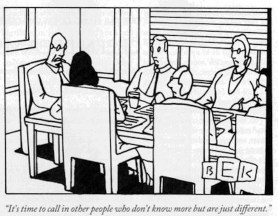
Might audience jealousy of artists explain why copyright is being officially destroyed on the internet?

Do artists deserve to eat?
Photograph by Mark Barron

In a March post, post-Gutenberg asked,

As more writers and artists without formal qualifications but with undeniable gifts find audiences for their work on the net, will micropayments finally take off?

[…]

So far, so-called Millennials – the generation in their twenties and early thirties now shaping our experience of the net — have shown little enthusiasm for […] experimenting with micropayments — direct transactions between buyers and sellers […]

Many ardent campaigners for the so-called ‘Freemium’ economy willingly pay small ransoms for the latest gadgets – even when these are only minor improvements or enhancements of last year’s versions, and are designed to fatten the profits of the hated capitalists. Few of them learn to cook simple meals from scratch: they are happy to pay huge mark-ups for bland microwaveable fare cooked and packaged by giant corporations, or to patronise fast-food chains.

Why is it seemingly only art that turns them into Scrooges?

For people working in the arts, the grim news last week – ‘European Parliament Kills Controversial ACTA’ — marked surging public support for depriving them of any protection from online piracy:

The European Parliament rejected the controversial global Anti-Counterfeiting Trade Agreement in a crucial vote on Wednesday. […] ACTA, abbreviation for Anti-Counterfeiting Trade Agreement, mandated that signatory countries implement legislation to criminalize certain types of downloading content such as music and movies, from sites not sanctioned by rights owners …

ACTA was killed by a vast online social network expressly formed to oppose paying creative artists for downloading copies of their work. There were some eye-popping attempts at justifying this European vote in the comments section of a furious protest against ACTA’s defeat by the Scottish novelist Ewan Morrison: ‘Throwing out Acta will not bring a free internet, but cultural disaster’.

To study that thread is to pick up a persistent undercurrent of jealous resentment – whose real target is not, as so many of those commenters claimed sanctimoniously, the ‘content conglomerates’ or multinational music publishers and film studios charging inflated prices for CDs and DVDs. It is the musicians, actors, and other ‘content-producers’.

One commenter seemed to speak for many in this post:

Bauhaus

Culture is shared and owned by everyone.

Floggin plastic discs, is a business, and nothing to do with culture.

A flurry of comments belaboured the point that artists must simply accept that technological change has made it difficult or impossible to prevent people from helping themselves to art free of charge.

At post-Gutenberg, we wondered why these stalwart defenders of freeloading have yet to form a movement against paying farmers for food. As tillers of the soil use air, earth, and knowledge of crop-growing ‘owned by everyone’, why not risk arrest and imprisonment by ganging up to pirate vegetables, eggs, milk and poultry from fields and farms unprotected by fences or other low- or high-tech barriers?

As heatedly as they insisted on freedom for themselves, the commenters crowing about ACTA’s defeat demanded that artists – especially musicians – work on their terms. These go beyond requiring musicians to ‘share’ recordings of their work for nothing. Never mind if they are brilliant composers with crippling stage-fright, or who would simply prefer not to perform live, these audience members know what is best for them … and some wrote strings of posts making essentially the same demands:

bleeper

The world has changed, and it has been changing for well over a decade now. A generation have grown up expecting free music and it’s nothing to do with being ‘radical’ or ‘hip’, it’s just the norm.

I suggest becoming a renowned performer rather than relying on CD sales.

To put it bluntly : adapt or die.

whitesteps

This little rant is of course based on the assumption that the grotesque wealth that has, in recent history, accompanied success in music or acting or writing is in any way desirable. 

wh1952

Pirating is wrong, but […] maybe the artists need to perform more. Those “used to be musicians” might still be if they’d got out of the studio and into the pubs and clubs like their predecessors did.

dirkbruere 

So music will once again be about artists performing live, instead of corporate fatcats presiding over billion dollar industries.

What a tragedy. 

seeingclearly

Most of the people you are talking about and their businesses, those in the creative industries, willingly use and exploit the free internet to give a wider audience a taste of what they are about and to use its capacity as free advertising for their events. The bonus of this is that live events which had been dying have now been invigorated.

wh1952 

[…]

[Musical artists must] do what most musicians have always done, flip burgers during the week and live for the gigs on Friday and Saturday night.

alloomis

[…]

… [U]nregulated web will lead to musos having to play guitar solo on street corners for thrown coins. can’t see anything wrong there. 

Existangst 

[…]

If you create something outstanding and expect to live off the work for the rest of your life, and your family for 70 years after your death, then you must charge a sufficient amount to invest the proceeds and live off the investment income.

Otherwise you need to continually produce new works, or perform existing works.

We did not have more than a few minutes to test our impression of artist-envy in a search engine trawl. Two results – not enough to prove anything, but admirably frank, and revealing:

From a post titled ‘Why we are insanely jealous of artists’ on Jason Kallsen’s Vinethinking blog:

At a certain point, usually in our youth … we stand alone in front of the mirror with thumb raised and sing along to a song that is pounding out of the stereo.  And during our dream sequence, we see thousands of screaming fans before us, cheering us on.  Yes, deep down, at some point, we all want to be that person.

[…]

We love artists, and we are jealous of them for two reasons: they live their life doing what they want to do without permission or apology, and their career creates legacy projects naturally. [his bold type]

From Momus’s click opera blog:

I’m jealous of artists especially when a shiny new copy of ARTFORUM arrives. I flick through the pages looking at the ads.

It’s important to be jealous, without rejecting. Jealous and full of desire.

[…]

I’m jealous of the super-elite art tribe who ride the global flow from one biennial to the next.

And I’m ultimately jealous of the fact that our society has evolved to such a level that we indulge people as if they were children, and let them act out the whims and games of children in public, and pay them for it. It seems that being an artist — in the West, or in China — is the ultimate evolutionary point of the individual. Perhaps it’s a point we’ll recede from as times get tougher later this century, but a world without these selfish, clever, silly children isn’t a better one.

Jason Kallsen points the way to the right solution – which is most definitely not to deprive artists of copyright:

[W]e can all live fuller lives than we probably do.  Even if you are chained to a desk (for now) find an outlet that allows you to creatively do whatever the hell you want to do.  A painting class, doing more personal writing, visiting museums more often, taking the camera around town on a daily mission to make one great photo, etc.

It is only a small leap from there to the reason why this post-Gutenberg blog was started last September – to campaign for changing the ownership structure of media to let members of the audience become co-owners, and give them the chance to perform and publish themselves. See, for instance: ‘Co-owning media is on the horizon …‘.

Julia Hobsbawm and a few more reasons to be wary of social networking

The New Yorker explains the ‘structural holes’ theory of social networking.
21 November 2005.

We are indebted to Ian Jack, writing in his latest Guardian column, for justifying our extreme suspicion of coercive social networking — and especially, of academic theorising about the value of something people have always done supposedly being on the verge of dominating everything else that we do.  (See footnotes for links to earlier entries on aspects of this alarming subject.)

Reflecting on a speech by Julia Hobsbawm, the new Honorary Visiting Professor in Networking at the Cass Business School at London’s City University – in which she pronounced ‘Facebook and Twitter … de facto, the new water cooler,’ but warned that extra-powerful networking takes place in ‘grassroots, lateral, face-to-face networks,’ — he noted,

The better people were connected, she said, the more they flourished. At the bottom end of the scale, “the completely un-networked” were often the unemployed. At the top end, networking away like barn dancers, were people who gathered at places such as Davos for the global events Hobsbawm always found “hugely stimulating and enjoyable” but regrettably confined to the same old elite. As I understood her talk, which may not be perfectly, the trick was somehow to open up these conclaves to less privileged people. Thus “social and intellectual plurality” would lead to “social and professional mobility”.

He came to this sad conclusion:

The Cass Business School should adopt a motto and paint it over the entrance: non quae sed quem cognoscis, not what you know but who. And thereby recognise the return of this unfortunate reality.

The New York Times, just as sceptical in its report of Julia Hobsbawm’s inaugural lecture, also emphasised her own splendid family and social connections as the key to her success – that she is the daughter of an eminent Marxist historian, Eric Hobsbawm, and was once the business partner of the wife of a former British prime minister in a public relations company.

Why do social networking theorists like her make their ideas so hard to understand?

Like Ian Jack, the New York paper quoted tiny snippets of her talk to convey deep bafflement – but post-Gutenberg did not really grasp what they were hinting at until we followed a link to a recording of exactly what she said. This longer segment of her lecture makes it easier to see why they found her — erm, ‘meta-concepts,’ is the way she and her fellow-theorists would probably put it, so elusive. We hope we have punctuated her words correctly in this transcript: it is not easy to decide how that should be done when struggling to make the ideas themselves fit together. After asking whether knowledge might be ‘more valuable when it is loose rather than tight,’ she continued,

The global workplace is itself becoming looser. Our graduate children are shadow-boxing hidden counterparts and hidden competitors on other continents. The Silicon Roundabout worker in London must be mobile and fluid because they may end up in Silicon Valley or someone from Silicon Valley may pinch their job. The garment producer in Mumbai may come from Mombasa. That’s because knowledge moves in a kind of diaspora now, uprooting from a fixed position and travelling. In fact, The Economist – again – noted in an article about diaspora networks last year that there are 215 million diaspora migrants in the world now. That’s the equivalent of 3 per cent of the world’s population taking ideas from over there back home. China’s growth may have more to do with the fact that over 500,000 people have studied abroad and returned, mostly within a single decade, bringing a huge brain surge through the ranks of think tanks and government.

The best expression of very loose knowledge that I can find is the sociologist Ronald S. Burt’s term ‘structural holes’. He describes the way ideas often form between formal [her emphasis] network nodes than in them. As Burt put it, and I quote, ‘Structural holes are the empty spaces in social structure. The value potential of structural holes is that they separate non-redundant sources of information, sources that are more additive than overlapping.’ And I’m minded to quote from Margaret Atwood’s The Handmaid’s Tale, in which she describes freedom as coming from ‘the blank white spaces on the edge of the print.’

‘Loose knowledge’, it would seem, is a stunning sequence of non sequiturs that could sink anyone listening for too long in a bottomless black hole.

Or, we might simply say, to encapsulate our yokelish incomprehension of the Hobsbawm networking spiel, very Swedish chef  … – in the hope that a few readers have come across this sublime Muppet Show character whose recipes could kill you, if you followed them – but that would call for understanding his directions.

_____________________

How would introverts like Beckett — and Wittgenstein, Kafka and P.G. Wodehouse — have survived social media?

https://post-gutenberg.com/2012/01/09/how-would-introverts-like-beckett-and-wittgenstein-kafka-and-p-g-wodehouse-have-survived-social-media/

Google, bowing to social media, is letting down tomorrow’s Samuel Becketts

https://post-gutenberg.com/2012/01/16/google-bowing-to-social-media-is-letting-down-tomorrows-samuel-becketts/

The Muppet Show’s Swedish chef in a meditative pause between utterances. http://www.olofssonfamily.se/wordpress/tag/the-muppet-show/

Advice for Lord Justice Leveson from Lao Tse: how to shape the afterlife of the 4th Estate and assist the birth of its successor

[ On 10 July 2012, The Independent, a ‘liberal’ London newspaper, declined to publish a comment on press reform linked to this post. That polite comment is here. ]

Niklaus Manuel’s ‘Dance of Death’ (‘Totentanz’, 1516-1519) was a hugely popular theme as Gutenberg presses proliferated and the Renaissance was in full sway. It could have symbolised a coming-to-terms not just with death but the dying of old ways.

Presiding over an Inquiry whose conclusions will shape the afterlife of the British press – doomed to extinction by digital media and the new voices of the 5th Estate – Lord Justice Leveson keeps reminding us of the contradiction in the difficult job he has been given. What mechanisms can he recommend to the government for the enforcement of ethical behaviour by the 4th Estate without ‘imperilling the freedom of expression or our free press’? – as he put it during Tony Blair’s testimony in late May.

Post-Gutenberg would like to recommend a fragment of ancient Chinese philosophy as a frame for thinking about a solution to his quandary. Lao Tse reportedly said, in the 6th century BCE,

If we wish to compress something, we must first let it fully expand.

Lao Tse

Rule-making can be seen as a sort of compression – in the sense of limiting, constraining and controlling. It is too soon for anyone, even the admirably wise men at the summit of Britain’s judiciary today, to draft rules for media being turned inside-out by the digital revolution. As perspicacious witnesses have pointed out, any new regulations that minutely specify what the 4th Estate can and cannot do must inevitably pronounce on who should be considered a journalist. How can that be done when the profession’s boundaries are being obliterated by the arrival of the 5th Estate?

It would be disastrous if the Inquiry were to lead to any blocking or impeding of this successor to the 4th Estate. What the arrival of the 5th Estate means for the press is that it has to share the megaphone it has so far had all to itself.  This succession is directly in line with the evolution and improvement of democracy – something that people everywhere want dearly, a yearning that events like the Arab Spring have dramatised.

To watch the Leveson hearings is to see the presiding judge agonise over too many details that an unimpeded 5th Estate will soon make irrelevant or outdated. They take up too much of his time, even when he understandably declines to deal with them in an Inquiry being criticised for taking on too much. As Dan Sabbagh noted in a good summing-up in The Guardian last week,

Leveson has so far showed little apparent desire to get into the question of the ownership structures of newspapers: when invited … to set a cross-media ownership limit that would force a Murdoch sale of the Sun or the Times, Leveson fought shy, “because that involves all sorts of competition issues which would require quite detailed analysis”.

Instead, Leveson went elsewhere to debate some practical solutions. The judge has been surprisingly consistent in the views he has espoused, taking the approach of testing out ideas periodically with witnesses he likes. Leveson is clearly sceptical of the PCC [Press Complaints Commission], telling Financial Times editor Lionel Barber in January that the body was not “really a regulator” but a “complaints mechanism” – and that it needed to be supplemented by another body, a new kind of court, “some sort of arbitral system” to cover libel and privacy claims – an imagined body that the judge said would be designed to be low cost – or to use a phrase he repeated many times “not make extra work for lawyers”. Its nearest analogue would be the industrial tribunals, or the arbitration system used in the construction industry. 

Post-Gutenberg likes the way the judge is thinking about  a replacement for the defunct and essentially toothless Press Complaints  Commission. We would also be happy to see the criminalisation of a small set of completely unacceptable infractions, such as extraordinary invasions of privacy by phone hacking and other underhand means.

But instead of pointless brain-cudgelling about precisely what percentage of which communication medium newspaper conglomerates like Rupert Murdoch’s should be allowed to own, Lord Justice Leveson’s highest priority should be to open the way to the largest number of competitors for the 4th Estate.

In other words, expand, don’t compress should be the principle guiding his recommendations to the government in September.

Check bad behaviour on the part of today’s media elite by maximising  opportunities for the outsiders of the 5th Estate to offer alternative presentations of facts and unfamiliar opinions, and to challenge and expose the biases and mistakes of every sort of media, new and old.

There is no shortage of good ideas for the democratic licensing of access to sensitive information by both professional and non-professional disseminators of facts. In a post a few months ago  on the blog of the International Forum for Responsible Media (INFORRM), Hugh Tomlinson QC made an excellent suggestion about ‘benefits for public interest journalism of creating a category of “accredited journalists”’.  These would be …

… a sub-category of those writing for publication [who] should be given specific privileges to assist them in their work. […] [P]rivileges should not be granted to journalists simply because they are employed to write or because they work for a media organisation.  Neither should the privileges be granted to any “citizen journalist” who claims to be writing public interest stories. Rather, the privileges should be made available to those who pass through a gateway policed by a voluntary independent regulatory body and sign up to an enforceable code of responsibility. [post-G’s ital.]

There are new ways of organising and financing journalism that could use Lord Justice Leveson’s support – even if that only means he will be careful not to hobble the reorganisation of the media as, for instance, a set of cooperatives in which readers and viewers could be offered the chance to become co-owners. In recent months, proposals for setting up and running these have been increasingly detailed and specific. (See, for instance, the mention of Paul Smalera’s suggestions in ‘Why a keiretsu-cooperative is a gentle transition for old media …’.)

The mere existence of the Leveson Inquiry has already had salutary effects. To give a small but critical example, the moderation of comments in The Guardian’s popular comments sections has become far less trigger-happy. Commenters are not being censored quite so reflexively for opinions or factual posts that conflict with that newspaper’s views and political positions, or criticise its friends. Last weekend, it was heartening to see a post about the Inquiry itself opened for comments after months of prohibition on grounds that made no sense – and to be able to read contributions to the debate about Ian Jack’s illuminating comparison of Leveson with an earlier government investigation of press practices.

As for the Leveson hearings, per se, their radical transparency — with a presiding judge confident enough to muse aloud and react spontaneously to testimony —  goes far beyond what many of us could even have imagined as a model of open government. (The best demonstration came an hour after this post: here). American lawyer friends looking on in awe tell us that nothing in the US system would permit Americans to copy the form of these proceedings.

Most amazing has been the discovery that the conduct of the Inquiry is characteristic of an exceptionally progressive judiciary. Utterly unlike the notoriously slow-moving and stodgy legal system wickedly satirised in Dickens’s creation, Jarndyce and Jarndyce — a court case that grinds on for generations – Britain’s top judges are not just acknowledging the implications of new communications media and adjusting to them, but doing so faster than the professionally nimble 4th Estate.

Post-Gutenberg only recently came across a news report from the spring of last year about a speech in Israel by the Lord Chief Justice, Baron Igor Judge, who put Sir Brian Leveson in charge of this indescribably gratifying investigation into press culture and practices. He explained that in Malta, where he was born, one of his grandfathers owned and edited a tiny newspaper. His sympathy for the press’s problems is, in a sense, inbred. But he favours the transparency and inclusion that are more the defining characteristics of the 5th than the 4th Estate – even for keeping his own legal system honest:

His “fervent hope” was that new technology would make it easier for the media to be “present” in court, reporting the proceedings, and “the present trend of fewer and fewer reporters in every court would come to an end”.

In an apparent reference to “virtual” courts based on video-conferencing, Judge insisted that justice should be done “in a public forum to which the public, or the media, has access”.

He continued: “Technology must not lead to justice done in secret, or some form of hole-in-the-corner justice.

Post-Gutenberg wishes to offer just more one scrap of advice to Lord Justice Leveson – who has invited everyone, however obscure, to contribute thoughts to his hearings: please do not allow political partisanship by the press to be conflated with press freedom. As we observed in a recent post in this spot, sanctioning political one-sidedness means licensing powerful media owners to be king-makers, with all the compromising wheeling and dealing that goes with that. It means condoning the skewed reporting of the facts so essential to the functioning of a genuinely democratic government.

With a fully licensed 5th Estate in full cry, media conglomerates trying to run Britain, with lots of help from British prime ministers – or what the Economist appears to dismiss nonchalantly as the inevitable ‘proprietor problem’ —  should be shown their proper place. And where would that be? If not oblivion, then as far below the salt as possible.

Gatekeepers II:  why not learn, like Bill Gates — so as not to dismiss subjects like intellectual India from blind ignorance?

‘The Indian Genius’: watch the menu at the top of the home page for a forthcoming compilation of articles on subcontinental topics.
Photograph by Amita Chatterjee

Before I built a wall I’d ask to know

What I was walling out and walling in …

‘Mending Wall’, Robert Frost, 1914

Gatekeepers would get more respect in this sceptical internet age if they could only acknowledge the vastness of what they – like the rest of us – do not know. The assumption of omniscience is inevitably a curiosity-killer. Satisfying deep curiosity – as even the most hopeless pilgrim on the road to wisdom knows – calls for humility, and for moving out of your zone of comfort in more than one sense. So it was that soon after Bill Gates stepped out into 44°C heat in the northern Indian city of Lucknow a few days ago, he went on Twitter to send out a link to a new post on his blog, thegatesnotes.com — a preview of a video report about this latest expedition to the subcontinent:

His entries about the trip are what you would expect to see in the online diary of the world’s most prominent philanthropist. He explores slums. He calls on chief ministers of Indian states. He visits medical research laboratories to check on progress in developing new vaccines. At the end of the short video clip, he gives his chief reason for travelling to this part of Asia: ‘Most of all, I go to learn.’

It was not subcontinental weaknesses and poverty but India’s strengths that originally put this country on his radar screen, when Bill was still running Microsoft. About a decade ago – and before he and his wife Melinda assumed control of their charitable foundation – he acknowledged Microsoft’s extraordinary dependence on Indian engineers for its operation and continued success. (See, for instance,  ‘Gates goes gaga over India’s developers, education system,’ The Economic Times, 14 November 2002).

As everyone in Silicon Valley is well aware, whereas the Chinese shine most brightly in computer hardware research and design, software is where Indians excel. This is not accidental. Cultural traditions going far back into antiquity supply highly plausible explanations for the difference. But you would be hard-pressed to find any book-length accounting for it.

Why?

Because book publishers in both the UK and US do not believe that readers have any interest in the subject – even though many thinking people, not just technologists and tech-entrepreneurs, know …

  • … that in the late 1990s, help from Indian programmers was crucial to averting the Year 2000 (Y2K) crisis that could have been disastrous for people using computers everywhere – however indirectly, as in digital telephone networks and computerised banking. Their energetic re-programming corrected the error that had left most computer software with no means of recognising, or independently adjusting its time-keeping for, the start of a new millennium.
  • … that, as much of a shock as it was for many Westerners to have to turn to the land of bullock carts and yogis for help with computers, the Year 2000 work was relatively trivial by comparison with evidence of the Indian aptitude for software design and development at the most sophisticated levels. That is why the loftiest rungs of research and management at Google, Microsoft, Adobe and other technology leaders are thickly populated by professionals of Indian origin.

In 2003 and early 2004, a book proposal and essay discussing the reasons for these phenomena were shopped to more than one newspaper and magazine – before a letter about the project landed on the desk of David Goodhart, the founding editor of the British magazine Prospect (whose charter, at its 1995 launch, called for it to succeed as a cross between the vanished Encounter and The New Yorker.) His unusual curiosity, easily the equal of Bill Gates’s, led over the years to him coaxing contributions to his magazine out of Francis Fukuyama, Margaret Atwood, and J.M. Coetzee, among other provocative intellectuals.

An article accepted and edited by David, setting out a hypothesis about Indian excellence in software and titled ‘The Indian Genius,’ ran in the April 2004 edition of Prospect. Its writer was invited to address a seminar in Paris at the French Senate on India’s transformation by globalisation, and gave a paper that had an exceptionally enthusiastic reception.

None of this changed the minds of our gatekeepers in Western publishing or led them to delve into the question of whether there was indeed an audience for a cultural and historical explanation for India’s competitive advantages in software, and how the West should react to them. Did they make any effort to fill gaps in their knowledge of Asia — if only as a gesture towards matching the depth and breadth of Indian interest and immersion in the Western cultural corpus? Apparently not.

What is to be done about this? Paul Kiparsky, a professor of computational linguistics at Stanford University, also a Sanskrit scholar, does not believe that the project will find the support it deserves until a sufficient number of wealthy Californian entrepreneurs of Indian origin are not just ploughing their money into new technology ventures and alleviating poverty in India, but turning their attention to Indian culture, scholarship and art.

While we await that happy day, post-Gutenberg will — as time and stubborn formatting gremlins permit — compile a small archive of essays and articles related to Indian intellectual contributions. Our first post will be the original version of the Prospect piece on India and software, truncated as the magazine was going to press, to make room for a reaction to train bombings by terrorists in Madrid.

In searching for links to post here for readers, we found that British Library Direct has begun to charge close to £ 20 for access to the article’s edited version. This, oddly enough, is being done without the permission of the author, or an offer to share any part of the proceeds – but its being offered on that site is additional confirmation that there is a readership for the subject.

If book publishing’s gatekeepers were less incurious, would the ascendance of China and India have come as such a shock to the West?

The answer is, unfortunately, all too obvious.