Gatekeepers I: in defence of Rachel Cusk — let cross-cultural flowers bloom in simultaneous international e-publishing

‘Brobdingnag o Lilliput’: the net has room for radically opposed perspectives and taste
in art and literature (see nearly invisible figures at base of shop windows).
Photograph by MIL22

Readers, all three of you, know that this blog could be one of the greatest fans Private Eye** has ever had – not just for its satire in direct descent from Jonathan Swift and other upholders of the grotesque tradition in English literature; not only for its unique compendium of whistleblowing about misused power and authority in Britain published every fortnight, but also for the futuristic modus operandi that makes these offerings possible.

This means that it is with excruciating reluctance that we at post-Gutenberg ask why the Eye keeps savaging the novelist and memoirist Rachel Cusk, who is capable of dystopian flights of prose of this calibre —

Summer came, clanging days of glaring sunshine in the seaside town where I live, the gulls screaming in the early dawn, a glittering agitation everywhere, the water a vista of smashed light. I could no longer sleep; my consciousness filled up with the lumber of dreams, of broken-edged sections of the past heaving and stirring in the undertow.

It reminded us of …

She listened … there was only the sound of the sea. … She saw the light again. With some irony in her interrogation, for when one woke at all, one’s relations changed, she looked at the steady light, the pitiless, the remorseless, which was so much her, yet so little her … but for all that she thought, watching it with fascination, hypnotized, as if it were stroking with its silver fingers some sealed vessel in her brain whose bursting would flood her with delight, she had known happiness, exquisite happiness, intense happiness, and it silvered the rough waves a little more brightly, as daylight faded, and the blue went out of the sea …

… lines by another good writer, about whom we’ll have a bit more to say in a moment.

The first passage is an extract from Cusk’s Aftermath: On Marriage and Separation, published this spring by Faber and Faber, today’s most prestigious literary imprint in Britain. With such a backer, she certainly did well with the gatekeepers in the sense in which the term is being used now – to refer to the old print media mafia of literary agents and editors deciding whose manuscripts will be lifted out of the slough of rejection, then promoted energetically, or left there to rot.

‘Gatekeeper’ could reasonably be used more widely, to include the reading public of a particular place either giving scribblers permission to think, feel and write in the ways that come most naturally to them – or attacking them or otherwise discouraging them from doing so.

That sanction has so far largely been denied to Rachel Cusk in Britain – for her divorce memoir. The Eye is far from her only excoriating mocker. Other British newspapers and innumerable citizen-commenters on reviews and articles about her have lambasted her eidetic, intelligent and ferociously self-critical account of this sad passage in her life. She has been denounced for solipsism, wallowing in dark emotions and imagery, and wrecking her own family’s privacy. For any objective witness to this battering – watching a long way from literary London – the last criticism is the most puzzling. Not once does she name her ex-husband or make it possible to identify him by his occupation, which has anyway changed since their divorce. Nor are her children easily identifiable, since they have no Christian names in her story, and presumably the surname of their father.

Yes, some of these facts can indeed be discovered online, but not by her choice – only, you suspect, because of the snippets of real life information extracted from her in publicity interviews on which book publishers insist, brooking no compromise.

You wonder why the anger about the baseless accusations of privacy invasion are never directed at ‘luvvie’ newspaper columnists, bloggers and social media networkers who never have to open the kimono, apparently delighted to live with it flapping high above their heads in a permanent hurricane of disclosure about themselves and their near and dear.

Cusk’s actual mistake was in violating the unwritten and unspoken rule for English writing in England – one that tends to make Americans uncomfortable. It decrees that sustained introspection and emotional intensity – when tending to chiaroscuro, if not outright melancholy – must be undercut by wit, poking fun at oneself, or some form of outrageousness like the scatological riffs and downright nastiness in some of Philip Larkin’s poetry. Admitting to admiring the lyrics of Leonard Cohen is asking to be sent to an aesthetic Siberia in most social circles. That makes no difference to those of us who marvel at the way sounds marry words in his contributions to music – even if we do believe the world’s greatest literary tradition to be English, inevitably: it shaped our taste.

But that is not the same as thinking that English aesthetic preferences should be used as a universal yardstick.

North America has crept into this scrap of wondering because Cusk’s writing style has partly been shaped by the years she spent there as a child. Her Mood Indigo prose in this memoir – I look forward to reading the others, and her novels – is strongly reminiscent of Joan Didion’s.

If Aftermath had been published simultaneously as an e-book in Britain and America – instead of in the UK alone – she would surely have elicited a more sympathetic or certainly, balanced, reaction from a cross-cultural audience. 

As sharp-eyed lit-critters have already guessed, the writer of the second extract quoted in this post is none other than Virginia Woolf – in To the Lighthouse. Much of her oeuvre consists of narcissistic, depressive, long-drawn-out exercises in introspection. Yet expert and non-expert British readers grant her genius status. Does a female writer have to be a victim of incest, and mentally ill, and finally, a suicide, to be allowed to say what she wants to as she sees most fit?

In a special editorial, no less, about Cusk, not long after Aftermath was published, The Guardian asked whether children can ‘really be counted as acceptable collateral damage in the self-styled vocation of the artist’ — without a substantiating word or phrase for the accusation. … Well! Should literary critics include in evaluations of the works of Virginia Woolf the question of whether it was right or fair that Leonard Woolf should have been obliged to interrupt his literary career, chronically, to serve as his wife’s psychiatric nurse? A nonsensical question, yes, but no more so than the one about damaging children.

The Guardian feels justified in lashing poor Rachel Cusk for writing a book that ‘plunges headfirst into the phenomenology of pain, which she wraps in a beautifying prose.’ Note the use of beautifying rather than beautiful – the compliment her sentences amply deserve – hinting that her writing so well must be reckoned another crime against decency; lipstick on a pig.

Time and the net will, we suspect, deliver the respect she deserves – for giving us, for instance:

We too came by car, along the motorway and then on smaller roads that took us through countryside and villages, little redbrick places that reminded me of the village where I used to visit my grandmother as a child. We lived in America then, and that English village, so damp and miniature-seeming, so full of twists and turns and cavities, constituted my education in the country of my parents, where soon I would come to live for good. In California I wasn’t quite sure who I was: large pieces of the jigsaw were missing, and it seemed that the missing pieces were here, in this rain-darkened place. I half-recognised them, the antiquity and the expressive weather, the hedgerows with their mysterious convoluted interiors, the sense of a solid provenance that underlay the surface movements of life like wood beneath the burnish: they were part of me and yet they lay outside me. … I was an onlooker, though I didn’t want to be. I wanted to live in the moment instead of always being lifted out of it into awareness, like a child lifted out of its warm bed half-asleep in the thick of night.

Brava! Rachel Cusk. Carry on scribbling, don’t let the Mini-Englander mentality get you down and in future, insist on simultaneous international publication.

——————-

** Feeling a bit low?  antidote: ‘Never too old’, a new love story by Dame Silvie Krin

The Leveson hearings are showing the world how beautiful transparent and open government would be

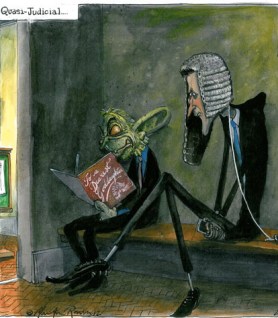
‘Quasi-judicial’: Jeremy Hunt, the minister responsible for culture and sport, awaits his turn at the Leveson Inquiry beside a former prime minister.
Detail from an anticipatory sketch by Martin Rowson for The Guardian, 26 May 2012

Strange times, these …

An incisive cartoonist can grasp the meaning of ‘quasi-judicial’ clearly enough to depict it with diagrammatic accuracy. Yet a British government minister charged with impartiality – the one with oversight of culture, no less – implied in evidence at the Leveson Inquiry that this aspect of a critical part of his job was really, really hard to understand. So difficult, indeed, that he saw only belatedly that there was something wrong with lobbying his cabinet colleagues to look favourably on a $16 billion bid by Rupert Murdoch’s News Corp. – the phone hacking champion – to take over the TV broadcasting giant BSkyB.

You might think that a cabinet minister should be capable of a less unconvincing defence, but you would be wrong. It was pathetic to watch Jeremy Hunt claim, last week,

This was probably the first time that I heard the phrase quasi-judicial or had some kind of exposure to what the implications of quasi-judicial meant, […] Obviously I did become extremely familiar with what quasi-judicial                  meant.

Two days before Hunt’s testimony, Michael Gove, another cabinet minister appearing before Leveson – the one in charge of education – defended Murdoch, his good friend and former employer, in ringing oratorical tones. He described him as ‘a great man’.  This eye-popping characterisation undoubtedly led others, not just sceptical post-Gutenbergers, to spend a few minutes learning more about such a faithful acolyte of the Digger’s. It took mere seconds to find the Telegraph columnist Tom Chivers, obviously beside himself with glee, telling his readers last June:

So here’s a thing. Her Majesty’s Secretary of State for Education, Michael Gove – the man charged with the schooling of our nation’s children …  in an interview with The Times, said: … “What [students] need is a rooting in the basic scientific principles, Newton’s laws of thermodynamics and Boyle’s law.”

Newton’s laws of thermodynamics! That’s Newton (died 1727, expounded the laws of motion in 1687) and the laws of thermodynamics (expounded between 1847 and 1851 by William Thompson, later Lord Kelvin).

And in a letter to the editor of a newspaper, that remark earned Gove six of the best from a cane that whistled as it descended:

I see that Michael Gove thinks that “what [students] need is a rooting in … Newton’s laws of thermodynamics” (Report, 18 June). As a science teacher, what I need is a secretary of state who knows the difference between motion and hot air.

Ben Littlewood

London

The Politicalscrapbook blog awarded him a dunce’s cap. No one looking on as he tried repeatedly — and dismally failed — to score points off Lord Justice Leveson could have doubted that the error fit the man. Neither he nor Jeremy Hunt seem to realise that even the dimmest members of the public find it impossible to comprehend members of government making excuses or pontificating without using search engines to check for factual accuracy and, or, plausibility, before they open their mouths. … Well, for goodness’ sake, they have aides to do such heavy lifting for them.

Both inexcusable ignorance and arrogance are harder for anyone to get away with now that encyclopaedias have morphed into the free and weightless Wikipedia. The Leveson hearings have let everyone observe human beings at the pinnacle of executive power being courteously but persistently grilled for hours on end. They been allowing us to compare the words of witnesses with body language and the most fleeting facial twitches.

The longer the Inquiry continues, the more new expectations it will create.

Who, after being riveted by judicial interrogations of the high and mighty, month after month, will be willing to put up with less than perfectly transparent and open government?

On Twitter, expressing a private opinion, Adrian Monck – who runs Communications for the World Economic Forum in Geneva – tweeted, after Hunt’s appearance, and in close sympathy with this blog:

RT @amonck: #Leveson should remain as a standing committee on British public life

— Jeff Jarvis (@jeffjarvis) May 31, 2012

It is difficult to imagine living without it.

Blogging shakes off its bastard status as the Leveson Inquiry legitimises non-professional, post-print media

Cartoon by an unknown artist at an exhibition, King’s Cross, London, 24 March 2012
Photograph by Katy Stoddard

A journalist giving evidence at the Leveson Inquiry on 23 May answered questions from the lead counsel, Robert Jay, QC, about his written submission – until the Bench intervened: 

Q.  … Can I ask you … about the arrangements or the negotiations with politicians which you say can become very convoluted. …

A. … I do find it easier not to have politicians as personal friends.  …

Q.  In the context of the symbiotic relationship you go on to describe?

A.  Yes.  I mean, it is like ticks and sheep, isn’t it?  One can’t exist without the other.

Q.  …  You might become parti pris or become just a little too understanding.  It’s obviously those vices which you carefully eschew.  Is that fair?

A.  Yeah, I mean I don’t want to set myself up as some sort of absolute prig here.  … I find it easier and cleaner to have a disconnection, that’s all … [A]nd the only justification, I think, for our existence, is that we act on behalf of the citizen.  We don’t act on behalf of the powerful or the vested interest.

LORD JUSTICE LEVESON:  Nobody will think you’re a prig, Mr Paxman, having just compared yourself to a tick.

Jeremy Paxman at the Leveson hearings

In 1999, after Jerri FitzGerald – the only doctor in a 41-person team on a research expedition to the South Pole – discovered a lump in her breast, she ‘performed a biopsy on herself with the help of non-medical staff, who practised using needles on a raw chicken.’

Everyone expecting courageous, detached professionalism in another sphere from newspapers covering the Leveson Inquiry into press standards and practices has been sorely disappointed. The most important story emerging from the hearings – confirmation of judicial sanction for members of the public who choose to blog, and for an unprecedented range of sources of information for voters seeking to make good voting decisions – is being concealed through a nearly exclusive focus on the implications for David Cameron’s government of sensational revelations from the phone hacking scandal.

All reporting on the Leveson proceedings by the press has been highly selective. Readers have even been deprived of such fun as the judge’s gentle takedown of the BBC’s best-known inquisitor on politics – the suave and debonair TV journalist Jeremy Paxman – recorded in our epigraph.

Reporting by traditional media about the changed status of blogging is non-existent, scant or distorted – sometimes gravely. Andrew Marr, one of the most respected political commentators in Britain, had this exchange with the Inquiry’s chief interrogator, Robert Jay:

Q.  …  [A]n article from The Guardian,  11 October 2010, … reports you as dismissing bloggers as “inadequate, pimpled and single” and citizen journalism as “the spewings and rantings of very drunk people late at night”. … Is that comment about … the tone and quality of some of the online debate, or is it a more fundamental criticism of bloggers as being detrimental to the good name of journalism?

A.  …[I]t’s partly a symptom of my deadly weakness for a vivid phrase.  It was a comment really aimed at the enormous amount of anger and vituperation that seemed to me to be swilling around parts of the Internet, most of it anonymous.  I was probably a bit out of date even if I was saying that. Now, you know, you look around and a lot of the most influential highly respected political commentators aren’t newspaper journalists, actually, they are bloggers.

In The Guardian, Dan Sabbagh supplied a master-class in biased reporting in a news story radically watering down Marr’s testimony about the value of political commentary by bloggers:

Lord Justice Leveson has queried whether bloggers would have to be brought in a revised system of press regulation, as he heard evidence from Andrew Marr about the growing power of political websites.

The BBC journalist and politics show presenter said that ConservativeHome and other sites are “now as influential as any newspaper” and any new system of regulation proposed by the judge “would have to include those alongside newspapers”.

Whereas the Sabbagh report had the judge merely reflecting ‘rhetorically’ on ‘the boundaries of regulation’ – meaning the degree to which bloggers would be treated as part of the 4th Estate – anyone paying close attention would have heard Lord Justice Leveson agonise about a ‘nightmarish’ task of a very different sort. What he said was clearly predicated on bloggers and citizen journalists not being be excluded from any new system of press regulation. His dilemma, he explained, lay in deciding exactly who should be required to redress complaints about journalistic misbehaviour in that new system – that is, wrongdoing not just by those traditionally considered journalists but by anyone practising journalism.

The judge must wrestle with the distinction within the blogosphere between those whose writing amounts to comments for the sake of commenting, versus ‘those that are in the course of — if you like, a trade or business.’ Or, as he later rephrased that division, bloggers and other newcomers who are ‘simply commenting and those who are doing more and getting towards the business end of journalism.’

It is money changing hands for commentary that is, for him, the key point of difference between traditional and non-traditional journalists – not levels of expertise, or indeed any intrinsic entitlement to comment.

Andrew Marr at the Leveson hearings

In another fascinating interlude in that day’s testimony, Andrew Marr noted – earlier – that a special category of political blogger had appeared on the scene:

I think what the world of the influential political blogger has done is introduced a new player into the system who isn’t the full-time professional journalist with a press card working at Westminster under an editor and isn’t a politician, but is somewhere between the two.  A lot of these people are card carrying party members.  […]  They have particularly strong contacts with their side.  And therefore you can’t treat them as old-fashioned journalists under old-fashioned journalistic codes …

Then, with commendable honesty, he added that newspapers had begun to employ these professionally partisan political bloggers – if not mentioning what post-Gutenberg has in recent posts about the ‘old-fashioned’ press now claiming partisanship as a basic right of a free press.  Paid political bloggers, he said, are

an  influential new thing.  I mean, even a lot of the papers are picking people up and using them as commentators now. I think the old distinction between a political player and would-be professional journalist is breaking down, and any system which is built upon the old system will quickly look out of date as well.

On Dan Sabbagh’s keyboard, that testimony was conspicuously tweaked, like the rest of his report – and made no mention of newspapers bringing spin-doctors into the fold:

Marr said that political bloggers were often “card-carrying party members” often with “strong contacts with their side”, which meant that they could not be treated as “old-fashioned journalists” but were nevertheless increasingly significant.

What a good thing it is that no member of the Inquiry’s outstanding legal team misses a beat.

There was, for instance, the moment when Marr told the presiding judge that the ‘buy-in from the editors and the journalists who are going to be part of it,’ would be critical to the success of any new system of regulation introduced.’ He emphasised that ‘you need them to be plugged in … enthusiastically and willingly so.’

This conversational minuet ensued:

LORD JUSTICE LEVESON:  In relation to buy-in, of course, if I’m going to recommend any system, it has to be a system that everybody has to buy into.

A.  Yes.

LORD JUSTICE LEVESON:  It will only have a chance of working if it works for the press, it works for the public as well.

A.  Mm.

… Not for ages has anything in public life offered the satisfaction of seeing right being done to remotely the same degree.

The lost wisdom of co-ops: a conversation about the key to future creative freedom for artists and inventors of every stripe

All artists now want to work on terms they co-determine.
Photograph by MIL22.

Post-Gutenberg will occasionally be letting visitors eavesdrop on discussions between our colleagues – starting with the pseudonymous and gender-free Escargot and Mustrun, who are not quite ready to divulge any personal details, except in warning about their tendency to be over-earnest, humourless, and on occasion, dull. Not the best qualifications for bloggers, we agree, but we make do with what we have – or rather, who.

Mustrun: I see that on Sunday we linked to The Observer — to a sharp John Naughton column about the Facebook hype falling flat on Wall Street. Someone here dropped into a comment there a link to our Valentine’s Day post about snubbing Facebook and re-inventing social networking sites as co-ops.

Escargot: So that’s why our traffic numbers have gone zooming into outer space. We’re not used to thundering herds of visitors shattering the monastic silence in these parts.

Mustrun: Right. Co-op promoters are the slave trade-killers of tomorrow.

Escargot: Trying to be aphoristic again, are we? Don’t. That one’s as clear as mud.

Mustrun: Just saying. All the clever people were sure for over two millennia that slavery would always be with us. Anyone trying to abolish it was written off as a lunatic or idealistic fool.

Escargot: Oh. Quite. Last week that lovely Leveson Inquiry judge, more owly than we are, was asking eminent witnesses to suggest how to make the British press behave in the future, and be less hopeless at holding politicians to account. No one mentioned redesigning media organisations as co-ops, but it’s surely a solution whose day has come. Not to mention dead relevant.

Mustrun: You’re thinking of the Harvard journalism lab experiment? Something to do with an Indian tree that looks like a multi-limbed goddess on steroids?

Escargot: The Banyan Project, yes. It’s been building a prototype for doing online journalism as a cooperative enterprise, focusing on local news. The man behind it, Tom Stites, has exactly the right idea. We’ve quoted him on post-Gutenberg before.

Mustrun: We have? Well, you know me. Any subject not mentioned in a post header, or that I didn’t write about myself, does not register.

Escargot: [sighing inaudibly] So as usual, you want me to urp up what he said, to fill you in?

Mustrun: Leopard, spots; all in the hard-wiring – yes? … If you would, please, Scargo.

Escargot: [reads through imperceptibly gritted teeth] ‘A significant source of co-ops’ strength is the trustworthiness inherent in their democratic and accountable structure. … This is also an era of rampant mistrust of journalism, so co-op news sites’ trustworthiness has the potential to add value to what they publish. Further, the co-op form allows, or rather demands, that news coverage decisions arise from what a community’s people need … The web is inherently collaborative — just as co-ops are — and at the local level this creates the potential for civic synergy — ’.

Mustrun: Translation: co-ops and the internet were made for each other. Spot-on, in that long-winded Murrican way. He might add that it’s strange but true that large parts of the internet sit on top of ‘peer-to-peer computing’. But this Justice Leveson, … how is he supposed to go from applauding a fine example like Banyan – assuming he does any such thing – to persuading the media to try out co-ops? He’s hardly going to order them to alter what we’re supposed to call their ‘business model’.

Escargot: Right. Britain is not a dictatorship. But he might recommend that the government offer old or new media organisations tax breaks for setting up co-ops – in the oldies’ case, by reinventing themselves, or parts of their operations, as co-operative outfits.

Mustrun: You think journos would sign on? Remember that the majority so detest the idea of any change that they can’t even bring themselves to report that Nick Davies — the journo hero of the phone hacking saga — told Leveson that the press cannot be trusted to regulate itself.

Escargot: Mmmm. Some of them will sign on, certainly. More will as the idea loses its strangeness, I suspect. There are editors and journalists who’d leap at the chance co-ops could give them to set rules and policies collaboratively. Mainly, I suspect, the craft-focused ones — hoping, like artists and writers everywhere, that this net revolution really will get rid of hierarchies and gatekeepers.

You saw the Tom Friedman column celebrating some of that on the New York Times site yesterday — yes?… But then of course, many journos live not so much for the craft as for the clubbiness in the profession. And sort of think of themselves as football teams – the women just as much as the men.

Mustrun: Clipped Friedman for skimming, later. Journos are petrified of more democratic media organisations, especially of any plan that involves making room for outsiders — for more varied contributors and voices. I’m always asked the same nervous-Nellie question about posts on here like ‘Co-owning media is on the horizon …’. It’s this: will working in a media co-op mean that trained journalists get paid the same as bloggers and citizen-journalists?

Escargot: Oh, I’m asked that. All the time. No matter how many times we explain that the way a co-op works will depend on the particular set of rules its owner-members agree on, the journos and media managers revert to projecting their most paranoid fears onto any mention of  co-operatives.

Mustrun: Someone ought to re-publish that superb Tom Lester article about co-ops in the disintegrating copy of Management Today you once disinterred from our archive. It’d make a terrific contribution to the new e-publishing collections of long-form journalism – with an introduction setting it in context, of course, and updated facts. Remind me of the year it was published?

Escargot: Imagine you proposing anything in long form, Musto. The owner of the world’s most attenuated attention span. The Lester piece — the cover date for the magazine says February 1979 — deserves every last gram of your praise.

Mustrun: Even text-grazers like me have to stop for a real meal, now and then. What he pulled off in that article is amazing. His subject was the failure of the Kirkby Co-operative in a depressed manufacturing town near Liverpool. Yet by the end of his dissection of how Kirkby was done in by badly-designed rules, you somehow feel hugely optimistic about a well-designed co-op’s chances of succeeding.

Escargot: Yes, yes, and yes. The piece partly answers the question of how journalists might be paid in relation to bloggers – not that we existed, then — by explaining the rules for profit-sharing in one of the world’s biggest and most brilliant co-ops. Mondragon, in the Basque country of northern Spain.

Mustrun: ‘Mondragon’ sounds like something in Lord of the Rings. Lester uses its exotic history — it was started by a Catholic priest in the desperate aftermath of the Spanish Civil War — to create a riveting context for a step-by-explanation of exactly how an individual could join a co-op and help run it.

Escargot: [ swipes over to scanned copy of the article in a tablet computer ] The ratios may have changed, but in 1979, Lester said that at least 30 per cent of a Mondragon co-op’s profits had to be put away in the collective reserve funds. Then, ‘the other 70 per cent is divided up among the members of the co-op according to a points system reflecting job status.’ … And of course, every member could help to decide the status of one job in relation to another.

Mustrun: But in addition to practical, nitty-gritty details like that, he tells about some of the lunacy that seemed to go hand-in-hand with the passionate idealism behind co-ops of the past.

Escargot: Mmmm. ‘No shortage of idealism,’ he says about Mondragon, ‘…but mixed with hard-headed realism.’

Mustrun: Yes, but noisy idealism has been the biggest enemy of co-ops. Makes sensible people mistrustful.

Escargot: Quite. If only people who believe in them and have the right skills – extroverts, unlike us – would just get on with setting them up with no fuss. The way, for instance, Tim Berners-Lee quietly invented this World Wide Web. What could be more idealistic than a way of communicating as powerful as this one, connecting the whole planet –  but given away, free? A scientist silently beavers away in a lab in Geneva and without any self-advertisement, no speechifying whatsoever, changes the world.

Mustrun: Well, I really must, … you know …

Escargot: Right. Off you go, then.