Proofs of concept for a keiretsu-cooperative to succeed the data collection and ad-dependent legacy publishing model— from TikTok, the online Daily Mail … and Shakespeare

By becoming a shareholder in an acting and theatre-owning joint-stock company, Shakespeare — a ‘country boy’ outsider — ‘was the first to turn playmaking into a potentially rewarding profession’ — Soul of the Age: A Biography of the Mind of William Shakespeare, Jonathan Bate

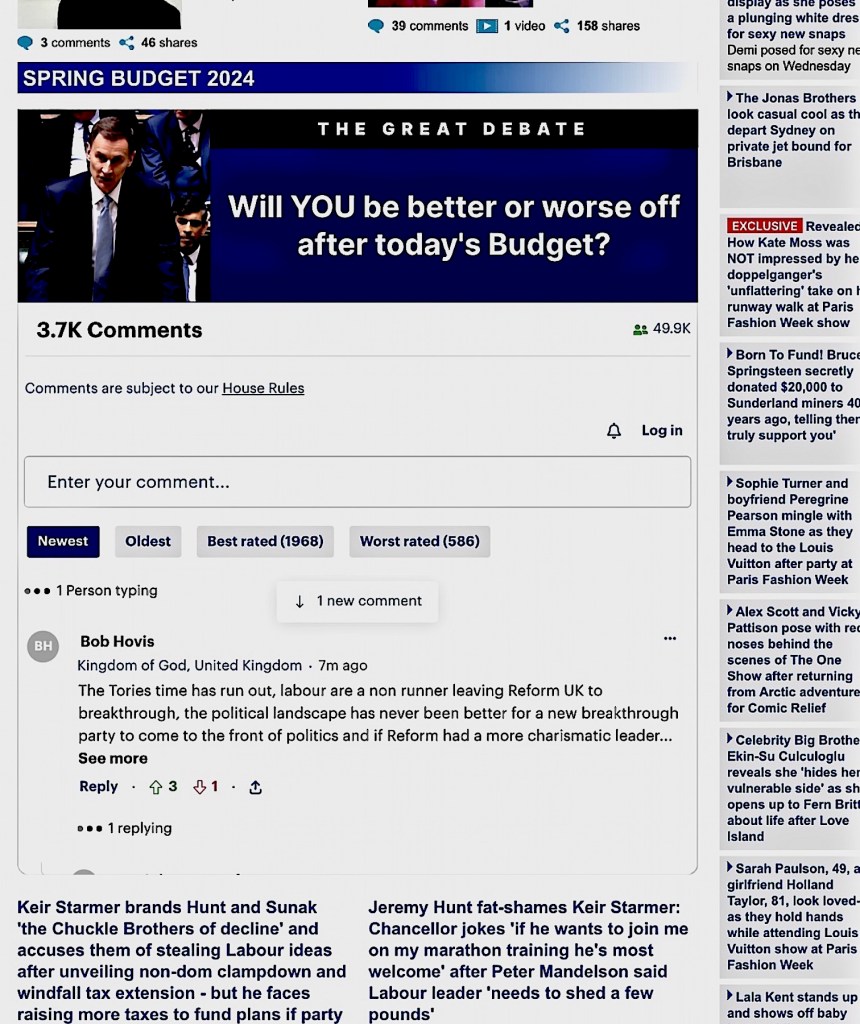
A live scroll of 3,700 readers’ comments on U.K. taxation and a comment invitation box on the 6 March home page of the online Daily Mail look like illustrations for William Dutton’s The Fifth Estate: The Power Shift of the Digital Age

Real-life counterparts of conceptions of things to come can appear in unlikely places, including some in the past. 

But, you may say — surely not the online Daily Mail coupled to the Chinese user-videos-plus-shopping platform, TikTok? Yes, and yes. But also from, of all people, the supreme William Shakespeare — or what literary experts and historians searching for the indisputable facts about his life have unearthed in recent decades. 

This improbable group answers the question of what evidence there is for the practicality of a keiretsu-cooperative to succeed the noxious advertising and personal data collection-dependent  surveillance business model for journalism and publishing. 

Though legacy media’s need for an innovative financing scheme and structure has proceeded from dire to desperate, this has somehow gone unmentioned in 2024’s mournful stream of reports about the decimation of employment in the news business. 

In noting that over five hundred jobs in U.S. print, broadcast and digital media fell to cost-cutters’ axes in January, Politico said that this followed layoffs of 3,087 in the same categories in 2023 and 2020’s high watermark of 16,060. A 5 March reminder in the Financial Times of 450 journalists losing their jobs in Britain’s dominant Reach publishing conglomerate last year — because of an advertising slump linked to a steep slide in its newspapers’ online reader numbers — was not accompanied by any discussion or speculation about ways to stop or reverse the trend. Legacy publishers exhibit no outward signs of interest in remedies except for tried and tired variations of subscription terms or experiments in taking paywalls up or down to limit what visitors to their sites can read. 

The New Year’s Day post here drew attention to the lone, faint glimmer in this doom-saturated panorama: old media managers do at last understand that reader-commenters are poised to become the core of their economic survival plans — the same people at the heart of the keiretsu-cooperative

These are the visitors — effectively, informal, indie micro-publishers — luring and engaging site traffic who in 2010 were still commonly referred to as ‘bloggers’. January’s  p-G jottings about them recorded that the business brains at some newspapers have begun to treat reader-commenters’ reactions and other ‘content’ like gold dust. As a result, some of them have begun — shamefully — to slap copyright claims with no legal justification onto those contributions from audience members, including many who are handing over cash as site subscribers.

How long is it going to take before most of them understand all the transformations underway sufficiently to see that reader-commenters are well on their way to morphing into: 

— CONVERSATION PARTNERS ON EQUAL TERMS 

or ‘interactive’ audiences who are no longer mere receivers for broadcasts by newspaper reporters and opinion writers. On 6 March, anyone popping in at the online Daily Mail would have noticed an apparent experiment — placing at the centre of its home page a blank commenting box inviting readers to have their say on the U.K. government’s spring taxation and budget announcement. 

This invitation was set in a screen within a screen with a moving scroll of other readers’ thoughts on the topic (see screenshot above, taken when the comment count had reached 3,700). 

The overall impression was of a live demo of William Dutton’s portrayals in The Fifth Estate (2023) of ‘networked individuals’ becoming powerful as ‘a new source of accountability, not only in government and politics but also in all sectors of society.’

— CO-PERFORMERS 

The online Daily Mail is the world’s fifth most-popular English language news title. It also magnetises more visitors to TikTok than any other purveyor of news on this Chinese-owned (ByteDance) social media platform where anyone can upload short videos they have made; earn cash from advertisers through product placements and promotions if they can lure enough traffic; and buy things hawked to them.

Publishing for people catching up on news where they go for relief from boredom, to play amateur auteur or entrepreneur, or to risk becoming shopaholics looks unavoidably like the future of journalism — because these people are disproportionately the youngest adults. 

In a mid-January feather-fluffing announcement, the Daily Mail Online claimed to have ‘surpassed 10 million followers’ on TikTok (estimated by backlinko.com, to have soared beyond X-Twitter, Telegram, Reddit, Pinterest and Snapchat in platform popularity measured by ‘monthly active users.’) 

The paper summed up its TikTok triumph as icing on the cake for its ‘unrivalled position as no.1 for engagement with audiences across all platforms.’ It explained that ‘[a]ccording to research by the Reuters Institute for the Study of Journalism, 20 per cent of 18-24s use TikTok to learn about current events, which was an increase of five percentage points from the previous year.’ A follow-up story in February quoted other research ‘showing that more than 40 per cent of 18-24s receive news from the Chinese-owned social media giant once or more times a day, compared with 19 per cent for the BBC, Instagram (44 per cent), Facebook (33 per cent) and Elon Musk‘s X (24 per cent), formerly known as Twitter.’

Luck being what luck is, my 2010 outline of a scheme for post-Gutenberg publishing, six years before the birth of TikTok, began:

New communication technologies have created a karaoke world. It is not just that we have the means to ensure, cheaply and easily, that—as Andy Warhol predicted— everyone could be world-famous for fifteen minutes … Practically nobody is content any more to be just a spectator, reader, passive listener or viewer. Audience participation as well as the right to talk back—which includes non-expert reviewing of works or performances by trained and seasoned professionals—have become absolutely standard expectations. 

— STAKEHOLDERS AND CO-DETERMINISTS

Few card-carrying cultural elitists inclined to shrug loftily about TikTokers earning cash from homespun, unmediated webcasting — making them de facto stakeholders in the platform’s success — will know that without the democratisation of culture in his own revolutionary epoch, we would never have heard of William Shakespeare. That man of mystery incommensurably more gifted than any other literary genius — forget TikTokers — has emerged from recent literary and historical sleuthing not as the aristocrat lurking behind a pseudonym in the centuries-old rumour, but incontestably a ‘country boy.’ 

He was ‘the grandson of a yeoman farmer and the son of a failed provincial shopkeeper,’ in his portrait by today’s pre-eminent Shakespearean scholar, Jonathan Bate, in Soul of the Age: A Biography of the Mind of William Shakespeare (2009). He got his start in playwriting by polishing the scripts of other writers while enduring mockery as ‘an upstart crow,’ a ‘rude groom,’ and a ‘peasant.’

But this book’s most unexpected revelation, for many, will be about Shakespeare’s business acumen, an asset as rare in writers then as it is now. He died a prosperous landowner at fifty-two, leaving his wife and the children he had fathered before his twenty-first birthday well provided for from his earnings as a shareholder in an acting company that operated very like a cross between an artists’ collective and a cooperative venture in our time.

Through becoming a shareholder, Shakespeare was the first to turn play-making into a potentially rewarding profession that could support a marriage and a family. His fortune was made not by a literary innovation but by a business decision. In his early career, Shakespeare would have noted the raw deal suffered by the script writers, who were paid only a few pounds per play. The serious money was made by manager Henslowe and lead actor Alleyn, who ran the Rose Theatre as an entrepreneurial partnership. Shakespeare and his close associates came up with an alternative arrangement: the Lord Chamberlain’s Men was formed in 1594 as a joint-stock company, with the profits shared among the players.

What could have been the equivalent of reader-commenter power for Shakespearean audiences? 

The 20th-century historian John Hale has shown that unlike the ‘patron-fostered painters of Italy, the Low Countries and Germany,’ the Bard ‘was reliant on popular support, as were his fellow playwrights.’ Their works and the venues for their performances were part of a democratically inclined ‘theatrical machinery that both responded to and increased the number of spectators and dramatists.’ Another impression from reading The Civilization of Europe in the Renaissance is  of how uncannily today’s social media frenzy resembles the explosion in early 17th-century mass entertainment in London:

During the boom period of new plays, 1600-10 … the places available each year in the commercial theatre, discounting Sundays and Lent, may have topped a staggering two million when the population of London was two hundred and fifty thousand. Never before in Europe had there been so heavy a vote of confidence in a single form of cultural activity.

In another prefiguring of the present, Civilization shows the joys of expanding free expression for playwrights soon proving to be too much for the authorities:

Altogether the appetite for theatrical dialogue and effects was so constant as to enable a playwright to indulge his own aspirations short of flagrantly inviting political and religious censorship; bawdiness was let slip with a shrug, a contributory reason for the Puritan criticism which led eventually, in 1642, to the order that the theatres should be closed altogether, an order honoured almost as much in the breach as in the observance.

Some of the Puritans especially disgusted by their inability to control this tide in public affairs presumably let a different one carry them away to found a new colony on the other side of the sea. But here we are now, being reminded that the most satisfying narrative arcs can turn out to be circles. 

The keiretsu-cooperative seems to rhyme naturally with what has gone before, not just with what will or should be.

The media establishment has begun to see sense in a user-owned Facebook — but in curbing surveillance capitalism, let’s separate the baby from the bathwater


silly moos LESS SC postgutenberg@gmail.com.jpg

Social media users must do more than refuse to be stripped of their data like helpless moos — postgutenberg [at] gmail.com

Let’s not forget — in imposing long overdue restrictions on data-gathering by the social media giants — that without the broadcasting platforms they have given us, the software engineer Susan Fowler might have got nowhere with bearing witness to sexual stalking and degradation at Uber. She might not have galvanised a movement with its silly ‘#metoo’ hash tag** and nonstop, numbing repetition of words like ‘harassment’ and ‘abuse,’ and lent it the gravitas it needed.

In other words, let’s not throw out a near-miraculous baby — direct, unmediated, all-points broadcasting — with the bathwater. Without internet chattering about her clear, self-evidently truthful account of her Uber managers’ attempts to bully her into choking down her anger with her persecutor and living with chronic persecution — because his work was seen as invaluable to the company — intermediaries like media editors and lawyers would have interfered with her choices of words and evidence, and put brakes on her telling us precisely what she wanted us to know.

She also had her well-deserved luck of perfect timing.

Four years ago, almost no one wanted to hear about the grave risks in the massive collection of intimate data about us by Facebook,  that we joined other critics in referring to as the surveillance business model. Almost no one was prepared to do anything about Facebook helping itself to this information without our permission, or offering any form of compensation for it. Or about the fact that this company actually rejected proposals for letting people pay subscriptions for the service it offered us, because it perceived the power in giving it to us in exchange for the unrestricted freedom to delve into our minds to construct detailed psychological profiles of us to sell to advertisers or anyone else prepared to pay for them — the capacity to use ‘likes,’ as John Naughton has reminded us today in The Observer, ‘to predict accurately a range of highly sensitive personal attributes, including sexual orientation, ethnicity, religious and political views, personality traits, intelligence, happiness, use of addictive substances, parental separation, age and gender.’

Few were moved, then, to support arguments that a Facebook based on other people’s information should rightly be owned by those people — in some form of mutualisation or cooperative venture, as we proposed on this site in 2012 in a post titled ‘A Better Facebook …’ republished here last November.

Five years later, last Wednesday, the New York Times presented, as if this were a brand new idea, the otherwise commendable suggestion by three scholars — Jeremy Heimans, Henry Timms and separately, Nathan Schneider in 2016: ‘[W]hat if a social network was truly run by its users?’ In a newly published book they have written together, Heimans and Timms note the unfairness of what we — like many others — have been pointing out for years: the injustice of ‘the creative output of billions of people’ being turned ‘into a giant, centralized enterprise, with most users sharing none of the economic value they create and getting no say in the platform’s governance.’

Nathan Schneider was virtually repeating exactly what post-Gutenberg proposed in 2012, in pointing out that a ‘new, improved Mark Zuckerberg wants to be perceived as a force for good in society — and [… is reportedly …] clashing with the strictly business-oriented senior executives in his company over this…. If he’s serious, why not acknowledge that Facebook’s users supply the personal information about themselves that he has exploited to get rich […] and flip ownership of his company over to Facebook’s members?’

A better justification of the NY Times’ reputation for fair and critically important reporting was in a recent story illustrating the ability of faraway foreign countries to use social media’s records of our exchanges with our friends and acquaintances to control us. No, it was not about evidence of Russia interfering in the U.S. presidential election or in the Brexit vote in Britain, but about China censoring commenters on its policies using social media platforms outside China, and owned by foreign companies, and punishing one company, Mercedes-Benz, for featuring the Dalai Lama in one of its advertisements.

The report by Paul Mozur began: ‘Within its digital borders, China has long censored what its people read and say online. Now, it is increasingly going beyond its own online realms to police what people and companies are saying about it all over the world.’

If the Chinese can do this, anyone can.

We apologise for the irritating, Cassandra-like, we-told-you-so tone of this entry, but post-Gutenberg predicted precisely such a consequence from data-gathering by social media companies — in 2013. As we noted here on 15 January 2014:

Not for ages has there been a pudding quite as over-egged as the one presented as the news story of 2013 – the Orwellian mass surveillance exposé which, as it unravels, shows the UK and US governments hardly initiating nonstop monitoring but, rather, striving to keep up with companies like Facebook, Apple, Microsoft and Google in gathering intimate information about us and watching what we do.

[…]

Last September, this blog warned that the blinkers needed to come off too many commentators on the NSA and Britain’s GCHQ – to let them appreciate that we should be protesting not just about spooks but anyone amassing personal data about us. In an entry about reader-commenters on newspaper sites correcting the unbalanced coverage of mass surveillance, we said

Stores of information, once they are gathered, can acquire new owners. 

Lately, we have seen a suggestion on various sites that the social media giants should be turned into public utilities. This would be the wrong solution. We need distributed, decentralised ownership — by social media users — to avert the abuse of any form of centralised power. Abuse by surveillance capitalists, or our governments, or anyone else’s.

** We prefer the more constructive, spine-steeling, #NeverthelessShePersisted.

Will this April Fool’s Year of canonising whistleblowers, any whistleblower, never end?

Whipped, if not quite dead: the putative whistleblower’s surveillance story -- with legs  -- ‘Horse and groom,’ 15th-century, Turkish Miniatures, Mentor-UNESCO, 1965

Whipped, if not quite dead: the surveillance story — with legs
— ‘Horse and groom,’ 15th-c., Turkish Miniatures, Mentor-UNESCO, 1965

Might the back-to-front spy story fingering government spooks rather than the villains subjecting us to the ‘surveillance business model’ be the longest-running April Fool’s wheeze in history?

Simon Jenkins in The Guardian, 27 march 2014:

Whistleblowers are not always right, let alone easy companions, but then nor were saints. Few can be saved from a degree of martyrdom. But we can at least canonise them as saints rather than persecute them as devils.

Surely that is a wickedly batty, not to mention irresponsible, suggestion — unless or until we are sure that any particular whistleblower is tooting for our collective benefit, not merely as a rebel in search of a cause? Anyone reading the closing paragraph of the Jenkins column would have proof that Spiked Online was hardly going overboard, last summer, when its editor, Brendan O’Neill, suggested …

Let’s call a halt to the worship of whistleblowers

11 June 2013

The cult of the whistleblower is getting out of hand

In 24 hours, Edward Snowden has gone from being a former contract worker at America’s National Security Agency to a godlike figure who has apparently ‘saved us’ from ‘the United Stasi of America’. It’s the religious terminology that is most striking. For leaking info about how the NSA keeps tabs on the communications of both American and foreign citizens, Snowden has been referred to not only as a saviour but also as a ‘martyr’. He’s praised for revealing to us, the sleeping ones, ‘the truth’ about our world. Journalists fawn over the ‘earth-shaking magnitude of the truth’ he has revealed. His own codename in his dealings with hacks was Verax, Latin for ‘one who tells the truth’ and a recurring word in the writings of old-world Catholic scholars on the lives of the saints and seers. If Snowden possesses Christ’s capacity for ‘saving’ people, he lacks His humility.

 As befits a modern-day teller of the truth, Snowden has been turned into an overnight icon by the guardians of liberal values. The Guardian itself plastered his picture across its front page yesterday, even taking the very unusual step of moving its own masthead down and replacing it with the words: ‘The whistleblower.’ This wasn’t news reporting; it was a secular beatification, an invitation to readers to look into the eyes of St Snowden, the latest in a line of brave revealers of liberal gospel, who, according to one Guardian columnist, has carried out ‘extraordinary human acts’ and showed ‘an endless willing to self-sacrifice’ – just like You Know Who. The creepy Jesus allusions are even more apparent in the Twittersphere, where Snowden is referred to as saviour, martyr, even ‘libertarian messiah’.

 The speedy beatification of Snowden reveals a great deal about the increasingly irrational worshipping of the whistleblower. Primarily, the cult of the whistleblower speaks to the profound passivity and deep moral lassitude of both modern journalism and radical politics …

Just as we are — as in recommending, two entries ago, a Laziest Journalism Ever award for the shrill, over-amplified Snowden coverage — Spiked’s O’Neill has been horrified by what it says about the state of the craft of journalism:

[J]ournalism … seems to have transformed itself into a passive receiver of ‘truth’ rather than active seeker of stories. Journalists are increasingly reliant upon sneaked-out information from the citadels of power. This is bad for so many reasons: because journalists lose their dirt-digging drive and instead become grateful recipients of discs or graphs from disgruntled individuals; because it redefines ‘the truth’ to mean something graciously given to us by those in the know, rather than something we shape through the very act of seeking it, of analysing and understanding what we have found out; and because it inevitably nurtures shoddy, rushed, ill-thought-through journalism. Indeed, some of the claims about the NSA are now being called into question, which suggests that getting mere info from one man is no substitute for spending a long time looking for a story, and then discussing it, checking it, contextualising it, and making it something bigger than simply, ‘Look at what was whispered in my ear….’.

… This is, admittedly, a somewhat lazy entry on the blog. We have too much to say, on a very different subject – and are waiting for all that to settle and simmer down to manageable proportions before we return.

Will there be a half-pint Pulitzer for The Guardian’s Snowden job, like the Paul Foot ‘special investigation award’? … & A Guardian overseer acknowledges ‘mass surveillance’ of readers

Secret, shadowy, tunnels into our lives, 2 - photograph: postgutenberg@gmail.com

Secret, shadowy tunnels into our lives, 2
– photograph: postgutenberg@gmail.com

‘Our tap’s been phoned.’ Neil Bennet, 1989, Private Eye: A Cartoon History

‘Our tap’s been phoned.’ Neil Bennet, 1989, Private Eye: A Cartoon History
– ( the subject of a staged National Theatre conversation: video clip)

In Britain the question of whether the barrage of banner headlines about the Snowden leaks deserves the highest journalistic honours has already been decided – but only, on the evidence, with deepest ambivalence.

No, we do not know any of the judges behind the 2013 Paul Foot Award ‘for campaigning and investigative journalism,’ established in memory of a legendary Private Eye investigative reporter who died in 2004. When we thought to look up its winner, after last week’s post about the argument over a possible Pulitzer for the Snowden story, we made the brow-raising discovery that although the Paul Foot prize was awarded last month to David Cohen of The Evening Standard for a series about London’s criminals, a ‘special investigation award’ went to The Guardian’s Snowdenia saga.

How in Hades could that have happened? Private Eye has had strikingly little – mostly, nothing — to contribute in any form of commentary (not even as cover cartoons or inside drawings) to the Snowden brouhaha. And yet anyone can see that the saga has an infinitude of giggly possibilities. The prize-givers made the predictable nod, in their citation, to ‘one of the biggest stories of the decade.’ But it seemed bizarre that as a compromise between handing The Guardian’s surveillance-consciousness-raising team the £5,000 main prize and the £1,000 that four shortlisted finalists took home, a £2,000 consolation prize had to be specially invented to placate … someone or other.

We took the logical next step, which was to look into the source of the prize money. Ah. The Paul Foot Award is co-sponsored by the Eye and … none other than The Guardian. … Just fancy that. … For anyone as mesmerised as we have been by the hopelessly confused allegations of ‘Orwellian mass surveillance’ – a misplaced cliché that seems mercifully to have been put to bed, in most coverage – the recording of Ian Hislop, the Eye’s editor, summing up l’affaire Snowden on Have I Got News for You, is a must-see. His body language telegraphed irrepressible glee, last October, as he delivered an explanation that seemed to account for his magazine’s lack of interest in the story:

The new head of MI5 has said that The Guardian has acted really irresponsibly in pointing out that we’re spying on people. It’s pointed out that we’re all being spied on all the time. [ … ] It’s a matter of consent, really. You can debate this and say, ‘Yes, I’d like to be spied on.’ I know I would. Anyone showing any interest in my life would be terrific. [Howls from live audience.] I’d be very, very, happy with that. But it’s a matter for public debate. And if we want to pass laws saying we can spy on people, we can. […] It’s just what The Guardian did was point out this is happening and nobody knows it.

Nobody would have needed telling if, as this blog has pointed out with tedious frequency, papers like The Guardian and The New York Times had only been listening to their own technology correspondents – instead of treating them as back-room bores. The public would have been educated about the all-pervasive ‘surveillance business model’ keeping track of everything we do on the internet, all the better to manipulate us for profit.

We complained earlier this month about the failure of the journals of record for the Snowden fount of classified information to acknowledge that it was corporate spying – as by internet giants of the likes of Google and Microsoft and most newspapers – that led to copycat government spying in the UK and US. The lead story in the business section of last Thursday’s New York Times by Nick Wingfield and Nick Bilton on the paper’s technology reporting team was titled, ‘Microsoft Software Leak Inquiry Raises Privacy Issues’. Its opening paragraphs said:

Technology companies have spent months denying they know anything about broad government spying on people who use their Internet services.

But a legal case filed this week against a former Microsoft employee shows the power these companies themselves have to snoop on their customers whenever they want to.

That is still a long way short of shouting about the government’s adoption of people-tracking tools routinely used by businesses, but it reveals Microsoft’s and other technology companies’ protests against NSA monitoring as resoundingly hollow.

Shortly before that, on 17 March, came a virtual admission of reader surveillance by Emily Bell, one of twelve non-executive directors of Scott Trust Limited, which owns The Guardian, and a former director of digital content for that newspaper who is now a senior academic in New York. We suggest reading past her obligatory parenthetical softening of what she had to say last Tuesday:

Using NSA-style techniques (although naturally much more benignly), the Guardian or any other publisher can track every movement you make on an online piece, where you come from, where you go to, whether you are actively reading or whether you have tuned out.

We do not think it mad to insist that it is time for both our corporate and government spies to admit that they are all equally guilty and proceed to the public debate about solutions — just as Ian Hislop said.

LOOKALIKE ( with thanks to Private Eye for vision-sharpening )

postgutenberg[at]gmail.com