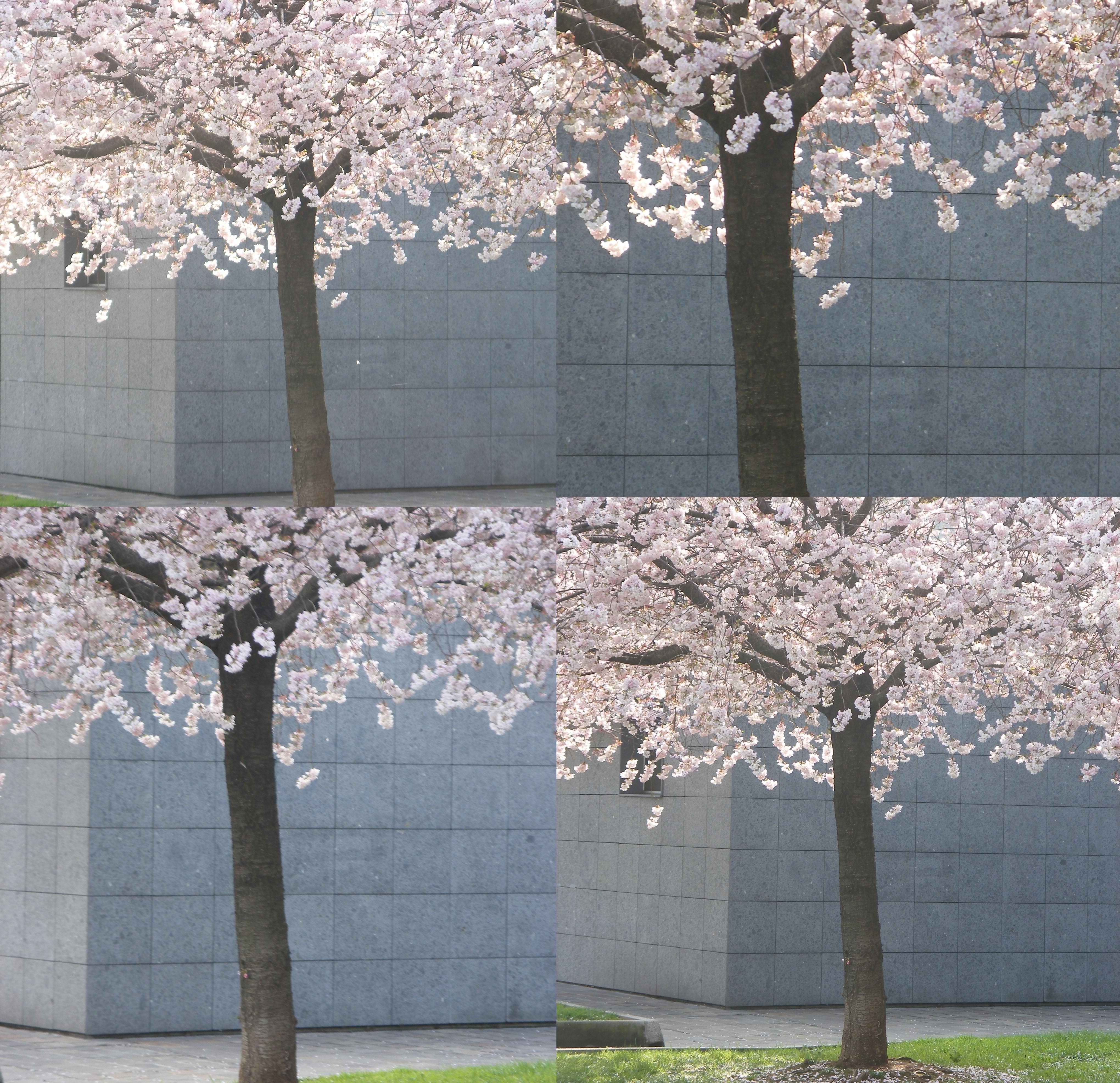
Do we need a campaign for micropayments to support ‘lyric perception’?

Photograph by MIL22

This helpless thing, lyric perception, is an authentic response to the world’s impossible contradictions which seem to resolve themselves, finally, as beauty. In fact, I believe that lyricism represents a form of courage, for it is the only response as thoroughly vulnerable as the jeopardized world itself is.

Patricia Hampl,  Spillville,  1987

'1 2 3 4 QUARTETTO b' MIL22

As more writers and artists without formal qualifications but with undeniable gifts find audiences for their work on the net, will micropayments finally take off?

By micropayments I mean fractions of €10 or $10 notes – or their equivalent – paid through a transactional service like Kachingle or Flattr to look at an image or video, read a text, or listen to a musical performance or composition. These are payments so minuscule that they barely register with our pocketbooks, but do earn their creators some measurable income in the aggregate.

Popular writers and artists would still far out-earn rivals who cater to more specialised tastes, but some of those appreciated by smaller audiences might be able to retain more of the earnings that they must give away, at present, to middlemen they cannot really afford to pay at all – intermediaries who rarely have the time or inclination to spend much time promoting their work.

So far, so-called Millennials – the generation in their twenties and early thirties now shaping our experience of the net — have shown little enthusiasm for micro-transactions. Their complaints about feeling cheated by corporate middlemen in the music business, when obliged to pay for the pleasure of  ‘sharing’ a song, are not completely incomprehensible.

But why are they so unenthusiastic about experimenting with micropayments — direct transactions between buyers and sellers?

Many ardent campaigners for the so-called ‘Freemium’ economy willingly pay small ransoms for the latest gadgets – even when these are only minor improvements or enhancements of last year’s versions, and are designed to fatten the profits of the hated capitalists. Few of them learn to cook simple meals from scratch: they are happy to pay huge mark-ups for bland microwaveable fare cooked and packaged by giant corporations, or to patronise  fast-food chains.

Why is it seemingly only art that turns them into Scrooges?

If more Millennials come to see themselves as artists, writers and musicians in years to come – using the democratic new publishing tools – will they become less unsympathetic?

Now, net-shunning Private Eye outranks even The Economist as Britain’s most popular current affairs magazine

Ian Hislop, who has been Private Eye's editor since 1986

Private Eye cover, 12 April 2008

All hail Private Eye, whose circulation grew by more than ten per cent last year, when so many famous names linked to old media were — are — howling about print meeting its doom.

All hail Private Eye, not least because, as far as I can tell, no one in mainstream media has, on this occasion. There have been no laurel wreaths from its rivals, no adulatory editorials or delving into the reasons for its astonishing success since the Audit Bureau of Circulations released the latest figures in mid-February – although the media section of one broadsheet did carry brief news items on the subject.

All hail Private Eye because, in spite of its (affectionate) marginalisation as a ‘satirical magazine,’ it looks as if it could be becoming Britons’ most reliable source of printed information about what is happening in the UK — or close to that. The trade publication Media Week anointed it ‘the leading news and current affairs magazine by issue in the country, nearly 18,000 copies ahead of The Economist,’ with the minor qualifier that ‘its rival title is published weekly.’ (That qualifier is probably meaningless, since I reckon that most subscribers would be delighted to buy it once a week.)

There is no reason to disagree with the Eye’s managing director, Sheila Molnar, who explained two years ago that ‘People always turn to us in times of trouble because they trust us. With the MPs’ expenses row and the banks, people trust Private Eye and what they read in it.’

Though the Eye has no digital edition and is virtually ignoring the internet, its pages are saturated with the fearless, irreverent, outsider ethos of the web and blogging world – most obvious in its ‘Street of Shame’ column. There, as its editor Ian Hislop told Lord Justice Leveson in January at the official Inquiry into press culture and standards, his writers concentrate on the foibles of the 4th Estate — on

… stories about

journalists misbehaving. It tends to be anything from

making up stories, drunkenness, stealing stories from

each other, printing things that are totally and utterly

untrue, promoting each other for reasons that aren’t

terribly ethical, sucking up to their proprietors, being

told what to do by their proprietors, running stories

because their proprietors insist on it, marshalling the

facts towards a conclusion that they’ve already decided

on.

Private Eye’s robustness confirms these suspicions at post-Gutenberg about the secrets of media thriving in the transition to the 5th Estate – in its case, with only token contributions to its operating budget from advertisers, which is why it cannot afford to give away its contents on the net:

It is strictly non-partisan

The political left, right and centre are all flayed with equal relish. As noted here last month, highly-placed apologists for a worrying shift in 4th Estate practices feel that there is nothing wrong with abandoning political neutrality – but a reader poll on the site of The Economist shows that this is, overwhelmingly, the very opposite of what the public wants.

It is – without fear or favour – supplying the uncomfortable, true facts indispensable to government by the people, or what we call democracy

It might just as well be called The Whistleblower Wire. It tackles malfeasance as no other publication does, across a staggering breadth of public life. A small sample: ‘Called to Ordure’ (parliamentary proceedings); ‘Medicine Balls’ (mainly, the National Health Service); ‘Signal Failures’ (the railway network); ‘The Agri Brigade’ (farming and food policies); ‘Rotten Boroughs’ (local government); ‘Music and Musicians’; ‘Keeping the Lights On’ (the law and lawyers); ‘Books and Bookmen’ (cronyism in book publishing).

It relies on its readers for its peerless investigative reporting

… and did so long before the internet came along with its promise of building reader ‘communities’.  As Ian Hislop said in his Leveson evidence, his magazine

operates as a sort of club where people not only buy the

magazine, they write a lot of it, which is the principle

we work on. Broadly, the sources come from people

inside their professions, so the medical column, the

column about energy, the pieces in the back, a lot of

those are given by people directly involved.

None of its content is influenced by advertising

As it does not run on the advertising-centred business model for publishing — unlike virtually every other great name in print journalism — it has no need to court or bow to corporate panjandrums and satraps, and its articles are not distorted by their manipulations.

Its success underlines the undesirability of concentrated media ownership, as it has the extreme editorial independence only possible when a publication is not beholden to any single media mogul or proprietor trading favours, buying influence, or vulnerable to manipulation or blackmail

In some ways, Private Eye can be seen as an early prototype of the ‘keiretsu-cooperative,’ a model for post-Gutenberg publishing  in which sites are co-owned with clubs of reader-contributors. Its Wikipedia entry lists no fewer than seventeen shareholders, and says that the magazine has never disclosed exactly who has contributed what to its capitalization and upkeep.

What is an instance of this magazine’s uniqueness and indispensability? The other day, when all the broadsheets reported that the education secretary, Michael Gove, had condemned the Leveson Inquiry for its ‘chilling effect’ on the media, they failed to explain why he was complaining so bitterly about an investigation initiated by his own leader, David Cameron, and in the same tirade, lauding Rupert’s Murdoch’s launch of the Sun on Sunday. They also offered not a single example of what noble journalism the Inquiry has supposedly been inhibiting — just as he failed to do.

Mystification over all that was beginning to make me feel mildly unhinged when the latest Eye arrived. There I discovered that the education secretary is married to  — well, well, well, a journalist on the Times. And who owns the Times? Let us say, a certain Australian-born media mogul.

And, returning briefly to the subject of ownership … As diligent use of both inductive and deductive logic has yet to yield incontrovertible proof of his existence, I must reluctantly dismiss as speculation all hints to the effect that Private Eye does in fact have a proprietor — a reclusive individual writing occasionally under the rubric, ‘A Message From Lord Gnome’. The same goes for any suggestion that he is simply too shy or coy to (a) scotch rumours that his life’s ambition is to be more elusive than the putative Higgs boson particle, and (b), admit that he has no help from ghostwriters in recording his sublime meditations, as on the subject of the recent fate of bankers:

[W]here, we must ask, will this witchhunt end? Which other leading figures in the economic life of our country will be next to be hunted down, to be publicly humiliated, as their names are execrated across the land?

Should ordinary citizens be denied a say in the media’s future — as in, ‘For legal reasons, this article will not be open to comments’?

Are cover-ups and the suppression of debate growing more frequent in the world's proudest democracies? Photograph by Amita Chatterjee

This is no ordinary elephant in the living room, the one the media are pretending not to see. She is pirouetting on stiletto heels in the shortest skirt ever sewn, displaying elephantine slabs of thigh. Still they behave as if she is invisible.

Recent events in England – which gave the rest of the world the model of a free press – are sending shivers up the spine of anyone who cares about democracy, from Calcutta to San Francisco and beyond. This is because of the eerie, silent void where you might expect round-the-clock media coverage of the media’s strategies for preserving their freedom and independence — on their terms.

Any attention paid to this struggle by the British press has focused on the tabloid phone hacking scandal, and just that part of a far wider judicial investigation of professional standards and practices, the Leveson Inquiry ordered by the prime minister.

Shameful and appalling as the hacking sagas are, they matter far less than the pachyderm in the parlour – on a par with the news earlier this month of Google being forced by the government of India, the world’s largest democracy, to cooperate with censoring web pages after ‘weeks of intense government pressure for 22 Internet giants to remove photographs, videos or text considered “anti-religious” or “anti-social”’.

That question no one in the media apparently wants to face is, will the public grant professional journalists a continuation of special privileges in the digital age if they no longer adhere to the traditions of fairness, neutrality and dedication to the truth that won them those privileges in the 18th century? Earlier this month, this blog mentioned the media’s refusal to acknowledge – or indeed discuss at all – the public’s dismay about an increasingly partisan press.

There are other alarming silences. Why, for instance, is no one in the British media mentioning the prohibition by a leading newspaper of free discussion – by ordinary citizens – of the future of the press, on three separate occasions last week?

In each case, a member of the Establishment – one high-ranking politician and two journalists – addressed the jubilation in the British press about Rupert Murdoch redux; many journalists only care about their belief that he is saving jobs in journalism. The media mogul who should have been fatally wounded by the hacking scandal is throwing his octogenarian energy into engineering a comeback with a new paper, the Sun on Sunday. None of these writers spared Murdoch the lash. Two of them delivered blistering warnings about the dangers of condoning this latest power-grab and about the perils, for British democracy, of concentrating media ownership in a few hands — especially, his.

Nothing in their excoriations suggested that they feared any legal retribution from Murdoch or his empire, News International. And yet each of these articles appeared on the portion of a newspaper site titled Comment is Free, advertised as a debating forum open to all, with an announcement that, For legal reasons, this article will not be open to comments’.

In that case, why were the Murdoch bashings put on this part of the newspaper’s site at all?

Could the real message behind blocking readers’ reactions be that the newspaper’s editors believe that only they and their colleagues have a right to discuss the redesign of the ‘media landscape’ – even though most British citizens still rely on the press to give them the facts a democracy needs to make decisions that affect its collective wellbeing?

This blog has recorded the same newspaper’s censorship of readers’ posts about media reform in its Comment is Free section (see the entries on 7 November and 15 November). The paper gives no sign of having absorbed the salutary reminder by the Lord Chief Justice, Lord Judge, last year that

[i]t is the birthright of the citizen that the press should be independent. It is therefore not a right of one section of the community, not just a sectional right. It is the right of the community as a whole. It is, if you like, our right, the right of every citizen.

Here are opinions that the Guardian refused to allow its readers to discuss on its site – without any explanation that made sense (Kafka-esque, for real?):

Item 1: extracts from an article titled, ‘We must fashion a new media landscape,’ by Norman Fowler, a former chairman of the House of Lords communications committee.

… Murdoch remains the traditional proprietor. From his New York headquarters he will continue to have his say in the politics of the United Kingdom – and make no mistake, there will be politicians who will play along with this. […] So we are back to where some of us began. Last summer we were within days of the culture secretary waving through the Murdoch bid to take full control of BSkyB and claiming that phone hacking was an entirely separate and irrelevant issue. That fate has been avoided, but the challenge remains to devise a system where nobody – Murdoch or anybody else – has a disproportionate share of the British media. […W]hat is a disproportionate share of the media market? Four newspapers controlling almost 40% of national press circulation and total control of a major television company would have put Murdoch the wrong side of the line. […] Any new rules on share of voice cannot be directed exclusively at News International. The BBC must come within the net as too must the other media giants like Google.

[…]

• For legal reasons, this article will not be open to comments

Item 2: extracts from an article titled. ‘If the Sun on Sunday soars Rupert Murdoch will also rise again,’ by Polly Toynbee.

[P]ractitioners are hired to do their masters’ bidding, even when that can mean spreading disinformation and disregarding evidence. The seventh Sun will offer jobs to those willing to put their pens to abusing migrants, travellers, trade unionists, single mothers, women, the unemployed, public sector staff, young people, Europe, foreigners or anyone to the left of John Redwood. Even the disabled are now being harassed as scroungers to win public support for benefit cuts reducing the already poor to penury.

[…]

Clouds of opposition are gathering around the Leveson press inquiry. Its remit grows, destination unknown. The Campaign for Press and Broadcasting Freedom, along with many others, are right to demand that it leads to new laws to reset limits on media ownership by any one organisation, which Margaret Thatcher abolished for Murdoch’s sake. If the Sun on Sunday soars, [Murdoch] will be back owning some 40% of press readership, plus Sky (to whom the BBC is wrongly obliged to pay £10m a year).

The Sun and its owner’s influence on British politics have been underestimated in the history of the last decades … […]

For legal reasons, this article will not be open to comments @commentisfree

Item 3: extracts from an opinion piece titled, ‘Rupert Murdoch’s Sun on Sunday sets on his empire,’ by Michael Wolff.

Curiously, he used […] the arrests of senior Sun staffers on suspicion of bribing the British police – as the crisis that justified the new Sun. The immediate launch of the paper, just days after he arrived in London, would be a way to stabilize an impending civil war in Wapping, he insisted – even as his own investigators continued to turn over evidence to the police. It would be a way, too, to shift attention from the negative to the positive, from retreat to advance.

[…]

Of course, all the investigations continue, the law suits mount, the US Justice Department is at attention, and, next week, public television in the US is promising an explosive new documentary on the Murdoch scandals, which will, in a sense for the first time, bring the story in all its details to the US.

[…]

• For legal reasons, this article will not be open to comments

There is no doubt that the Guardian is furious with Lord Justice Leveson, who asked at the official commencement of his Inquiry, ‘Who guards the guardians?’ Last week, the news that British judges would be rating British lawyers for their performance in court gave the newspaper a chance to play tit-for-tat in an editorial that remarked, ‘Advocates might reasonably ask who is judging the judges’.

No one watching the Leveson hearings could fail to be struck by this judge’s open-mindedness, or by the deference and respect he shows witnesses. He comes across as genuine when he asks for their opinions of what should be done about the media’s failed self-regulation – and is frank about not knowing how to resolve the dilemma that follows from the all-but-universal dislike of proposals for statutory control.

He seems keenly aware of the media’s annoyance with interference with what they see as their business – and sympathetic. But from the odd remark he has let drop about the importance of allowing free discussion – for instance, that statements made on social networks such as Twitter must be counted as mere chat, and not held to the same standards as professional reporting – it seems unlikely that he would disagree with Albert Einstein about the undesirability of letting a wealthy or powerful few control the dissemination of facts and opinions for the many.

It feels not a little odd to be quoting the great physicist’s essay, ‘Why Socialism?’ for the second time this month. But there is a rather stunning parallel between present events and his noting, in 1949, that ‘Clarity about the aims and problems of socialism is of greatest significance in our age of transition. Since, under present circumstances, free and unhindered discussion of these problems has come under a powerful taboo …’.

This was the most vital point he wanted to impress on his readers:

[U]nder existing conditions, private capitalists inevitably control, directly or indirectly, the main sources of information (press, radio, education). It is thus extremely difficult, and indeed in most cases quite impossible, for the individual citizen to come to objective conclusions and to make intelligent use of his political rights.

Now, as I was saying, about that elephant

Why a keiretsu-cooperative is a gentle transition for old media — and how about saying, ‘an exaltation of bloggers’?

Parallel and convergent thinking about co-ownership

What’s in a name?

A lot, I suspect, when the subject is cooperatives.

Writers delete or tear up drafts, painters scrape paint off canvases that refuse to match the visions of a mind’s eye – and versions of co-owned enterprises, surely hundreds of thousands of them over the years, have ended up on some equivalent of the cutting-room floor.

But associations with failures of the past should hardly be allowed to stain the excellent solution cooperatives could be. Certainly not now, when – as noted on post-Gutenberg last week in a post about Facebook – the World Wide Web is proving to be a matchless engine for running them, and getting around the classic banes of collaborative ownership and administration.

What if our name for these organisations has become the chief enemy of their promise? Should we call them something else? Say, leaps – as in a leap of leopards, to convey a  jump in the right direction for co-ownership and co-action? Peer-to-peer pods, anyone? Straightforwardly, collaboratives? Or just flats, perhaps, as shorthand emphasising that these are anti-hierarchical, anti-authoritarian and decentralised structures.

The next few years should see the evolution of specialised terms for variations of such online organisations – or simply net-related groupings – that meet different needs. I have for some time been fondly considering an exaltation of bloggers for our key-tapping multitude, in a nod to the seductive title of James Lipton’s book about collective nouns, An Exaltation of Larks.

Since last week, search engines have led me to others who think that Facebook should be turned into a cooperative – although there was little open support for this suggestion when it was first proposed under the screen name ‘postgutenberg’ last September in a comment beneath David Mitchell’s semi-serious call for the ‘nationalisation’ of the social mega-network. (That comment, too, was inexplicably censored by The Guardian, but I have a copy of the page as it was before the axe descended.)

A writer for Reuters, Paul Smalera, carefully set out the reasons why a collaboratively owned and run Facebook makes sense:

Why not share the company itself? It’s fine to talk about technology’s power to change the world if you’re the one who’s going to profit from it. But this isn’t really a change […] it should become a nearly one-of-a-kind company for the technology sector: a co-op.

[…]

Facebook wouldn’t be forgoing its fundraising if it abandoned its IPO and became a co-op. […] In Facebook’s virtual community, its 845 million users could easily pay a small sum — say $5 in the U.S. and some locally adjusted equivalent in other countries — to become an owner. Some of that money would be used to buy out existing stock owners and set up the new management model — it would still have Zuckerberg as CEO with a management team, but with the same one vote that every other member has. Over time, if Facebook’s owners keep the cost of becoming a member as low as possible without in any way starving the site for cash, Facebook could even become the world’s first trillion-dollar company — just in a way no one has ever previously imagined.

He went on to give even more specific suggestions for how it might operate:

Facebook already offers voting tools, organization pages, recommendation links, polling, etc. With the help of a management team and committee structure, it would be pretty easy to let members assign themselves to committees and shape Facebook into the community they want it to be.

[…]

[T]hink of a sample proposal. Say a user wants Facebook to give 10 percent of its income to charity.

1. She creates a new page and persuades her friends to follow it. The page holds the pro and con discussions of the proposal.

2. After hitting a certain threshold of followers, the page makes the Revenue Committee agenda, where a subcommittee is assigned to study its feasibility and write a summary about the proposal’s impact on Facebook, including how it would affect the bottom line.

3. The committee then votes on the summary — if it’s approved, it goes into a general Facebook meeting, where the entire user base gets to vote. […]

Commenters on the Smalera piece were understandably pessimistic about the chances of Mark Zuckerberg handing over Facebook to its members. So was a colleague of his, Edward Hadas, in a critical but beautifully balanced consideration of his arguments a few days later. He concluded on an encouraging note:

[T]he limited success of the cooperative movement does not equate to a resounding triumph for its ideological opposite – the shareholder value cult. If profits were all that mattered for the economy, then more than a quarter of all American workers would not be employed by enterprises that function, often quite well, without profit motive – 17 percent by governments and another 11 percent by private, not-for-profit, organisations.

[…]

In organising the economy, greedy schemers and utopian dreamers are not the only alternatives. Like well-run government agencies and prudent shareholder-owned companies, well-designed cooperatives can be efficient servants of the common good.

The expectation of resistance to a pure cooperative explains why the keirestu-cooperative — first proposed two years ago for the evolution of publishing – does not entail starting a co-owned enterprise from scratch.

It lays out, instead, a scheme that amounts to a halfway house for old print media moving into the future. A newspaper publisher could experiment with sharing ownership of a segment of its site with readers paying small sums for their subscriptions or shares. This section would ideally be one in which readers already contribute most of the content today, in their role as commenters.

As part of the experiment, the co-owners would share any profits from advertising attracted to the trial site, which would give them an extra incentive to lure more readers and part-owners to it.

Setting up such a site – starting with software design and registering co-owners – would cost money. A newspaper publisher could share that, and the expense of site administration, by entering simultaneously into a funding partnership with, say, a book publisher catering to essentially the same audience.

That would make for a collaboration resembling the loose affiliations between firms that the Japanese call a keiretsu.

People who reject that word as too exotic need to know that it is easy to say – ky-ret-su – and should remember that there was a time when we were just as frightened of the word karaoke, which has since become as unremarkable as pizza.

The scheme is all. A keiretsu-cooperative by any other name would be fine by me – as long as someone, I mean, some few, are brave enough to try it out.