No one in old media apparently wants to transmit the cheering reasons for the gap between America’s trust in its military vs. its elected leaders

Barred from the medieval bell tower; but in the age of blogging we need no key to get the message out -photograph: postgutenberg[at]gmail.com

Barred from the medieval bell tower; but in the age of blogging, we need no key to get the message out
-photograph: postgutenberg[at]gmail.com

achilles LARGE

[ After this entry was posted, we followed a tweet to Glenn Greenwald’s report on The Intercept about dire consequences of militarising the police – his reaction to the nightmare killing of young and unarmed Mike Brown in Missouri. It is essential reading. But because polling results showing exceptional public esteem for the military have been so drastically under-reported for years, most people would find it hard to understand why the authorities blithely assumed that the citizenry would approve of arming and equipping policemen like soldiers. Media biases badly need counterweights. ]

We have searched and searched again but, so far, failed to find in online newspapers – well-known or obscure – any mention of, or solution to, the puzzle in our last post, the question of why Americans trust their military vastly more than other public institutions. If we were using all the wrong search terms, Google could hardly have served up the missing explanation in a persuasive paper by three collaborating scholars from which we will paste in a segment below.

But first, we must draw attention to a caveat, and then the reason why traditional media’s neglect of this subject is tragic – showing just how much the world needs the new media space that independent blogs have created:

• ‘The military’ is distinct from the political decisions its armed forces are obliged to execute – that is, which wars they fight, and where, and in broad strategic terms, by what means (eg., bombs dropped by drones vs. boots on the ground). Jonathan Shay, a psychiatrist of rare gifts who made his name treating veterans of the Vietnam war for post-traumatic stress disorder (PTSD), makes this essential point: ‘The justice of overall war aims and of operational theories – “strategic” bombing of civilians to weaken the industrial capacity to wage war is an example of such a theory – is not within the individual soldier’s scope of moral choice, unless he or she is willing to face imprisonment or death by refusing to fight.’

• Media hostility to, or neglect of, what the military does for civilians, since the Vietnam war — not just in America but in similar disenchantment elsewhere — could account for why it has been far more common for veterans of recent wars than for their historical predecessors to have the mental afflictions now called PTSD. That fits Shay’s suggestion in his brilliant Achilles in Vietnam (1995) – in which he drew riveting parallels between the tragedy of Achilles and his comrades, Homer’s subject in The Iliad, and the disturbances in Americans who fought the Vietnam war twenty-seven centuries later. He says, in extracts slightly rearranged, here, for concision:

What a returning soldier needs most when leaving war is not a mental health professional but a living community to whom his experience matters … [W]e should care about how soldiers are trained, equipped, led and welcomed home when they return from war. … [H]ealing from trauma depends … on being able safely to tell the story to someone who is listening and who can be trusted to retell it truthfully to others in the community. … Economically, unhealed combat trauma costs, and costs, and costs. Recall that more than 40 percent of Vietnam combat veterans … reported engaging in violent acts … Between a tenth and a quarter of all males in prison are veterans … When combat trauma results in domestic violence … there is an intergenerational transmission of violence.

The New York Times, for one, has published excellent and massive reports about sufferers from PTSD and their families. But, as far as we know, it has devoted no equivalent analysis to – or run any report on – the shining public image of the military, as revealed by Gallup’s stunning findings about the confidence gap in which the military reigns virtually unchallenged as a reservoir of trust. For that, anyone curious must hunt down a 2012 American Academy of Arts and Sciences dissection of similar results in an opinion poll a year earlier, unenticingly titled, ‘The Origins & Lessons of Public Confidence in the Military’.

First, it notes a contradiction:

[T]he relationship between the American people and its defense establishment has historically been anchored in two opposing sentiments: on one side, Americans see a large, standing military as a potential threat to liberty; on the other, they revere the U.S. military for its role in establishing the nation in revolution, preserving it against rebellion, and defending it from foreign aggression.

The start of the next extract is a hugely welcome surprise for anyone depressed by the impression — seemingly based on irrefutable facts — that Americans care most about wealth creation, and the feeding of the gigantic getting-and-spending beast we call capitalism:

In addition to valuing competence, society also expects institutions to serve a greater good. This public-mindedness is grounded in three principles: selflessness, accountability, and fairness. These factors are highlighted by the other institutions that enjoy widespread public confidence: small business and the police. According to a 2011 Gallup poll, 78 percent of Americans expressed “a great deal” or “quite a lot” of confidence in the military; 64 percent said the same for small business, and 56 percent for the police. In contrast, Congress (12 percent), the presidency (35 percent), and big business (19 percent) are held in relatively low regard by the American public.

What does the military have in common with the police and small business? In the case of the former, unselfish service is a common trait. The police (ideally) have no other purpose than to protect and serve the nation’s communities. In performing this service, capable men and women make sacrifices. They give up potentially lucrative and rewarding opportunities in other jobs. They put themselves in danger, sometimes sacrificing their lives. Small business is perceived to share two key traits with the military: fairness and accountability. In small business, Americans see the best qualities of the nation’s economic system (opportunity for those who seek it, rewards for those who succeed), absent the abuses and corruption that they impute to big business and banks. Small business owners pursue self-interest, but their success is deserved because it emerges from their own hard work and not from a manipulation of the system’s resources. Small businesses create wealth and opportunity; they are a gateway for immigrants to enter the American middle class, and they evoke the entrepreneurial spirit and mythos of American economic history – think of Andrew Carnegie, Bill Gates, the fictional heroes of Horatio Alger stories, and so on. Furthermore, small business owners are exposed to risk; if a small business fails, it is left to fail. Thus, fairness works both ways. [the highlights in bold type are post-Gutenberg’s]

The essay is a good read, all the way …While on the subject of strangely unpublicised opinion poll findings, here is a question for dining table entertainment: are Democrats or Republicans likely to be more sympathetic to the NSA’s spying on American citizens?

Gallup’s startling answer, from June of 2013:

There are significant partisan differences in views of the government’s program to obtain call logs and Internet communication. Democrats are more likely to approve, by 49% to 40%. Independents (34% vs. 56%) and Republicans (32% to 63%) are much more likely to disapprove than approve.

The newspapers associated with the left, which broke this story, do not seem to have paid much attention to what turns out to be a strictly partisan split in opinion. Gallup’s explanation makes it unlikely that the poll would have a very different result today:

In 2006, when Gallup asked the similar question about a program that came to light at that point, Republicans were significantly more likely to approve than Democrats. The differences in partisan reaction between 2006 and 2013 reflect the party of the president under whose watch the programs were carried out at those two points in time.

Now, why has the information in this blog post had virtually no attention in traditional media, as far as we can tell?

Might the shockingly low numbers for public trust in the media solve the mystery? As we recorded last week, in Gallup’s poll earlier this summer, the 74 per cent statistic for the military compared with just 22 per cent for newspapers – in an ever-narrowing gap in status with ‘news on the internet,’ deemed trustworthy by 19 per cent of those surveyed. Still, that was several cuts above the 7 per cent for the U.S. Congress – to which we saw theadvocates.org blog referring, pointing to

… a Public Policy Polling poll last year (reported in the Liberator Online) … found Congress less popular than lice, root canals, cockroaches, hemorrhoids, and colonoscopies, among other plagues and pests.

If the Snowden leaks proved that government spooks are evil, why do Americans still trust the military more than any other institution?

‘… the Snowden brand - with hints of baby Jesus - and the Guardian  brand - as something like God the father and protector …’: GQ , June 2014  - postgutenberg[at]gmail.com

‘… the Snowden brand – with hints of baby Jesus – and the Guardian brand – as something like God the father and protector …’: GQ , June 2014
– postgutenberg[at]gmail.com

In honour of the silly season, here is a real-life puzzle drawn from opinion polls. Somehow, members of the public remain obstinately un-manipulated by the one-sided reporting on the Snowden leaks about NSA and GCHQ surveillance. Reorganising media to make such an extreme, pointless bias impossible would be an incalculable enrichment of our culture, as we proposed last week.

The other day, we came across the results of a Gallup poll in June: by a staggering margin, Americans still trust their military more than any other public institution, including the people’s own elected representatives in Congress – and the presidency, and Supreme Court. Just look at the percentages of interviewees who answered that they had a ‘great deal’ or ‘quite a lot of confidence’ in each of these groups: military (74); Congress (7); the church or organised religion (45); presidency (29); public schools (26); banks (26); medical system (34); criminal justice system (23).

Most government spying is done on behalf of the armed forces, to serve military ends. Indeed, America’s citizens are slowly coming round to a less benign view of the NSA’s arguments about needing to collect vast stores of personal data about them for their own safety. But they also seem, on the whole, to accept the government’s arguments that changes in technology and the differences between fighting terrorists and waging conventional wars have changed what spies must do to spy effectively.

This flatly contradicts the claims of some of the most ardent campaigners on behalf of Edward Snowden – who remains more unfathomable than either wicked or virtuous, for many of us – that he has sparked mass outrage about government surveillance. (Though, by last November, the weaselly word ‘resonate’ was being used, as in, ‘His disclosures about the NSA resonated with Americans from day one.’)

A new specialist in conducting interactive, continuous polls, isidewith.com – commendably non-partisan, if a Forbes report is accurate – suggests that Americans, by a solid 10 per cent margin, oppose granting Snowden immunity from prosecution. But where in The New York Times or The Guardian – two purveyors of news analysis considered disproportionately influential– has this view been reflected, delved into and explained in perceptive commentary by either insiders or outside commentators?

Since there has been no such delving, nor in-depth reporting on the reasons for the public’s continued support of the military, the true mission of the 29 year-old at the heart of l’affaire Snowden continues to be as mysterious as the Turin shroud. Or, so we thought, as we read Michael Wolff, in his GQ profile of the Guardian’s chief, describing the newspaper’s attempt to ride the uproar about the leaker that it largely manufactured to make itself the talk of America and win a vast new transatlantic audience:

Its efforts so far had hardly put it on the map in the US – and suddenly Snowden did. … News outlets want to break big stories but at the same time not be overwhelmed by them – a certain detachment is well advised. It is an artful line. But the Guardian essentially went into the Edward Snowden business – and continues in it. … The effort to pretend that the story is straight up good and evil, … without peculiar nuances and rabbit holes and obvious contradictions, is really quite a trick.

In an effort to pull off that trick, the Snowden brand – with hints of baby Jesus – and the Guardian brand – as something like God the father and protector – become nearly symbiotic. (The Guardian now campaigns fiercely for a Snowden pardon.)

Because the Snowden exposés were so crucial to the paper’s U.S. ambitions — in turn, part of a future plan sequestered behind dust sheets, as we said last week — it stifled virtually all perspectives and discussion critical of him and his band of helpers, including the lawyer-turned-journalist Glenn Greenwald:

The theoretically freewheeling Guardian locked itself down. Staff and contributor Twitter feeds were closely monitored for indications of Snowden or Greenwald deviations, with instant reprimands when any party-line divergence was spotted.

Devotees of the Guardian will find it hard to recognise it in that censorship usually associated with dictatorships, unless they have been loyal readers of this blog – and remember the comments about press reform that its moderators deleted, which post-Gutenberg saved and reproduced here. (Scroll down to the bottom of this earlier entry: ‘Why is The Guardian censoring debate about press reform and ignoring the Lord Chief Justice’s endorsement of citizen journalism?’ 7 November 2011.)

Such drastic warping of the discussion in a democracy of a subject as serious as military tactics and defence must be countered. How? In the spring of last year, we suggested that for systematic and regular audience consultation, media might adopt equivalents of Switzerland’s Publikumsrat – the five-man Public Council of Swissinfo.ch, which is the internet adjunct of the Swiss Broadcasting Corporation (SBC) founded in 1999. (See: ‘How Swiss audience inclusion and a certain sort of nudity might be the key to success for post-Gutenberg media,’ 3 March 2013.)

An extract:

The style of government that makes Switzerland the world’s most democratic democracy is replicated in organisations of every size and kind in CH – including its many businesses run as cooperatives, two of which make the list of the world’s top twenty-five in sales.

The Publikumsrat gives Swissinfo’s editors and journalists detailed feedback on their choice of subjects as well as on the way these are tackled. It makes suggestions for new topics. It also defends Swissinfo from its detractors. More than once, in the last ten years, it has led campaigns to protect it from accountants wielding budget-slashing axes – inspiring ‘Save Swissinfo!’ petitions from as far away as New South Wales, in Australia.

We see Publikumsrat equivalents in the Anglosphere as unavoidable and essential. If the Guardian had one, the gap between popular opinion and the paper’s religious fervour, covering Snowdenia, could not be the great black hole it is.

The proof of quite how badly we need one is in the Gallup poll statistic for public confidence in the press. It was a humiliating 22 per cent, only three points higher than for ‘news on the internet’ (19).

Can Alan Rusbridger do what he must to make a true mark on media’s future history?

- postgutenberg [at] gmail.com

Behind scaffolding – postgutenberg [at] gmail.com

No media editor is being watched more closely by peers around the world than Alan Rusbridger, leading The Guardian into the future – and sounding as if a cooperative seems to him, too, the logical structure for media drifting towards ‘participatory journalism’. Never mind if he calls going co-op ‘mutualisation’ – as in this exchange in India with two editors at The Hindu, G. Ananthakrishnan and Mukund Padmanabhan:

You have been speaking about mutualisation of the newspaper, and you explained how it makes sense to involve readers, … But traditionally, were we not listening to readers … ? What has changed now?

I think it is going further. It is technology. Because the readers now have the ability to publish and link up. And I think in all this we have to make a judgment about whether essentially our role stays the stays the same. You are right to say that the best newspapers have listened to their readers and drawn upon their expertise. But the realm of newspapers is shrinking and all this energy is being created elsewhere and I think it is a real life or death position for newspapers as to whether they essentially ignore all that or whether you have to redefine the role of the newspapers to encourage it to come inside with what they are doing.

Very well said, but that conversation is now four years old. We cannot unfortunately peep behind the scaffolding and dust sheets to observe the latest stage in planning for The Guardian’s digital future. Does it make sense to hope that Rusbridger will walk his talk — unveil a plan for, at the very least, an experiment in mutualisation that involves giving reader-commenters the financial stakes that are of the essence of the cooperative idea?

We ourselves were pessimistic about this, a few weeks ago – in a post arguing that it is far more likely that younger media innovators will take that particular leap. But Rusbridger’s temperament and managerial style, more than his age, could rule him out as the most important pioneer in the next phase in media’s Darwinian shift.

That is certainly the likely conclusion of anyone reading the most thoughtful, complex and revelatory profile of any newspaper editor still in harness – Michael Wolff’s portrait of Rusbridger, published in the British edition of GQ last month. It is surprisingly even-handed – unstinting with praise for Rusbridger’s strengths – given that the Guardian eliminated Wolff’s perch on its web site earlier this year.

These sections of his essay, if true, are discouraging for anyone hoping to see real action, soon, in mutualisation that actually means something:

While the Guardian has a business staff with a CEO, and is overseen by trustees with ultimate responsibility, it has one real power centre, strategic thinker and moral compass: its editor, Alan Rusbridger. (A kind of preternatural consensus surrounds Rusbridger, but underneath him the Guardian is a fraught political cauldron, with underlings struggling to align with him, stay in his favour and undercut everyone else who is trying: “a nest of vipers”, in the description of an outside consultant brought in to work on one of the paper’s big redesign projects.)

[…]

His is an absolute, pre-modern sort of power, faith-based and exclusionary. You believe or you don’t. You are in or you are out.

Why bother to wonder about Rusbridger proving himself capable of, say, redesigning his role so that his position as editor-in-chief would have to be ratified by members of a mutualised Guardian voting in a referendum? Because, being optimistic, we hope that we and Wolff are mistaken – and that neither age nor personality will scupper his ambition to make a true mark on history.

… In our next entry, we will consider how much richer the cultural contribution of a mutualised Guardian would be.

A surprising — but long overdue — condemnation of censorship by the press from The Guardian … and summer sign-watching

- postgutenberg [at] gmail.com

CENSORS in THE PRESS

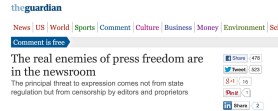
‘Comment is free’, 30 June 2014

Let us hope that the admirably honest George Monbiot, with his huge following, can get this subject the attention it deserves. Regular readers have seen almost everything in his Guardian blog post on Monday here on post-Gutenberg.com — and his concluding sentence, two years ago, in ‘Censorship by the Press‘. We wrote that after some frustrating months of drawing attention to this problem:

Why is The Guardian censoring debate about press reform and ignoring the Lord Chief Justice’s endorsement of citizen journalism?

The solution proposed by the commenter ‘Natacha’ in her reaction beneath the Monbiot piece defines this blog’s very raison d’être: censors IN the press - NATACHA See:

Loomio: open-source tools from young New Zealand techies to make the dream of practical, efficient, sexy cooperatives come true

Just a short post, for today. We have been on the road, watching for signs – and here is one of our rewards: SIGN w freeway postgutenberg@gmail.com get happy 3

- photographs: postgutenberg [at] gmail.com

– photographs: postgutenberg [at] gmail.com