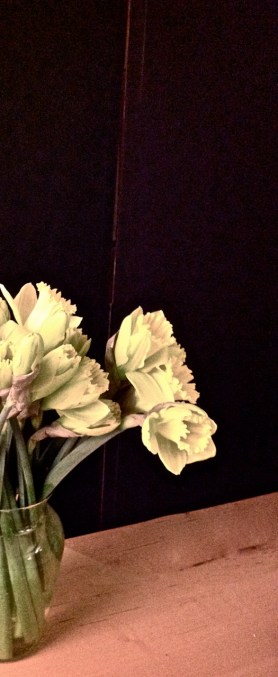
Daffy spring doggerel break: from a treasured comments archive on the net, and a beloved doggerelist

Daffodils: postgutenberg[at]gmail.com

daffy cornucopia 2


An experience of helpless laughter … one of the most memorable in that category, ever?

Blame a doggerelist’s contributions to a discussion of William Wordsworth’s best-known poem in a 2007 thread on The Guardian’s books blog, one with no shortage of literary scholars weighing in. It comes to mind every spring — with heartache. We miss the doggerelist, @cynicalsteve — a scientist with a fine Cambridge pedigree and excellent taste in literature; a dearly cherished, cherishing, invisible, net friend snatched before his time by the Reaper.

The tone for the most impish reactions in that comments section was set by an irreverent post by Sam Jordison:

Terrible poet – great museum

Wordsworth’s appalling ‘Daffodils’ seems to me a terrible advertisement for the Lakes. But the Grasmere museum is just terrific.

Before we reproduce a few choice extracts – not necessarily in the right chronological order: please quote this thread whenever you have to suffer yet another blinkered enemy of commenters claiming that virtually all web comments are the work of evil trolls.

Finally, research is supporting those of us insisting for about a decade that comment sections are often friendly and enlightening places. The New York Times reported last month that

Corinne A. Moss-Racusin, a psychology professor at Skidmore College […] and her co-authors Aneta K. Molenda and Charlotte R. Cramer analyzed comments from three sources (The New York Times, the Discover magazine science blog and a Facebook group for science buffs) … They found some encouraging signs: Positive comments were more common than negative ones.

And here’s proof … although anyone appalled by English schoolboy wit gone off-leash will please stop reading after the second comment by @freepoland:

cynicalsteve 25 Apr 2007 1:35

I thought it was only me that thought the daffodil poem was a piece of third rate doggerel. It’s main drawback is the schoolboy-like monotonous rhythm of the piece – “I WANdered LONEly AS a CLOUD…”

Anyhow, it’s much improved in the real schoolboy version:

I wandered lonely as a cloud That floats on high oer hill and dale When all at once I saw a pub And went in for a pint of ale.

liberaldogooder 25 Apr 2007 2:22

Seems just a little unfair to slag off a great writer by more or less sole reference to perceptions of their most popular work, which by its nature isn’t normally going to be their most challenging. (with Wordsworth ‘The Preludes’ already been mentioned, but then you have ‘Immortality’, ‘Tintern Abbey’, ‘The Leech Gatherer’, etc, where tons of stuff are going on under the hood). By these standards Dickens is a writer of sentimental childrens’ tales, Chaucer a teller of dirty stories and TS Eliot a dyed-in-the-wool registered cat fetishist.

But having said that it’s a great way to cause controversy – I think you should put up a thread entitled ‘Shakespeare was shit’, and then we can play ‘The Ride of the Valkryes’, as the ranters come down on you like a wolf on the fold.

Henuttawy 25 Apr 2007 4:08

Well I blame anthologies for endlessly re-printing “Daffodils”. It appears so often, we are led to think that it’s great verse. But I personally think it comes so perilously near to doggerel that I wonder if Wordsworth was actually being a bit tongue-in-cheek when he wrote it.

Still, I wouldn’t say that he’s the best of the Romantics anyway – not by a long, long way. Keats was much better. And Byron, of course.

freepoland 25 Apr 2007 4:16

Nobody has improved on J.K.Stephen’s commentary on Wordsworth:

Two voices are there: one is of the deep; It learns the storm-cloud’s thunderous melody, Now roars, now murmurs with the changing sea, Now bird-like pipes, now closes soft in sleep: And one is of an old half-witted sheep Which bleats articulate monotony, And indicates that two and one are three, That grass is green, lakes damp, and mountains steep And, Wordsworth, both are thine. […]

israelvisitor 25 Apr 2007 4:20

I like “Daffodils”; I even knew it by heart once. Not maybe one to be put to a class of ten-year-old boys, though, who would instinctively vie to be the most openly unimpressed by it.

The rhyme of “gay” with “company” could quite easily be seen as bold and innovative, for what it’s worth.

The wild daffodils beside Ullswater – were they the ones that inspired Wordsworth? – certainly impressed me, when I saw them in 1980: they are not your garden King Alfreds, but delicate little wild ones that do flutter in the breeze, and are present in seemingly illimitable numbers along the shore. (In this way they contrast with WW’s solitude – and I am sure that even in the pluvial Lake District, solitary clouds are to be seen.)

[…]

No, I don’t think “Daffodils” is a crap poem. I think it’s nice. But I’m aware that many would say that means the same thing…

freepoland 25 Apr 2007 5:39

… Wordsworth and money were a curious combination. Raisley Calvert’s legacy enabled him to live out an idyll at Dove Cottage, where it is usually said he did his best work. Later, he took Lord Lonsdale’s shilling and the post of controller of Stamps for Westmorland. Poets shouldnt be wealthy. His career trajectory was rather modern, and his ideals probably suffered, but it is difficult to locate a socialist poet in the period 1800-1850. Ideals were a good deal more cerebral than fifty years later. Above, I suggested he was not perhaps worthy of the title of 3rd best poet, but at least he had a crack at the epic, and The Prelude has some good things in it. A useful comparison is with Tennyson, whose command of the technicalities of language were as good as WW’s, but who reads Idylls of the King now? Undergraduates are still subjected to the Prelude, and usually come out with something worthwhile. My favourite is Michael, and if you stroll up Helvellyn out of Grasmere and sit down there to read it, you get a real feel for what Wordsworth thought of as the rustic life and its disappointments.

cynicalsteve 26 Apr 2007 4:51

I wandered, desperate for a piss Whilst walking by the Canyon Grand Dare I let fly o’er the abyss? Or should I use a rubber band….

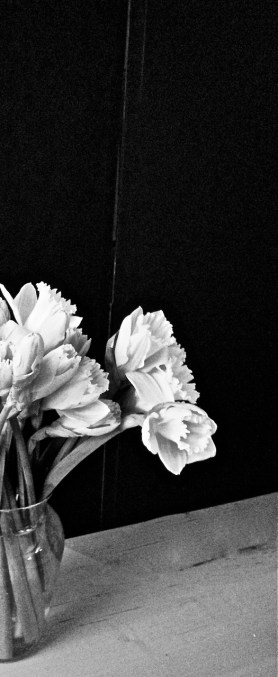
bouquet black backdrop


daffy long Screen Shot 2014-03-23 at 00.47.37

If Silicon Valley knew any history, would it be encouraging the destruction of artistic copyright — as energetically as it fights infringements of technology patents?

‘Venus and Cupid,’ Cranach the Elder, 1509

German artists of the Renaissance, inspired by Italy, took off in other directions: ‘Venus and Cupid,’ Cranach the Elder, 1509

There is something wonderfully right about a son of Italy, Federico Faggin, being the designer of the ur-ancestor of the miniature electronic brains at the core of our computers, tablets, and every other intelligent device in our nearly all-digital, all-wired existence.

Italy was the first place in Europe to experience the damburst of transformative creativity we call the Renaissance. The worship of invention and innovation that defines Silicon Valley is easily traced across six centuries to Veneto, the region in which Federico, the architect of the first commercial microprocessor, was born in 1941– with today’s date on his birth certificate. Vicenza, the town on that document, is famous as the home and chief showplace of the work of Andrea Palladio, the most influential architect of the Renaissance and, experts say, Western architectural tradition. We have been amused to discover, in looking up his lifespan, that yesterday was Palladio’s birthday – in 1508.

None of these are connections we have ever heard anyone in Silicon Valley make – even if Federico is mentioned in the Wikipedia entry for Vicenza. Why, you might ask, do they need making? Why should geniuses frantically multitasking to design our collective future stop to trace the antecedents of their grand enterprise?

Well, we were dismayed by the green light a U.S. federal judge gave Google last month, which lets the search engine leader continue to scan and upload millions of books online. It can do this without paying living authors of any of those print originals a cent for the free access it gives any web surfer to sections of the texts. This, as Google insists and the judge accepted, is an important act of cultural generosity. All very well, we agree, until you consider that it allows Google itself, already one of the world’s richest companies, to grow even richer from selling advertising space in its vast library of scanned texts, Google Books – while making no contribution to easing the notorious financial uncertainty of book-writing, or reversing the comprehensive destruction by the digital revolution of too many struggling writers’ livelihoods.

Google’s defence for this seeming callousness is all tied up with the scholar Lawrence Lessig’s insistence – enshrined in the ‘free culture’ movement – that loosening copyright laws will permit more ‘sharing’ of artistic and original works and a flowering of collective creativity; conversely, that the enforcement of traditional copyright blocks such creativity.

Too many of his ardent disciples are also apt to parrot the notion that all creativity is ultimately derivative and builds on the work of others. Fair enough, until that truism is wielded as a club, justifying the smashing of an artist’s right to earn income from the labour of shaping derivative inspiration. This argument is particularly unwelcome from anyone working in, say, Google – famous for its ferocious secrecy about its equivalent of Coca-Cola’s secret recipe, the algorithms on which its search engine runs. These are thickly enmeshed in protective patents. There is incontrovertible proof of the company’s recognition of intellectual property rights – but only in its own sphere, technology, where it follows the conventions for acknowledging in cash its indebtedness for creative opportunities. Google has for years been paying royalties to Stanford, the university where its founders Sergey Brin and Larry Page developed the algorithm they used to set up shop – a total of $337 million so far.

If Silicon Valley-ites knew their history, would Lessig’s wish to dilute if not dismantle copyright have proved so popular? Technologists know enough about the importance of the Renaissance for Bill Gates to have snapped up Leonardo da Vinci’s Codex for $30 million in 1994. But do they realise that the expression of personal, individual creativity was the key to that revolution? That in the Renaissance, artists were liberated from the constraining group-think and rigid rules of minds enslaved to medieval church doctrine?

Giorgio Vasari, a painter of that era and also the first historian of Italian art is said by the historian John Hale to have looked for maniera – the manner in which an artist expressed himself, a novelty after the Middle Ages’ convention of anonymous stonemasons toiling on great Gothic cathedrals, humbly suppressing their individuality in the service of God.

That individuality was of the essence of the Renaissance was also discernible in the way each country – and individual artists in it – reinterpreted the marvellous innovations in Italy in its own way. As Hale put it, ‘Whatever was made in Italy in the fifteenth and sixteenth centuries … met two major obstacles: personal genius and shared temperament – the stereotypes of national character …’. This accounts, for instance, for the strikingly different treatment of the female subjects of the German painter Lucas Cranach (1442-1573), whose ‘Venus Restraining Cupid’ Hale calls ‘the first frontally nude goddess in German art.’

Technologists need to help artists to prosper from the expression of their individual visions. In the eight years Google spent fighting the legal battle over its book-scanning, couldn’t it have found a way to use its clout and brilliant inventiveness to establish micropayments as a way to compensate artists, writers and musicians – the way Amazon has taken online retailing from a futurist’s pipe dream to everyday reality?

… We must note in closing that in years of delightful conversations with Federico and his lovely wife Elvia – also born in Vicenza, and whom he considers indispensable to his achievements in Silicon Valley – he has never sought any reflected glory from the Renaissance, nor drawn any attention to Palladio’s stamp on the appearance of his birthplace. His modesty is exemplary. Still, we doubt that he would disagree with this entry in post-Gutenberg, his eldest child being not a technologist but a painter … of whom we will reveal just a little more, anon.

Buon compleanno, Federico!

BLUE BACKDROP faggin

Does copyright law turn art into commodities? part 2: copying China, here, is hardly the right road to take

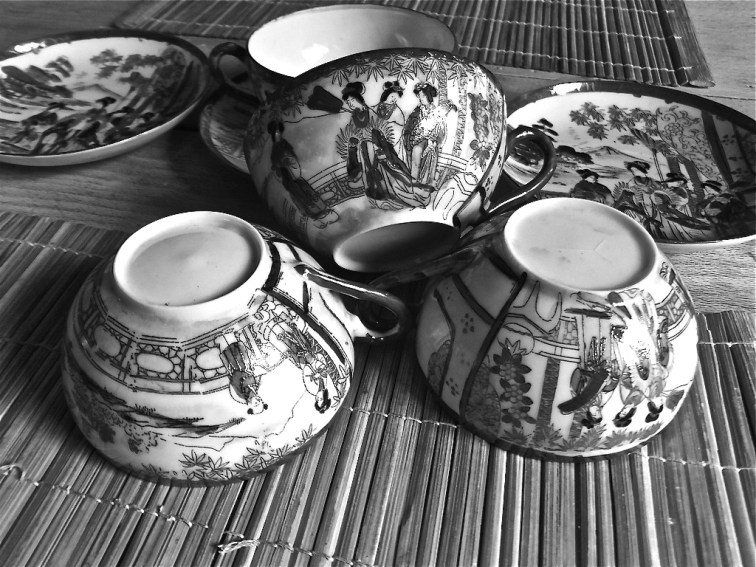
‘Nonna’s teacups’ – the original (below, by MIL22) displays the Chinese colour sense, something missing from this uncomprehending adaptation

‘Nonna’s teacups’ – the original (below, by MIL22) displays the Chinese colour sense, something missing from this uncomprehending adaptation

chinese cups disarranged 22luckyseeds 9287353120_2a9a94b6cc_b

Surely America, supremely the land of individualists, is the most unlikely destroyer of copyright?

In the home of Thoreau, Walden Pond’s immortal hermit; of Gertrude Stein, so original that she revelled in her incomprehensibility – also the country that reveres the hard act to follow of a Janis Joplin flaring up, dying young, and leaving behind an inextinguishable brilliance – you might expect to read that copyright law is …

… concerned with the moral rights of authors, which are based on the author’s creative sense of self. Moral rights are the author’s right to protect his or her personal relationship with their work.

But no, those thoughts of a lawyer, Anna Spies, were published on an Australian website dedicated to discussions of intellectual property law. She was referring not to the American perspective on copyright, or the antipodean one, but to the historical view of ‘civil law countries in continental Europe.’

Today’s America — or certainly the one envisaged most enthusiastically by its youngest adults — apparently looks forward to adopting Chinese practices that do not, by long-established tradition, place any value on the shaping of work by a distinctive sensibility and the quirks in the exercise of a particular individual’s talent and skills.

This is not a little ironic. As post-Gutenberg’s last post showed, rich countries outside Asia have been showing scarcely any interest in digging down into the roots of Chinese culture and philosophy. Yet intelligent thinkers, with Americans in the lead, are making a case for replacing the glorification of creativity and originality that sparked and drove the Renaissance with deeply Chinese arguments in favour of wholesale imitation, extending to wide-ranging intellectual and commercial piracy. Last month, a Reuter’s blogger with a following among power-brokers was citing a respected scholarly journal when he rallied his fellow copyright opponents:

[L]ook at the Chinese YouTube, Youku, which is displacing television in large part because it has no copyright verification. As Chinese media companies evolve to take advantage of Youku, they will be much better placed to compete in the 21st Century than US companies which rely on copyright laws to keep consumers boxed in to increasingly-unnatural modes of consumption. […]

Chinese piracy also brings innovation within the grasp of a huge population of poorer Chinese, with long-term positive effects for all … [… from …] shanzhai — low-cost copies of items which would not be affordable otherwise.

Like so much else in China, the meaning of shanzhai is undergoing a drastic change. As The Wall Street Journal recently noted, “Once a term used to suggest something cheap or inferior, shanzhai now suggests to many a certain Chinese cleverness and ingenuity.” Indeed, Beijing seems to believe that shanzhai is something to cultivate. In 2009, an official from China’s National Copyright Administration declared that “shanzhai shows the cultural creativity of the common people.” He added, “It fits a market need and people like it”…

Might ‘Yay, shanzhai!’ … have replaced ‘The East is red!’ for sinophiles among those U.S. intellectuals bent on aligning themselves with the future? Anyone interested in reading the curious case for that in the blogger’s source, Foreign Affairs, is blocked by a paywall protecting …well, could you ever have guessed, copyright? This is so absurd, and what we have gleaned of Foreign Affairs’ endorsement of shanzhai so underwhelming, that we see no point in handing over $5. 

‘How the World Benefits from Chinese Piracy’ is the Reuters blogger’s title. Fine, bring it on … if – as he and some of his commenters (below his post) agree – the Chinese pirates’ targets are multinational pharmaceutical giants, or other obscenely profitable and dishonest corporations or business sectors. Unfortunately, it does not stop there, and both the Reuters blog and what we have gleaned of the Foreign Affairs essay fail to impress, for at least two reasons:

• Benjamin Franklin, the American founding father most admired for his inventiveness, is dragged in to sprinkle holy water on intellectual piracy because he ‘made a substantial sum from republishing the works of British authors without permission or payment.’ Surely that has to be reckoned as an act of aggression, not a feat of commercial genius? Franklin’s dislike of his transatlantic cousins is notorious. (See  ‘The fine and noble china vase, the British Empire …’ — or, for a contemporary perspective, ‘Ben Franklin Really Fucking Hated the British …’ in cracked.com.)

•  Once again, it seems, the greed of monster corporations in the music business has been spotlighted to justify depriving, of even their token crusts, the majority of artists and musicians getting by on their equivalents of Grub Street.

Foreign Affairssummary of the essay says:

Traditional music labels have decried the copying of recorded music, arguing that it discourages the composition and performance of new music. According to the authors, that is simply not the case: it is the traditional business model of the labels that is under threat, not the production of music. And copyright was conceived to protect creative activity, not particular business models.

By now, this line of attack on copyright is not merely unconvincing but verges on lazy and boring. Why not pour the mental energy into finding ways to separate the needs of creative artists from the exploitation of copyright by large corporations selling copies of works of art?

The ‘author’s creative sense of self’ to which Anna Spies refers in the Australian blog post at the start of this entry encapsulates what we sensed about an outstanding friend of this blog, as we watched Crofters, a marvel of documentary film-making about a small crofting community in the Scottish Highlands, shot in 1945.

Screenshots from the film ‘Crofters’ (1945) about everyday life in Achriesgill. Seated woman (below) is polishing an oil lamp, her source of night light. Director: Ralph Keene. National Library of Scotland.

Screenshots from the film ‘Crofters’ (1945) about everyday life in Achriesgill. Seated woman (below) is polishing an oil lamp, her source of night light. Director: Ralph Keene. National Library of Scotland.

Screenshots from the film +++Crofters+++(1945) about everyday life in Achriesgill. The seated woman is polishing an oil lamp, her source of night light. Director: Ralph Keene. National Library of Scotland.

Writing movingly about losing his mother, Agnes, in May, John Logan (or, to avert Google-fusion, John A. A. Logan) said on the Authors Electric  site that she was ‘the best person I ever knew’. She is the smallest girl in the party of schoolchildren following their teacher in our still photograph (above) and, her son has told post-Gutenberg, gave his work her enthusiastic, unqualified, unstinting support.

Listening to the lovely concision in the language of folk in Achriesgill, where she lived at that age, you realize that you have heard their echoes in the dialogue in John’s finest short stories, of which we have featured samples, here. In the film, someone is heard speculating about the destination of Nurse McKay, also the local midwife: ‘I wonder, now, where will it be she’s off to in her wee car this morning?’ A female voiceover, in footage of a woman cleaning a lamp: ‘I wonder, now, when will we get the electricity that there’s been so much talking about?’

The anti-copyright crowd insists that all art is ‘remix’ or ‘mashup’ trickery – a bizarre and anachronistic re-definition based on capacities for simulating artistic creation that were impossible before we were given today’s technological equipment. The words of long-dead artists are misconstrued for credibility (of the inattentive):

Although remix has always been an aspect of human culture the phenomenon takes on more significance in the digital age, because of the ease with which a creator of a new cultural artifact can “steal” to use the term from Stravinsky’s observation that all composers steal and the great composers steal the most. Music, text and images are easily transferred from one digital device to another especially because of the Internet which allows this phenomenon to take place on a global scale.

This remix culture means, apparently, that no artist deserves to expect to make anything like a living from his art (a subject that goes unmentioned in the movement’s manifestoes). But, like John’s, any work of literature or art is both saturated with and dictated by family and place – or their rejection; with psychological inheritances and consequences – indistinguishable, in other words, from personal experience and individuality.

It is from studying the techniques of artistic forebears that most arts workers learn how to shape this raw material, which bears the stamp of its influences. That is not the same as puffed up cut-and-paste exercises or shameless copying. Both the ability and opportunity to make use of gifts of personal history and talent are almost always hard-earned – or, as so many biographies testify, when seemingly effortless, can extract the steep price in misfortune that often follows success.

There are Chinese cultural traditions worthy of surpassing respect and even imitation. Why conflate bringing consumer goods — manufactured commodities — and prescription drugs within the reach of poor Chinese, with rights of artistic ownership, depriving all artists of the means to earn the occasional soupçon of calories – if not, as the internet pioneer Jaron Lanier insists, the chance to grow rich?

Why not distinguish between copyright protection for individual creators and corporations hawking the fruits of creativity? Why not help to make micropayments for artists routine — as unremarkable as online shopping? (See: ‘Do we need a campaign for micropayments to support “lyric perception”?’)

Does copyright law turn art into commodities? part 1: an answer with help from Albrecht Dürer, ARTICLE19, Salman Rushdie and Anthony Storr

Artists who can control copying with copyright have more creative freedom - photograph by postgutenberg@gmail.com

Artists who can control copying with copyright have more creative freedom
– photograph by postgutenberg@gmail.com

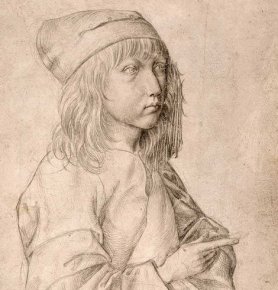
Albrecht Dürer: self-portrait, aged 13

Albrecht Dürer: self-portrait, aged 13

How does newness enter the world?

Joseph Anton, Salman Rushdie, 2012

Dear Copyright-Haters,

How about picketing Tupperware?  Yes, … we are perfectly serious. Imagine the Facebook updates of yourselves holding giant sock-it-to-‘em placards shouting, ‘STOP COMMODIFICATION NOW!’ … What’s that? … Right. How, you ask, would you store your left-over microwaveable meals in this post-cooking age without plastic boxes so much alike that, even with brand names, they are virtual commodities? You could try porcelain bowls covered with plates or tin foil for an alternative – but no, you say, no one does that any more … muttering to yourselves, inaudibly, ‘Idiot!

We’ve been hearing that you hate commodification. After last week’s post with Jaron Lanier warning about the consequences for other professions of destroying artists’ rights to control the use of their work, a friend emailed us to say that enemies of copyright are not playing Scrooge when you refuse to contribute even micropayments to enjoy art. (Most of you agree merrily with, eg., the blithe prediction by the editor of Wired: ‘ I think most music will soon be free, …’).

The problem, this friend explained, is that you fear the commodification of the arts. We have heard similar thoughts expressed as, more or less, this: ‘Why should a musician get to charge every time he or she sells a replica of a single performance on cheap plastic CDs over and over again – and get obscenely rich from the proceeds, in some cases?’ Well. Just as a thought experiment, how about putting music CDs lower down on your hit list and starting with obvious horrors – those containers made of processed petroleum, clogging landfill in their millions? One day last month, Tupperware’s share price went rocketing into the heavens – hitting ‘a new 52-week high,’ we noticed. Now, that’s encouragement for commodification!

Why pick on artists instead of finding some way to hijack the profits from  (comparatively) mindless replication elsewhere? The new digital technologies were supposed to relieve some of the pain and hardship behind the centuries-old ‘starving artist’ cliché. They introduced the possibility of financial independence for more artists than ever before — linked to their ability to control how they work, and own the results. By, for instance, recording and distributing their own musical performances; or publishing or exhibiting their e-books, paintings, sculpture, and so on.

On the blog of The New York Review of Books, there is a perfect example from medieval Europe of an artist using new technology as an aid and spur to artistic independence, creativity and an evolutionary leap in drawing and painting. About the sublime German, Albrecht Dürer (1471-1528), whom the Wikipedia reasonably pegs as ‘the greatest artist of the Northern Renaissance,’ the NYRB blogger Andrew Butterfield writes:

Dürer was perhaps the first artist in history to work primarily at his own direction, rather than on commission and at the pleasure of princes and other exigent patrons. The change was made possible by his concentration on printmaking rather than painting as his main artistic and commercial endeavor. Most paintings of this time, such as altarpieces, were made for well-established religious or civic purposes, and the patrons and other viewers had specific needs and strong expectations regarding both what was depicted and how it was represented. But printmaking was a completely new medium, little beholden to tradition. Even when treating Biblical themes, Dürer was comparatively free to pursue a more personal investigation of subject matter.

The painters of Dürer’s time who specialised in portraiture worked like – shall we say, analogue precursors of photo-editing software, who did all the retouching in the act of image-creation rather than after it. The most talented of them could grow rich themselves by following the conventions for flattering their powerful, wealthy subjects in oils – but with their creativity as constrained as the ‘lotus feet’ tortured into existence by foot-binding. Printmaking allowed Dürer  to flout those rules to develop an entirely new, realistic style in portraiture:

Typically portraiture was honorific and meant to represent the exemplary virtues of the person shown; Dürer instead often sought to capture the idiosyncratic and psychological characteristics of the people he portrayed. He was fascinated with the close scrutiny of dark and brooding emotion.

The Wikipedia explains the effect of his independence:

Dürer exerted a huge influence on the artists of succeeding generations, especially in printmaking, the medium through which his contemporaries mostly experienced his art, as his paintings were predominately in private collections located in only a few cities. His success in spreading his reputation across Europe through prints were undoubtedly an inspiration for major artists such as Raphael, Titian, and Parmigianino, all of whom collaborated with printmakers in order to promote and distribute their work.

Copyright laws were one invention that accompanied the replication that the printing press and printmaking introduced. Before reproducibility could be taken for granted, only the wealthy could afford to adorn their walls with the work of painters; after it, peasants could have their own woodcuts of saints and angels.

This makes your association of copyright with elitism, o copyright-smashers – and your attempts to cast artistic ownership as stifling or destructive of creativity — alarmingly batty, to say the least.

ARTICLE19’s excellent prescriptions for bloggers’ rights — putting them on a par with those of professional journalists — were recently the subject of a post in this spot. This same organisation has also made thoughtful recommendations for the evolution of copyright laws in another paper. Perfectly in keeping with what copyright allowed Durer to do, this document says:

Freedom of expression and copyright are complementary inasmuch as the purpose of copyright is the promotion of literary, musical and artistic creativity, the enrichment of cultural heritage and the dissemination of knowledge and information goods to the general public.

Some of us can only pray that protecting copyright as its rules are revised for the digital age will free arts workers from paymasters. From the domain of musical composition, the psychologist Anthony Storr offers in The Dynamics of Creation (1972) an elegant example of what financial dependence costs creativity:

Some very good music has been written for film … but the limitations imposed by having to tie the music strictly to the action means that the composer cannot choose for himself a vital dimension of the composition, its length. Most composers, therefore, rate film music as ‘incidental’ music, and separate it sharply from original compositions which truly reflect their own creative personality.

… In the last few days, we have learnt from Salman Rushdie’s riveting autobiography, Joseph Anton, about ARTICLE19’s crucial support in his years of enforced hiding from assassins trying to carry out his death sentence, the Iranian fatwa. Curiosity about this organisation’s backers led us to discover that these include Britain’s Foreign Office, the Department for International Aid (DFID) / UKAID, the Dutch Ministry of Foreign Affairs, the European Commission, the Norwegian Ministry of Foreign Affairs, the Open Society Institute (OSI), the Ford Foundation, the Swedish International Development Cooperation Agency (SIDA) and in Silicon Valley, the William and Flora Hewlett Foundation.

That was a real comfort – knowing of the existence of an organisation with international financing that advocates both blogging as a form of free speech and copyright protection.

Now about your Tupperware march …

… over to you,

post-Gutenberg