Orhan Pamuk on Updike suggests that more foreigners should be invited to pronounce on talent in the Anglophone world

- postgutenberg@gmail.com

– postgutenberg@gmail.com

The most hopeless navigational advice usually comes from locals – people who have travelled a route too often to know what it looks like – and foreigners can be far more perceptive evaluators of fiction than insiders.

Turkey’s Orhan Pamuk is not any old foreign critic. He won the 2006 Nobel literature prize. Someone at The New York Times was brave enough – in a country not overly interested in the opinions of aliens – to invite him to review the first biography of John Updike, the work of Adam Begley. Twenty years ago, we bet a dinner guest that Updike’s Rabbit trilogy, and those novels alone, would earn him his place in posterity. He argued the merits of the scurrilous Henry Bech, another of the novelist’s creations and closer to his own segment of middle-class existence – also someone with whom we suspect our guest secretly identified. But we nearly always found Bech’s characterisation flat, rather flaccid, and not half as amusing as he found himself.

Pamuk, we were pleased to see, takes much the same view of the Rabbit books as we do, and for virtually the identical reasons. His comparison of the Updike oeuvre with some of its best-known competitors in 20th-century literature is just as rewarding:

[T]his talent and a reverence for the ordinary problems of ordinary people were obvious in the first Updike novel I ever read, “Rabbit, Run” (1960), published in Turkish translation in 1971. This was a completely different, less dramatic but more believable and more intensely felt America than the one inhabited by Steinbeck’s California fruit pickers or Hemingway’s war-loving and assertive heroes, far from Faulkner’s gothic atmospheres crumbling under the weight of the past and of problems of race. The dirty words and sexually explicit passages that were a problem for Knopf (and for the editor of the British edition) were less pronounced in the Turkish translation, but even from that distance, the reader could perceive that the latest news from America was all about the fragility and the fury of the individual, about sexual freedom, guilt and small-town life. If I consider “Rabbit, Run” and the three books that followed it in the Rabbit tetralogy — “Rabbit Redux” (1971), “Rabbit Is Rich” (1981) and “Rabbit at Rest” (1990) — to be Updike’s biggest and most lasting achievements, this is due in no small part to the news-like quality of these novels. The adventures of Harry Angstrom are a very enjoyable chronicle in decennial installments of the lifestyles, emotions, politics and daily lives of America’s endlessly growing middle classes. Unlike historical novels that look back in time to events they describe, the Rabbit novels were about life as it unfolds; Rabbit’s adventures functioned as a social history of sorts, each installment a summary and a representation of the previous 10 years — as Updike himself wrote in his introduction to the Everyman’s Library edition of the series, “a kind of running report on the state of my hero and his nation.” The fact that Rabbit is a demonic, ethically troubled but also entirely ordinary character, together with Updike’s signature richness of style and his use of the present tense (one of the peculiarities of the Rabbit series), all serve to steer these novels away from didacticism and banality, dangers that can plague chronicles and social novels. In the same introduction, Updike identifies these literary dangers in the United States: “The slot between the fantastic and the drab seems too narrow. . . . The puritanism and practicality of the early settlers imposed a certain enigmatic dullness, it may be, upon the nation’s affective life and social texture.” Updike thought previous generations of writers had avoided this dullness by chasing rootless and eccentric characters, thus writing masterpieces like “Moby-Dick.” Begley’s biography, though, shows that Updike’s writing and ultimately his entire life were shaped by his attachment to the ordinariness of his suburban middle-class life, and his desire to reach beyond its boundaries. In a way, what Melville did for whales, Updike did for upper-middle-class life in suburban America …

Nigella, no longer a ‘domestic goddess,’ has risen through work and the post-print power of the true image to a more dependable claim on our affection

nigella portrait

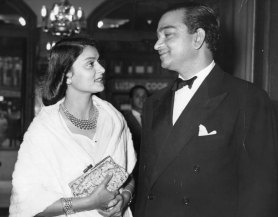
Nigella on screens last week; Maharani Gayatri Devi with the Maharaja of Jaipur, 1955 - The Evening Standard

Nigella on screens last week; Maharani Gayatri Devi with the Maharaja of Jaipur, 1955
– The Evening Standard

Before we get to Nigella Lawson hammering the last nails into the coffin of the domestic goddess myth, we must record a milestone reached in the suicide last month of 49 year-old L’ Wrenn Scott, the ethereal clothes designer and domestic partner of Mick Jagger. No doubt she killed herself in a tragic confluence of exterior and interior pressures. Entirely unprecedented in the celebrity universe, as far as we know, was the prominence accorded — in speculation about a female suicide — to the possibility that her failure as an entrepreneur could have been the deciding factor. This is a species of tragedy we associate exclusively with the lives of men.

For reasons of interest to no one else, we have in mind today both the miserable and triumphant potential in the lives of women – because of a particular woman we are sending a birthday greeting she can no longer read. What connects the topic to this blog’s interest in post-print media is

• how Nigella’s vindictive ex-advertising mogul ex-husband, Charles Saatchi, was undone by his over-reliance on what remains of his once-tremendous old media influence and connections

• how Nigella’s mediagenic genius – more than mere physical beauty greater and more mysterious than the sum of its parts – came to her rescue in an age of communication dominated by images. How it became the steel-plated shield that excellence in the domestic arts can no longer supply, for her or any other woman – any more than the womanly heart-over-head softness that traditionally went with that

In making work her principal occupation, L’Wrenn Scott – about five years younger than Nigella – had satisfied the now inescapable requirement that a woman establish her worth, both monetary and otherwise, independently of any man. Never mind if she is a delectable nineteen year-old besieged by suitors from every point on the compass bearing engagement rings .

Last month in Britain, following a Law Commission recommendation that British courts actually honour pre-nuptial agreements instead of, presumably, treating them as philosophical tracts, the Guardian columnist Lucy Mangan lauded the guarantee, in these contracts, that she could take what is hers if her marriage should fail. That is too simple a reason for wanting one. The harsh fact is, the action a woman needs to take to protect herself from the peculiarly female forms of vulnerability in long-haul relationships has to precede any such contract.

The setting of terms for a pre-nup will usually entail a chilling discussion. Yet these unenticing agreements that we see becoming indispensable for ordinary people, not just celebrities, set a value on what the chief monetary contributor to a household – still generally male – will owe the provider of non-monetary sustenance, comforts and gifts, including child-bearing, if an ‘uncoupling,’ whether ‘conscious’ or otherwise, becomes inevitable. Unless she has a large inheritance for a lifelong security net, the contributor in kind rather than cash will, ideally, prove her economic value long before any such negotiation; years before she even thinks of spending a span of years working principally as a nurturer.

As any specialist in family law would tell her, one crucial consideration in a court’s decision on what she should receive, in a financial settlement at the end of a partnership, is the size of the cheques from employers that she gave up when she and her partner agreed that she would switch from working outside to inside their home.

The numbers on those cheques could even prove critical in legal proceedings that have nothing to do with divorce. Say that she is a single woman and artist whose forte is highly-praised but uncommercial watercolours, someone who does not see herself settling into marriage for years. She will want to establish the highest possible pre-marital price-tag for her toil in the ‘day jobs’ she does to support herself. Why? As any personal injury lawyer would tell her, that earning power would be weighed in determining what she was owed if — after she has married and taken herself off the market, for any reason – she became the unlucky victim of a road accident.

Her ‘historical’ earning ability could be the chief index of value for the insurance company of the drunk driver who, say, knocked her off her bicycle and hurt her seriously enough to cripple her ability to work for months or years afterwards. If she dropped out of dentistry school or an internship in financial trading to give birth to twins, her compensation from the insurer for the work she has done since, as a loving housewife and mother, would be only a fraction of what she would be owed as a worker who clocked up a few years of practising the profession in which she won her spurs.

… Which brings us back to Nigella, and the particular advantages flowing from her ease before a camera, which have helped to make her story seem part of the life stories of millions of audience members who actually have nothing in common with her. She, of course, sought no financial compensation or alimony in her divorce last summer. That was in spite of submitting to one wrenching adjustment after another in a marriage ‘always on his terms’, and the lustre she lent the Charles Saatchi persona – an especially valuable contribution to a specialist in advertising and the fabrication of glamour-by-association.

In the high drama of having to defend herself, last December, against Machiavellian allegations of a cocaine habit, during the trial of former housekeepers of hers and Saatchi’s, the media commentariat made no reference to the reports, last autumn, that she had agreed to make no financial claims on him. According to the rumours, then, that was partly in the hope of defusing his threat to expose a particularly damaging secret about her. This bargain did her no good, as many signs pointed to his having had some never quite specified role in inspiring the housekeepers’ claims of being indirectly bribed by Nigella to hide her cocaine store and – as she admitted, with unfortunate consequences that have stretched to being declined permission to enter the U.S. last Sunday — occasional use.

For a less resilient woman, becoming the target of Saatchi’s spite, in the latest chapter of a life pock-marked by exceptional suffering, might have been ruinous. But on screens only last week, there were signs of a Nigella recovering her radiance, and drawing on the tremendous capital in respect and affection she has created for herself by following the path that her first husband, John Diamond, put her on. It was he who spotted the potential for the witty, sexy, glamour-puss television cook before anyone else could envisage her in such a role – going by the accounts of other family members and friends.

Alas, a domestic goddess needs a devoted domestic god for a mate. Nigella had one in Diamond, but after he died much too young, she married Saatchi – who, perhaps out of jealousy of the famously enjoyable, casual and spontaneous John-and-Nigella hospitality – proudly broadcast his preference for breakfast cereal over anything from his third wife’s kitchen, and for feeding people in restaurants over anything cooked by her.

As things turned out, at the zenith of her fame as a de-mystifier of the art of cooking – in roughly the last ten years – with a superb, eclectic palate to guide her, Nigella was obliged by Saatchi to be a virtual, if not quite fake, model of a household divinity. Out of consideration for his (understandable) dislike of being invaded by bustling TV crews, her kitchen in the house they shared was replicated in a television studio. In the footage much-loved by her audience of her raiding her refrigerator for nocturnal snacks, she was only acting — like any other performer on a set. Her cookbooks, according to the housekeepers’ court-room testimony, were written in the dead of night, her concentration assisted by whiffs of cocaine. By day, according to other reports, she was responsible for the kind of physical chaos abhorred by Saatchi but more or less typical for creative types of any stripe, though possibly not for chopping-board deities – none of it visible on-screen.

Yet nearly everyone who has watched her at work in a kitchen willingly suspends disbelief to get lost in the parade of beguiling images she offers us, and her self-deprecating and populist – though never condescending – charm. She is a supremely mediagenic phenomenon – all the more so for her emotional transparency. On the day she was photographed striding into court, head held high, she looked as if she was going to do precisely what she did – be ashamed, proud and defensive, all at once; admit to drug use she had fought hard to conceal, but also deny the most extreme related accusations, and explain the excruciatingly painful circumstances (watching her first husband die slowly) in which she was introduced to cocaine.

She made no attempt to hide her tear-swollen and angry face as she left the court. Transparency is what she almost always seems to be delivering, with looks that make her a late-born member of a tiny club of iconic 20th-century women that includes Jackie Kennedy and India’s Gayatri Devi, whose name Google supplies when a searcher does no more than tap in the first few letters of her title, ‘Maharani’. Millions of us exposed repeatedly to free, digitally replicated images of them puzzle over and marvel at their uncanny magnetism.

And Saatchi? There is nothing of presence or anything personal in his form of media power. He made his name as an advertising genius – a canny, intuitive shaper of public perception who, with his much nicer brother and business partner Maurice, put Margaret Thatcher into No. 10, Downing Street. Print barons vied for their agency’s patronage, for the streams of advertising revenue they could put their way – lifeblood, for their newspapers.

Apparently blind to that difference between the sources of his and Nigella’s sway, he imagined that he could reverse the ineradicable damage done by last summer’s tabloid photographs of himself with his hand on her throat with a blizzard of photo-ops arranged to depict himself as genial and aspirationally elegant. In the decades when print media still dictated what the public saw of anyone famous – or not – he could have insisted on only being photographed from his most flattering angles. His is a closed face with calculation written all over it.

Nigella’s, on the other hand, is inexplicably WYSIWYG, as the computer geeks say – ‘what you see is what you get’. Inexplicable, because the truthfulness characteristic of her somehow gets through the layers of television makeup she must often wear, and the contrived domestic haven in the backdrop of her cooking shows. Something about her, as well as plain old hard work, has helped her to create the defences against exploitation and degradation that every woman ought to have.

Spooky yarn-spinning: just how did the Guardian and New York Times get the surveillance story back-to-front?

Snowden surveillance saga: leaving the tech giants out will be remembered as clickbait-shaped storytelling with a touch of the surreal  -drawing by Martin Disteli (1802-44)

Snowden surveillance saga: leaving the tech giants out will be remembered as clickbait-shaped storytelling with a touch of the fantastic
– drawing by Martin Disteli (1802-44)

… or why most editors and writers specialising in technology see no actual scoop in the Snowden leaks …

Sometimes the person dancing backwards and in high heels – famously, Ginger Rogers, compared with her dance partner Fred Astaire – is a man. In this instance, he is the writer and new media entrepreneur Michael Wolff. With a set of super-sensitive manoeuvres that Ginger would have envied, he wickedly added his voice last week to the revelation that the ‘surveillance business model’, not exactly news, has been mistaken by some newspapers for a creepy invention of government spooks bent on invading our private acts and communications.

His ostensible topic was a book published earlier this month about a 1971 break-in by activists that revealed the spine-crawling extent of FBI surveillance under that agency’s notorious founder, J. Edgar Hoover, who ran it from 1935 to 1972. The inside story of the break-in had already been told in another book, Wolff said, eleven years ago. He was briefly puzzled by the huge attention paid to its forty-year old subject in recent weeks in headlines of the two old print stars of the Snowden saga. ‘Earlier this month, The New York Times, Guardian and other media outlets “revealed” the identities of several people who burgled the FBI in 1971,’ was how Wolff’s s Guardian sub-editor encapsulated his gently sardonic amazement. Wolff himself described how the answer came to him, as follows:

[W]hy, 11 years later, was I reading about this as though, mirabile dictu, the lost secrets of the past were suddenly being revealed and now making headlines everywhere? … In the age of Snowden, revelations about government spying are not just hot stories, but suddenly part of a vast new narrative canvas and moral tale. … [I]t is apparently possible to ignore what is known – even in the age of Google – and, when convenient, reposition it to be new and useful again. … There is not just a new age of political activism, à la Edward Snowden, but also of story telling activism.

Quite, and successful storytelling activism makes irresistible clickbait that works even better when it becomes outrage that goes viral when the audience confuses the story with other – justified – targets for anger. At post-Gutenberg, we have had irritable email from dear readers, including two Americans, in which a complaint about our refusal to be impressed by the Snowden narrative has billowed into a polite rant about U.S. military actions and policy – the use of drones at all, or against poor countries, nuclear testing, Guantanamo, and so on – as if the correspondent had never met the idea of a non sequitur.

Let us be clear: post-Gutenberg is chilled to the viscera by the thought of all military weapons, used by anyone, for any reason – and has the identical reaction to any mention of torturing prisoners.

The real surveillance story’s only connection with all that is the use by the UK and US governments of the same tools invented and deployed by large US companies. As Andrew Leonard wrote in Salon last summer in ‘Netflix, Facebook — and the NSA: They’re all in it together,’ expanding on a genuine Wall Street Journal revelation about free surveillance software available to anyone to use:

By making it economically feasible to extract meaning from the massive streams of data that increasingly define our online existence, Hadoop effectively enabled the surveillance state.

And not just in the narrowest, Big Brother, government-is-watching-everyone-all-the-time sense of that term. Hadoop is equally critical to private sector corporate surveillance. Facebook, Twitter, Yahoo, Amazon, Netflix — just about every big player that gathers the trillions of data “events” generated by our everyday online actions employs Hadoop as a part of their arsenal of Big Data-crunching tools. Hadoop is everywhere — as one programmer told me, “it’s taken over the world.”

… In the past half-decade Hadoop has emerged as one of the triumphs of the non-proprietary, open-source software programming methodology that previously gave us the Apache Web server, the Linux operating system and the Firefox browser. Hadoop belongs to nobody. Anyone can copy it, modify, extend it as they please.

They’re all in it together. The spooks and the social media titans and the online commerce goliaths are collaborating to improve data-crunching software tools that enable the tracking of our behavior in fantastically intimate ways that simply weren’t possible as recently as four or five years ago. It’s a new military industrial open source Big Data complex. The gift economy has delivered us the surveillance state.

… Hadoop quickly secured the critical mass of cross-industry support necessary for an open-source software program to become an essential part of Internet infrastructure. Even engineers at Google chipped in, although Hadoop, at its core, was basically an attempt to reverse-engineer proprietary Google technology.

People reading those extracts might wonder why Hadoop and not Snowden was the surveillance sensation of 2013. Two answers — aside from the plain truth, verifiable by five seconds spent typing the appropriate search terms into a Google box, that Hadoop has been snapped up enthusiastically by both The New York Times and The Guardian for spying on their readers:

In the way traditional media work, writers who understand technology do not get much of a hearing from the editors at the top, who specialise in politics. The technology writers usually work for sections that cover business and, or, science. In other words, they are treated as incomprehensible boffins or wonks.

Why, demanded one irate friend, an American poet, didn’t they and post-Gutenberg – who has also served as one of those gnomes — tell everyone else about government surveillance if we knew all about it long before the Snowden hooha? Erm, well, we did … We distinctly remember confessing to him, years ago, our anxiety about email being read by eyes for which it was not intended, including those of spooks. And, quickly noting his sceptical reaction, we realised what he was only thinking but others, equally oblivious but less tactful, had stated bluntly: ‘You’re being paranoid.’

Being able to pin information about technology to a face, a personality, an identity, and ideally – drama — humanises it. That can suddenly magnetise people who usually ignore it for good reasons: it is complex, and learning about it and the culture and ambitions of Silicon Valley consumes attention they would rather focus elsewhere. But because they do not really understand it – even though some political editors, like Alan Rusbridger at The Guardian, have a hobbyist’s deep fascination with the ‘mechanics’ of their devices and the net – they are easily misled. Think of the millions who really believe that Steve Jobs invented the computer revolution, or that Al Gore had something to do with the birth of the internet.

To reach Joe and Jane Everyone and work them into a tizzy, news of our subjugation to the ‘surveillance business model’ had to be delivered to them as visions of nightmares about a totalitarian state — fronted by the ghostly and bespectacled clever-boy-next-door visage of Edward Snowden, the high drama of his secret-stealing and travails as a fugitive.

Not so much activism as storytelling activism, just as Wolff says.

But the extent of yarn-spinning always gets out, eventually, and diminishes trust in the media. As we keep repeating on this blog – tiresomely – because that trust should not be sacrificed to clickbait, another way of financing and structuring media has to be found – and soon.

John Updike: the literary seer who predicted too much privacy as the price for living on the net

In hindsight, Updike's is one of the strangest sour predictions - photograph by MIL22, 2013

In hindsight, Updike’s is one of the strangest sour predictions
– photograph by MIL22

Loathing and resentment of the e-future can even throw off a mind as sharp and capacious as the late John Updike’s.

Martin Amis, writing in 1991, described the great novelist – one of the most astute observers of American life — as ‘a master of all trades, able to crank himself up to Ph.D. level on any subject he fancies: architecture, typography, cave painting, computers, evolution (“asteroidal or cometary causation” set against “punctuated equilibrium”) and Gospel scholarship …’.

But Updike never waxed more bilious than on e-publishing and the internet. His judgment about their effects was at least as warped as that of a few other worthies, pontificating on the most recent twist in the privacy debate – a subject to which we hope to return in our next post. In the meanwhile, here is the masterly wordsmith’s prognostication, reproduced for the pleasure of quoting someone who was never so elegantly and profoundly mistaken:

Millions find bliss of sorts in losing themselves in the vastness of the Internet, a phantom electronic creation which sublimates the bulky, dust-gathering contents of librarians and supermarkets into something impalpable and instantaneous. The Web is conjured like the genie of legend with a few strokes of the fingers, opening, with a phrase or two, a labyrinth littered with trash and pitted with chat rooms, wherein communication is antiseptically cleansed of all the germs and awkwardness of even the most mannerly transaction with another flesh-and-blood human being.

A mass retreat into richly populated privacy has occurred before: in the acts of reading and going to the movies. Excitement lay in both for my generation … I have yet to be persuaded that the information revolution, so-called, is anything but an exercise in reading and writing wherein evanescent and odorless PC screens take the place of durable, faintly fragrant paper and ink.

John Updike, ‘The Tried and the Treowe’ (2000) in Due Considerations: Essays and Criticism, 2007